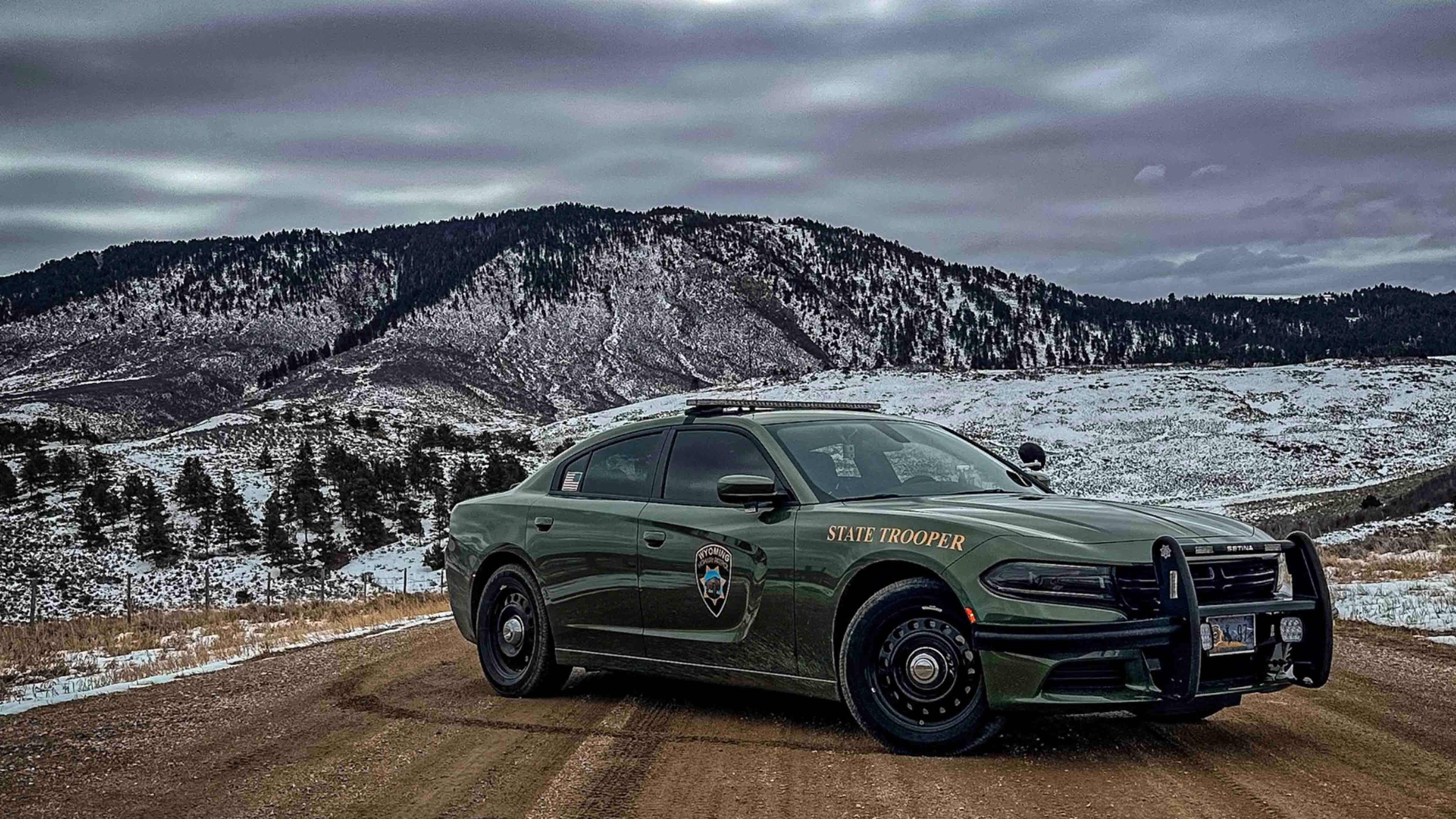
The Wyoming Department of Transportation is auditing the Wyoming Highway Patrol’s overtime spending after the agency burned through its annual overtime allocation at more than triple the authorized rate, Col. Tim Cameron told Cowboy State Daily.
Cameron leads WHP and said his agency logged too many hours of overtime in 2025.
“We used more than 50,000 hours of overtime, which was a cost of over $4 million,” he said. “Our budget for overtime yearly is $1.6 million. That is an increase of 226% from baseline.”
WYDOT’s office of audit and compliance is now reviewing how it happened, and WHP’s own office of professional standards is conducting a parallel internal investigation.
In a statement provided to Cowboy State Daily, WYDOT said it, “Began an audit of the overtime budget and policy… Staff is addressing the concerns with relevant personnel and is reviewing all corresponding policies and procedures to ensure future compliance with state overtime and on-call policies.”
WYDOT also pushed back on characterizations by some WHP staff that overtime had been eliminated entirely.
“Overtime has not been stopped but rather must be limited and subject to approvals outlined in state and WYDOT policy,” the statement said. “We can see how this change may feel like a cut, but to say it’s a complete cut is an exaggeration.”
“It was an unchecked, unfettered misuse of overtime by all levels of personnel,” Cameron said. “Lack of supervision regarding that put us in a budget deficit in total, which meant we had no authority to spend any other money.”
Cameron traced the roots of the problem to the COVID era, when the agency began using heavy overtime to fill staffing gaps, with spending above the baseline allocation going back to at least 2017.
Cameron took command of WHP in 2023.
December Order
WYDOT notified Cameron in December that the agency was significantly over budget. On Dec. 11, 2025, he issued Special Order 25-012: Overtime Reduction Guidelines.
WHP had been authorized a total labor budget of $64,411,088 for the 2025-2026 biennium, with $3,197,383 of that designated for overtime.
As of Dec. 9, the agency had already spent $4,884,838 in overtime — exceeding its authorized allocation by more than $1.6 million with more than a year remaining in the budget cycle. If spending trends continued, the memo warned, WHP was on pace to exceed its overtime budget by approximately $7 million.
“Immediate corrective action is necessary to ensure fiscal responsibility and operational sustainability,” the order read.
Cameron emphasized that the order did not eliminate overtime — it reasserted a state policy that had gone unenforced.
“All overtime has to be approved in advance by a supervisor,” he said. “That’s statewide policy. It simply wasn’t being adhered to.”
Mission-critical overtime — for officer-involved shootings, use-of-force incidents, employee injuries, and significant crashes — remains available.
Legally required overtime, such as when a trooper catches a crash call at the end of a shift, still gets paid, according to WHP.
What the order targeted was routine, unsupervised overtime that Cameron said didn’t warrant approval.
In January, Cameron said, overtime spending dropped by more than half a million dollars from the prior month’s rate.
Scheduling Issues?
Beyond supervision failures, Cameron identified the agency’s use of 4/10 scheduling — four 10-hour days per week — as a structural factor that compounded the problem.
In a follow-up email to Cowboy State Daily, Cameron wrote that the agency’s 4/10 work schedule — implemented in 2018 — gives troopers “an additional 52 days off per year when compared to a traditional 5/2 schedule.” While the schedule offers “improved work-life balance,” Cameron wrote, “it also carries operational consequences that must be recognized.”
Chief among those consequences has been thinner road coverage. Cameron wrote that one of the anticipated downsides at the time of the 2018 transition was “an increase in shifts with solo coverage, reducing the number of troopers available on duty at any given time.”
To fill those gaps, he wrote, “the 4/10 schedule has contributed to increased overtime utilization in order to bolster staffing levels and maintain adequate highway coverage.”
Compared to a traditional five-day schedule, Cameron wrote, the 4/10 model “results in nearly 9,000 fewer available shifts annually,” a structural shortfall he said has been “further constraining coverage and contributing to overtime demands.”
The agency is now evaluating shift alternatives, including moving to an 80-hour pay period to give supervisors more flexibility in managing time.
“We’re evaluating everything to improve our response to calls for service,” Cameron said. “You could not run a business and have to pay a 226% increase in overtime. You wouldn’t be successful.”
Trooper Perspective
Trooper Crosby Ralston, based in Lovell, spoke to Cowboy State Daily about the pressures troopers face working a vast geographic area in northern Wyoming.
Ralston described a region spanning Park, Big Horn, Washakie and Hot Springs counties, where a call near Thermopolis can be two hours from his post.
When the WHP can’t get there, duties often fall to the local sheriff.
“We’ve been seeing a lot of the sheriff’s departments quite upset with us, saying, ‘You guys need to be in the area.’ And we can’t — we just don’t have enough people,” Ralston said.
Lt. Matt Arnell, president of the Wyoming Highway Patrol Association, said the overtime restrictions had created coverage gaps.
“When you go the complete opposite side of the scale and cut overtime — of course that does affect the time they were using to help just make ends meet,” Arnell told Cowboy State Daily. “But now it has also seriously restricted our coverage, in that we just don’t have as much coverage on the road because we can’t afford to put people out on overtime.”
Cameron disputed that characterization, saying mission-critical overtime remains available and that the problem was never a coverage gap — it was a spending pattern the agency cannot sustain.
“It is the taxpayer’s money,” he said. “It’s incumbent upon us to do the best we can with it.”
Staffing Issues
Cameron acknowledged that staffing remains a challenge — and said that even a fully staffed agency might not be enough for a state Wyoming’s size.
“I’m authorized 208 trooper positions, and we have 190 in place,” said Cameron. “If we were at 208, I would say there would probably be an argument that we don’t have enough people. Wyoming is vast.”
The vacancy picture has improved since Cameron arrived, according to WHP.
When Cameron took command in January 2023, the agency had more than 50 open trooper positions and a 23.6% vacancy rate, according to WHP. By 2025, that rate had fallen to 12.4%.
Dispatch remains the most strained area, with 29 of 45 authorized positions filled.
On compensation, Cameron said he has been an advocate for pay increases throughout his tenure and backed Gov. Mark Gordon’s budget, which passed after being restored following earlier cuts by the Joint Appropriations Committee.
Arnell credited the governor for backing raises for state employees.
“We want to thank the governor as well for proposing that $111.8 million in the first place,” Arnell said. The raises, he added, will bring employees to roughly the 90th percentile of 2024 market pay levels — a meaningful step forward, he said, given how far behind state employees had fallen.
Data Tools
Alongside pay raises, the WHP is also getting a bump in its technology.
Back in May, Cameron told a legislative committee: “We have gone completely to data-driven intelligence-led policing, which means we equip our troopers with where crashes are happening, the causative factors of those crashes, so they can enforce specifically the places that we know through data where accidents are occurring. That is a big change.”
WHP has adopted DDACTS (Data-Driven Approaches to Crime and Traffic Safety), a crash and crime-mapping platform, and Cameron said WHP is the first state agency to fully implement the DDACTS system.
The data is used to map out property damage, injuries and fatal crashes down to causative factors, giving troop lieutenants concrete numbers to direct enforcement, according to the WHP.
“The concept is: if you can track it, you can affect it positively,” Cameron said.
“If you do heat maps on crashes and heat maps on crime, they’re the same in both places,” Cameron explained. “So the construct is, if you’re doing enforcement where crashes occur, you also effectively reduce crime.”
“Our troopers, our inspectors, our port of entry people are out there every day educating and enforcing — and thereby ensuring safe roads, safe trucks, and safe drivers,” Cameron added. “For that, I’m intensely proud of them.”
David Madison can be reached at david@cowboystatedaily.com.