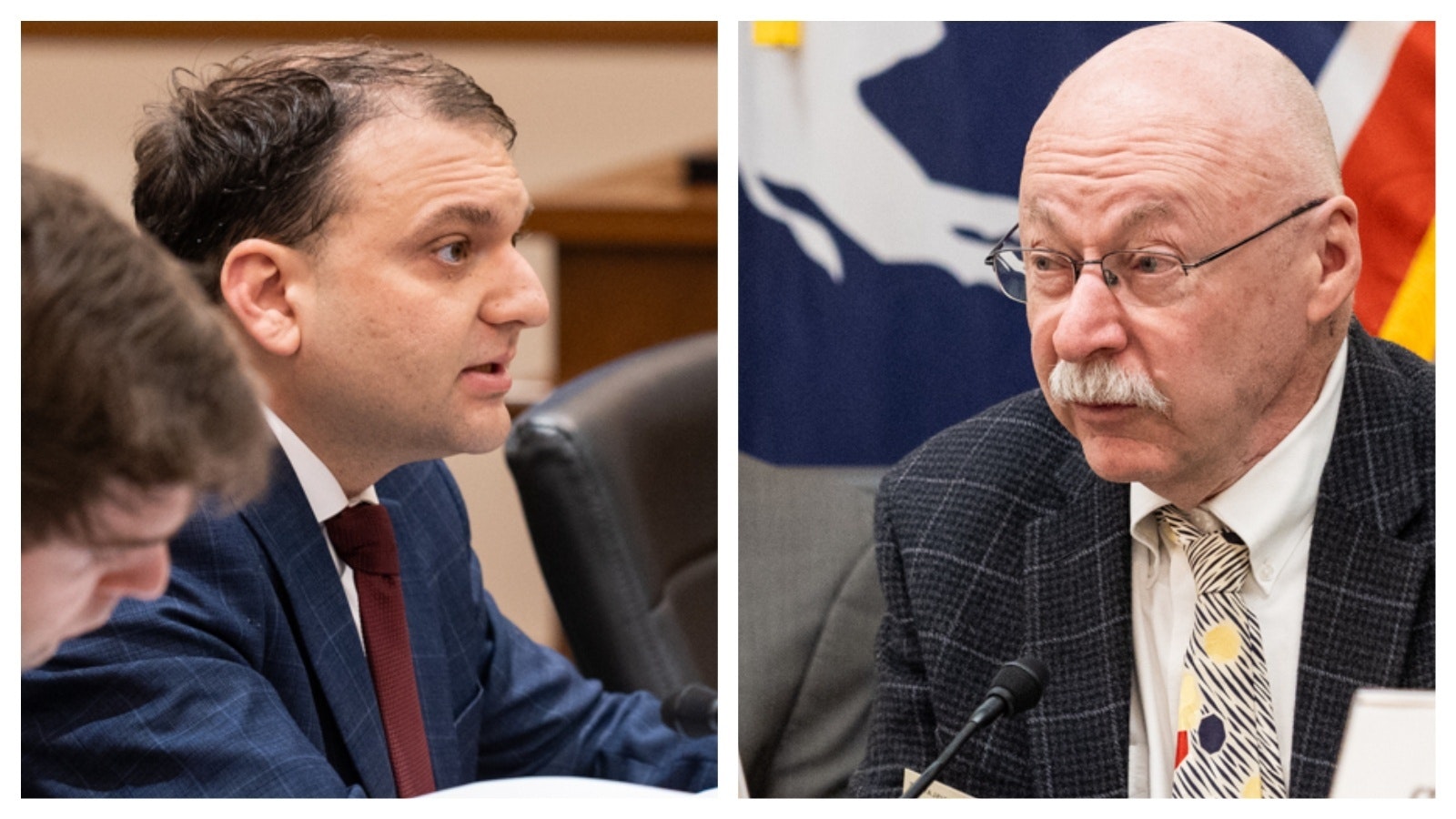
CHEYENNE — Secretary of State Chuck Gray and Sen. Cale Case, R-Lander clashed Monday over whether a bill born from a prolonged election controversy was a necessary reform or a product of personal politics — and Case had the votes to kill it.
House Bill 86, which would have let the Secretary of State file formal complaints with the governor seeking the removal of county clerks for election code violations, died 3-2 in the Senate Corporations, Elections and Political Subdivisions Committee that Case chairs.
Gray presented a detailed timeline of what he called a 15-month odyssey to hold Weston County Clerk Becky Hadlock accountable after she submitted what he described as a false post-election audit following the troubled 2024 general election. He told the committee the bill would close a gap that left his office with intimate knowledge of misconduct but no standing to act on it.
Case wasn’t buying it. He told the committee the bill was entangled in a feud between the state’s top elected officials and that the timing was wrong.
“I think this bill is kind of feeding into a dispute,” Case said. “I don’t think that’s really a good Wyoming way.”
Gray fired back: “For me, I’m always about accountability, and it’s not about animus. It’s not about personality conflicts.”
A 15-Month Odyssey
Gray traced the saga from the day before Thanksgiving 2024, when Weston County electors first filed a complaint with the governor’s office. He said the governor sat on the complaint for about seven months before declining to act in May 2025.
“Because the citizens of Weston County didn’t necessarily explicitly put the post-election audit in the complaint, it became sort of a way for the governor’s office to say that they couldn’t do anything on that issue,” Gray said. “Even though there was within that complaint a broad statement of her overall misconduct over time.”
Gray credited the Management Audit Committee with breaking the logjam, calling its investigation “one of the great moments of legislative oversight that I’ve seen in the last 10 years.” The governor finally took action last week, asking the attorney general to pursue removal proceedings.
“This system of having accountability shouldn’t require some sort of Odyssean sort of follow-through that occurred over 15 months,” Gray said.
He pushed back on the argument that because the system eventually produced a result, no changes were needed. “Just because you have one situation where because there was follow-through over a 15-month period, which is way too long, that doesn’t mean that we can’t improve this system,” he said.
“So Much Animosity”
Case made clear during committee deliberation that his objections ran deeper than process.
He questioned whether meaningful harm had occurred at all: “I also come back to, I’m not sure in the big picture of things there was real harm done. The election results were corrected and stood in a timely way.”
Then he turned to what he saw as the real problem.
“I think it feeds this dispute within our top five elected officials that I’m uncomfortable,” Case said. “I don’t even think the time is right to carefully analyze that. There’s so much animosity, very disappointing.”
“And so I can’t support this,” he said.
Gray made the point that the bill wouldn’t benefit him personally.
“I’m not running for reelection, so I’m not going to be the one that’s utilizing this,” Gray said. “But I think it’s an important thing for our state, important improvement to the election code.”
Cross-County Concerns
The committee spent time on the question of whether the bill inadvertently restricted who could file complaints.
Sen. Bill Landen, R-Casper, pointed out that the bill’s new language required a complainant to be “a qualified elector in the county,” while the existing statute referred more broadly to “qualified electors” without the geographic limitation. He asked whether the change might actually narrow the pool of eligible complainants.
“If a Crook County voter had issues with a Weston County situation, does this restrict it further?” wondered Landen.
Gray agreed and said he would support broadening the language.
“I think that’s a great amendment,” he said.
Sen. Brian Boner, R-Douglas, raised the scenario of a house district that crosses county lines, where a voter in Crook County affected by a Weston County problem would have no standing to complain.
Gray acknowledged the issue, pointing to House Speaker Chip Neiman, R-Hulett, as an example.
“He couldn’t issue a complaint, and he was the candidate in one of the races that was affected,” Gray said.
Sen. Cheri Steinmetz, R-Lingle, asked whether giving the Secretary of State complaint authority would effectively solve the cross-boundary problem.
Gray said a diligent secretary would act on such concerns: “If the secretary were diligent, yes, I mean, and we would. But, you know, I don’t know about future ones, whether they would.”
“Extreme and Serious”
Elizabeth Stephani, special counsel for Gov. Mark Gordon, told the committee the governor’s office had no objections to the bill but offered a careful assessment.
She explained the governor had taken a narrow reading of the existing statute because “the remedy of removing elected officials, in our view and the governor’s view, is pretty extreme and serious.”
She cautioned lawmakers to consider the precedent: “I think we would just caution that it’s important to be thoughtful as you expand the power of the governor under this statute, because again, it is a pretty extreme remedy to remove an elected official from office.”
Stephani also said the governor had “deep respect for the voice of the people” and believed the people who elected a county officer should generally be the ones empowered to seek that officer’s removal.
Asked by Sen. Dan Dockstader, R-Afton, whether the governor’s office believed the changes were needed, Stephani said: “We are not opposed to these changes. In the cases that we’ve received complaints, I think the process has worked.”
Political Leverage?
Gail Symons, representing the nonpartisan nonprofit Civics 307, urged the committee to reject the bill, calling it unnecessary and politically motivated.
“House Bill 86 does one thing,” Symons told the committee. “It adds the Secretary of State as an authorized complainant to the governor for removal complaints against a county clerk.”
“HB 86 adds political leverage, not improved governance,” Symons added.
Symons told the committee the Weston County episode was being milked for political purposes.
“I see this no longer being about what an individual did, and it is now about what political talking points and positions can we continue to get out of that dead horse,” she said.
Marguerite Herman, testifying for the League of Women Voters, echoed the concern, warning that the bill would insert a statewide political official into a process that should remain local.
“If a secretary of state, this or any other secretary of state, tried to come in and remove my clerk that I elected, I’d be very concerned,” Herman said.
She added: “I think to add another out-of-county statewide official as a source actually does damage to the process and it could insert politics into it.”
The Vote
When the hearing turned to deliberation, Steinmetz told the committee she had arrived wary but changed her mind.
“When we first came in, I was kind of skeptical of this bill,” Sen. Cheri Steinmetz, R-Torrington, said. “However, after thinking it through just a little more on the good discussion we’ve had today, I think it makes sense to add the secretary for the reason that our elections have changed so much… We have split districts and we have statewide candidates that may need the secretary’s help in this area.”
But the bill ultimately failed by one vote 2-3.
The Roll Call Vote
Ayes: Boner, Steinmetz.
Nays: Dockstader, Landen (proxy), Case.
David Madison can be reached at david@cowboystatedaily.com.