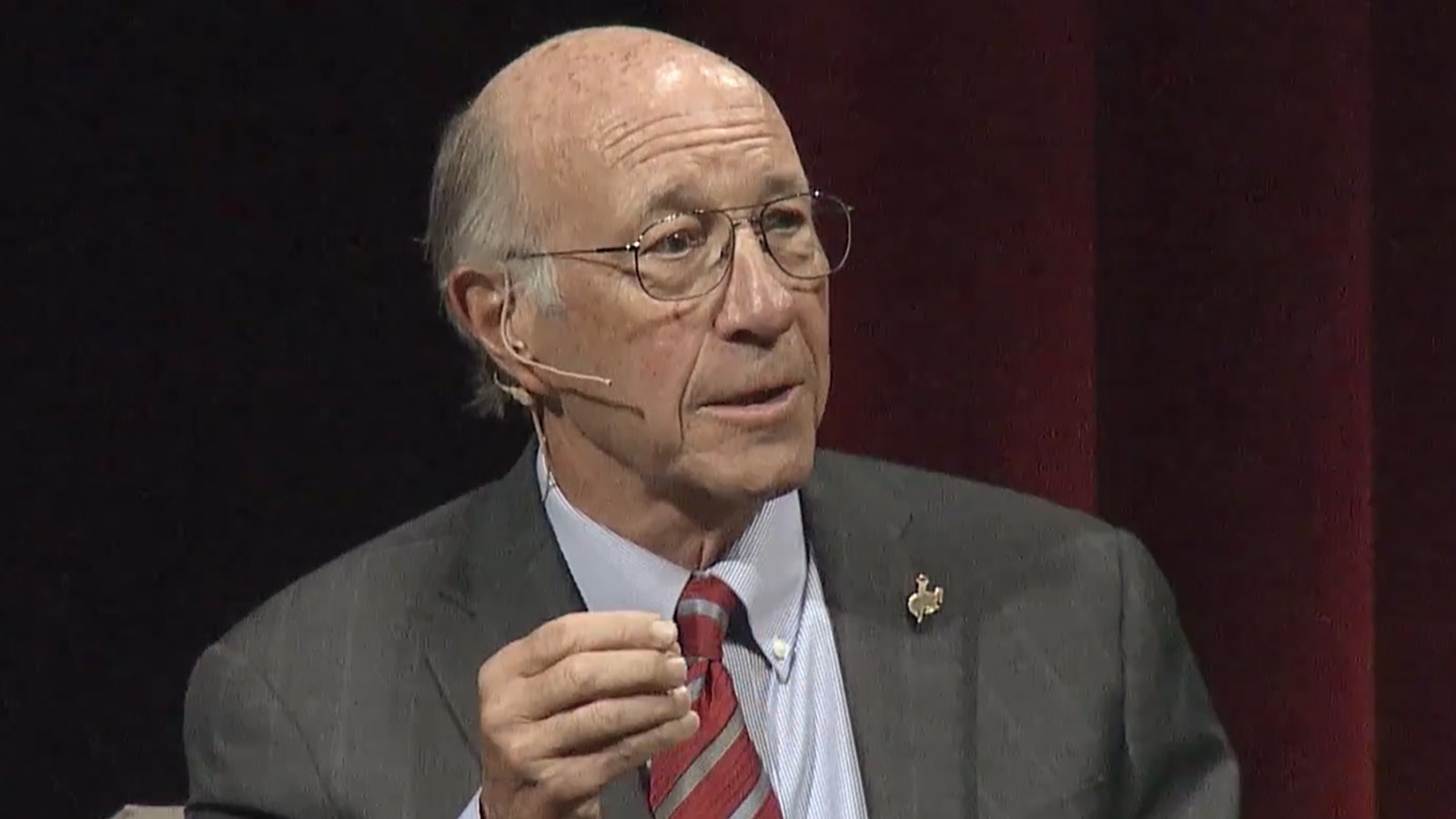
Former Wyoming Gov. Mike Sullivan has a unique insider perspective on President Joe Biden’s diplomatic trip to Ireland this week, having served as U.S. ambassador to Ireland from 1998-2002 and playing a key role in brokering one of the most important peace agreements of the 20th century.
“It was a wonderful privilege to represent the U.S. in Ireland,” he said. “In Ireland, it was special because of the relationship and my own heritage with Ireland.”
A Douglas, Wyoming, native and governor from 1987-1995, Sullivan’s work as ambassador to Ireland was instrumental in brokering peace in the violent and politically turbulent nation. It was not a role he ever envisioned for himself playing, even in the years leading up to his appointment.
“You look back and say, ‘How did this happen?” Sullivan said. “When I graduated high school in Douglas, Wyoming, my parents never thought I’d be ambassador to Ireland, and neither did I.”
Biden’s Trip
Biden, the nation's second Irish-Catholic president, went to Belfast, Northern Ireland, on Tuesday and to the Republic of Ireland on Wednesday.
Sullivan said he hopes the trip results in a renewed American support for both countries of Ireland and the Good Friday Agreement.
“The relationship between the countries is really incredible,” Sullivan said about the nation’s two countries, the Republic of Ireland and Northern Ireland.
One of the largest issues testing Ireland and its peace accord these days is Brexit, England’s 2020 departure from the European Union (EU). The British move to withdraw from the EU has created new tensions over trade between the UK and Ireland and could cause future disputes over borders.
“I think they’re better off in the EU,” Sullivan said of Britain’s move. “Brexit didn’t make a lot of sense to me when it first happened, and I believe that’s been proven correctly.”
A new agreement aims to ease the tensions, but it’s unclear how much this will resolve issues for the long term.
“It’s hardly ever a consensus over there on the issues,” Sullivan said. “But people generally seem to be acceptable to it.”
Biden is meeting with the leaders of Northern Ireland’s political parties Wednesday ahead of a speech to mark the 25th anniversary of the Good Friday Agreement.
According to the UK news organization The Independent, during these meetings Biden plans to “prod” and “nudge” the Democratic Unionist Party to end its protest over post-Brexit trading arrangements and resume its participation in the power-sharing institutions.
Sullivan said it would be impossible for Biden to avoid all criticism on these highly divisive issues, and he supports the president’s approach.
“He and the U.S. have been strong in saying, ‘look, this is your business, but the Good Friday Agreement is our business,’” Sullivan said.
Important Role
Many may not know the former governor served as ambassador to the European country after being appointed by another Democratic president, Bill Clinton.
Sullivan, also a Democrat, was there during an extremely critical time in Irish history and the country’s relationship with the United States.
Nine months prior to taking the post in Dublin in January 1999, the Good Friday Agreement was signed, bringing peace to Northern Ireland. The agreement was made between paramilitary forces of the largely Catholic Irish Republican Army (IRA), mostly Protestant loyalist fighters and others like the British Army.
Sullivan helped maintain the newly crafted peace accord, a relatively fragile agreement that came on the heels of three decades of bombings, murders and stalemates.
“Trying to maintain and establish the government that had been negotiated,” Sullivan said of his work. “Just working with them and continuing to try to establish continuing steps forward.”
‘Patience And Perseverance’
The former governor said he recalls many meetings with leading members of the Sinn Féin, an Irish Republican and Democratic socialist political party with ties to the IRA.
He credits former U.S. Sen. George Mitchell, who was appointed by Clinton to help broker peace in Northern Ireland, for playing an important role in facilitating the Good Friday Agreement, a document that took nearly five years to hash out.
“His patience and perseverance was just immense,” Sullivan said. “I can’t imagine anybody else who would have come close to getting it done.”
How It Happened?
Sullivan met Clinton during the tail end of the former president’s second term as Arkansas governor.
The two built a relationship, and Clinton visited Wyoming twice during his 1992 run for the Oval Office, which Sullivan endorsed. He was the first governor to give Clinton an endorsement.
“He was, in my opinion, clearly the most intellectually and politically qualified to serve,” Sullivan said.
Clinton remembered Sullivan and his endorsement when the Ireland ambassadorship opened up, quickly moving the former governor to the top of his list.
“I guess you could say he never forgot it,” Sullivan said.
‘Strategic’ In Breaking The News
When he found out he was being considered for the position, Sullivan said he was instantly interested, but knew that he had to speak to his wife, Jane Metzler Sullivan, before making a decision.
That night, he sat through dinner with his wife before breaking the news, a move he described as “strategic.”
At first, he gently probed about how she would like to go to Ireland. When she inquired if he meant on a vacation, he couldn’t hold the secret any longer.
“She said, ‘And you waited three and a half hours to tell me that?’” Sullivan remembered with a laugh.
She agreed to the move, and Sullivan confirmed his interest to the White House the next day.
Surprisingly Qualified
Although Sullivan is of Irish heritage, he had never visited the country before taking the ambassador appointment.
“It started out a little scary because it was all new, but it turned out to be quite pleasant and fit, as far as I was concerned, pretty well,” he said. “It hit home.”
Rich Lindsey, who worked in Sullivan’s administration from 1991-1994, said the former governor had an incredible ability to bridge relationships, to turn potential foes into allies by genuinely listening to what they had to say and trying to understand their problems as individuals.
“His willingness to talk to people and listen and actually care about them was incredible,” Lindsey said.
Lindsey said Sullivan authentically cared about people. When a constituent’s family member died, he would send a sympathy card out – not to gain a vote, but out of genuine condolence.
“There are people who would do that to get political mileage out of it. He did that because he meant it,” Lindsey said. “People felt that.”
Sullivan said the political and professional lessons he learned as governor proved invaluable while working in Ireland.
“I think it was very important,” Sullivan said. “I had the same sort of steep learning curve as governor. You were dealing with difficult issues, people with strong feelings in both places.”