A Colorado-based federal judge has dismissed all but one claim in the case of 11 collegiate women’s volleyball athletes — including three from the University of Wyoming — filed in late 2024 against the board that manages San Jose State University.
The women had also sued the Mountain West Conference (MWC). But U.S. District Judge S. Kato Crews dismissed all the women’s claims against the Mountain West Conference, in his March 3 order.
San Jose State University’s governing entity, the California State University Board, remains under legal challenge.
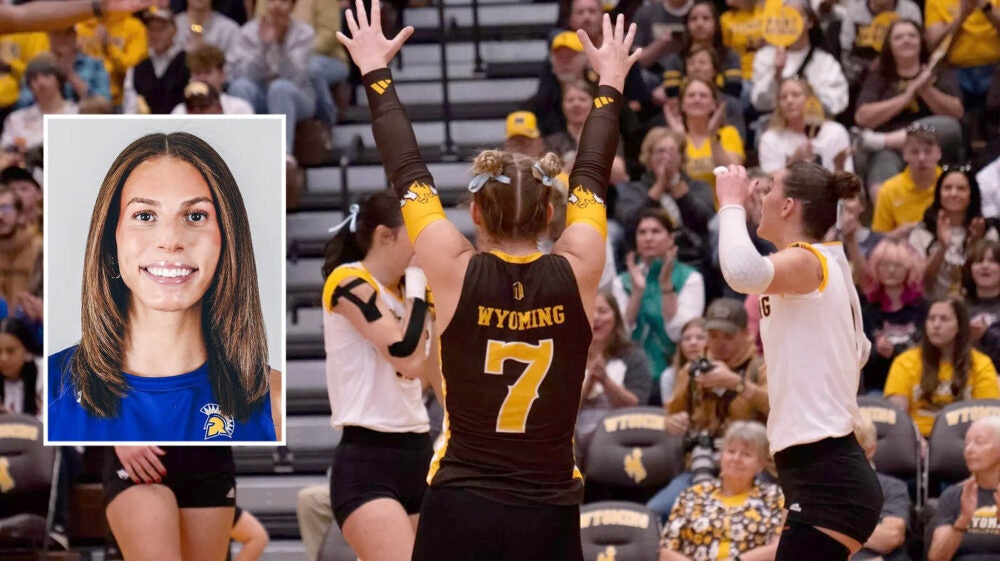
The controversy erupted in 2024, as the University of Wyoming and four other women’s volleyball teams boycotted games against San Jose State University after reports surfaced that a top SJSU player, Blaire Fleming, was transgender.
Due to the Mountain West Conference’s transgender participation policy (TPP), those protest forfeits counted as losses. The policy allowed transgender players to participate in women’s sports after one full year of testosterone suppression and demonstration of testosterone levels below a specific threshold.
UW players Macey Boggs, Sierra Grizzle and Jordan Sandy joined the SJSU team’s co-captain Brooke Slusser and others in suing the California State University board. They also sued a handful of individuals, including SJSU’s head coach, and the Mountain West Conference, and asked the judge to overturn their losses in time for the championship tournament Nov. 27, 2024, in Las Vegas.
The judge declined to tweak their record, citing in part 2020 U.S. Supreme Court case Bostock v. Clayton County – in which the high court held that a federal sex discrimination ban also bars discrimination on the basis of gender identity.
The Supreme Court’s reading was confined to a federal employment statute, not the Title IX education law at issue in this case. But numerous courts have expanded it to Title IX due to similar wording in the two laws.
In the case of a transgender student athlete, “BPJ,” who alleges West Virginia’s ban on cross-sex transgender athlete participation in single-sex sports is unlawful, the high court is now weighing whether Bostock’s broad definition of sex discrimination applies to Title IX – or not.
That’s why just a sliver of Slusser v. California State University remains, says Crews’ order of last week.
Crews acknowledged that he’d leaned, in part, on other courts’ broader interpretation of Bostock in denying relief to the volleyball players earlier in this case.
“This interpretation of Bostock is now called into question and might be upended by the Supreme Court,” wrote Crews. “So the court defers ruling on the Title IX damage claims until after the Supreme Court has issued its ruling.”
The Many Dismissed
Crews at this juncture is keeping alive the women’s claim that they can sue as two distinct “classes” of people wronged.
“While this Court questions the propriety of the proposed classes,” wrote Crews, “this question is better suited for the class certification stage.”
The judge dismissed the women’s claims against the Mountain West Conference because the laws they invoked to challenge it don’t fit its nature, he wrote.
While the Mountain West Conference had based its transgender participation policy on the NCAA’s rule, the NCAA changed course two weeks after President Donald Trump’s second inauguration.
On Feb. 6, 2025, the NCAA banned male student-athletes from competing on women’s teams.
It’s unclear if the Mountain West Conference has followed suit, wrote Crews, but the plaintiffs have told the court that the conference adheres to the NCAA’s Trump-era policy.
Not A State Actor
The claims the women asserted against the Mountain West Conference relied on “Section 1983,” which is a part of the law curbing state actors from violating people’s rights.
Though it includes public as well as private universities across nine states, the Mountain West Conference is not a state entity, Crews concluded.
That’s because MWC’s public-school members can resist its rules and depart from the conference – and they didn’t delegate their state power to the conference, he wrote. Athletic directors from the various schools ratified the conference’s transgender participation policy, he wrote. But the plaintiffs don’t identify which state of the nine allegedly oppressed them.
“They argue that there is pervasive entwinement (of state officials) because presidents and actors from the state universities generally adopted and ratified the (policy),” wrote Crews. “But how can there be ‘known and definite’ state actions cross nine states?... Supreme Court precedent makes clear there cannot be.”
Addressing another claim leveling Title IX’s language against the Mountain West Conference, Crews concluded that the conference is not subject to Title IX.
Though its members receive federal funding, MWC doesn’t receive money directly from the federal government, which severs it from Title IX’s ban on sex discrimination, the judge wrote.
He added that the women could challenge their own schools in court, under Title IX, if they believe the way their schools applied the transgender participation policy violated their rights.
Is A State Actor But Is Immune
The women’s claims for damages against two California State University officials are dismissed because California State, as a state entity, retains its sovereign immunity under the Eleventh Amendment to the U.S. Constitution, Crews ruled.
The Eleventh Amendment generally prevents states and their governmental entities from being sued for damages, except where the states themselves have outlined how they can be sued.
So Crews dismissed the plaintiffs’ claims against two California State University officials.
Another claim, against three California State University officials in their individual capacities, failed because those people are entitled to qualified immunity, wrote Crews.
Qualified immunity is a doctrine that says government officials are protected from liability for civil damages unless they’ve done something that violates a clearly established statutory or constitutional right that would have been apparent to a reasonable person.
The women’s claims that the three officials censored their boycotts and violated their right to equal protection were too generalized, Crews wrote.
Lastly, as Fleming is no longer playing in the conference and the women don’t allege there’s another transgender player still in the conference, their claim for declaratory relief against California State University is now moot.
A declaratory relief action is a request for a court to affirm and uphold one’s rights.
Crews pointed again to the NCAA changing its policy to fit the new Trump administration.
He dismissed some of the women’s claims since they’re no longer eligible collegiate athletes and lack standing to sue, and he dismissed Title IX claims against individual defendants.
With one claim remaining, this case is ongoing in the U.S. District Court for Colorado.
Any legal findings that emerge from it would impact Wyoming’s federal court as well, since the two districts are both within the Tenth Circuit.
Clair McFarland can be reached at clair@cowboystatedaily.com.