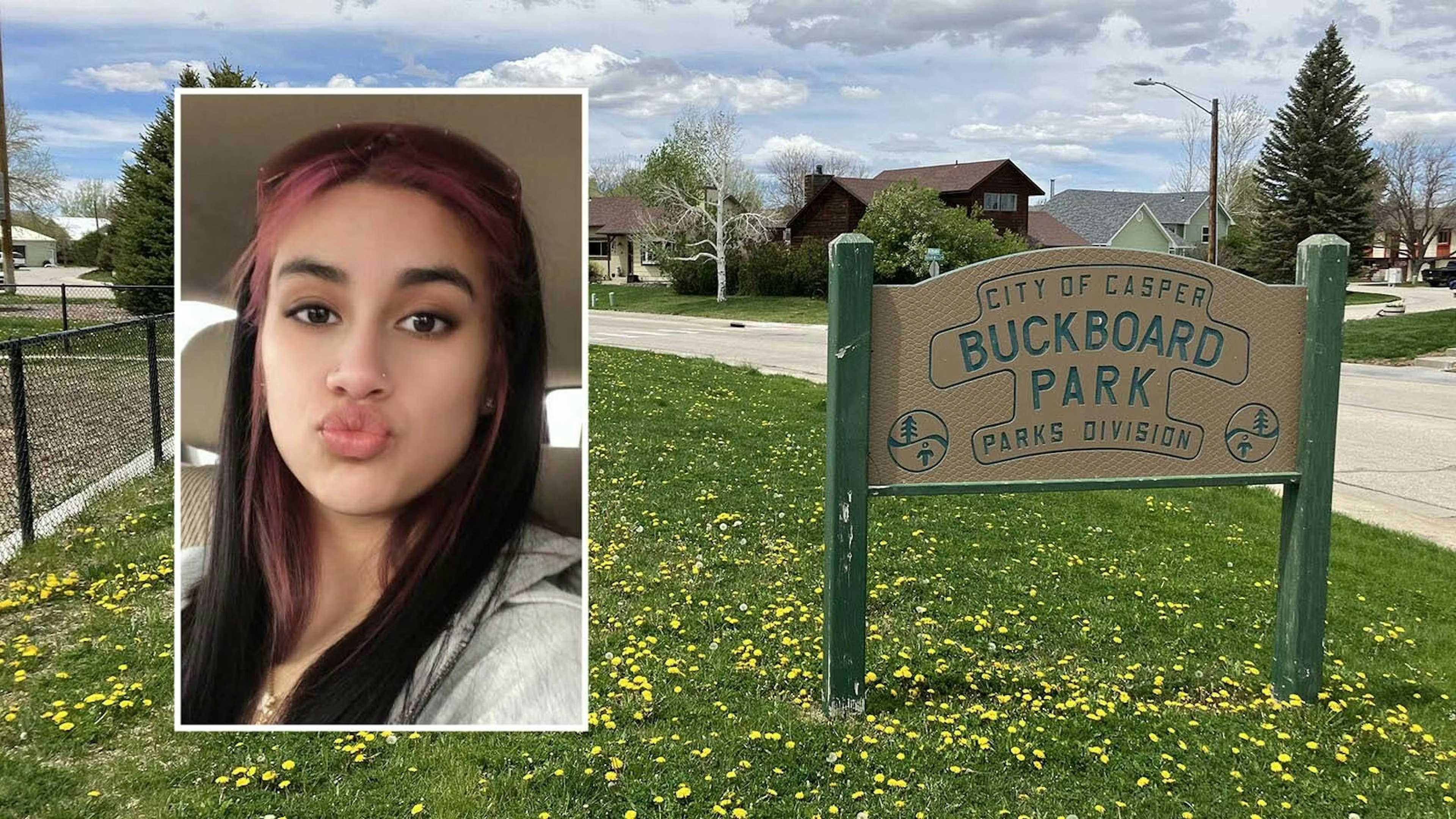
Arguments that the lengthy sentence a Casper teen received for shooting his ex-girlfriend in the head at a Casper park in 2024 violated Wyoming statutes and represented “unusual punishment” failed to sway Wyoming Supreme Court justices.
The Supreme Court issued a 13-page decision Tuesday affirming the sentence. It was written by Albany District Court Judge Misha E. Westby who considered the case with Supreme Court Chief Justice Lynne Bomgaarden, and Justices Kari Gray, John Fenn and Robert Jarosh.
The court found that Eavan Castaner’s sentence by Natrona County District Judge Daniel Forgey for second-degree murder was appropriate and did not violate Wyoming statute language that covers juvenile sentencing in the state.
“Further, Mr. Castaner failed to demonstrate a clear consensus of state legislatures has abandoned the sentencing practice, or that a clear consensus of courts has deemed his sentence to be contrary to law,” Westby wrote.
The court also found that it was not “unusual” punishment under Article 1, Section 14 of the Wyoming Constitution.
Castaner’s attorney Ryan Semerad told Cowboy State Daily on Tuesday that the ruling is a disappointment and leaves a situation in which youthful offenders could suffer worse for getting a jury to drop a first-degree murder charge in favor of a second-degree conviction. In that way, said Semerad, a trial win would be a sentencing loss.
“We deeply disagree with the decision, and we are exploring our options,” said Semerad. “We may file a petition for re-hearing.”
If Semerad files the request within 15 days the Wyoming Supreme Court may grant a request for re-hearing, which amounts to a reconsideration on supposed errors in its ruling. But it doesn’t have to grant that request.
In his initial appeal to the court, Semerad argued that the sentence for his client violated two different Wyoming statutes and also the Wyoming Constitution’s prohibition against unusual punishment.
Arguments
Prior to sentencing, the Natrona County District Attorney’s office told the district court that Castaner’s case fell under the precedent of a 2014 Wyoming case, Bear Cloud v. State.
Under that precedent the prosecution recommended a sentence of 44-to-75 years for second-degree murder.
Semerad asked the district court to consider a 22- to 30-year sentence.
“Mr. Castaner argued a life sentence for a juvenile was 25 years according to Wyoming statute 6-10-301(c)” as well as the Bear Cloud case, Westby wrote in the ruling. “Mr. Castaner also argued that if the district court imposed a term of years sentence instead, that it could not impose a minimum term of incarceration that exceeded 43 years … because that would be imposing a functional life without parole sentence.”
The Wyoming Supreme Court found that because Castaner’s sentence was a term of years and not just a “life sentence,” it did not violate Wyoming statute 6-10-301(c) because that statute “only applies to juvenile who received a life sentence.”
“To apply the statute to a juvenile homicide offender who received a term of years sentence, we would have to ignore the plain language of the statute,” the court ruled. “We are cognizant of the important doctrine of separation of powers that is implicated when courts engage in statutory interpretation.”
The court also found that Castaner’s sentence did not exceed punishment for second-degree murder under Wyoming law. Wyoming law calls for a sentence of “not less than 20 years, or during life.”
The court noted that sentences have to be within the limits of the statute that is violated and have a minimum and maximum term of confinement. The minimum term cannot be more than 90% of the maximum term imposed. Castaner’s sentence fits that criteria, the court ruled.
“As currently written, there is no exception in the statute for juveniles convicted of murder in the second degree,” the court ruled.
Not ‘Unusual’
The high court also noted that Castaner’s sentence did not meet the criteria as being an “unusual” sentence under the Wyoming Constitution, Article 1, Section 14. The high court said to be unusual, the court must determine that “the punishment is obsolete or contravenes contemporary standards as measured by a clear consensus of state legislators or courts.”
The court wrote that Castaner’s argument was that it was “unusual” because 35 other states “have abandoned” imposing parole ineligibility periods greater than 25 years on juveniles sentenced for homicides.
The state counter argued that there is “no clear national consensus” that would reject Wyoming’s sentencing practices for juveniles convicted of second-degree murder.
When applying the law, the high court said that courts look at whether the sentence is “obsolete” and that to be “obsolete” refers to the form of punishment and not the length of sentence. The defendant failed to meet the burden showing the sentence was “obsolete,” the court ruled.
Castaner also failed to show that the sentence was “unusual” in terms of being “abandoned by state legislatures,” or having been deemed by courts as “contrary to law” or that “contravenes contemporary standards.”
Fails To Meet ‘Burden’
While Castaner argued that the minimum 42-year sentence would be legal in only 14 states and the maximum 75-year sentence legal in eight states, the defendant “fails to meet the considerable burden” that state legislatures have “abandoned” similar sentences, the high court ruled.
“While the data demonstrates Wyoming may be in the minority of states that would allow Mr. Castaner’s sentence, there is not an obvious and generally accepted opinion among state legislatures that a 42-to-75-year sentence for a juvenile convicted of second-degree murder is never permissible or warranted,” the high court ruled.
The high court also noted second-degree murder sentences out of Louisiana, Nebraska and South Dakota in recent years that were higher than the one imposed on Castaner.
The case involving the then 15-year-old Castaner shooting his 17-year-old ex-girlfriend, Lene’a Brown, occurred as the city was reeling from the fatal stabbing of a 14-year-old boy by two teens at the city’s mall the previous month.
In a social media message to Brown leading up to the shooting, Castaner allegedly told her that he would “celebrate when you die,” a police affidavit in the case stated.
At his sentencing hearing, Castaner told the court that he was sorry for his actions.
“I would give up my life for her to have her life back,” he said, adding his actions have “imprisoned me mentally for the rest of my life.”
An attempt to reach Natrona County District Attorney Dan Itzen for a comment on the ruling was not immediately returned.
Dale Killingbeck can be reached at dale@cowboystatedaily.com.