Seeking a cheap and effective way to protect livestock from predators, Utah researchers think they’ve found the answer — sticking flashing lights on sheep and cattle to scare off coyotes, wolves and other marauding carnivores.
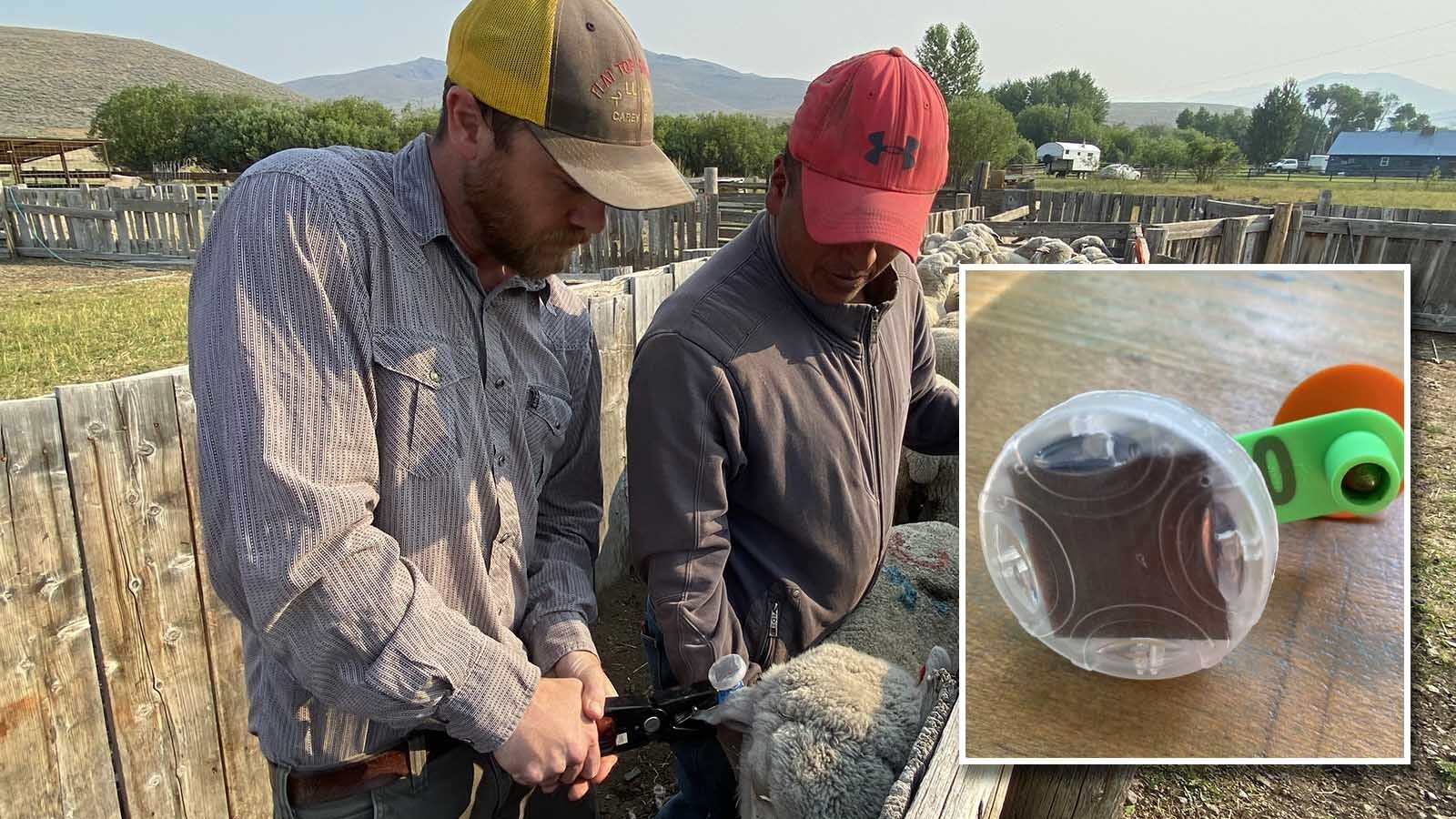
Flashing ear tags, or FlashTags as they’re called, are one of the latest attempts to keep predators from killing livestock, without having to kill the predators.
There’s been a few tests of the technology in Wyoming and other Western states. The results of one pilot program
The Northern Ag Network reported that early results of test runs seem promising.
The results weren’t always perfect, one of the lead developers told Cowboy State Daily.
On one Montana ranch, a grizzly killed a calf that was wearing a tag, said Julie Young, associate professor and director of the Berryman Institute of Wildlife Damage Management at Utah State University.
The light-up tags are motion activated, and apparently the calf didn’t move, she said.
“We had one rancher in Montana that considered it a failure. He lost a calf to a grizzly bear,” she said.
“The calf didn’t even move, it was asleep,” Young added.
Won’t Predators Get Use To It?
One criticism of non-lethal predator control methods is that eventually, coyotes, wolves and other predators just get used to them and go back to killing livestock.
The Gittleson family runs a ranch near the Wyoming-Colorado state line and have lost cattle to wolves. Family members told Cowboy State Daily that they’ve tried a variety of deterrents, including stationary flashing lights mounted on stakes, but eventually wolves stopped being scared of them.
Young acknowledges that predators can get acclimated to non-lethal deterrents, but so far, FlashTags have passed that test.
At one test site, there was no evidence of coyotes developing “habitation” to FlashTags, even after two full seasons.
The secret could be that the lights don’t just flash continuously.
“They only go off after dark, and when the animal moves its ears,” she said.
In other words, the FlashTags are activated when livestock animals get agitated by a perceived threat in the night and start twitching their ears.
That seems to make predators directly associate trying to stalk livestock with a negative experience, she said.
“The flashing lights go off and they (predators) think ‘whoa, what’s going on?’” then run away and usually don’t want to come back, she said.

Something Ranchers Are Used To
Young said a “design flaw” in the first batch of FlashTags caused many to break during the first season at one site.
However, that’s been corrected, and it’s hoped that the tags can last ranchers for at least a couple of seasons before needing to be replaced, she said.
From ranchers’ perspective, the FlashTags are designed to be zero-maintenance, she said.
They can be attached like any other livestock ear tags “which is something ranchers are already used to doing” and then essentially forgotten about, she said.
The tags are charged by solar energy during the daytime, so there’s no batteries to change, she said.
FlashTags also don’t seem to bother sheep and cattle, Young said, and that’s important.
“We didn’t want to change the behavior of the livestock animals,” she said.
She also noted that FlashTags don’t need to be attached to every animal in a livestock herd.
They can be effective when “10 to 15% of the animals” are wearing them, she said.

‘Wait And See’
Longtime Wyoming sheep rancher Jim Magagna said he’s heard talk of FlashTags. He told Cowboy State Daily that he’s open to the idea, if further testing proves they really work over the long run.
“We’re certainly open to any tools that will be effective in reducing the number of predations and that will be affordable to the livestock producers,” said Magagna, the executive vice president of the Wyoming Stock Growers Association.
If the tabs catch on, he’d like to see some sort of “funding program” to help offset the costs to ranchers, he said.
For now, he’s taking a “wait and see” approach to FlashTag technology.
Magagna noted that most of the losses his family’s ranch has suffered have been to coyotes, as well as some losses to black bears in the Wind River Mountains.
“In the early days, 'lethal take' of predators was the preferred method of cutting losses, he said.
He recalled a bad episode with wolves in the 1990s.
“For about two years, we had very significant losses to wolves,” he said.
“After the second year, and after I had lost over 60 head of sheep, Wildlife Services obtained a permit and removed the wolf pack that had been doing the depredations,” he said.
Mark Heinz can be reached at mark@cowboystatedaily.com.