Bald eagles might be regarded as the most fearsome predators of the sky, but like any other wild creature, they’ve got to do whatever it takes to survive the winter.
Accordingly, they might scavenge more than they hunt during the cold months, biologists told Cowboy State Daily.
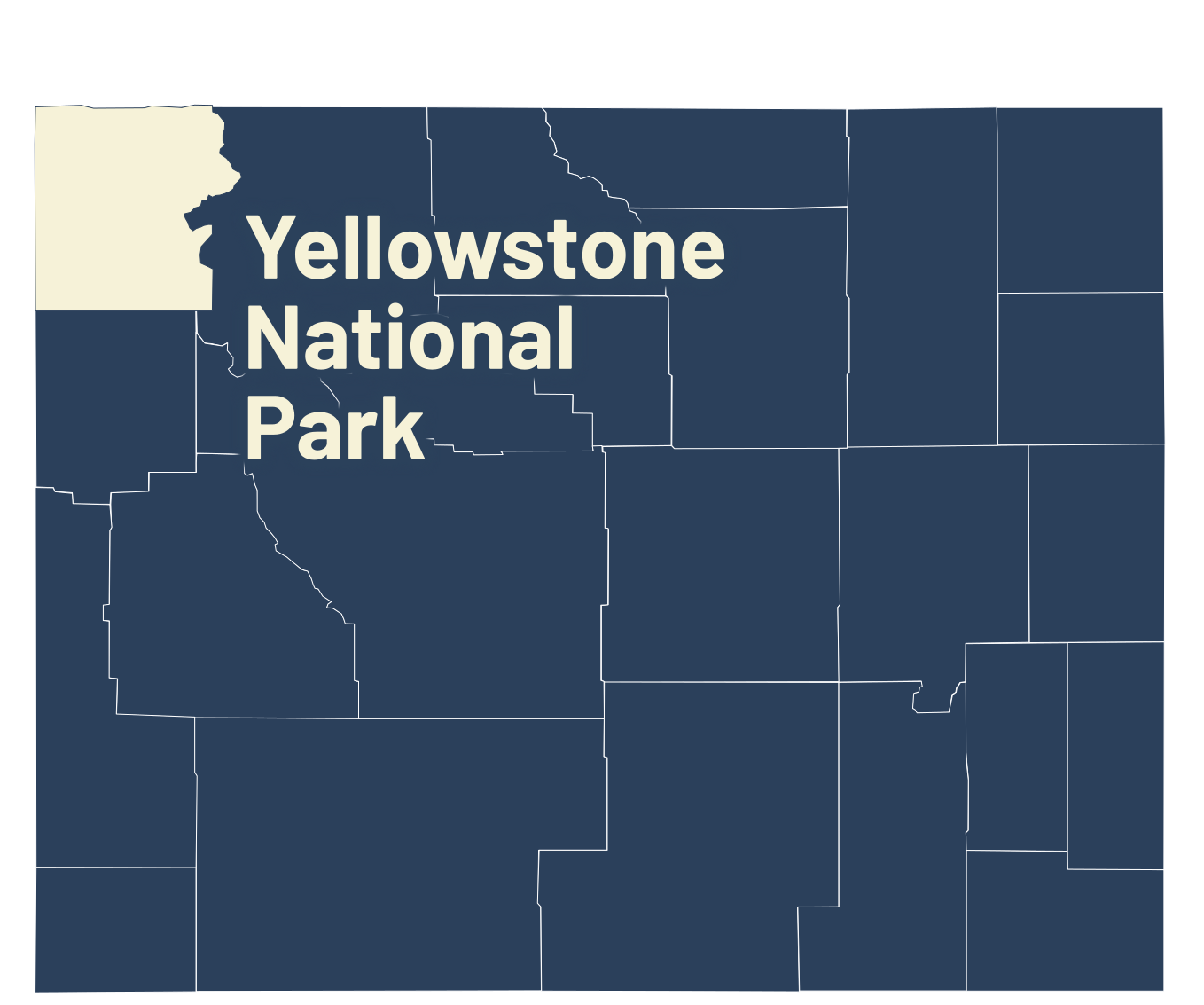
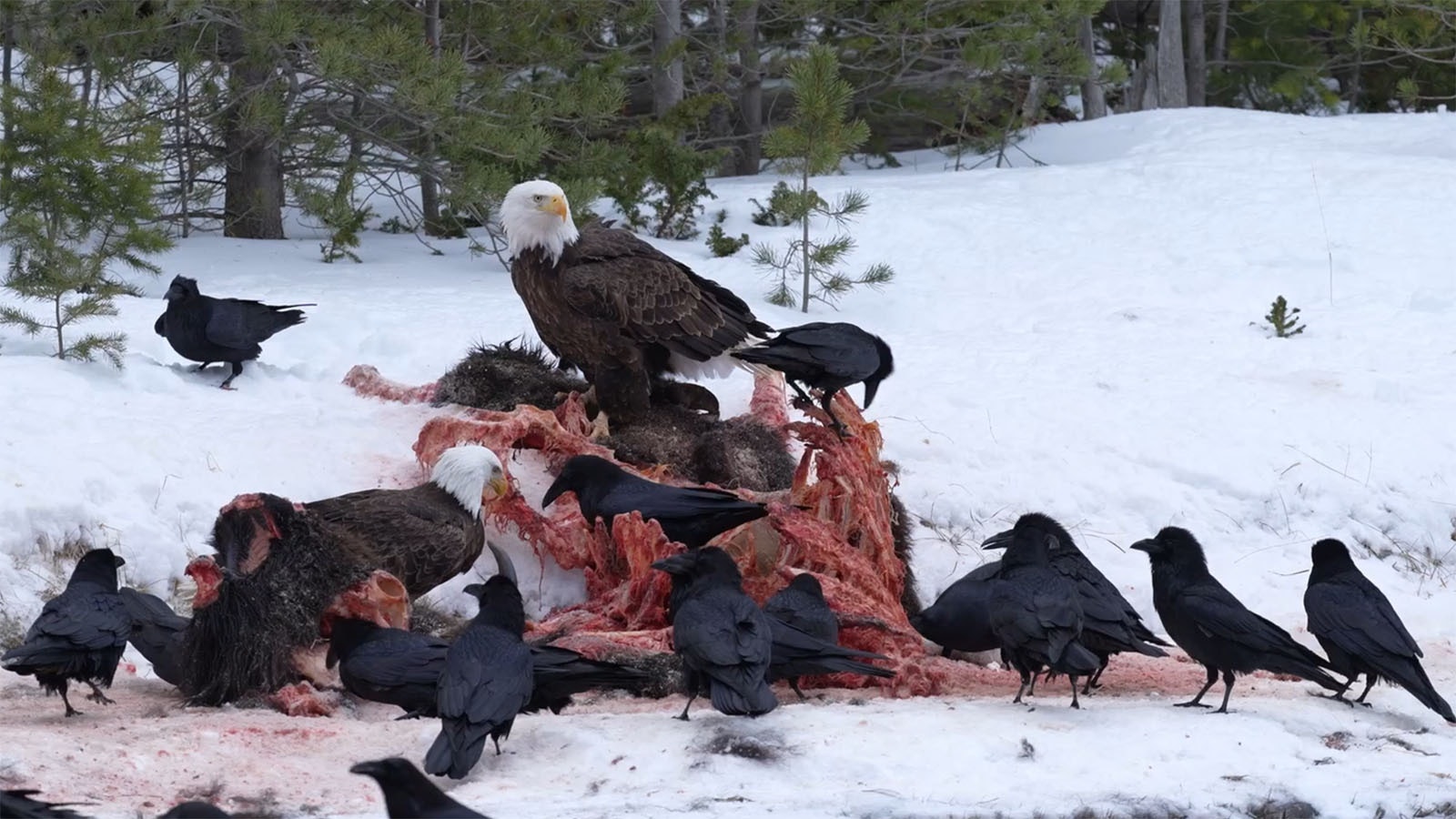
That was evidenced in a raw display of how nature works in Yellowstone National Park. After the Wapiti wolf pack killed a bison and ate their fill, scavengers moved in.
Among them were a dozen bald eagles and roughly 40 ravens, said John Winnie Jr., who took photos and video of the feast.
“What really impresses me every time I see a carcass is, it’s sort of like a conveyor belt of scavengers getting in there, grabbing it and taking it away,” he said.
“We’re talking about many pounds of meat being taken per hour,” added Winnie, an associate teaching professor in the Department of Ecology at Montana State University.
Wolves Take Down Weakened Bison
Some of Yellowstone’s wolves have pivoted from preying mostly on elk to hunting bison.
It’s not an easy undertaking for wolves, Winnie said. The packs typically target old, sick or weakened bison. And the bigger the bison population, the more chances wolves have of finding softened targets.
But with bison, there’s no such thing as an easy kill.
“No matter what, they (bison) are kind of badass animals and hard to hunt,” Winnie said.
He wasn’t there when the Wapiti wolf pack killed the bison that the eagles and ravens scavenged from.
According to what witnesses told him, the bison was suffering from a broken leg, and the wolves killed it either late Friday or early Saturday near a roadside, along the banks of the Madison River.
‘Straight-Up Competition’
Once the wolves gorged themselves and backed off, it was time for coyotes and the birds to take their share.
At one point the carcass was completely mobbed by eagles and ravens. And it was a free-for-all.
“I don’t think there was any cooperation at all, it was straight-up competition,” Winnie said.
The ravens knew better than to mess with adult eagles. However, Winnie noticed a raven pestering a juvenile eagle, pecking at the eagle’s tail.
Winter Food Options
During the warmer months, bald eagles in Yellowstone eat mostly fish and ducks, Winnie said.
When lakes, ponds and streams freeze over during winter, the ducks leave to go south. And ice prevents the eagles from getting at fish. So they must scavenge meals.
“Bald eagles in particular rely very heavily on carrion as a winter food source,” Winnie said.
That’s the case for eagles across the state, said Bryan Bedrosian, the conservation director for the Teton Raptor Center.
He also noted that there are far fewer ducks and fish available for bald eagles during the winter. And golden eagles can’t find prairie dogs, one of their favorite prey species.
Moreover, the number of eagles in Wyoming soars over the winter.
“There are just more eagles here in the winter, because so many migrants come into Wyoming," Bedrosian said.
It’s estimated that Wyoming’s golden eagle population doubles during the winter.
Many bald eagles migrate down from Canada to winter in Wyoming, Bedrosian said.
He urged winter drivers to keep an eye out for raptors because “eagle-vehicle collisions greatly increase during the winter,” he said.
That’s because eagles gather on or alongside highways to feed on roadkill.
Jackrabbit carcasses can get eagles killed, he said.
“Jackrabbits get frozen to the road. And if an eagle is trying to pull a carcass off the road while it's feeding, it might not be able to do so fast enough as a vehicle is approaching,” Bedrosian said.
Mark Heinz can be reached at mark@cowboystatedaily.com.