CHEYENNE — In 2019, the mayor of Mills informed the town’s firefighters their contract would not be renewed.
They were given less than three weeks’ notice. The town had no replacement plan.
Just like that, Mills — a community of a few thousand people outside Casper — was left without fire and EMS services.
One resident, Leah Juarez, stood up at a packed town council meeting and demanded the mayor resign.
Residents circulated a recall petition, according to press reports at the time. But they quickly discovered something that stunned them: Wyoming law provides no mechanism to recall a mayor or city council member.
On Wednesday, Juarez — who defeated that mayor, Seth Coleman, in 2022 and now leads Mills herself — testified before the House Minerals, Business and Economic Development Committee in support of House Bill 22, a measure that would give Wyoming communities the power to remove municipal elected officials between elections.
“I stepped forward to advocate for our firefighters and our community,” Juarez told the committee via online testimony. “I asked our state representative at the time to reintroduce his recall bill. Initially, he agreed. After discussions with the mayor, he withdrew it, stating it was not ready. That deepened the frustrations of the residents who had already felt they had no meaningful recourse to recall him.”
Juarez urged lawmakers to act.
“I’m asking you to vote yes on this recall bill because the residents must have the ability to protect their community when an elected official is causing demonstrable harm,” she said.
Today, Juarez said, she is still cleaning up the damage left behind.
“It took nearly two years to unwind the financial and operational damage from the previous mayor,” she told the committee. “Although I can’t go into full detail regarding the financial and legal damage that occurred, we are still working through some of those legal challenges today.”
The Bill
Rep. Scott Heiner, R-Green River, introduced HB 22 by explaining that when Wyoming’s constitution and original statutes were written, most towns operated under a commission form of government, which included recall provisions. But over the past century, as communities nationwide shifted to mayor-council structures, the recall mechanism was never extended to cover them.
“It was only about 100 years ago in the 1920s when Galveston had a hurricane down there, and they transitioned to a mayor and town council, and that went like wildfire throughout the whole country,” Heiner told the committee. “Here in Wyoming, that’s all of our municipalities and cities — town councils and mayors that have elected government.
"So if there’s an issue with any of these elected, there’s nothing they can do to recall those, because it’s only in the part of the statutes for commission style of government.”
The bill would require petitions signed by registered voters and a general statement of grounds for removal.
Potential Amendments
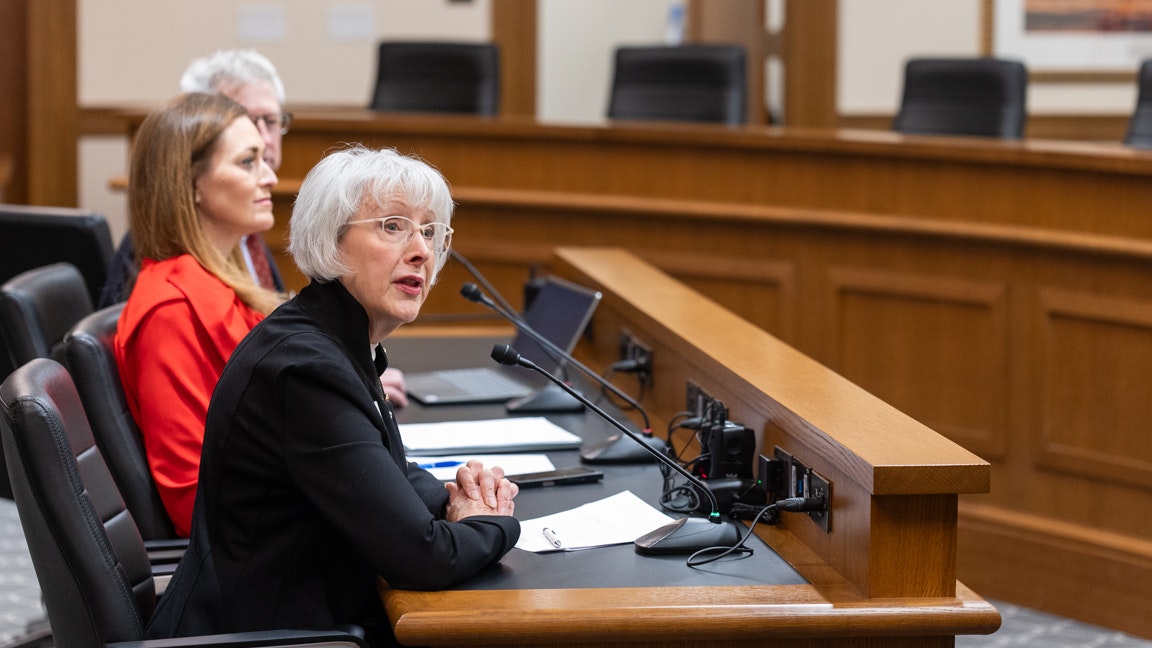
Ashley Harpstreith, executive director of the Wyoming Association of Municipalities, told the committee her organization supports the bill but urged several amendments to add guardrails.
Her proposed changes included raising the petition threshold from 25% to 40% of registered voters, restricting petitions to voters who were actually entitled to vote for the official in question, imposing a nine-month waiting period after an official takes office before a recall could be initiated, and barring recalls close to a general election to save taxpayer money.
“So it’s not retaliatory in nature,” Harpstreith said, adding that the organization also wanted to “let the dust settle after elections” and ensure the bill aligned with existing vacancy statutes rather than creating a competing election process.
Pinedale Mayor Matt Murdock, who also serves as president of the Wyoming Association of Municipalities, told the committee that WAM was “in a moderate position on this, but I think with these amendments, WAM would support this bill.”
Without tying in existing vacancy statutes, Murdock warned, a recall could devolve into a political free-for-all.
“If that’s not included, then this becomes some sort of — it could become a contest outside of a normal election,” Murdock said. “Like Bob just didn’t like Jack. And so we get a recall vote, and Bob runs against Jack and it becomes a whole different election. So I think the process is: remove Jack, and then we follow the vacancy rules to get in — and if Bob gets in, great. But we don’t let Bob just run against Jack. Otherwise, it could become really competitive, and it just turns into the wrong model of democracy that we have.”
Murdock also pushed back on the 25% threshold, noting how small the numbers could be in Wyoming’s tiny communities.
“The last town of Pinedale election, the non-mayor election, we had 62 people vote,” Murdock said. “That petition could be a very small number in some small towns. And that could turn into a clan fight instead of an actual political issue.”
Rep. Martha Lawley, R-Worland, raised concerns about costs and election administration, noting that many small municipalities rely entirely on county clerks to run elections. She told the committee she had consulted with her own mayor, who shared similar worries.
Laramie County Clerk Debra Lee testified that her association had already been discussing municipal election reforms and urged that the bill be sent to an interim study to work out potential conflicts with the election code.
“It’s a bit like pulling a string out of a sweater,” Lee told the committee. “Before you know it, it can be unraveled.”
Lawley moved to table the bill, but the motion failed on a voice vote. Rep. J.T. Larson, R-Rock Springs, then proposed an amendment specifying that only one recall per person per term be allowed — so that if a replacement official also proved problematic, voters could recall that person, too.
Larson also added language that a recall petition could not be filed within six months of the next election, saying “it would be important that it be done before the May filing period for office.”
The committee passed the bill 8-1, with Lawley casting the lone no vote. She explained that while she supported the concept, her rural district’s reliance on county-run elections left her concerned about unresolved procedural conflicts.
Scandals Past
Across the state, a mix of personal problems and professional conflicts reveal the kind of issues that might lead to a recall effort. For instance, when the Guernsey’s police chief started investigating the town’s methamphetamine epidemic, someone left a dead bird on her porch with a nail driven through it.
She reported her findings to state and federal law enforcement.
Two weeks later, she was fired by the mayor. She sued, won a $300,000 settlement, and a jury found her reports were a motivating factor in her termination. In Evanston, council members hit the mayor with a formal “no confidence” statement in 2024 over alleged procedural violations, according to local press reports, which quoted one observer who noted the statement was a toothless “political gesture.”
Then last summer, Cody’s newly elected mayor was arrested at 2 a.m. for DUI. She blew a 0.190% — more than twice the legal limit — and spent the weekend in jail. A detention deputy briefly scrubbed her name from the public jail roster. The sheriff’s office called it an error.
Pinedale’s Past
In an interview after Wednesday’s hearing, Harpstreith — the WAM executive director — said there’s a statewide need for a recall mechanism in local government.
“I think every community, at some point in time, has had somebody,” she said — but there was nothing residents could do.
Asked if anyone in Pinedale had been threatened with recall, Mayor Murdock was blunt: “Previous mayors,” he said. “They couldn’t be recalled.”
“We need to make certain that we have a reasonable way to remove elected officials if it’s across the board, from top to bottom,” added Murdock. “And then I think we need to make certain that we’re not entering into bad politics that are just seeking personal battles.”
Illinois Warning
Heiner opened his presentation to the committee with a cautionary tale from outside Wyoming’s borders — the saga of Tiffany Henyard, the self-proclaimed “super mayor” of Dolton, Illinois, a small village south of Chicago.
“She was elected to be mayor of this small village — it’s called a village — and she immediately began spending a lot of money,” Heiner told the committee. “She raised her wages up to over $360,000 a year, spent a lot of money on the town credit card for stylist, personal security, and trips to some expensive places. And the people were outraged. The town halls became very contentious, but there’s nothing they could do until she was finally up for re-election, and she lost by an overwhelming amount.”
Henyard’s scandal-plagued tenure drew national headlines and an FBI investigation.
An audit found the village’s general fund had gone from a $5.6 million surplus to a $3.6 million deficit, with village credit card charges exceeding $779,000 in a single year. Henyard was defeated in the February 2025 primary.
“I’m not saying that’s happening in Wyoming,” Heiner told the committee. “But we do have some issues in Wyoming.”
The roll call vote on HB 22:
Ayes: K. Campbell, Heiner, Larson, Webber, Riggins, Knapp, Schmid, Tarver
Nays: Lawley
David Madison can be reached at david@cowboystatedaily.com.