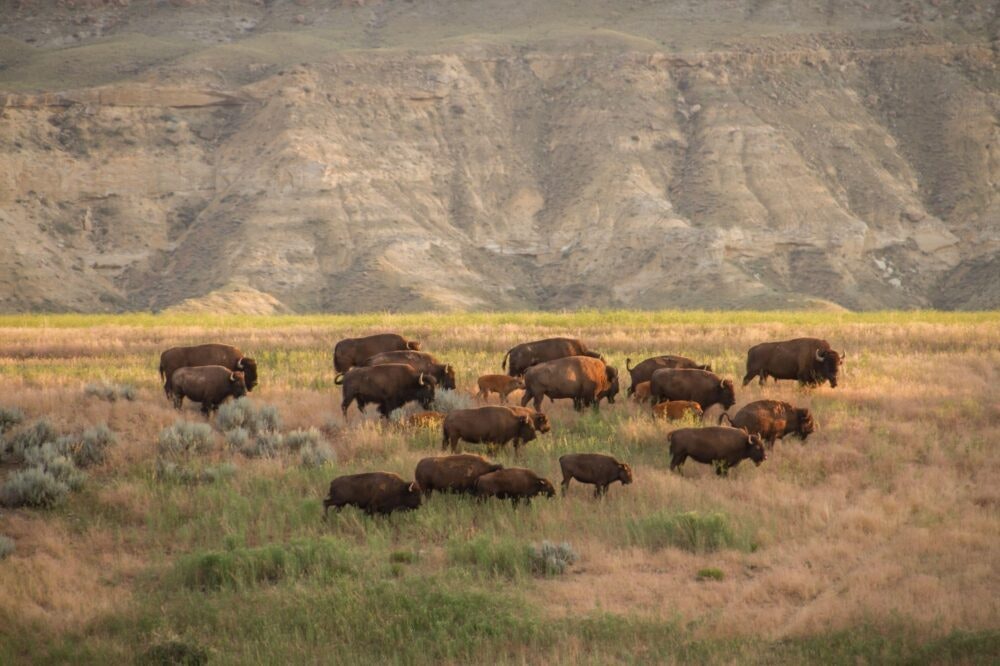
A rancher embroiled in what he calls a “catch-22” of legal loopholes over tribal bison is urging Wyoming lawmakers to clarify who responds, and how, when the tribes’ buffalo trample their neighbors’ fences and hay fields.
Though the animals are technically “bison,” the locals call them “buffalo.”
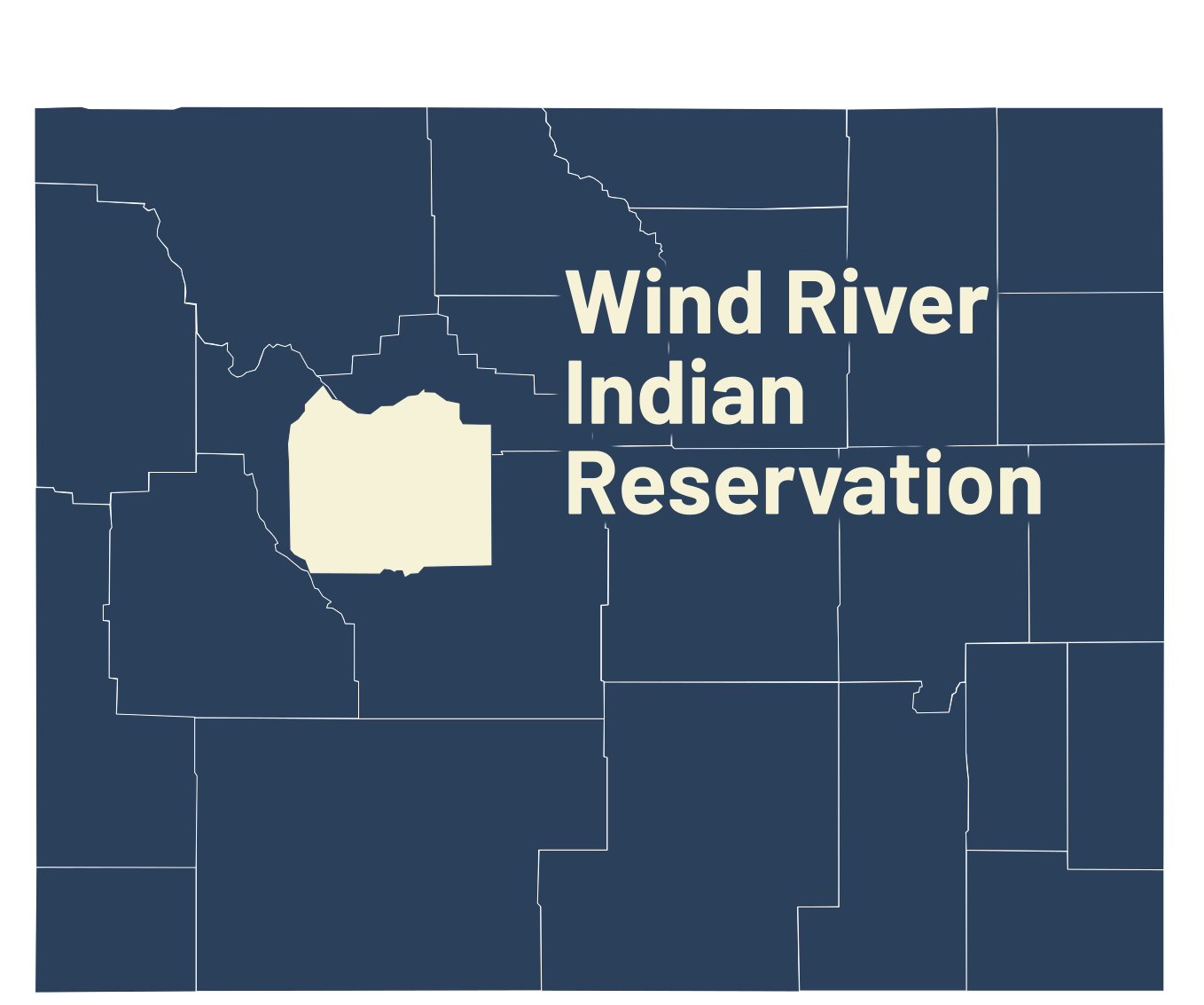
Mitch Benson ranches near the Wind River Indian Reservation on his own, privately-held land.
Buffalo have trampled his fence and fields in recent months, according to his Wednesday testimony for the legislative Select Tribal Relations Committee, photographs and past interviews with Cowboy State Daily.
Benson said this has sparked a larger debate about the tribes classifying their local buffalo as “wildlife,” versus local ranchers’ expectations that animals be branded and traceable to their owners – based on state law calling buffalo “livestock.”
But Benson told legislators on the committee during their Wednesday meeting in Riverton that the tribal buffalo restoration project is part of a larger effort to increase the size of the reservation.
“As you heard Jason (Baldes) say, this is not necessarily just about restoration of buffalo,” Benson told the committee. “This is about regaining diminished lands.”
Jason Baldes, director of the Wind River Tribal Buffalo Initiative, acknowledged to the committee that the buffalo restoration coalition is trying to move land designated as private into the category that pertains to reservation lands.
That is, tribally-owned but held in trust by the federal government.
Baldes said that’s important to restore both the buffalo and tribal autonomy.
He called the animals a sacred piece of tribal history and said they’re considered “relatives.”
He also said buffalo restoration, hunting, and ecotourism can help build economy and cultural identity in an area where unemployment rates, suicide rates and other negative life factors are high.
“The tribes are just trying to protect what little we have left,” said Baldes. “Our way of life; our being able to hunt; to be able to fish; to be able to gather; to be able to harvest a buffalo to feed our families — that’s all a part of our self-determination. That’s our treaty rights being expressed.”
Here’s where the two men’s viewpoints diverge.
Benson told lawmakers he wants them to make clear laws about buffalo ownership, and he wants "harmony" between the buffalo initiative and the neighboring ranchers.
"There are a lot of tribal and nontribal ranchers that are very nervous because of the lack of clarity by the governing bodies," said Benson. "I don’t want to see relationships get torn apart. I don’t want to see livelihoods be threatened. And I don’t want to see the reintroduction of the buffalo cease."
Baldes indicated to the committee, conversely, that Benson is campaigning for remnant ideologies of “colonization, colonial attempts and assimilative processes.”
He reiterated that in a Thursday email, saying Benson and similar figures across the country are "questioning the legitimacy and rights of Tribes to exercise their sovereignty."
Hooves On The Ground
For Baldes, restoring the buffalo is his life’s work.
He started training and studying toward that goal as an undergraduate and graduate-level college student. Meanwhile, the effort to bring the animals back to the Wind River has been brewing since at least as early as 2006, he said.
Both the Northern Arapaho and Eastern Shoshone Tribes, which occupy the reservation together, have since joined the Intertribal Buffalo Council.
Baldes said he worked for the National Wildlife Federation, which supported the idea. He and the entity identified “the old Owens property,” 300 acres of private land as “a place to start.”
But the National Wildlife Federation can’t own land, so Baldes started the initiative to fundraise — more than $10 million so far — and buy private land. That 300-acre plot has grown to 2,000 acres for buffalo habitat, Baldes said.
Private Lands Though
The issue with buffalo running on private rather than federal trust lands, Benson countered, is that that puts the animals under state jurisdiction.
The state classifies the animals as livestock and subjects them to brand inspection rules.
Fremont County Undersheriff Mike Hutchison confirmed Thursday to Cowboy State Daily that the four parcels the county’s mapping system lists as belonging to the Wind River Tribal Buffalo Initiative do not fall within the greater reservation outline where federal and tribal jurisdiction would reign.
That's his understanding at this point, based on his experience with jurisdictions and the legal advice he's received, Hutchison said.
Classified As Wildlife
The tribes, conversely, have formally classified the buffalo as wildlife, which Baldes said “makes sense” because the U.S. Bureau of Indian Affairs layers cumbersome bureaucratic “red tape" onto tribal livestock operations.
It’s not ideal that buffalo the tribes have deemed “wildlife” roam private lands, Baldes acknowledged.
“Yeah, it was probably haphazard,” said Baldes. “But that’s where we had to start. The goal is to get that fee (private) land over into trust status.”
Switching a plot of private or other non-reservation land into federal/tribal trust status can be immensely difficult, however.
Committee Co-Chair Ivan Posey, D-Fort Washakie, who is also a past leader of the Eastern Shoshone Tribe, recalled one land re-designation effort that took 18 years.
“There’s always been opposition north of the Wind River,” said Posey. “Probably more opposition if it’s in a reclamation area.”
Meaning, the state, county, or locals may oppose re-designating certain lands as reservation.
Baldes said it’s nearly certain they will.
“Being that (our herd land) is in the middle of Midvale Irrigation District, we can almost safely assume it’s going to be opposed. So we are stuck in a corner,” he said.
The Midvale Irrigation District manages Reclamation lands across a water and grazing network that serves Fremont County ranchers.
Rich Pingetzer, the district’s board president, gave a brief interview response Thursday to Baldes’ claim that the Midvale Irrigation District would resist letting parts of its region roll into the reservation: “Yes, we will.”
Going OK On This End
Wyoming State Veterinarian Hallie Hasel told the committee that Baldes has cooperated with her office, and the buffalo are tested for brucellosis before entering the state.
Wyoming Game and Fish Director Angi Bruce emphasized that where her jurisdiction starts on state land is also where her jurisdiction over the buffalo would end, since the state considers them livestock and not wildlife.
Wyoming Livestock Board Director Steve True said the tribes have been a model of compliance.
Except for within certain preserve areas, owners of loose bison have 48 hours to remove them after receiving a request to do so from the Livestock Board, True said.
If the board can’t determine who owns the animal, “we may destroy the bison,” he added.
In the case of the October bison encroachment, Baldes was responsive and guided the buffalo home within the timeframe, True said.
Benson has questioned how the Livestock Board or anyone else could determine Baldes is responsible for the buffalo if, labeled as wildlife, they’re not branded.
Baldes told Cowboy State Daily he doesn't know of any tribe that brands buffalo, and even nontribal producers frown upon the act.
True noted that his brand inspectors don’t have jurisdiction to document ownership transfers on the reservation unless invited.
Little Details In The Clash
Benson and Baldes' accounts of the Oct. 1 encroachment differ from each other.
Benson said he called Baldes and Dennis O’Neal, who runs the Northern Arapaho Tribe’s side of the buffalo operation, before calling anyone else.
“And I was a damn good neighbor,” said Benson, adding that he hasn’t billed the tribes for the trampled fences and the expenses he said he still has.
The issue is bigger than the expense, and more about murky rules and laws, Benson said.
Benson told the committee that he couldn’t reach Baldes and O’Neal that day because they were at a sweat ceremony.
Baldes disputes that.
“We were not in a sweat ceremony that day, and there is never a time when we ‘can't be bothered,’” said Baldes in a Thursday email, adding that the team on the Arapaho side of the program was working to retrieve the buffalo, and he told them he’d bring horses if they needed.
“When I showed up with horses, and was on a horse at (Benson’s) gate, he wouldn't allow me onto his property, claiming I would be trespassing and that I didn't have jurisdiction,” wrote Baldes.
Baldes said a state brand inspector arrived to negotiate on his behalf, and it took eight hours.
“And when (Benson) finally allowed me, I had the animals out of his hay field in 15 minutes,” said Baldes.
O'Neal declined Thursday to comment, saying he would prefer an in-person interview under a longer deadline.
That Time EPA Called Riverton ‘Reservation’
In 2017, the 10th Circuit Court of Appeals after a massive local dispute and legal case upheld Congress’ 1905 decision to diminish the borders of the Wind River Indian Reservation.
The U.S. Environmental Protection Agency sparked the clash at the time by announcing that it believed the Act of 1905 was invalid, and Riverton and surrounding areas were part of the reservation.
The Wind River Indian Reservation originally spanned 44 million acres under the short-lived Fort Bridger Treaty of 1863 — then 3 million acres under the Fort Bridger Treaty of 1868.
The Act of 1905 diminished the reservation to roughly its current 2 million-acre outline in central Wyoming.
By refusing to hear the Northern Arapaho and Eastern Shoshone Tribes’ appeal of the 10th Circuit’s ruling, the U.S. Supreme Court also kept those boundaries in place.
That means the town of Riverton, and numerous ranch and reservoir areas around it, are not part of the reservation.
Baldes in his Thursday email countered, saying tribal treaties “supersede” Wyoming’s statehood.
Clair McFarland can be reached at clair@cowboystatedaily.com.