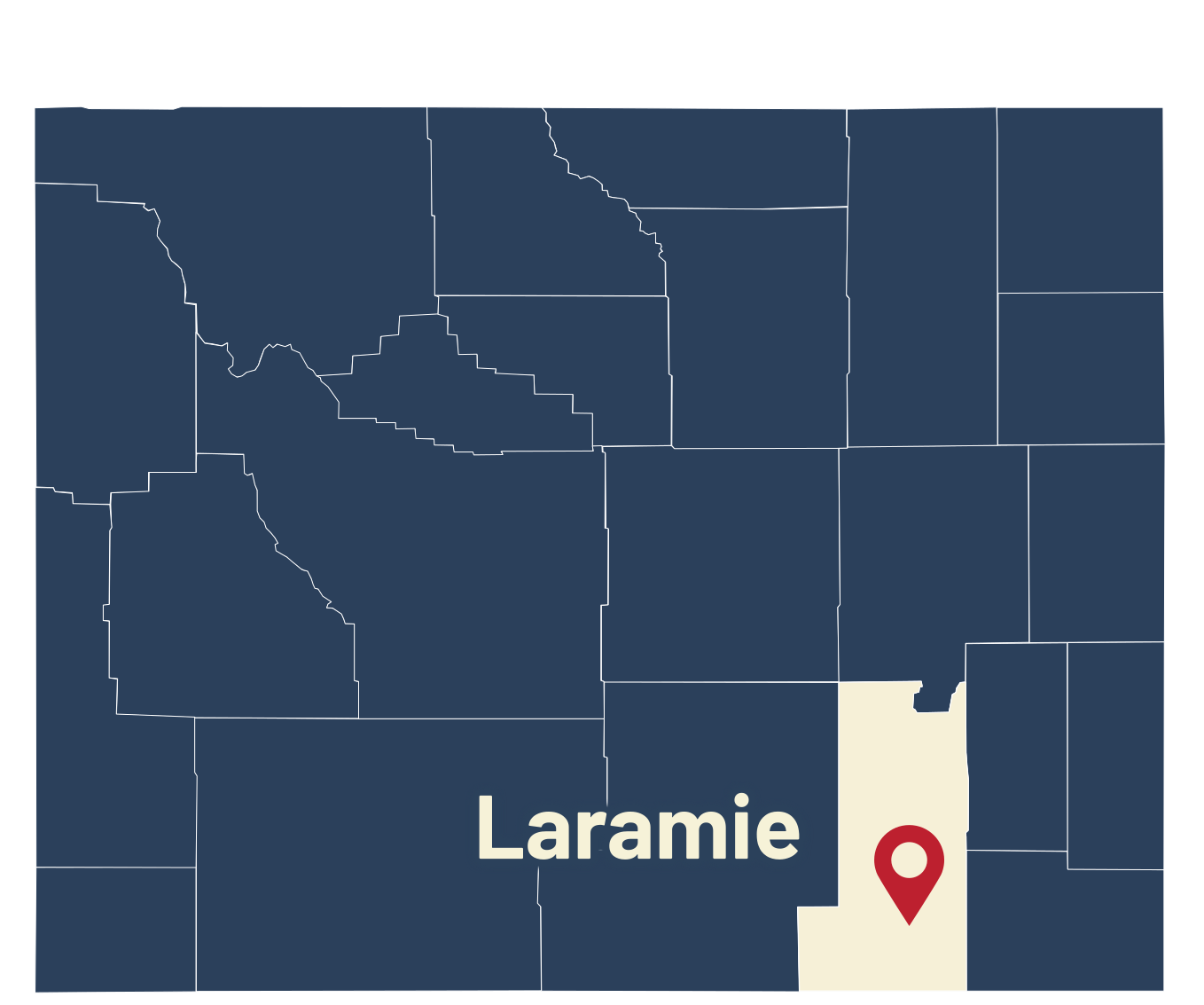
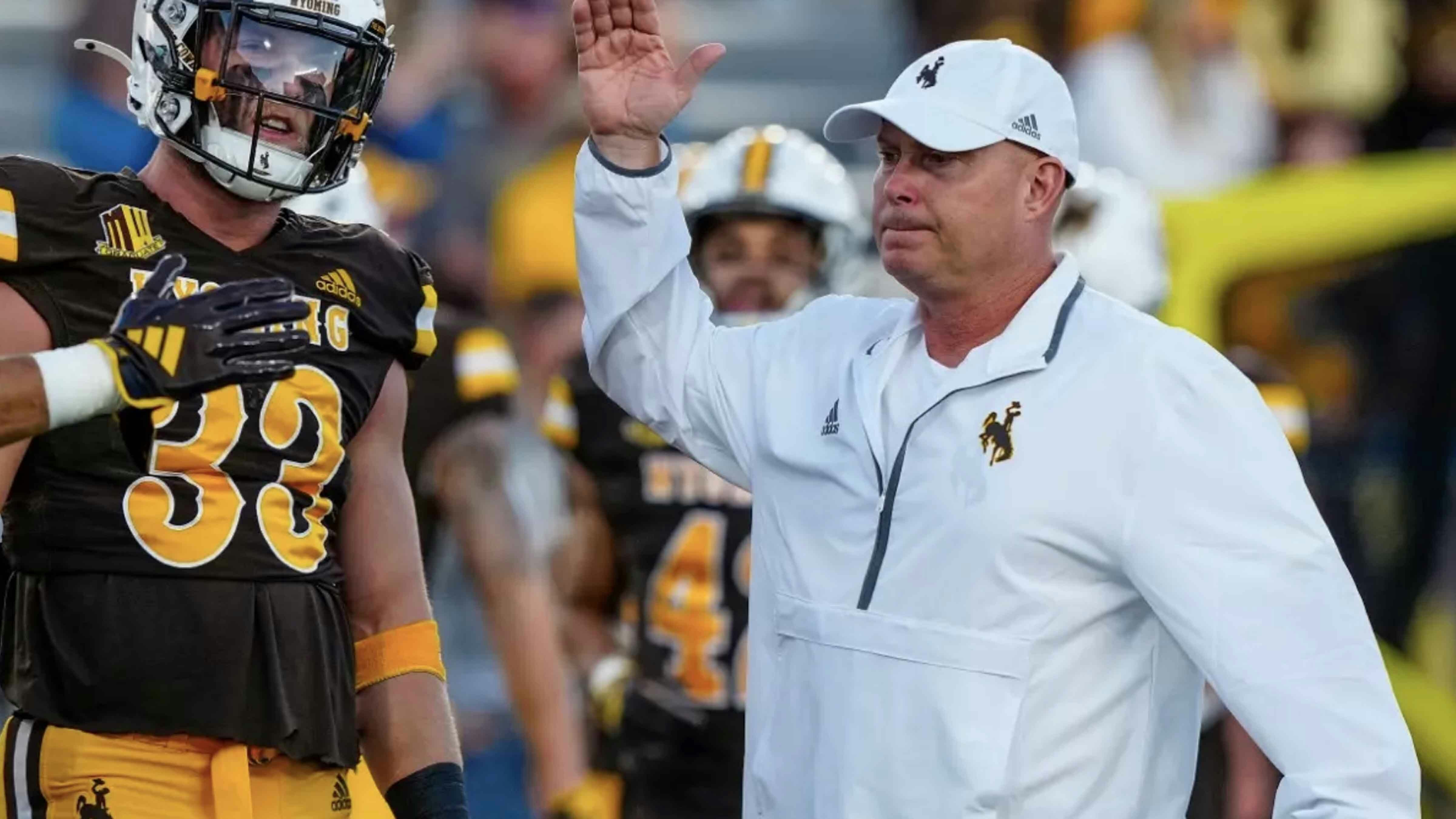
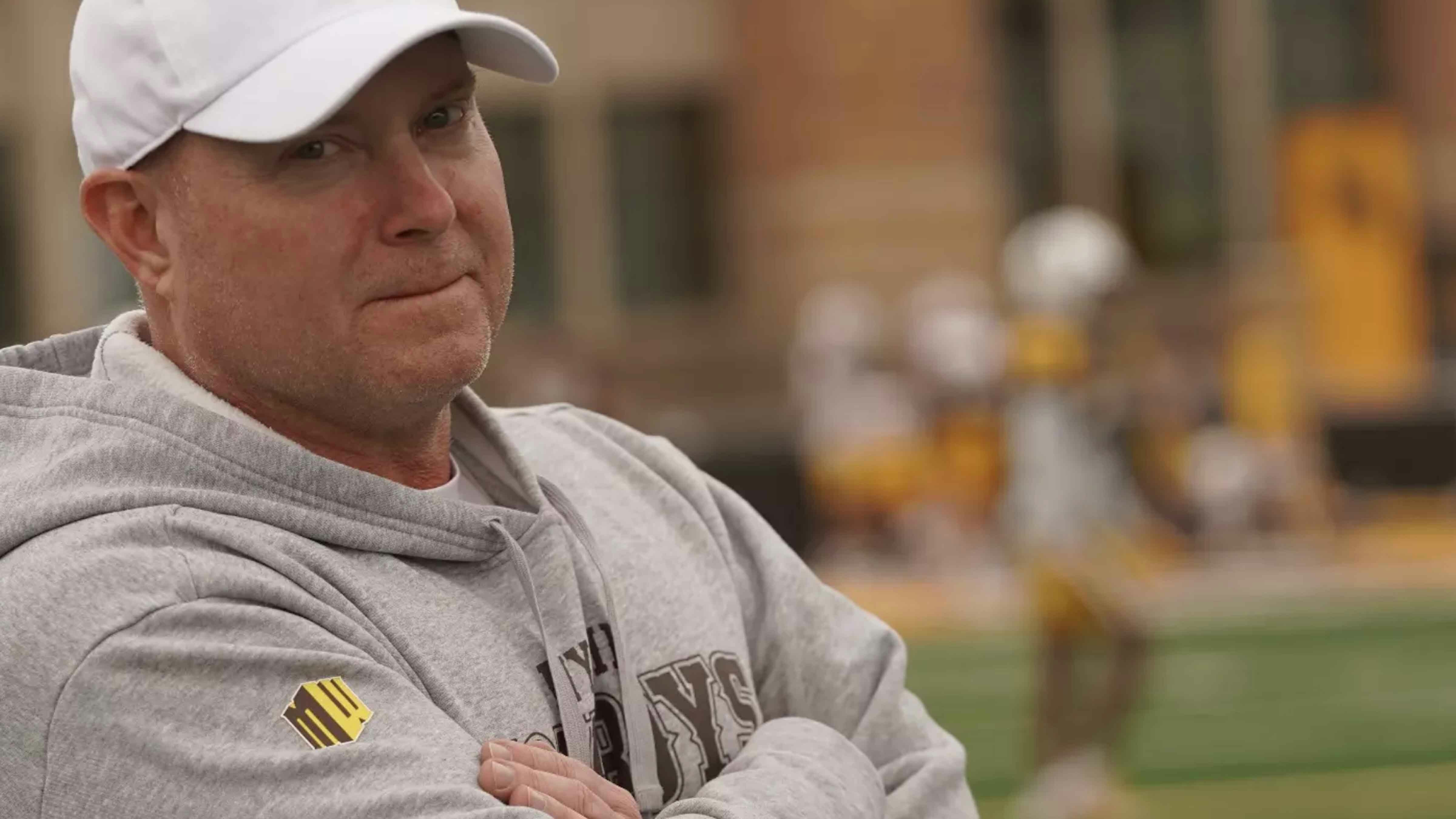
LARAMIE — University of Wyoming head football coach Jay Sawvel revealed Saturday that he voluntarily took a $125,000 pay cut in December, redirecting the money to help fund player compensation as the Cowboys navigate the increasingly expensive landscape of college athletics.
“I signed an addendum to my contract in December that took a $125,000 reduction to my salary to put into our revenue share,” Sawvel said during a Jan. 24 press conference announcing the hiring of new Offensive Coordinator Christian Taylor.
“I thought that with what we had returning player-wise, with where we were at budget-wise, that I thought we could have a really good cycle here but we needed a shove a little bit and we needed a little extra,” Sawvel said. “You don’t have time to wait and so there was one vehicle and one means to do it and it was to do it yourself.”
Coaches donating their own money to help fund player compensation remains uncommon in college football. Ryan Thorburn, communications director for the UW athletic department, said he hasn’t heard of many coaches doing the same.
“I remember last year, Brian Kelly at LSU, I think, donated a million bucks, but he was on the hot seat,” Thorburn told Cowboy State Daily. “It’s a different level.”
Kelly, who earned approximately $8 million annually coaching in the Southeastern Conference, faced pressure to assemble a competitive roster quickly.
Sawvel’s situation differs — his donation came not from panic but instead a desire to give the program momentum, said Thorburn.
“The reason he decided to donate his own money was not out of desperation, more like, we need a boost,” Thorburn said. “I think one reason he wanted to go public is like, we need this boost and I’m going to give it and hopefully if we do well, the fan base will get behind this because it’s the new world order.”
Personal Stakes
Sawvel and others on the UW coaching staff were on the road Monday, checking in with recruits they hope to sign as part of the 2027 recruiting class.
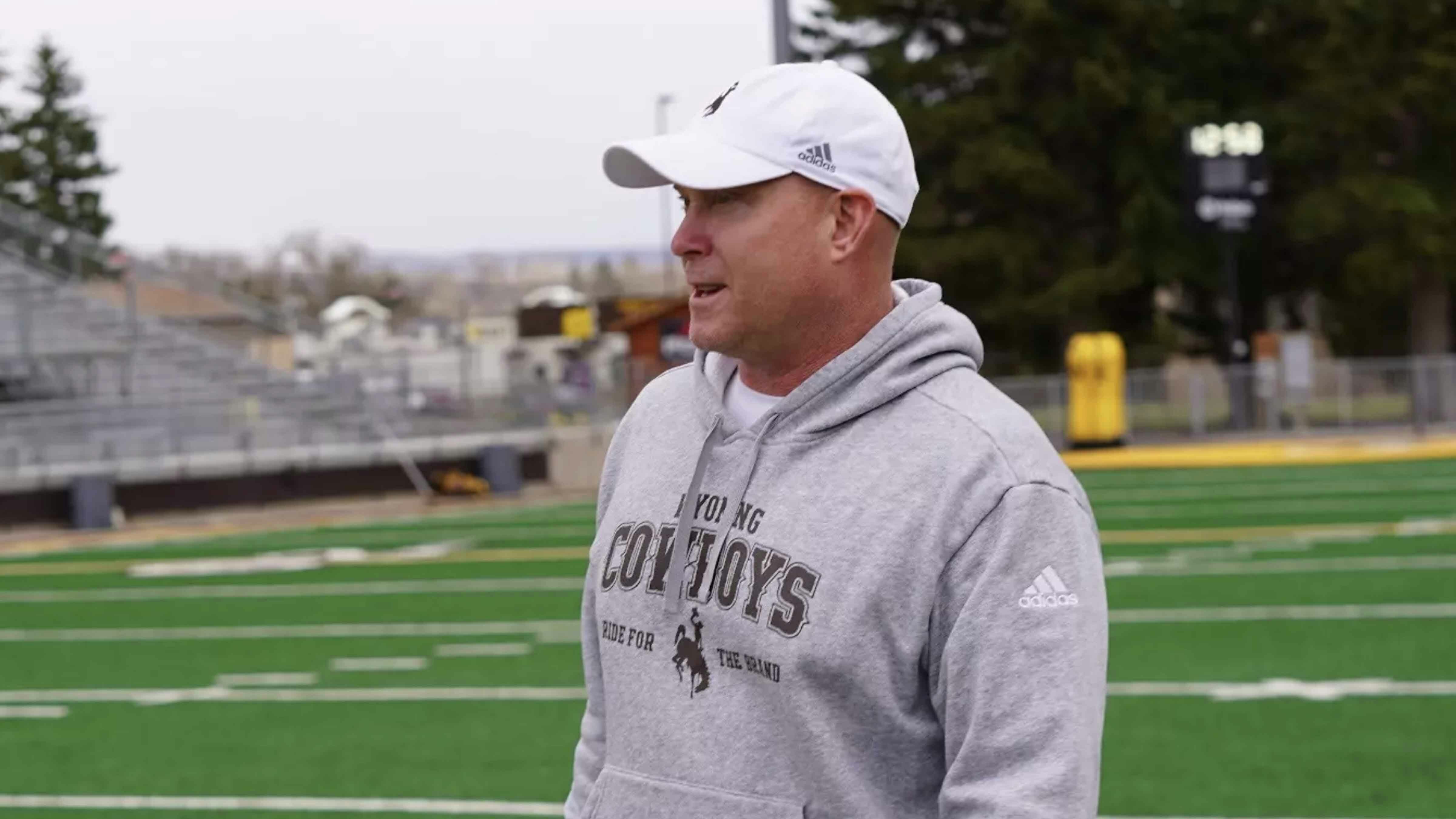
Now leading the Cowboys after serving as defensive coordinator under Craig Bohl, Sawvel has deep ties to the university. His daughter is a student at Wyoming and runs cross country for the school.
“I love this place. I love Wyoming. I want to see us succeed. I want to see the whole university succeed,” Sawvel said.
The coach indicated this isn’t the first time he’s reached into his own pocket. He said most of his contract bonuses go toward retaining assistant coaches.
“I’ve always done that. That’s something that will always be done in that regard there,” Sawvel said.
Thorburn confirmed that Sawvel donated money last year as well but never discussed it publicly. At the time, Sawvel was busy building an impressive defense, which was largely composed of new players.
Now, with Taylor’s hiring at offensive coordinator, Sawvel is trying to pull together a complete team.
“An offensive vision that we tried to achieve for my first two years here didn’t work,” said Sawvel. “We were very ineffective at throwing the ball for a period of time. And so there was an emphasis on how do we create balance in the offense… in doing so we also lost our creativity in the run game.”
Taylor spent the last two seasons with the Buffalo Bills, working as a defensive quality control coach and then offensive advisor, which he compared “to getting my Ph.D.” in football. Before that, he was offensive coordinator at his alma mater William & Mary, where he led the program to a school-record 11 wins and an appearance in the NCAA FCS quarterfinals.
“He utilizes his players and his diversity in the run game as those are areas where we feel we need to make great improvements in this program,” said Sawvel, whose program has another connection to William & Mary.
Taylor recruited incoming transfer quarterback Tyler Hughes to William & Mary, and now he’s welcoming him to UW for the 2026 season.
Taylor called Hughes “an awesome young man” who “works his tail off” and “loves ball.”
Millions Vs. Hundreds of Millions
Sawvel’s personal donation contributes to a fund that helps bring in players like Hughes. All told, when it comes to revenue-sharing funds, Wyoming’s total falls somewhere between $2 million and $3 million, Thorburn estimated.
There is no public ledger ranking Division 1 football teams by the amount of revenue each generates and shares with players, but Wyoming is believed to be among the “have-nots,” according to those tracking UW’s journey into the increasingly professionalized future of college sports.
A recent Wall Street Journal analysis of program valuations and “adjusted revenue” for 2025 put the University of Texas on top with $298 million, followed by Texas A&M at $218 million, LSU at $213 million, Michigan at $200 million, Georgia at $195 million and Ohio State at $185.
When UW turns to the Wyoming Legislature asking for financial support, Thorburn said, “That’s to pay bills,” not to pay players.
Thorburn offered one example: “Insurance for student athletes has gone through the roof. Might have tripled or whatever. Those bills still need to be paid when football players get hurt. You need to pay medical costs.”
Go Pokes!
Sawvel used Saturday’s press conference to make a broader case for investment in the football program, describing it as “the front porch of this university.”
“We’re the only vehicle that gets 25,000 people together,” Sawvel said. “And we bring the alumni together, which brings fundraising together, which brings many opportunities together.”
He questioned why the university would consider contracting any programs.
“When we recruit players from a number of different places, and I ask them, ‘Was this what you expected when they come here?’ Every single time, it’s like, ‘Coach, this is way more than what I expected,’” Sawvel said. “We should be spreading our message to as many places as we can because it’s a great place.”
In his comments, Taylor echoed the power for local support.
“We need the community’s help to do that too. We need the fans’ help to get that done too,” Taylor said. “Watch how much fun we’re having playing together.”
Retention Success
Sawvel said the additional funding helped Wyoming retain key players during the transfer portal cycle. He entered the offseason with a list of 13 must-keep players and retained nine, including eight of the top 10.
“Make the case compelling, you know, to where like, ‘Why would you leave?,’” Sawvel said.
The program structures revenue-share payments to players in thirds — August, February and June — which helps protect the university’s investment if a player transfers mid-year.
The Cowboys signed 20 players from the transfer portal this cycle and more than 20 high school recruits, requiring what Thorburn described as essentially two separate recruiting budgets.
“In the old days, you would have 35 to 40 high school players visit during the season,” Thorburn said. “But now, with the portal, it’s a whole different thing. They had to bring in all these different guys on trips to sign 20 portal acquisitions in January.”
Looking Ahead
Sawvel compared the current moment in college athletics to broader institutional challenges, using an analogy about budgeting he learned in business.
“A budget is like the human body. And you can cut certain things, and it can be like scrapes and scratches and that heals and you don’t really notice it,” Sawvel said. “But there’s other things that’s like a knife wound and that’s deep, takes a long time to heal and it’s always going to leave a scar.”
He warned that some decisions being discussed could have generational consequences for Wyoming.
“Once you cross a certain line, you don’t recover, and that’s in everything,” Sawvel said.
Spring practice begins March 24, with a spring game scheduled for April 25. Practices will be closed to the public because Wyoming opens the season with a “Border War” against a team located just 70 miles away.
David Madison can be reached at david@cowboystatedaily.com.