A legislative committee on Thursday voted 9-3 to adopt a bill that seeks to remove the Wyoming Business Council from the state’s law books and eliminate many of the programs it operates.
That maneuver follows the Joint Appropriations Committee's vote Tuesday, to defund the agency.
The bill's next stop is the Wyoming Legislature, which convenes in a budget-planning session Feb. 9 and can modify, reject or pass the bill. If Gov. Mark Gordon, who has defended the agency, vetoes the bill seeking to kill it, the legislature would need a two-thirds majority to override his veto.
The Wyoming Business Council is a state government agency that gives grants and loans to businesses and communities.
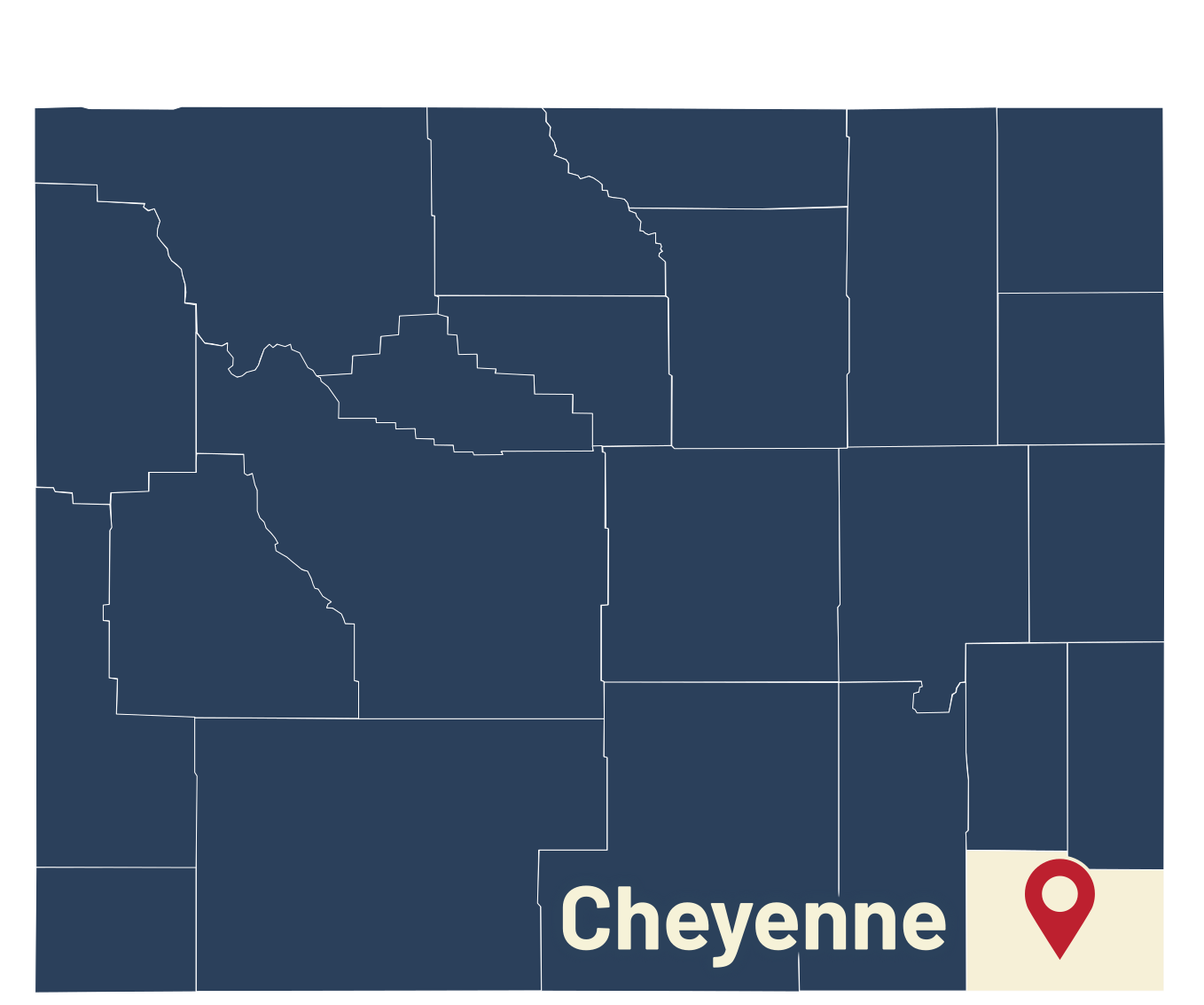
Detractors speaking at the Joint Appropriations Committee’s Thursday meeting in Cheyenne cast the bill to repeal the agency as rushed, poorly crafted and ill-informed about how necessary government involvement is to economic development in Wyoming.
Proponents of the repeal said some economic metrics in Wyoming have declined since the agency’s formation in 1998, and that targeted aid to certain businesses isn’t a fair function of government.
“I think it’s time the taxpayers who aren’t receiving benefits from this type of ‘economic development’… have a word, and I think that’s what this body has been trying to do: represent those people,” said House Appropriations Chair John Bear, R-Gillette.
Rep. Ken Pendergraft, R-Sheridan, echoed that, and parried a claim by Gov. Mark Gordon’s policy director, that repealing the business council “smells bad” and won’t look good for the public.
“I think how this looks to the public depends a lot upon the circles that we run in and our own sphere of influence,” said Pendergraft. “The longer we serve in a place like this, the more our sphere of influence tends to be altered.”
The message the repeal sends to the public is that Wyoming is an even playing field for businesses; that the state’s government doesn’t meddle in the business economy, he said.
“I don’t want a bunch of businesses coming to this state that are here for the handouts,” added Pendergraft.
Randall Luthi, former speaker of the House who serves as the governor’s policy director, used strong language when he approached the Joint Appropriations Committee on Thursday — which he prefaced by saying he respects the committee, the legislature, and the staffers who help them craft bills.
“Frankly, Mr. Chairman, in my opinion and professionally speaking as much as I can — this is nuts. This is crazy,” said Luthi.
The bill is rushed, the agency is more than two decades old, and the governor and other stakeholders would like more involvement in this process, he added.
Sarah DiRenzo, deputy policy director for the governor’s office, asked the committee to build a task force to address the issue over the “interim” months between lawmaking sessions.
"It is a conversation the governor would like to be a part of," said DiRenzo, "as well as communities, businesses, economic developers... There is a lot of room for improvement (but the programs) are all worthy of careful discussion and criticism and also collaborative problem-solving."
Though Bear floated a question about whether the governor would be interested in having taxpaying “skeptics” of the program on that task force, he said the committee didn’t want to delay this bill.
The committee’s two Democratic members, Sens. Mike Gierau of Jackson and Trey Sherwood of Laramie, along with Republican Sen. Ogden Driskill of Devils Tower, voted against the repeal.
Both Republican committee chairs Sen. Tim Salazar (Riverton) and Bear voted in favor, as did Republican Reps. Jeremy Haroldson (Wheatland), Scott Smith (Lingle), Bill Allemand (Midwest), Abby Angelos (Gillette) and Republican Sens. Dan Laursen (Powell), and Tim French (Ralston).
Wyoming Business Council CEO Josh Dorrell in a Thursday interview with Cowboy State Daily urged lawmakers to be careful of “unintended consequences” of such a huge legislative attempt.
“We also need to be careful about the message it sends to our families, our businesses and our communities about how we feel about creating a landscape where businesses can thrive,” said Dorrell. “It’s a signal you can’t un-ring, and we’ve got to make sure that doesn’t continue.”
Dorrell emphasized that he’d like to work with the legislature to refine, rather than eliminate the agency.
Nuts And Bolts
If it becomes law, the repeal bill would send $2 million and two employees for the upcoming two-year-budget cycle to the Wyoming Budget Department, to take over the surviving functions of the Business Council.
That’s about 2% of WBC’s most recent two-year budget of $94.2 million.
The agency requested $111.8 million for the upcoming cycle, though Gordon recommended it receive about half that, at $54.6 million. It has used or conveyed about $1 billion in public money since its formation, Haroldson related from the committee staff’s research.
By April 30, WBC would have to report to various state entities, and the successors of its few surviving programs, all of its obligated grants and ongoing loans, bonds, property holdings and ongoing programs, and what it’s doing to “wind up” most of its functions.
The state budget department is slated to take over WBC’s ongoing loans, liabilities, assets and other lingering projects by July 1, if the bill passes.
Bear asked the committee to require a forensic audit, so lawmakers can learn of all WBC’s accounts and holdings. The committee approved that tweak.
WBC’s unexpended, unobligated funds would revert to their respective sources. The state would take on its property and active leases.
Bear advanced a provision giving private donors the option to get their money back.
Haroldson lamented that the bill doesn’t contain severance packages for WBC’s 40 employees – who are slated to be terminated. He urged the sponsor, Laursen, to change that.
Survivors
The bill provides for some programs to survive under other state divisions.
A federal broadband project is to survive, with its account transferring to the State Auditor’s office and with the panel of all five elected state executive branch officials able to allocate its money.
The Wyoming Energy Conservation improvement program is already being administered not by the WBC, but by the Wyoming Energy Authority, via an agreement between the two agencies.
The Wyoming Energy Authority would take over that program, along with another of WBC’s programs, the Wyoming Minerals To Value Added Products program.
The bill can’t interfere with preexisting contracts under the Wyoming Constitution, and it’s written so that it won’t.
Clair McFarland can be reached at clair@cowboystatedaily.com.