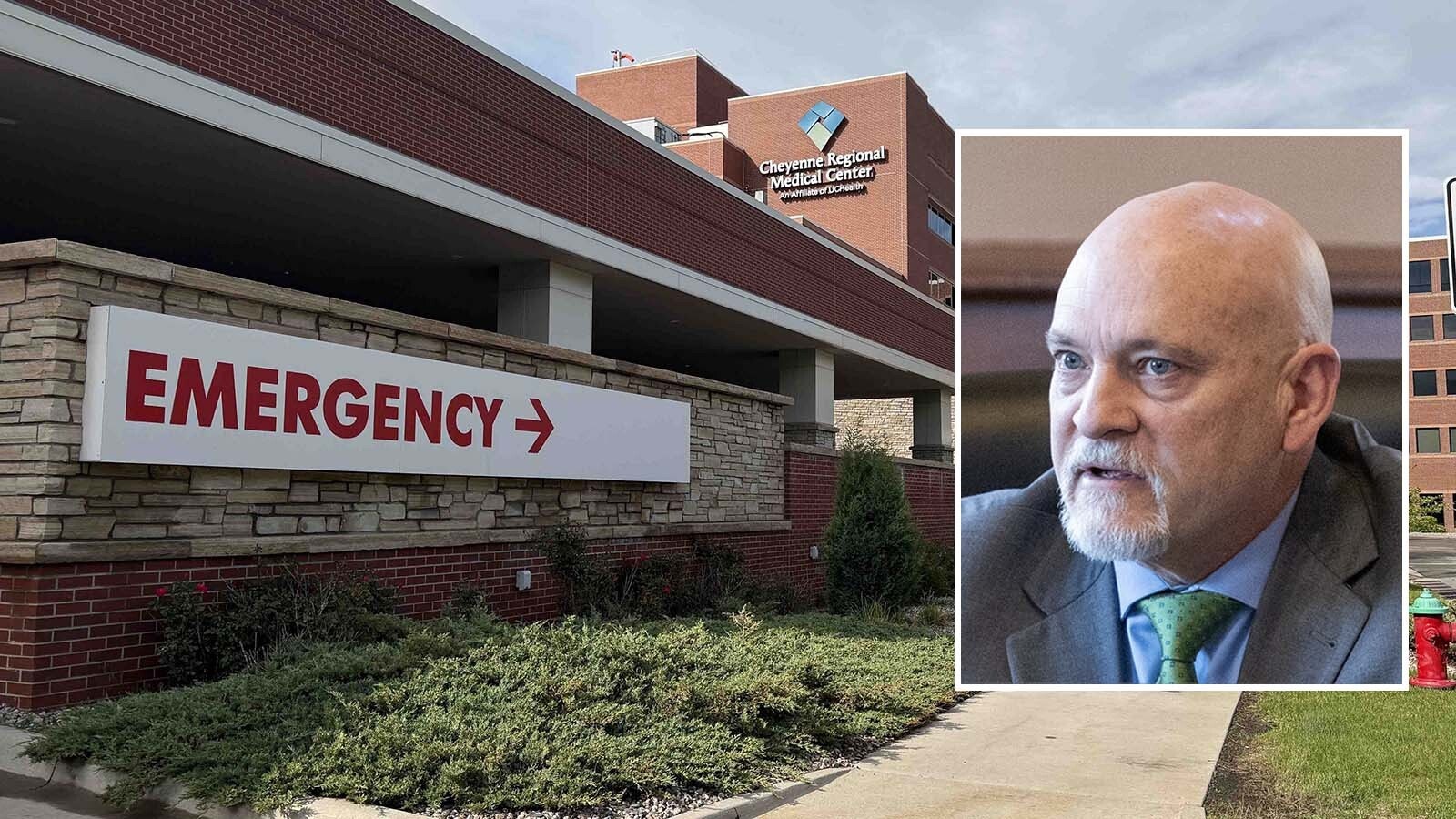
The federal government announced Monday it’s approving $205 million in public money for the first year of a five-year awards cycle for Wyoming’s Rural Health Transformation Program.
Congress ushered that program into law in July via the One Big Beautiful Bill Act, which President Donald Trump backed.
At this point, it appears the hotly-contested “Bear Care” — a proposed state government-run catastrophic insurance program — is within the scope of the Centers for Medicare and Medicaid Services (CMS) award, the Wyoming Department of Health confirmed Monday to Cowboy State Daily.
House Appropriations Chair John Bear, R-Gillette, told Cowboy State Daily that he plans to vote against state authorization for the program.
Bear said he still isn’t sure whether the program name is a subtle jab at his own surname or is, as Wyoming Department of Health (WDH) officials attested earlier this month, a quaint nod to Wyoming’s heavily forested bear territory areas.
Either way, he said, “it’s not off to a great start.”
Seed Money
Bear opposed the program Dec. 8, when WDH presented it as part of the Rural Health Care Transformation Program and a way to alleviate mounting pressures on the insurance marketplace.
Bear cast the insurance program as government competing against private insurance companies, heaping more hardships upon them.
Wyoming Department of Health Director Stefan Johansson cast it instead as an alternative to compete with Affordable Care Act-backed programs, or “Obamacare.”
He said it would be designed to extend “catastrophic” incident or emergency medical event coverage to people and small business groups so that they wouldn’t have to buy a “Cadillac” program from the marketplace to extend those offerings.
WDH Deputy Director Franz Fuchs in a Monday email confirmed the program appears viable at this point, at least on the federal end.
“At this point, our understanding is that our application has been approved in its entirety; we were never asked to amend or remove any components before the award was made,” wrote Fuchs.
“Important to note, however, (is) that BearCare is not directly paid for or subsidized by government funds, either state or federal,” wrote Fuchs. “Rather, a small amount of one-time federal dollars will help build the infrastructure to set up a self-insured risk pool, and then BearCare fees paid by members would pay for all health care and associated administrative costs.”
In other words, the federal government would give the seed money under the One Big Beautiful Bill, and the program is slated to become self-sustaining after that, Fuchs indicated.
The entire federal award — outside of Bear Care — would need to be appropriated, and the Legislature will need to set up the framework for the Rural Health Transformation Perpetuity, as well as any specific legislation that would authorize the WDH to operate BearCare, said Fuchs.
“As noted, any funds to be spent on BearCare are small, one-time investments to set up the capability, not ongoing claims or operating expenses,” he added.
Fuchs said the plan may improve small-hospital sustainability and help staffers focus on necessities, may scale up workforce recruitment in the health sector, expand behavioral health and primary care sites, and help providers acquire new technology.
Doubt
John Bear cast doubt on the concept of the program becoming self-sustaining.
“Have you ever seen the government run a business efficiently?” he asked Cowboy State Daily. “I have not. So I have a pretty low confidence they can create something that the private sector hasn’t already done — and done well enough we shouldn’t be competing with it.”
Bear said the answer to mounting insurance costs, rather, is to open up more competition in the sector nationwide.
As to the Rural Health Transformation Program, Bear said he’d rather support using that money to “shore up” hospitals.
It was a notion he also offered during the Dec. 8 meeting regarding paying unpaid bills to Wyoming hospitals.
“We’re getting into a business that, frankly, the government created the problem in the first place,” he said then. "I’m not inclined to want to compete in the private sector. I don’t think that’s the proper role of government to do so.”
Hey Just Happy About Rural Health Care Over Here
Speaking to the rural health initiative broadly, including its less-controversial programs, Gov. Mark Gordon celebrated the award in a Monday statement.
He congratulated Johansson and his team “for their work in creating a sustainable, innovative plan to meet Wyoming’s future health care needs,” says his statement.
“I am excited for what this award means for health care in Wyoming, particularly for our rural communities across the state,” Gordon said. “Thanks to President Trump, Wyoming now has a unique opportunity to help address some of our state’s most challenging rural health care issues like hospital viability, EMS sustainability, OB care, and bolstering workforce.”
He thanked Wyoming residents who contributed to the plan.
“I would like to thank all of the Wyomingites who participated in town halls, online meetings, and the survey across the state,” Johansson said. “While there are a lot of details inside this award that we are still reviewing, I am confident we will be able to move forward with implementation in the coming months.”
Gordon’s statement notes the program’s money is meant to support goals such as:
• Chronic disease prevention and behavioral health.
• Sustaining Critical Care Access hospitals across rural Wyoming.
• Sustaining access to labor and delivery services in rural communities.
• Innovative approaches to care delivery and payment models.
• Workforce development and training.
• Technological and consumer health solutions.
• IT advances and technical assistance.
Gordon had also backed Bear Care.
“And I hope you’ll call it ‘Gordon Care,’” parried Bear in his Monday interview.
Clair McFarland can be reached at clair@cowboystatedaily.com.