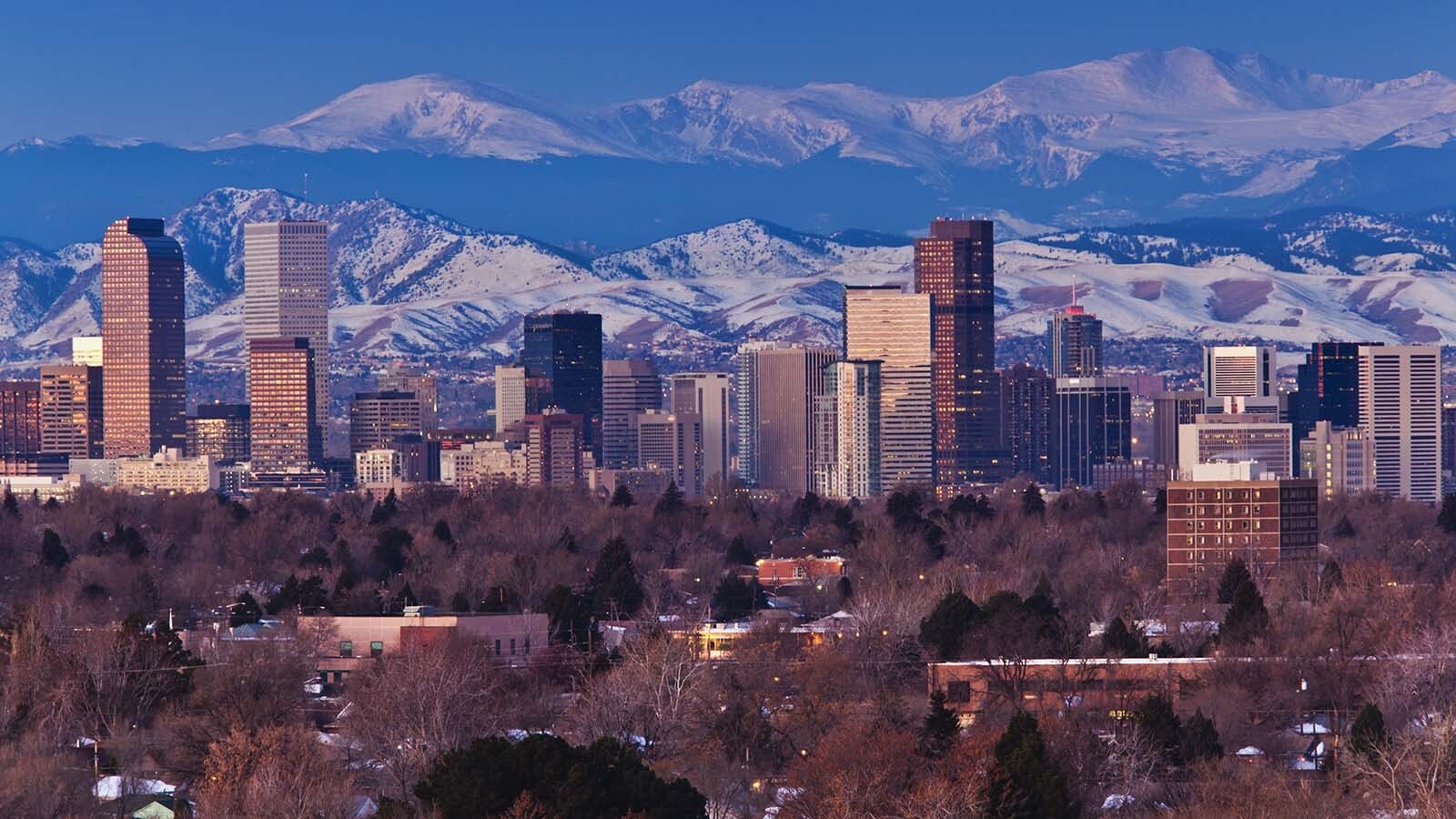
For years, Denver seemed to draw newcomers as steadily as the Rocky Mountains cast their evening shadow. Now that's dropping off dramatically, slowed by steep housing prices and shifting migration patterns.
Wyoming leaders see an opening in the slowdown just south of the border, yet the state remains caught in its own long-running struggle with too many residents leaving and too few young, well-paid workers choosing to put down roots.
Two recent studies paint a similar picture of the Denver metro area: People don’t want to move there.
According to numbers produced by MoveBuddha, a technology company that builds tools to help people relocate, people are about 48% less likely to move to Denver now than they were before 2019.
In another study, released by the right-leaning Common Sense Institute of Colorado and spanning from 2015 to the present, the Denver Metro area has seen a 69.6% decline in net migration since 2015.
Net migration is the number of people moving into the state minus the people moving out of state.
Those statistics are not necessarily exciting for Colorado’s northern neighbor, whose outmigration rate is statistically the worst in the country.
“While that may be true about Denver and parts of Colorado, Wyoming’s workforce-age outmigration rate is double the national average — worst in the country,” said Ron Guilberg, Strategic Partnerships Director for the Wyoming Business Council, in an email.
“Denver, and other metro markets such as Salt Lake City and Houston, are big draws for our higher-education and skilled workers. So, the only way Wyoming can benefit from what’s in this report is to create good jobs, address infrastructure needs, attract businesses and curtail regulatory barriers such as housing development."
Dale Steenbergen, President and CEO of the Greater Cheyenne Chamber of Commerce, agrees that Denver’s current net migration statistic is not necessarily good for Wyoming.
“A lot of Wyomingites will say, ‘I told you so,’” Steenbergen said. After all, it’s no secret that Denver’s population exploded over the past few decades and its politics grew more progressive.
While the numbers from the two reports basically agree with the numbers the Cheyenne Chamber is seeing, Wyoming is the No. 1 state for young people to leave, Steenbergen said. He told Cowboy State Daily that attracting and retaining young professionals is one of the biggest challenges the state faces.
“We need businesses and people to be interested in the Front Range,” he said. “We’re not growing. We’re getting older and it’s a big problem for us that we have to work on.”
Wyoming Strengths
On the bright side, Wyoming is attractive to small business owners for its zero-income tax, reasonable regulations and friendly small business environment, Steenbergen said.
Wenlin Liu, chief economist at the Wyoming Economic Analysis Division, agreed. New businesses are fast increasing across the state, he said, as evidenced by an increase in the state’s general fund due in part to new business registration fees.
“Wyoming’s migration has always been driven by employment,” Liu said. “For Wyoming’s migration, I always feel like we can attract people who love open spaces – fishing, hunting, hiking.”
John Baggett grew up in Wyoming and moved to Denver in 1988. Back then, Denver was a “great big cow town,” he told Cowboy State Daily.
He and his wife, Deb, lived in Denver for 32 years, working solid careers and raising kids there. They lived in the same house for 30 years.
“Our boys didn’t know any other place,” he said.
But increasing traffic coupled with Baggett’s dream lifestyle (“I’m 64 and still want to grow up to be a cowboy,” he said) made him “desperate to move out” six years ago. He and his wife returned to his hometown of Sheridan in 2019.
“That lifestyle I’ve always been fond of — Denver went the other way from that,” Baggett said.
Liu told Cowboy State Daily he believes that Denver’s biggest growth-related challenge is housing prices. According to one realtor.com study, 90% more homes are on the market in Denver than before the COVID-19 pandemic.
Traffic Vs. Amenities
For John Baggett, the Denver of the 1980s is long gone. As traffic increased there over the years, he would tell his friends visiting from Wyoming to park in Broomfield, a suburb about 18 miles north of the city. He would pick them up so they wouldn’t have to drive in traffic.
“Watching that growth and that change and some of the things that came with it … clashed with who I am,” he said.
The Baggetts sold their house in Denver at the peak of property values there. Baggett’s wife, Deb, who grew up in Cincinnati, wasn’t entirely eager to move to Sheridan at first. But now she has a few horses and “loves the lifestyle,” he said.
Still, there is a lot about Denver that Baggett says he misses — like being so close to the Broncos, the lively music scene at Red Rocks, the charm of the cowboy boots and cowboy hits among the skyscrapers back in the ‘80s.
Across state lines, “We know the thing that’s driving people right now is economy,” said Steenbergen.
Added Guilberg, “It's a chicken-and-egg problem.
“You'll notice that the survey cites the hot markets for in-migration right now are college towns not too far from metropolitan areas. These are our competitors," he said.
Are people moving to Wyoming from Denver? Yes. Colorado is second only to California in highest net migration to Wyoming, according to Liu.
“It could be opportunity,” Steenbergen said.
Wyoming needs help, he said, especially in the tech sector.
But offering a paycheck worth the move is key.
“I think the big challenge right now is, if you poll folks coming out of college, their No. 1 interest is how big their paycheck is,” he said. “Ten years ago, if you asked the same question, the No. 1 answer would be quality of life. When the paycheck is the No. 1 interest, Wyoming has a hard time competing.
“The question is, what are we going to do with payroll and quality of life to entice them to come here?”
Kate Meadows can be reached at kate@cowboystatedaily.com.