Recent national lists are singling out every state’s “richest” small town, but the one for Wyoming is particularly eye-catching. That’s because it’s not a town at all, nor is it even close to being the wealthiest.
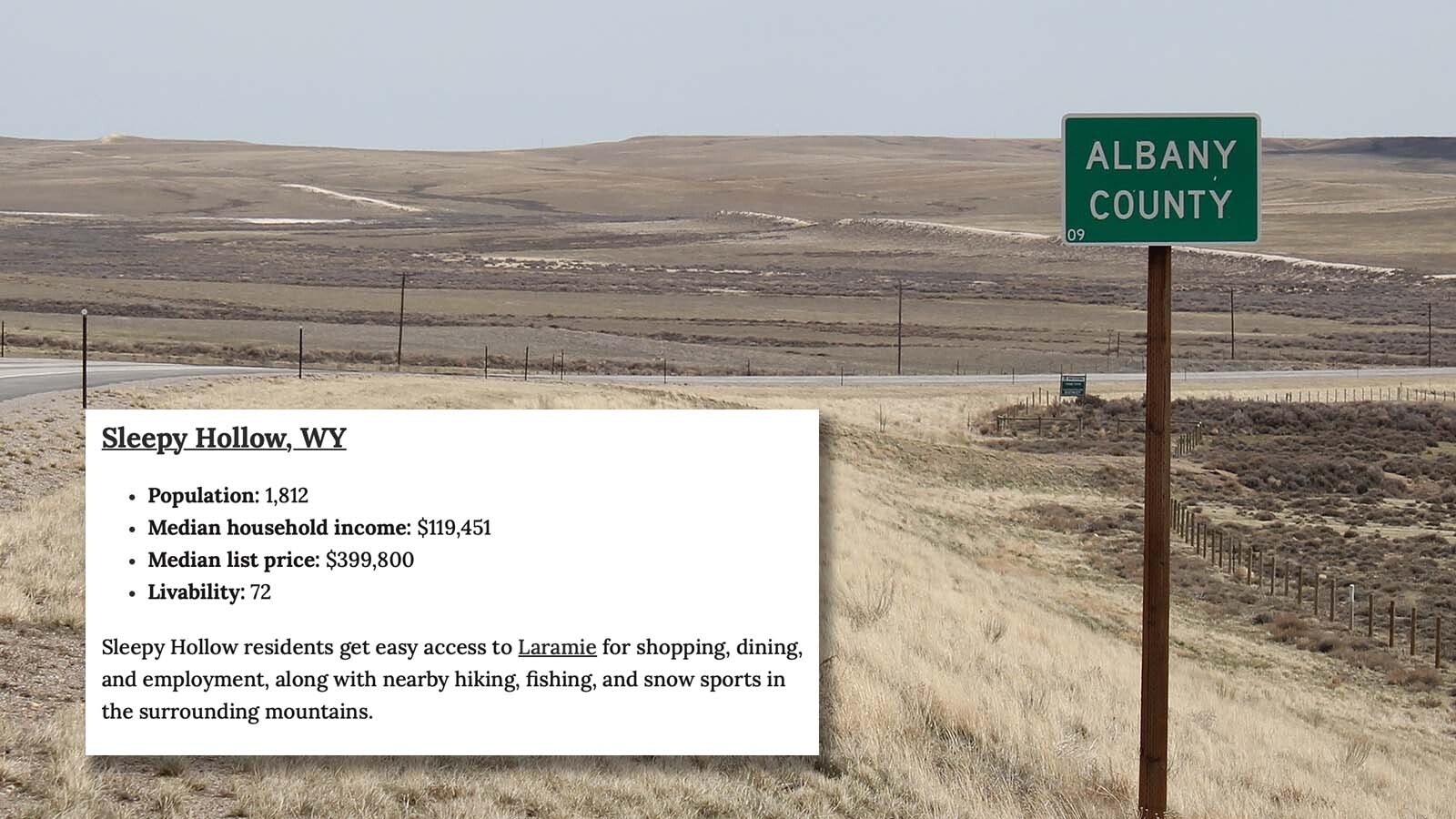
Sleepy Hollow, Wyoming, according to Realtor.com, is Wyoming’s wealthiest small town. It has a population of 1,812 people with what Realtor.com says is a median household income of $119,451 and a median home price of $399,800.
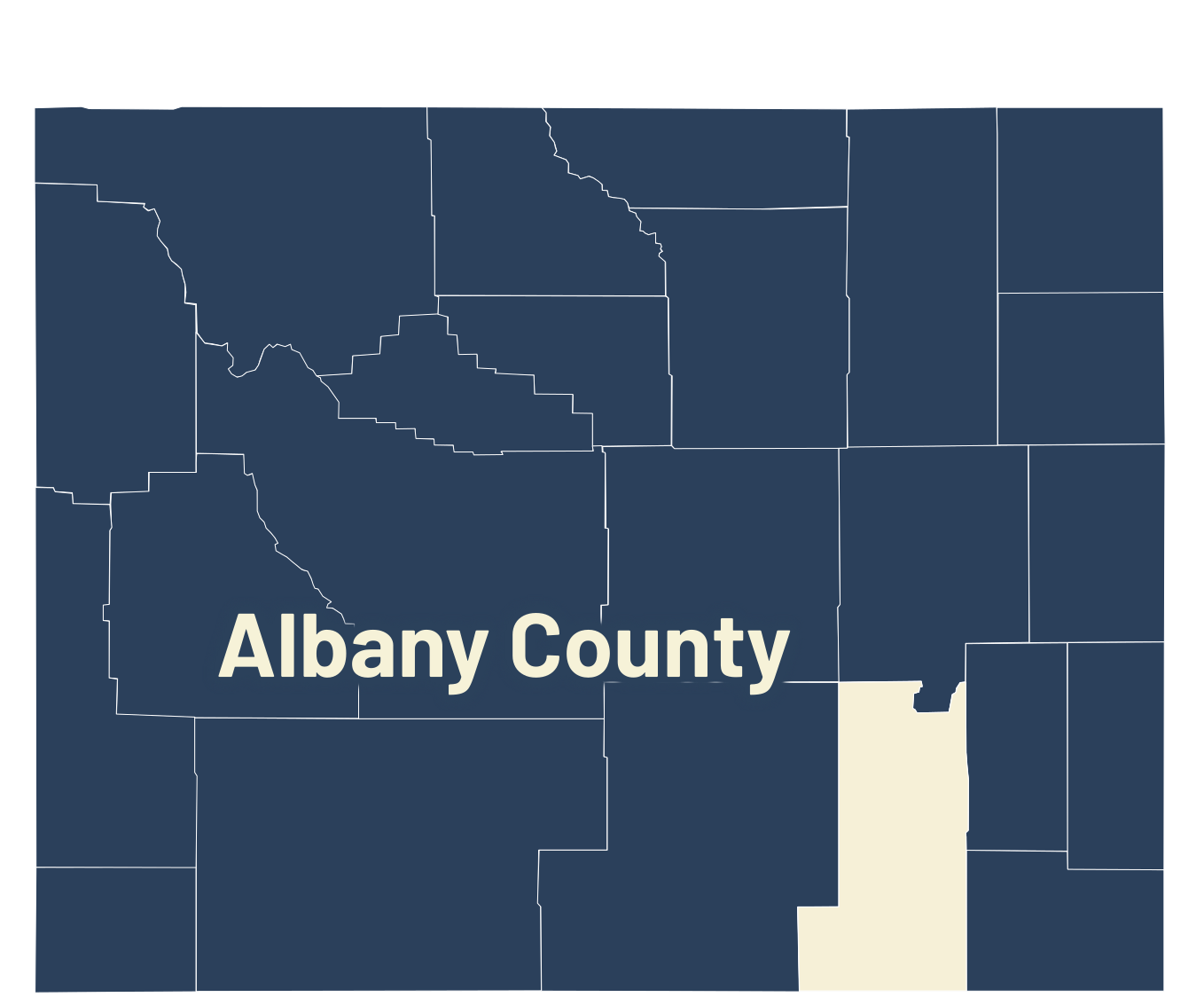
“Sleepy Hollow residents get easy access to Laramie for shopping, dining, and employment,” Realtor.com goes on to say in its article. “Along with nearby hiking, fishing and snow sports in the surrounding mountains.”
However, Realtor.com's link to Sleepy Hollow takes readers to a listing of homes with Gillette, Wyoming as their address — nowhere near Laramie or the Snowy Range.
Realtor.com did not respond to inquiries about the mistake by the time this story was posted. But it credits GoBanking.com for the analysis, which says it used census data to pick out the “richest” small towns in America.

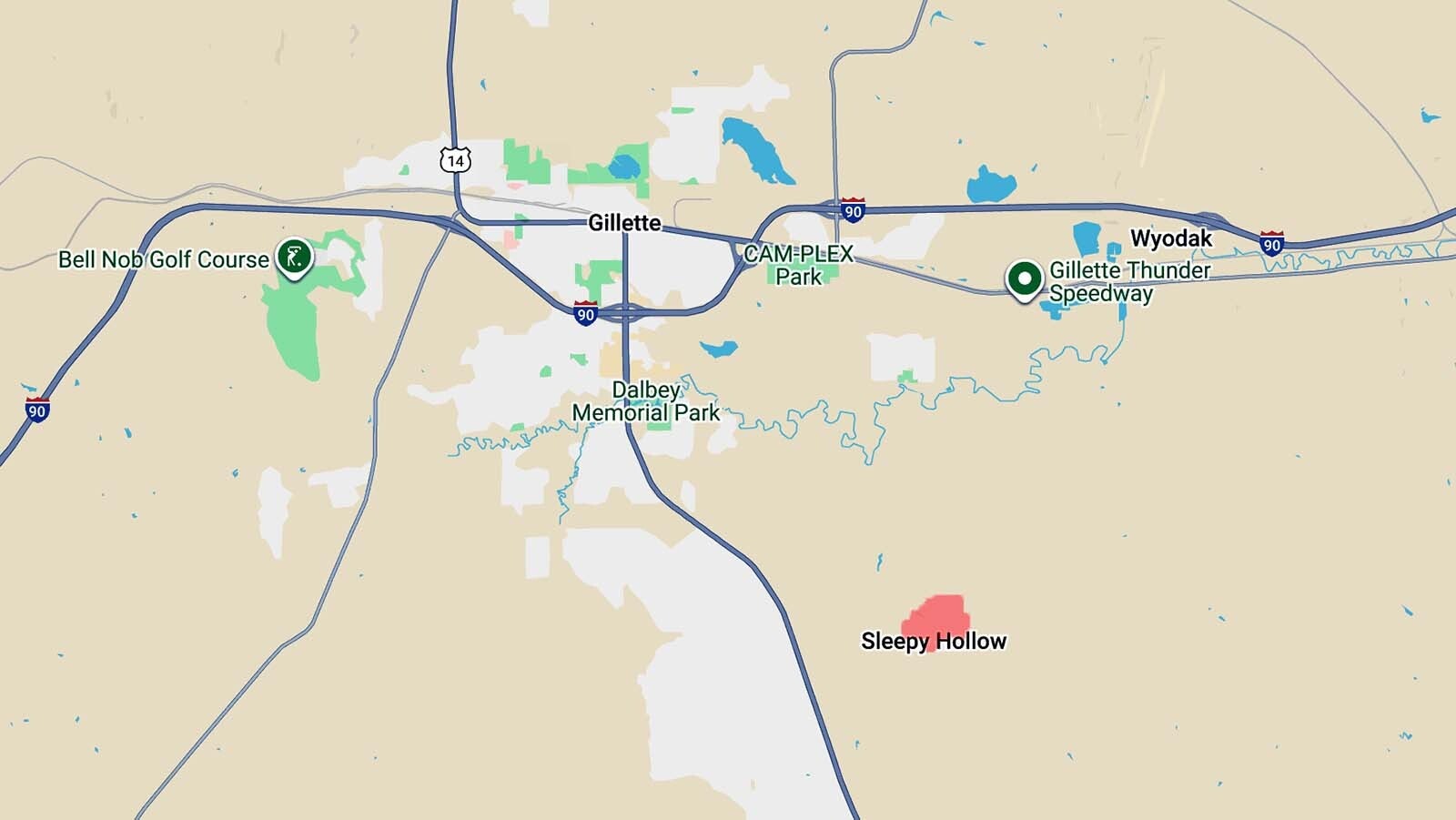
GoBanking's listing more correctly puts Sleepy Hollow in northeast Wyoming as a rural neighborhood southeast of Gillette, rather than near Laramie.
Even so, Sleepy Hollow is still not a town, nor is it clear how the census-designated area could possibly be beating similar census-designated areas in Teton County.
It’s nice, but anybody who’s been there wouldn’t call it Wyoming’s wealthiest small town, wealthiest neighborhood or wealthiest anything in the Cowboy State.
A GoBanking representative told Cowboy State Daily that its analysis wasn’t generated by artificial intelligence (AI) and that Sleepy Hollow qualified for its listing as a census-designated location.
The representative did not respond to further inquiries.
We Don’t Even Have A Mayor
Sleepy Hollow is an unincorporated area just outside the southeastern border of Gillette. Google Maps shows a small cluster of streets centered around Conestoga Elementary School, which is in the Campbell County School District.
According to the school’s website, Conestoga Elementary opened in 1982 in what was then a new subdivision built in response to a coal and oil boom.
Wendy Branscom, a secretary who works for the elementary school, was surprised to learn that she’s been working in Wyoming’s wealthiest small town.
“We’re just a subdivision,” she said. “There’s no post office, there’s no gas station, there’s nothing here.”
The only thing of note in the “town” itself is a school, Branscom said.
“We don’t have a mayor or anything like that,” she said. “I think there’s an HOA out here. That’s about it.”
About 330 children attend the school, coming in from various subdivisions around Gillette. Places like Antelope Valley and Rodeo Flats, as well as Sleepy Hollow.
Branscom’s guess for the wealthiest small town in Wyoming would be Big Horn, or one of the smaller communities in Teton County, like Moose or Wilson. The latter aren't really towns, they are census-designated places.
So What About Teton County?
Sleepy Hollow as Wyoming’s wealthiest community was a bit of a head-scratcher to real estate agents as well.
Dominic Valdez with #1 Properties in Cheyenne and Latham Jenkins with Live Water Properties in Jackson Hole both feel the wealthiest small towns in Wyoming are undoubtedly in Teton County.
“My guess is this was AI-generated content,” Valdez said. “And maybe it was a hallucination. It’s just one of those weird things. I don’t know where that would come from.”
Jenkins said it’s not the first time he’s seen online articles highlighting places in Wyoming that aren’t really towns at all with eye-catching headlines.
“Like Wilson is an unincorporated area of Teton County,” he said. “And you see it in various articles, even in the New York Times, as like the most expensive ski town in America. But it’s technically an unincorporated area.”
Hoback, meanwhile, often pops up in his feeds as the wealthiest in Wyoming, but that, too, is not an actual town, Jenkins said. Nor does he believe it’s necessarily wealthier than Jackson.
“Just from my gut, not a data-backed-up statement, I would argue within incorporated areas, Jackson has to be the wealthiest in the state,” Jenkins said. “The problem with Jackson is I feel like so much more wealth is on the outside of the town. It’s in Teton County. But the town itself should rank very high.”
Jonathan Schechter, asked to weigh in on which small town or census-designated area in Teton County might be the wealthiest, told Cowboy State Daily that he felt the articles in question were just “a silly click-bait exercise."
Forbes Puts Hoback First
Forbes, too, has analyzed wealthy small towns in Wyoming using census data, most recently in 2023, using the 2022 American Community Survey that is put together annually by the Census Bureau.
Forbes puts Hoback as the most expensive small town in Wyoming. That’s a census-designated place with 830 households. The median value of homes is $930,700, while the median income is $130,236.
That’s nearly triple the median value of homes in Sleepy Hollow, which Forbes put at No. 18 on its list.
The next wealthiest “town” listed by Forbes is South Park, also in Teton County, with a median household income of $163,152 and a median home value of $1.33 million. The third wealthiest is Moose Wilson Road with a median income of $96,056 — not the highest, seemingly. But the mean is more like $162,057, and home values are well over $1.22 million, which contributed to Forbes' decision to place it at No. 3.
All three of these areas are in Teton County, though none are actually towns.
The rest of the Top 10 on Forbes' list is rounded out by Rafter J Ranch, Wilson, Arrowhead Springs, Alta, Casper Mountain, Albin, and Ranchettes.
Interestingly, Jackson didn’t make the top 10 in Forbe’s list, which was another head scratcher for realtors everywhere.
It came in at No. 12 with a median household income listed as $83,289 and a mean of $115,634. The median home value was listed as $836,300, based on data that Forbes said was taken from the Census Bureau’s 2022 American Community Survey.
AI Slop Is Coming
Whether it’s AI causing all these discrepancies in data used by some media outlets for what amounts to clickbait-style headlines is hard to tell.
Go Banking denied it had used AI to parse Census Bureau data and generate its article, while Realtor.com didn’t respond to inquiries about why it had paired Sleepy Hollow with Laramie in its regurgitation of Go Banking’s article.
One thing is sure, AI is contributing to more and more online content, and some of that content is less and less accurate.
“The slop is coming,” Rep. Daniel Singh told Cowboy State Daily. “It’s definitely coming.”
Singh, like Jenkins and Valdez, had never heard of Sleepy Hollow and didn’t recognize it as a town either. He, too, said he wouldn’t be at all surprised if the whole thing was the result of some sort of AI hallucination.
Right now, most people don’t really understand what AI really is, or how to use it to get the most accurate answers, Singh said.
“Because these large language models are running off the entire internet, they’re going to find all sorts of information and try to piece it all together in a way that’s statistically most likely to be the result,” he said. “So, it’s not really founded on what is true and what isn’t true. It’s just what exists on the internet.”
With both true and untrue things co-existing online, that’s going to contribute to the kind of answers that show up in AI-generated overviews.
That means users have to handle the AI answers to their queries with caution. They can’t trust the information is sound.
Singh Married With Two Kids?
Singh, for his part, has googled himself just to see what AI would have to say about him. From that he discovered a few things about himself that he hadn’t known.
Like having a wife and two kids and loving to fly fish in Central Wyoming.
“I haven’t actually gone fly fishing in Central Wyoming,” he said. “And I haven’t met my wife yet. So, like AI has a bright future charted out for me.”
Singh, as a member of the Select Committee on Blockchain, said one of the things Wyoming is looking at is to require open-source models for AI, so that there’s transparency in how data is being formulated. That way people can see what kind of information is going in and can understand what some of the biases might be.
One of the other things he’s advocating for is states retaining their rights to decide what guard rails are right for their communities.
“On the issue of guardrails, I think we do need to have that conversation,” he said. “But we cannot have that conversation at all if the federal government pre-empts AI policy from the states. And I admire President Trump. He’s pushing forward to make sure we’re not losing this technology race with our adversaries. But I would also caution that we need to make sure that we’re upholding our original values as written in the Constitution.”
Anything not explicitly mentioned in the Constitution belongs to states, Singh said.
“So, I would hate to see, and maybe it doesn’t happen in this administration and maybe it doesn’t happen for a decade, but I’d hate to see the people in Wyoming stripped of the ability to even determine what is appropriate for an AI to have that responsibility given to Congress. I just don’t trust Congress to think about what my constituents have to say.”
Red Flag On The Play
Singh’s not the only legislator to notice AI making up stuff about them.
Sen. Cale Case, R-Lander, learned from AI that he lost his election and isn’t a Senator after all, while former state legislator Tyler Lindholm learned that he somehow failed to run for office in 2020 at all.
Neither of which are actually true.
It’s not a problem Case sees getting fixed at state levels.
“It’s not like a Wikipedia page,” he said. “You can get that fixed. You can get that straight. AI is kind of ephemeral. It only really exists in that moment. You can go back and check it again, and the answers will be different.”
More recently, using Google navigation, Case found himself miles away from the Civil War site he’d wanted to visit while at a conference in Mississippi. He ended up instead at some kind of muddy road and a locked gate.
“It gave me very precise directions,” he said. “Turn at the next deal, blah blah blah. Except it was very precisely wrong. It just drove me crazy. Is Google liable for that? What if my car would have gotten stuck?”
That scenario is also happening in Wyoming on a regular basis, Case added.
“There’s a place where the county commissioners have put up a sign and said, don’t follow Google in here,” Case said. “It’s a technology-driven issue … but how do states fix that?”
People just have to “wise up” Case suggested.
“We have to be skeptical of this. We have to have a guard up,” he said.
'User Beware'
It is user beware, Lindholm acknowledged, but he doesn’t believe that necessarily means new guardrails are needed at this point. Existing guardrails already in place should be enough.
“We do have the right to hold people and corporations accountable,” he said. “If there’s libelous things out there, people can hold those companies liable for them.”
Getting the government involved at this stage is premature, he believes.
“I’m a big fan of permissionless innovation,” he said. “Eventually things will square out as far as the use of AI for research or these types of articles.”
AI is so new, people and companies are still figuring out how it will be used, Lindholm added. Guardrails at this point would likely focus on all the wrong things.
“Go back and look at when vehicles were first becoming a thing,” he said. “There’s a little-known fact about where the terminology ‘red flag’ comes from.”
The history of the phrase goes back to the beginnings of automobiles in England.
“People were really worried there were going to be runaway automobiles all over the place that were going to kill everyone,” Lindholm said. “And they passed this law that if you were going to drive an automobile instead of a horse and buggy or mule down the streets of London, you had to have someone walking in front of the automobile, waving a red flag.”
That might sound silly today, Lindholm added. But it was a real law on the books when automobiles first began in London.
“So, when it comes to any type of AI regulation or any type of regulation that is not permissionless innovation, I always throw up a red flag in this regard,” Lindholm said. “We should be very careful. We could absolutely get this wrong because we don’t know what this is going to look like in a year, let alone five or 10 years.”
Renée Jean can be reached at renee@cowboystatedaily.com.