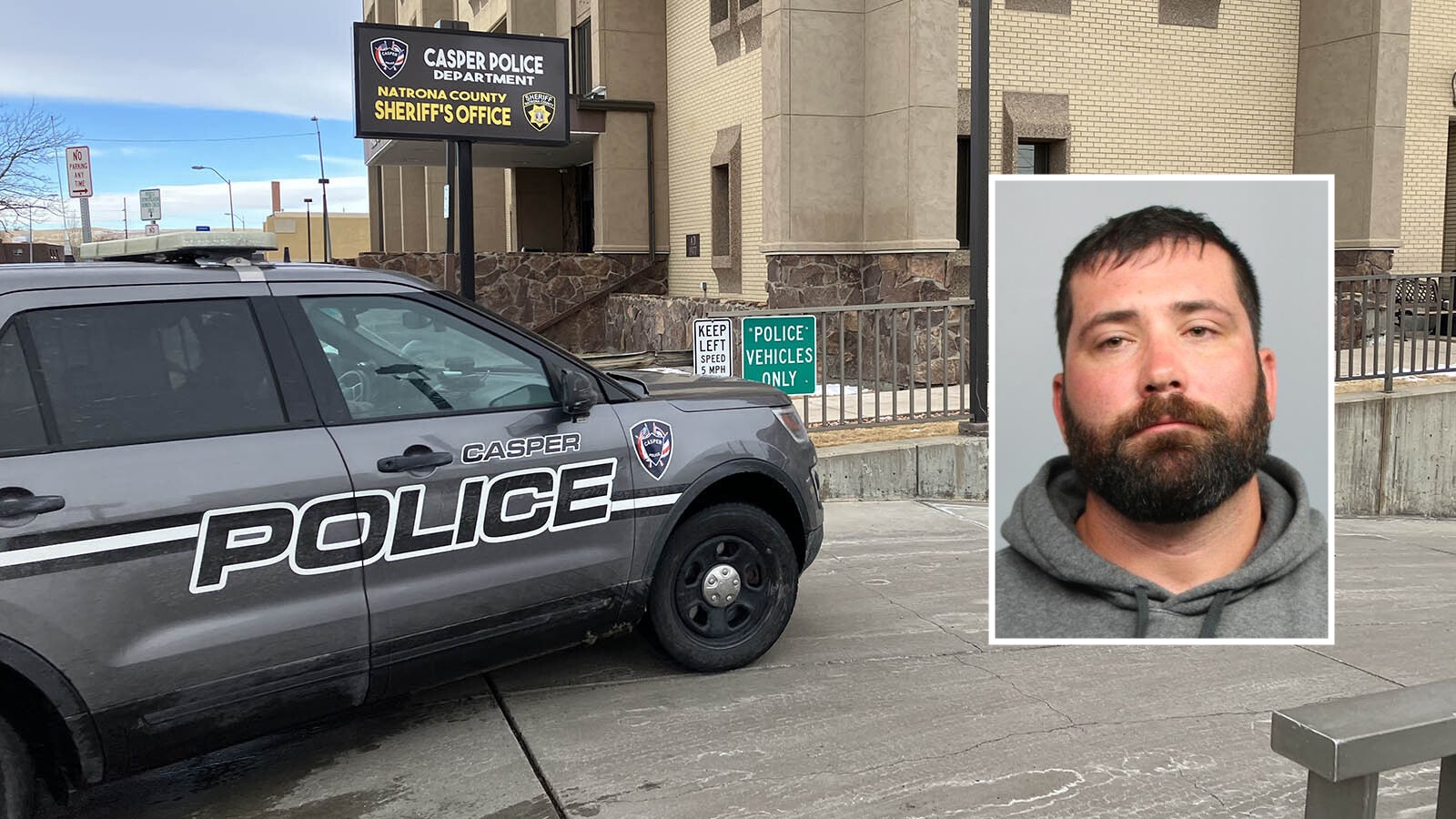
CASPER — A former Casper police officer who was involved in an armed standoff last year has appealed to the Wyoming Supreme Court to throw out a Natrona County District Court judge’s decision to ignore a plea deal and sentence him to five times the maximum sentence he expected to receive.
Michael Scott Hughes shot through his apartment window at Natrona County Sheriff’s deputies and into an apartment ceiling during a 17-hour standoff on Aug. 22-23, 2024, at Quail Run Apartments in Casper.
He is asking the high court to reverse actions by District Court Judge Catherine Wilking in her sentencing on Aug. 20, 2025.
Wilking sentenced him to 21 to 26 years in prison, adhering to a five-year cap for each of the five aggravated assault and battery charges he faced. But the judge made them consecutive, instead of concurrent as was stated in the plea deal with Natrona County District Attorney Dan Itzen.
Itzen had asked for three-to five-year sentences on each aggravated assault and battery count.
The judge also made Hughes’ one-year sentence on a reckless endangering charge consecutive to the other charges. Itzen asked for a concurrent sentence.
The plea deal also involved Itzen dropping a felony property destruction charge in return for Hughes’ guilty pleas.
Appeal attorney Ryan Semerad’s 52-page brief argues that the court “misclassified” the plea deal under Wyoming Criminal Procedure Rules as one that could be overruled by the court while at the same time giving the defendant no recourse to withdraw his guilty pleas.
He argued that when the plea deal was made, the prosecution determines which kind of deal is in place, one that allows the defendant to back out if the court rejects the plea, or one that allows no withdrawal of guilty pleas should the judge the reject the deal.
The prosecution never made clear the type of agreement made with Hughes but did agree to drop the felony property destruction charge, which falls under the Wyoming Criminal Procedure rule allowing Hughes to withdraw his plea should the judge reject the agreement, Semerad wrote.
“To correct the District Court’s legal errors, this Court should reverse and remand with instructions to allow Mr. Hughes to withdraw his pleas so he can renegotiate a plea agreement with the State or take this case to trial,” Semerad wrote.
‘Ambiguous Suggestions’
Semerad also argued that the judge “failed” in creating a court record to reject the plea agreement.
The judge “comprehensively discussed the seriousness and severity” of Hughes’ crimes but only made “two ambiguous suggestions to justify” her rejection of the plea deal, he wrote.
Semerad said the law makes it clear that the court has discretion to accept or reject a plea agreement and that some plea bargains give the judge more discretion than others.
Because Hughes’ plea deal, done with advice of his defense attorney Trevor Schenk, involved dropping the property destruction charge and a cap on sentencing it became a “hybrid bargain” rather than a “charge bargain” or “sentence bargain, ”Semerad wrote.
In cases cited by Semerad, he argued that the law makes it clear that in rejecting a plea deal, the judge has to put on the record the prosecution’s reasons for making the agreement and the “court’s justification for rejecting it.”
Contrary to the rules of criminal procedure, the court added the “plea lock-in” arrangement in Hughes’ deal, preventing his ability to withdraw from the agreement, Semerad wrote.
The court never asked the defense or prosecution if the agreement was made under the rule that would prevent withdrawal of his plea.
The court “misconstrued” the parties’ plea deal in its actions, Semerad wrote.
“This appeal turns on whether plea agreements are predictable contracts or lottery tickets,” Semerad wrote. “To preserve the integrity and fairness of Wyoming’s criminal justice system, this Court (Wyoming Supreme Court) should hold that trial courts must not add to plea agreements under the guise of ‘interpretation.’”
‘No Ability To Challenge’
Semerad also argued on behalf of his client that trial courts “must set forth clear reasons for rejecting a plea.” He argued that would allow defendants to seek a meaningful appellate review of their case and the rejected plea deal.
“Because the District Court gave no meaningful explanation for rejecting the plea agreement, Mr. Hughes lost the benefit of his bargain and the ability to regain those benefits through appellate review,” Semerad wrote. “In real terms, Mr. Hughes received a prison term five times as long as he bargained for with no real ability to challenge the District Court’s justification for rejecting the plea agreement on appeal.”
A copy of Hughes’ sentence appeal was sent to the Wyoming Attorney General’s office which represents state courts and judges on appeal matters. The office did not return a request for comment by deadline.
Case Background
The case against Hughes began with a 911 call from his estranged wife that informed authorities that on a FaceTime call with him he appeared to be drunk and possibly abusing ketamine. He had threatened to shoot any “(expletive) through the door” if anyone responded and that he had “numerous firearms.”
Because he was a Casper Police officer, Natrona County Sheriff’s deputies responded and were met by his current girlfriend outside who told them he was drunk and threatening to take his own life. She told officers he had fired a round from a handgun into the ceiling.
The 17-hour standoff ensued with Hughes at various stages threatening to shoot officers, cursing, crying, and apologetic.
An affidavit in the case stated that he snatched a drone sent through a window into his apartment out of the air, bent its propellers and threw it out the window. As officers from a tactical team tried to remove curtains from his front window and a deputy broke a windowpane, Hughes fired a shot through the window at the officers.
In the end at 4:15 p.m. on Aug. 23, he surrendered by handcuffing himself and then laid down on the floor. He threatened officers as he was arrested according to the affidavit.
Court records show that following his arrest, Hughes’ initial $500,000 bond was reduced to $20,000 cash so he could attend a mental health treatment program in Utah for police and first responders that specializes in helping those dealing with mental health issues, addiction, and the impact of trauma. He completed the treatment.
The arrest affidavit showed that the August standoff followed Hughes drinking whiskey and beer the evening of Aug. 22 after the phone conversation with his estranged wife during which he made threats to kill himself.
Court documents show that Hughes’ wife had filed for divorce and his attorney was served with papers six days earlier on Aug. 16.
Dale Killingbeck can be reached at dale@cowboystatedaily.com.