Wolves have been stealing bait from underwater crab traps in British Columbia, Canada, which some researchers claim amounts to the predators' “tool use."
Some Rocky Mountain wolf experts say it’s notable behavior, but a stretch to call it that.
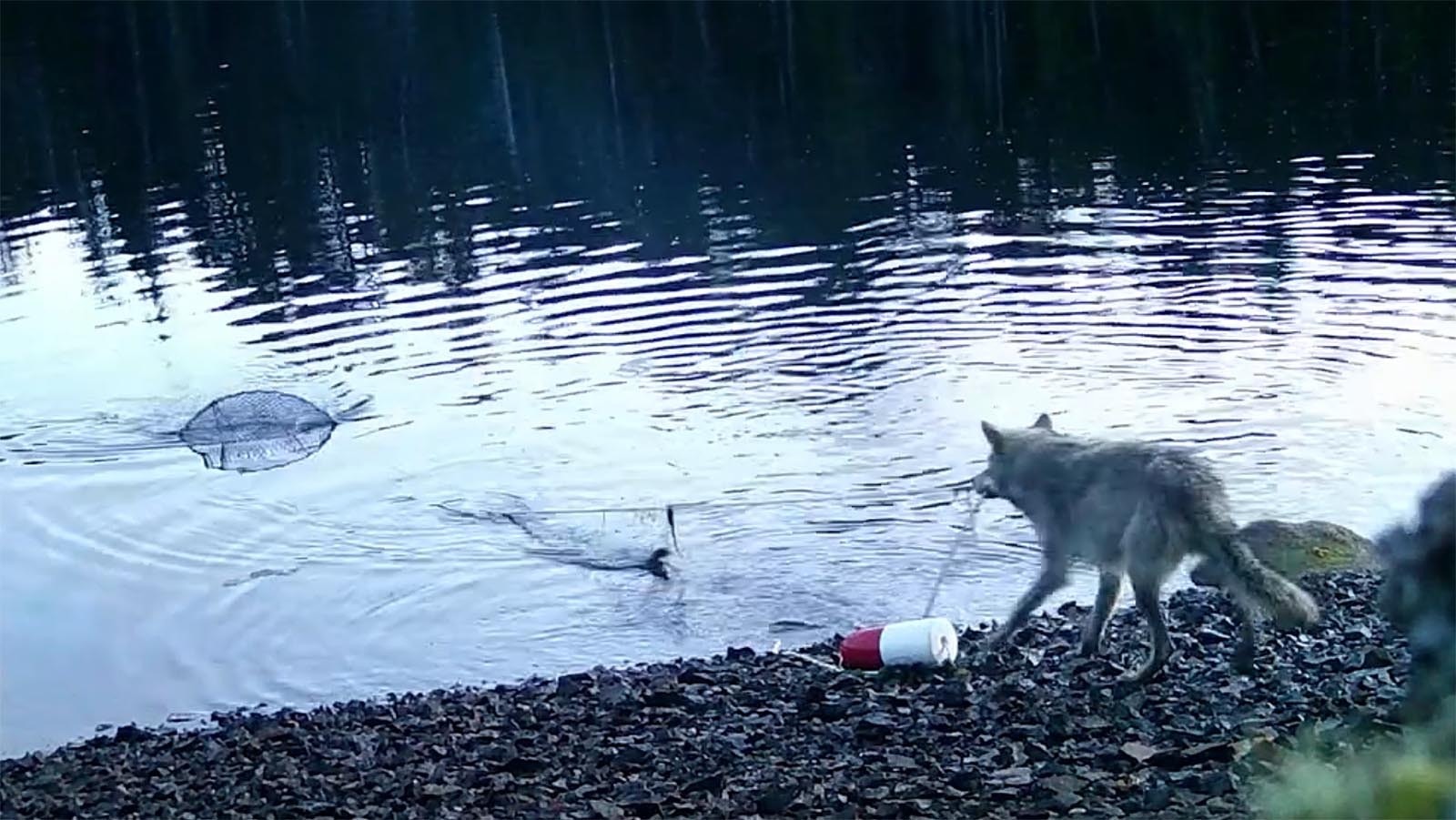
Bait started to go missing from crab traps along the central coast of British Columbia in 2023. So remote cameras were set up.
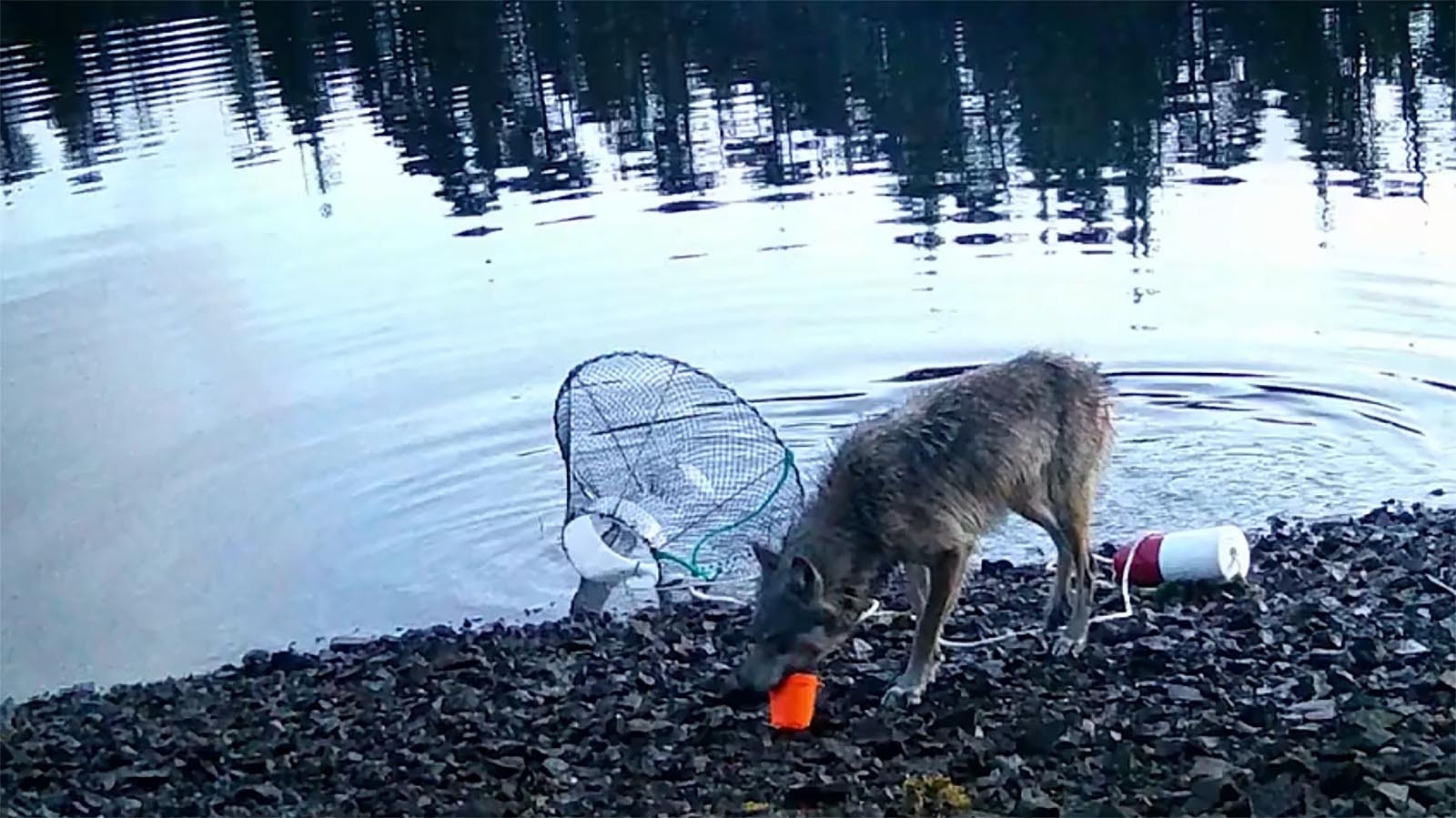
One camera captured video of a female wolf swimming into the water to retrieve a crab trap line buoy. Once back on shore, she pulled the line to retrieve the trap, then gobbled up the bait that was in the trap.
In an article recently published in Science, some researchers touted that as proof that wolves’ intelligence is rising to the level of “tool use.”
Wolf expert Rick McIntyre told Cowboy State Daily that’s not quite what he saw in the video.
“I don’t quite get why they’re calling it tool use,” he said. “The only thing the wolf did was pull on the rope to drag in the bait."
McIntyre was a naturalist ranger and wolf behavior interpreter in Yellowstone National Park, and worked with the Yellowstone Wolf project from 1998 to 2018.
He also observed wolves in Glacier National Park in Montana and Denali National Park and Preserve in Alaska.
Still A Smart Move
While the wolf stealing crab bait might not qualify as tool use, it was a clever move and speaks to the intelligence of the species, McIntyre said.
The most compelling part is that the wolf knew there was a food reward there, even though it was underwater, so she couldn’t see it, he said.
“You have to wonder, what was the sequence of events that led to that, over time?” he said.
“You (the wolf) are smart enough to understand that even though you can’t see the reward, you’re going to get it if you pull on the rope,” McIntyre said.
Retired federal trapper Carter Niemeyer told Cowboy State Daily said he was impressed by the cleverness of the wolf in the video, but also wasn’t ready to label it as tool use.
“I have never thought of wolves as using tools,” he said.
And a “sample size of one (wolf)” from a video isn’t enough to establish a pattern of alleged tool use in the species, he added.
Wolves’ success in the wild often boils down to their natural gifts, said Niemeyer, who used to kill wolves as a wildlife agent, but has since become an advocate for them.
“I give them credit for having acute senses. They’ve got good eyesight, good noses,” he said.
A ‘Psychopath’ Wolf
McIntyre said there have been some legitimate examples of tool use among wild animals.
For example, legendary primatologist Jane Goodall documented chimpanzees using sticks to catch and eat insects, he said.
While the wolf retrieving crab bait probably doesn’t rise to that level, wolves are remarkably intelligent in the social sense, he said.
As an example, he recalled watching an interesting interaction between a male, Wolf 21, and his adopted father, Wolf 8, in Yellowstone years ago.
Wolf 8 helped raise Wolf 21, but when the latter wolf reached adulthood, they were the leaders of two separate, rival packs.
Wolf 21’s pack included an alpha female, Wolf 40.
“Wolf 40 was, in human terms, a psychopath. She was killing pups born into her own family, born to her sister, so that her pups could have more protection and more food,” McIntyre said.
One day, the two packs had squared off, and a fight seemed imminent, he said.
Wolf 21 probably didn’t want to seriously hurt or kill Wolf 8.
“But he knew if he took it easy on Wolf 8, maybe pinned him and nipped his ears, then Wolf 40 would come in behind him and kill Wolf 8,” he said.
“So, 21 was in an impossible social situation,” McIntyre said.
At the last second, Wolf 21 “acted like he was afraid to fight,” and started running around.
That resulted in a “melee of wolves running around” but none of them being seriously injured, he said.
Apparently, Wolf 21 had displayed enough intelligence to defuse a potentially explosive social situation, he said.
‘They Learn Quickly’
When wolves are being trapped, even live-trapped for research, they’re clever enough to figure out threats, Niemeyer said.
“They learn quickly. If you mess up, or they get a hint that you’re out to catch them, or hurt them, they quickly go into avoidance mode,” he said.
A trapper might have to change methods or just leave the wolves in that area alone for a while, Niemeyer said.
“Give it a rest, wait a few weeks or a month. And then when you come back, they’ve lowered their guard a little bit,” he said.
As for the wolf snatching underwater crab bait, Niemeyer said it’s evidence that wolves learn through persistence, particularly if there’s a payoff involved.
“Wolves pick up on life experiences. And this wolf found a method that worked for getting food,” he said.
Mark Heinz can be reached at mark@cowboystatedaily.com.