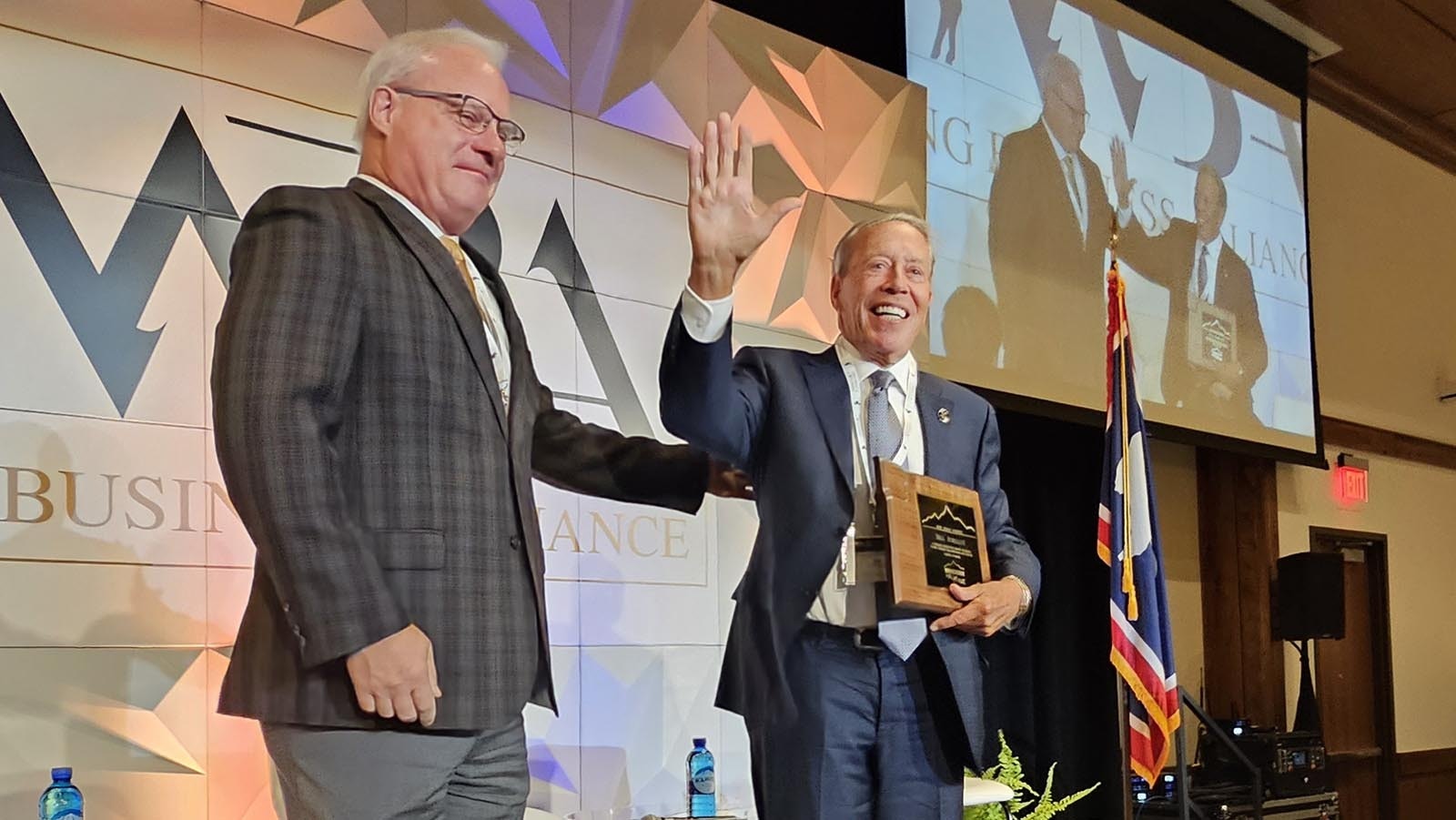
When Bill Schilling came back to Wyoming to accept his induction into the Wyoming Business Alliance Hall of Fame last week, there was one emotional moment that brought home the impact of his four decades of work in the Cowboy State.
That moment happened when Schilling asked people in the audience to raise a hand if they had either been the recipient of a Hathaway Scholarship or knew someone who had.
More than half of the room raised their hands.
Everyone looked around the room, including Schilling, taking it all in.
“Isn’t that amazing,” Schilling said quietly. “Twenty years ago, that wouldn’t have happened, would it?”
The visual was a testament to one of Schilling’s best-known achievements in Wyoming, a merit-based scholarship that ensures any student with C+ or better grades and good citizenship has a path to college.
Schilling often bumps into people who have been recipients of Hathaway Scholarships. He gets hugs from strangers when he tells them he had a hand in helping to create it.
He never gets tired of that, nor of seeing their eyes light up as they tell him what a difference it has made in their lives.
“I was checking into the Holiday Inn in Rawlins once, and the person managing the front desk, who was the manager of the hotel, was scurrying about because her daughter was graduating from high school,” Schilling said.
“We were chatting a bit, and we chatted a little bit and, ‘Oh she’s going to University of Wyoming,” and, ‘Oh, we’re so excited. It’s the first time ever (that) anyone in our family is going to college,’” he added.
As they were chatting, the woman suddenly realized that Schilling seemed to know an awful lot about the Hathaway Scholarship.
“How do you know so much about it?” she asked.
That’s when Schilling told her he’d played an instrumental role in helping to create it.
“She runs around from behind the desk where you check in through the door up to me and gives me a great big hug,” Schilling said. “That kind of experience happens to me time and time again across the state.”
The Hathaway isn’t the only achievement attached to Schilling’s Hall of Fame membership.
He also championed the Kern River pipeline, which was an integral part of creating funding through the Permanent Mineral Trust Fund to support the Hathaway Scholarship.
He also created Leadership Wyoming, a nine-month program that helps Cowboy State leaders from communities across the state understand Wyoming better, and the Wyoming Business Council, which works to economically diversify the state.
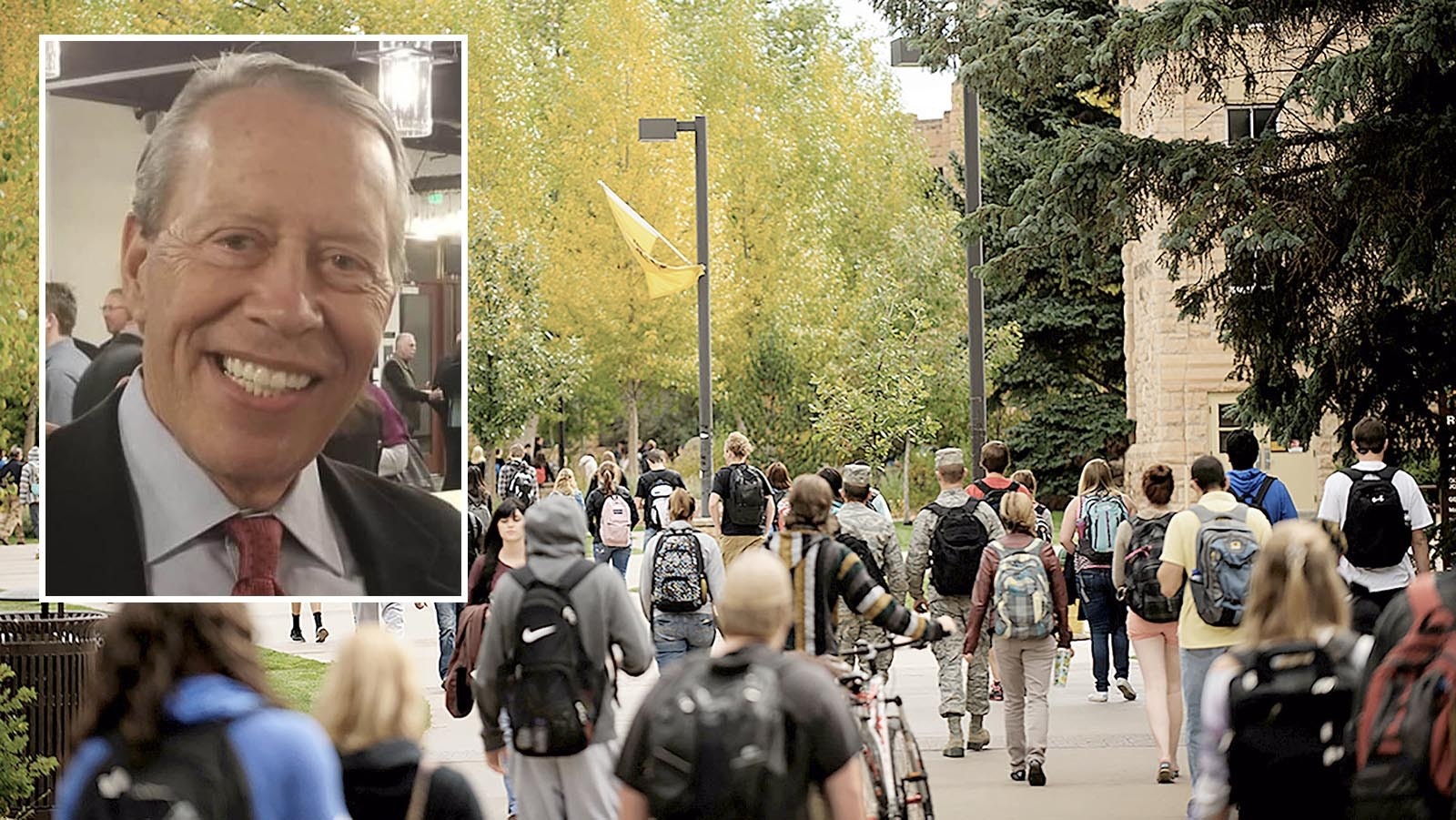
It Started With A Young Man In Cody
The story of the Hathaway Scholarship was decades in the making, and is woven into the achievements of many other men and women, too. Certain frameworks had to be there for the scholarship to come together, like the Permanent Mineral Trust Fund, created under Gov. Stan Hathaway’s watch in the 1970s.
Schilling’s part in the story doesn’t begin until 1983. He was a young man, in love with the West, and deciding where in that West he should live.
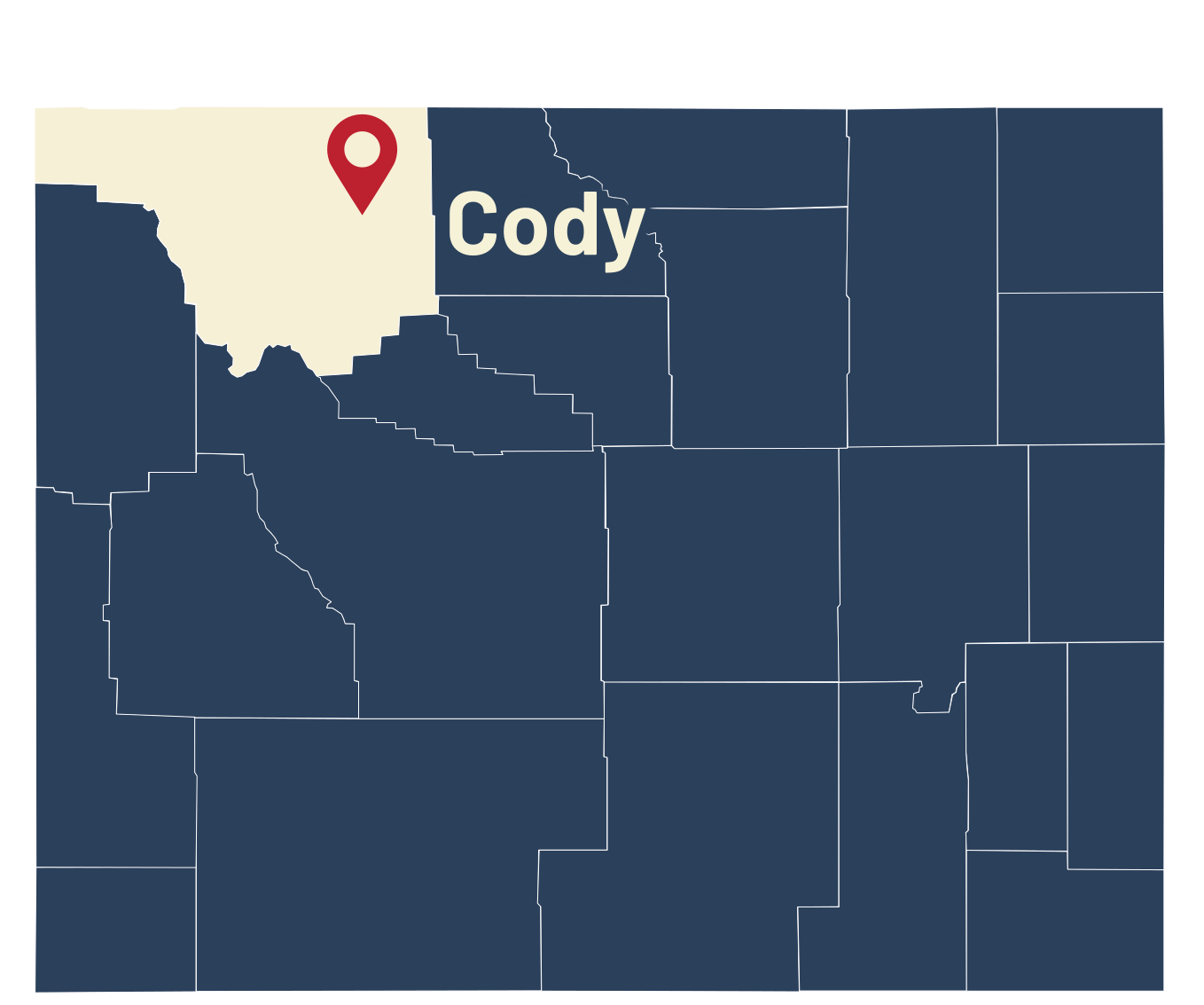
He settled on Cody, Wyoming, where he became director of the Chamber of Commerce.
“Cody was amazing,” Schilling told Cowboy State Daily. “And it still is. Cody, when you’ve lived there for a month, people treat you as if you’ve been there for years.
"They just embrace friendship. They treat you squarely. There’s never a this side or that side of the road kind of thing. It’s just a very welcoming community, and collectively working for the good of the community.”
Harry Roberts, former superintendent of education, was one of Schilling’s board members, and ultimately the reason Schilling became involved with Wyoming Business Alliance.
“He was running for governor, and he wanted me to be his campaign manager and chief of staff,” Schilling recalled.
Schilling turned him down, but that didn’t stop Roberts. The next thing he wanted to know was why Schilling wouldn’t become his associate director for the Wyoming Heritage Foundation and Society.
“I said, ‘Harry, I’m not going to be associate director for anybody,'” Schilling recalled.
After Roberts retired, he still had Schilling in mind and steered the board to pick Schilling as his replacement.
They were persuasive people who included former Governor Hathaway and Wyoming businessman and one-time state representative John Schiller Wold, came to call on Schilling.
“We want someone who will push for economic diversification in Wyoming,” Hathaway told Schilling. “Not just minerals and the traditional stuff.”
From Robust To Bust
Wyoming was in the midst of a bust at the time Hathaway and Wold were talking Schilling into becoming the leader of the Wyoming Business Alliance’s predecessor, the Wyoming Heritage Foundation.
“The state’s population went from 515,000 to around 470,000,” Schilling recalled. “There were bank closings for housing, housing foreclosures. Homes that were going for $200,000, $300,000 here in Casper were going for $95,000.”
Because of that Schilling, who had decided the pro-business entity should be centrally located to Wyoming, was able to buy a $200,000 home for a mere $96,000.
“I mean, there was some real hardship, and that was when Mike Sullivan became governor,” Schilling said. “In '86, things were bleak. They were just bleak.”
All that bleakness meant Schilling didn’t have much of a budget for one of his primary aims — building up a business conference meant to bring the state’s brightest minds together, to dream up a better, more prosperous future for the state.
There’s A Little Cowboy In Everyone
Schilling might not have much money to work with, but he had something else. A great state with generous people, and that Wyoming cowboy allure.
“It turns out there’s a little cowboy in everyone,” Schilling said.
Schilling was able to leverage that yearning to be a cowboy, even if only for a weekend, to his advantage, collaring nationally prominent, buzz-worthy speakers, who could come help put Wyoming leaders on the cutting edge.
“Their budgets were such that they would be covering their own transportation,” Schilling said. “So, I’d get them to come because I’d say, ‘Hey, if you come out, you know I can’t give you an honorarium, but how would you like to have a Wyoming ranch weekend?’”
The answer to that was almost always an enthusiastic yes, even when there might be some negotiation around the exact date.
“We’d go up to the Wold Ranch, the Hole in the Wall Wold Ranch, which was owned by John Wold, and we’d go up there on a Friday night and be there Friday and Saturday night with these couples,” Schilling said. “And we had the former governor from Virginia. we had these wonderful authors. We had Sylvia Ann Hewlett. She was terrific. We had a radio (commentator) out of Seattle, Michael Medved, and he was terrific.”
Those kinds of nationally prominent names created buzz for Schilling’s forums and proved a magnet for business leaders from across the state.
Those Size 14 Shoes
It took more than a ranch stay, however, to interest Paul Volcker to speak at the conference. There, Schilling relied on a name drop to get his call through, as well as some pretty creative logistics.
“Volcker and Al Simpson were great friends,” Schilling said. “They’d become great friends because they’re very tall and they both had size 14 shoes.”
Volcker was pretty gruff on the phone, though, despite the Simpson name.
“He said, ‘Well, I’ve got a board meeting at the Mayo Clinic that week, so I just can’t come,” Schilling recalled Volcker saying.
But then Volcker happened to mention where he was, at the Rocky Mountain Oil and Gas Association meeting.
“Dave True was there, with the True Oil Co.,” Schilling said. “And Dave was on our board. So I said, ‘Hey Dave, is there any way we could get your jet, your private jet, to pick up Paul Volcker and get him to the forum?’”
True had no problem with that, so Schilling called Volcker back to let him know he’d lined up a private jet for him to come to the forum, and all Schilling needed to know was what Volcker would like to have for lunch on the plane.
“So he says, ‘You got me,’” Schilling said, chuckling a little at the memory. “And I said, “I did.” So he came and we gave him a wonderful fishing rod, because he was a fly fisherman, at the forum. He had a wonderful time and he loved it.”
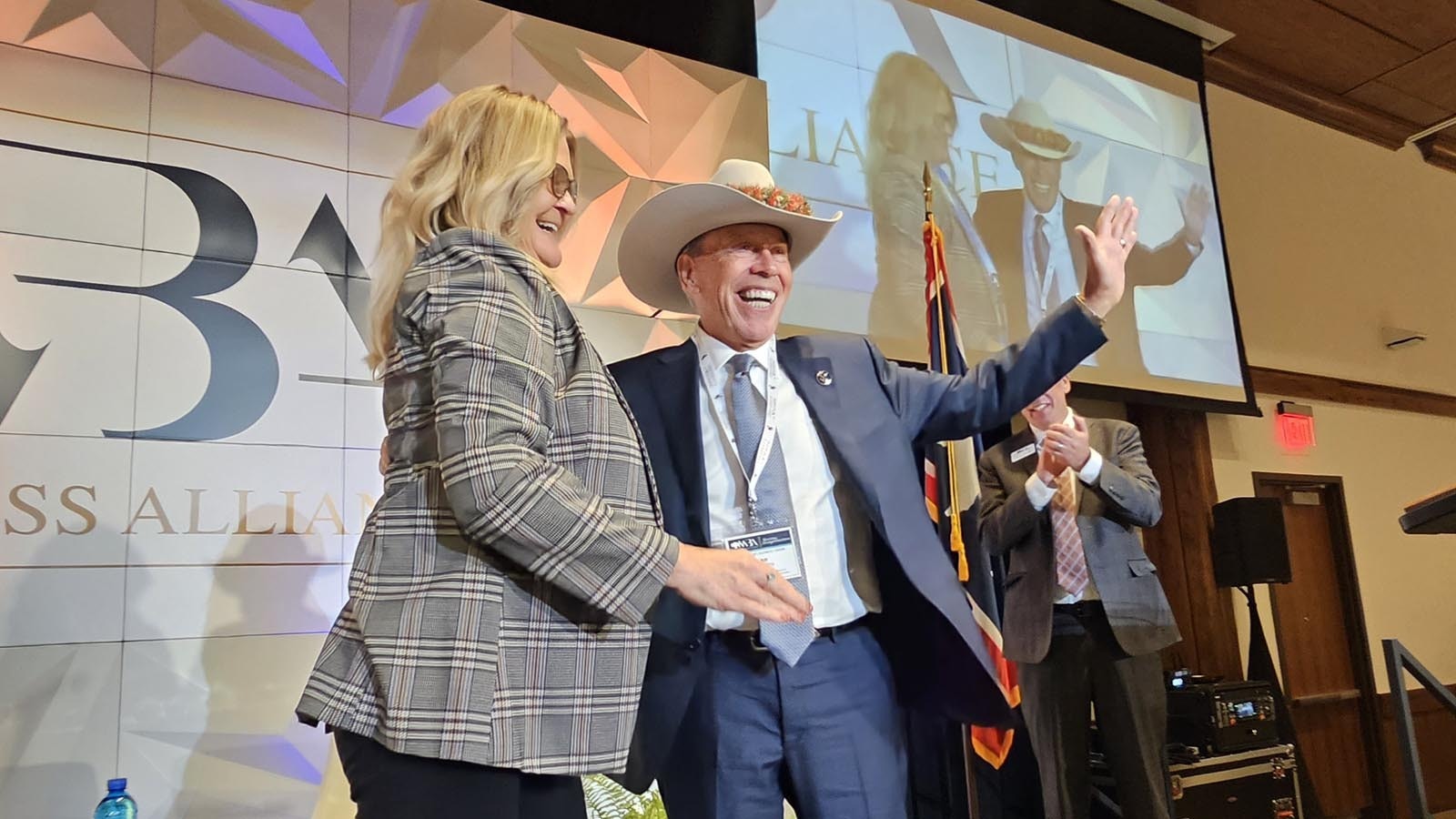
Becoming The Governor’s Conference
In the early days, the forum had no association with Wyoming’s governor. For one thing, then Gov. Ed Herschler, a Democrat, didn’t want anything to do with a bunch of mostly conservative business leaders.
Times changed, though. Schilling decided, for one, to move the conference to Little America in Cheyenne. The hotel the conference had been held at in Casper had become old and dated and had a number of problems that made the conference problematic.
By then, there was also a new governor, Matt Mead, so Schilling decided to pitch Mead on becoming involved with the conference. In Mead, Schilling found a new ally in his quest to bring nationally prominent speakers to his forum.
“The governor would actually make calls sometimes as well to get speakers,” Schilling said. “So we’d get these multimillionaire business people to speak and other governors or whatever.”
Being the Governor’s official business conference also lent new credibility to the organization, and continued to expand its reach.
“It was exhilarating connecting all the dots to make something enjoyable and a learning experience for Wyoming people,” Schilling said.
The Kids Everyone Had Given Up On
The idea behind all of the speakers Schilling brought was to encourage Wyoming leaders to stay on the cutting edge, think outside the box, and take on the Cowboy State challenges just like a cowboy riding a bull.
It was one of those speakers that helped Wyoming land the Hathaway Scholarship. James Callier served as the Taylor Foundation president and served as a stand-in for Patrick Taylor, who died three weeks before he was to come speak about the Taylor Opportunity Program for Students, or TOPS.
Taylor made a fortune in oil and gas, and was owner of Taylor Energy, the largest independent oil and gas company operating in the Gulf of Mexico.
Taylor’s TOPS program came about on the spur of the moment. He’d been asked to speak to 183 high-risk youths in a Louisiana high school. At one point, Taylor asked the students how many of them could afford to go to college.
He was shocked when not one of the 183 youths raised their hands.
Taylor then asked how many of them would want to go if they could afford it?
All of them raised their hands.
Taylor had just one more question at that point.
Would they be willing to get good grades and stay out of trouble to go to college?
Again, most of the hands went up. Because, these were just poor kids, not stupid kids. They were smart enough to know a good opportunity when they saw it, and they weren’t averse to hard work to get there.
That spoke to Taylor, who had humble beginnings himself. He, too, had not been able to afford going to college. But there was a Louisiana university offering a free petroleum degree. Taylor had known nothing about petroleum at the time. He just knew it was his ticket to a college education and a better life. He was going to take it and make the best of it that he could, no matter what a petroleum degree was all about.
So it was that right then and there Taylor made a bargain with the 183 students who reminded him of himself.
He would pay the tuition, fees, books and room and board for any student who got at least C+ or better grades and maintained good citizenship — no felonies, no pregnancies, no alcohol or drugs.
These were the kids who were all supposed to become high school dropouts. The kids who were supposed to land in jail, or worse. There was no future for these kids. Not until Taylor came along and offered them a personal hand up.
Most of the 183 Taylor kids, as they became known, not only graduated from high school and then college, but they made much better lives for themselves than anyone had even thought possible.
For many years, the Taylor kids gathered on the Taylor ranch every year to celebrate, long after they themselves became adults. And their success inspired other states to follow suit, including Wyoming, which was the 21st Taylor state. The last was Alaska.
Curmudgeonly Lawmakers
Getting the program in Wyoming was no slam dunk, though.
Schilling still recalls what people were saying after Callier’s talk.
“We were up at the ranch with some of the speakers and Charlie Scott was there, and I think Tom Stroock was there and anyway, these legislators were (being) kind of curmudgeons,” Schilling said. “They were saying, ‘Well, we can’t do that.’ And the women who were at the forum, Marla Wold, John Wold’s daughter-in-law, and a couple of other women they just jumped all over them, saying, ‘No this is the right thing to do for these kids.’”
State Rep. Steve Harshman, R-Casper, whose career was teaching, was among those moved by the idea. He was going to carry the standard for the idea, he decided, even though he thought he might be the only one.
When he got to the session, however, he was surprised to find that several of his colleagues had rethought their positions on a Taylor-like scholarship program in Wyoming.
“There were like seven bills presented by different legislators,” Schilling said. “There was one by an oil guy from Cody, there was one by a state senator and the president of the college down in Rock Springs. There was a variety, because they’d all had experiences themselves of struggling to get to college, because it was so expensive for them.”
Harshman’s bill, though, and all the others, found themselves in the Speakers drawer, however, then a Lusk man named Jeff Wasserburger.
A Charlie Scott Spell Is Cast
It seemed like the issue was dead, for this legislative session anyway.
Until that is, Harshman noticed that Natrona County Sen. Charlie Scott, R-Casper, had a bill to create an endowment for professors, using K-12 money. That endowment just happened to have the word “scholarship” in the title.
“That’s a beautiful thing, because that allowed then a potential amendment,” Harshman said.
The day Scott’s endowment bill crossed over, Harshman brought a 13-page amendment, Substitute Bill No. 1, to replace Charlie Scott’s bill. The replacement would keep Scott’s endowment, but it would add a merit-based scholarship. Harshman called it the Hathaway Scholarship.
“You remember those old meeting rooms before the Capitol was renovated?” Harshman said. “We were upstairs in a little closet area, gathered around a table, everyone looking over your shoulder.”
Wasserburger, that night after Harshman’s maneuver, asked Scott what he thought of it.
Scott knew the fate of his bill was now tied to Harshman’s amendment. So, he was unequivocal about it.
“I think it’s a stroke of genius,” he told Wasserburger.
That quote made headlines in newspapers across the state, and also helped build momentum for the Hathaway Scholarship. Schilling, meanwhile, was working behind the scenes, bringing Callier back to Wyoming on multiple occasions to talk up the idea.
Ultimately, The Harshman-Scott “stroke of genius” bill went on to sail through the legislature and float to the governor’s desk. Hathaway was on his death bed at the time. Not only did then Gov. Freudenthal sign the bill, but he took it to Hathaway so he could sign it in front of him. Hathaway would pass away in October 2005, not long after that.
“That’s the real backstory of the politics,” Harshman said. “It was a great idea that nearly died, but our system allowed us to amend the bill coming across and then gain support. And then we did the work, and here we are today.”
Wyoming’s Core
Schilling now lives in Hawaii, after meeting the love of his life there, but returning to Wyoming was a life-affirming moment for him. It supported a young man’s notion, so many decades ago, that Wyoming was the right place for him to make a life.
“What we experienced the last few days in Laramie defines what Wyoming really is at its core,” Schilling said. “It’s all about the friendliness of the people, listening to different viewpoints and encouragement about new strategies and advancing our state.”
Staying in one place, refusing to change, clinging to the past — these are things Schilling doesn’t believe characterize Wyoming, a state that was built by pioneers.
Wyoming is a state where everyone rolls up their sleeves, Schilling said, regardless of party, to focus on what’s better long-term for the state, and where people aren’t afraid to ride change like it’s a bull.
“Life around you is changing,” Schilling said. “So for me, that’s what I’ve tried to do in my career, is just try to get people together to connect the dots.”
One of Schilling’s favorite memories of his time in Wyoming was an occasion when Al Simpson was introducing him at an event.
“There’s persistence, and then there’s the most persistent person I’ve ever met,” Schilling recalled Simpson saying. “And he’s right here in this room. It’s Bill Schilling.”
Words like that from colleagues get written on the deepest parts of a man’s soul, and get taken with him wherever he is in the world. At heart, those words are all about what Wyoming has meant to Schilling, and why he has loved the state so much.
“It was a great run,” Schilling said. “And Renny MacKay is going to be doing the same job for the Business Alliance. I’m so proud of him and what he’s doing. It’s exciting for me, not being here, but being here in spirit, to see the growth of the leadership. And Mandy Fabel who followed me (at Leadership Wyoming) with Renny. It just doesn’t get any better than this.”
Renée Jean can be reached at renee@cowboystatedaily.com.