The devil can’t look her in the eye. Such must be the courage and spirit of every Miss Frontier whenever she’s riding out on her horse and waving to the crowds at Cheyenne Frontier Days.
The line is a prominent part of the chorus of the Miss Frontier Anthem, written by the twin daughters of the 1947 Miss Frontier Ann Dinneen Smith, Amy Smith Meier and Annie Smith Jackson, to honor the fearless and free spirit of every Miss Frontier.
Meier said the song drew on interviews with past queens for its inspiration. That line about the devil came from Miss Frontier 1979, Shirley Holmes Churchill’s aunt Louisa Holmes Bartlett, Miss Frontier 1938.
“She is a powerhouse plus, and she was kind of coaching Shirley when she was queen,” Meier said. “She was saying, ‘Shirley, when you ride and you’re going out there in the arena, you have to look the devil in the eye.’”
The minute Meier heard the story, she knew that had to be in the song. The attitude conveyed everything it means to be Miss Frontier.
“To me, she represents liberty and freedom, because the line says she’s fearless and free,” Meier said. “She’s fearless and free, our rodeo queen.”
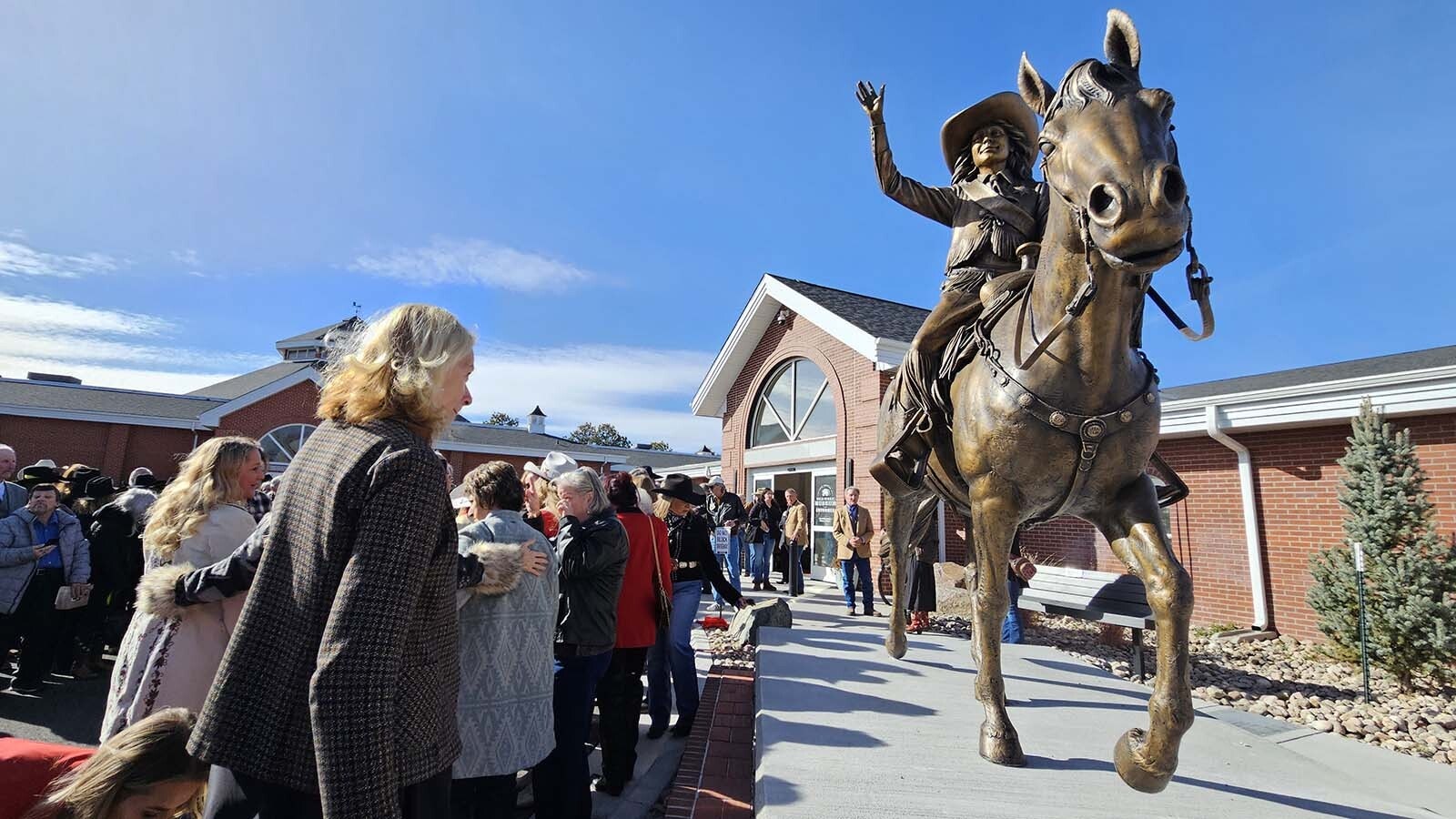
Immortalizing that in a life-size bronze was the not inconsiderable task set before sculptor Joey Bainer, tapped to create Cheyenne’s newest statue, The Bronze Queen.
“Joey has a way of capturing the truth as he describes it,” Meier told a crowd gathered to unveil the statue last weekend. “But I call it the soul. The soul of the woman and the beauty.
"And to me, she represents liberty, and that’s what we wanted as Miss Frontier and Joey has brought that to life.”
The statue that Meier, Jackson and the Deaver twins helped spearhead now sits outside the Old West Museum, perpetually greeting visitors to Frontier Park while also celebrating every Miss Frontier from 1931 to today.
That’s 95 Miss Frontiers and counting, each of whom has represented Cheyenne Frontier Days, the Daddy of 'Em All rodeo, with grit and grace for almost a century.
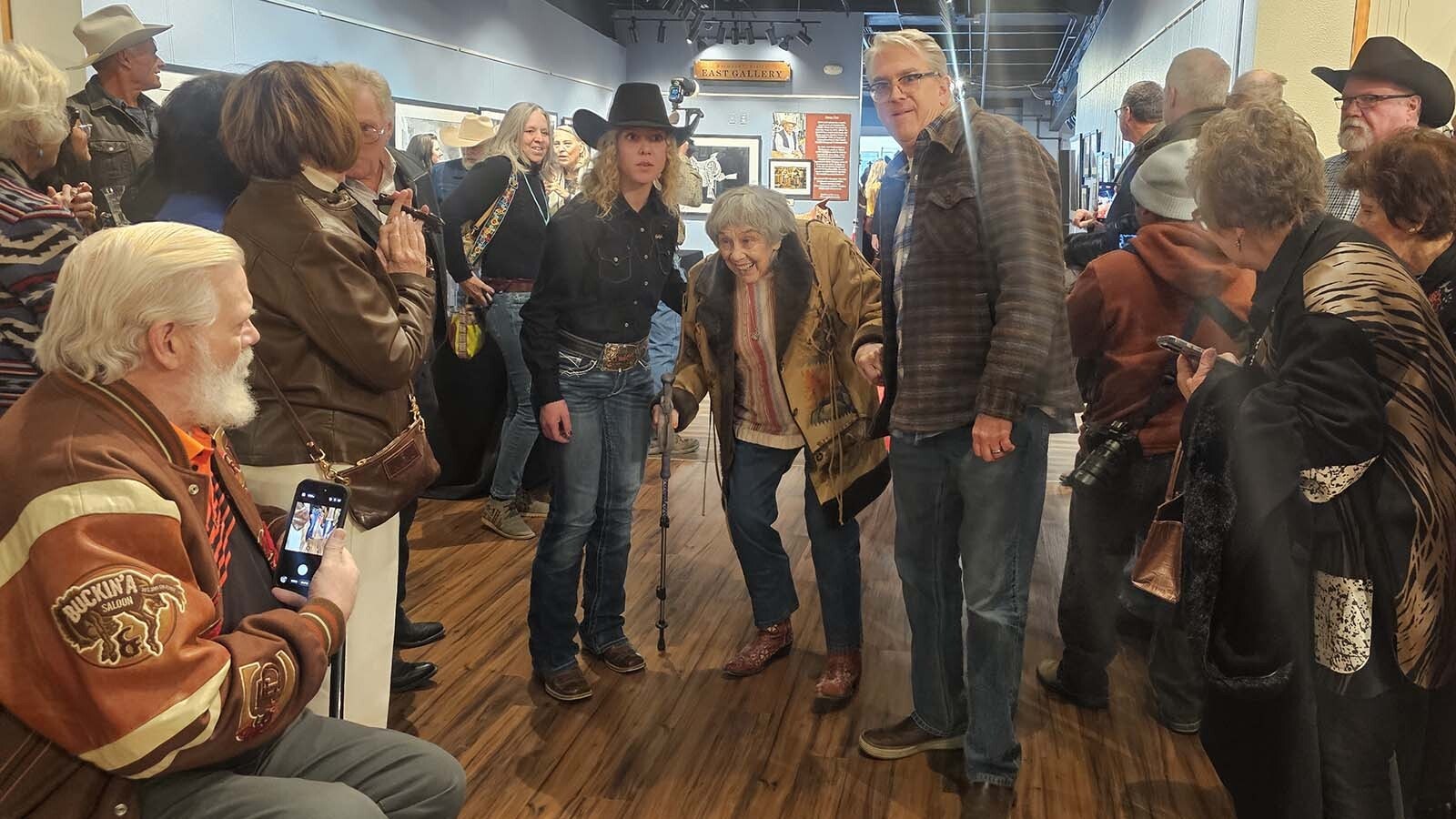
A Cheyenne Frontier Days Dandy escorts 1958 Miss Frontier Jeanette Tyrrell Daly across a red carpet into a ceremony honoring all past, present and future Miss Frontiers. Daly is the oldest living Miss Frontier. (Renee Jean, Cowboy State Daily) 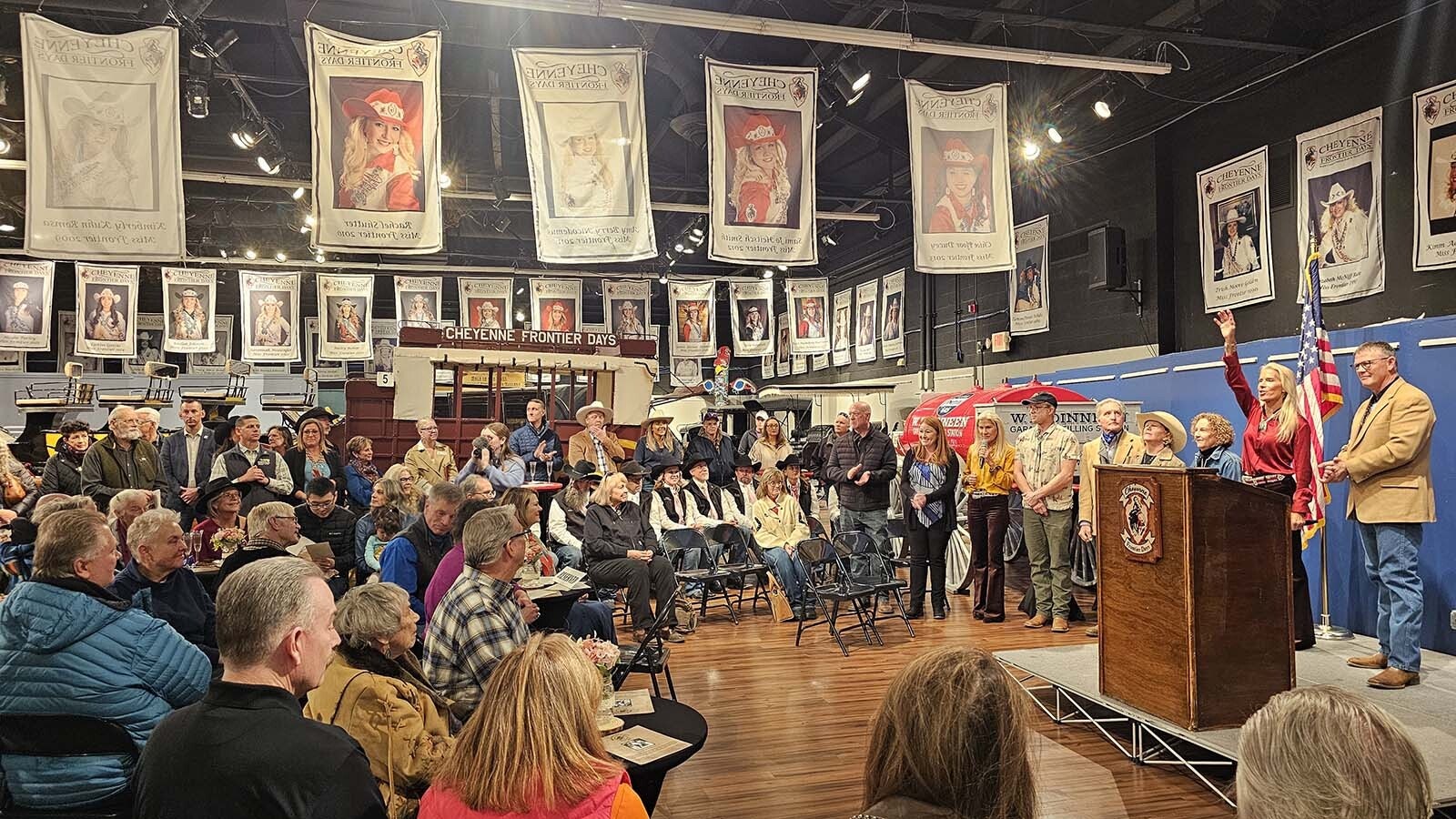
A crowd gathered in the Old West Museum in Frontier Park for a ceremony to unveil Miss Frontier. (Renee Jean, Cowboy State Daily) 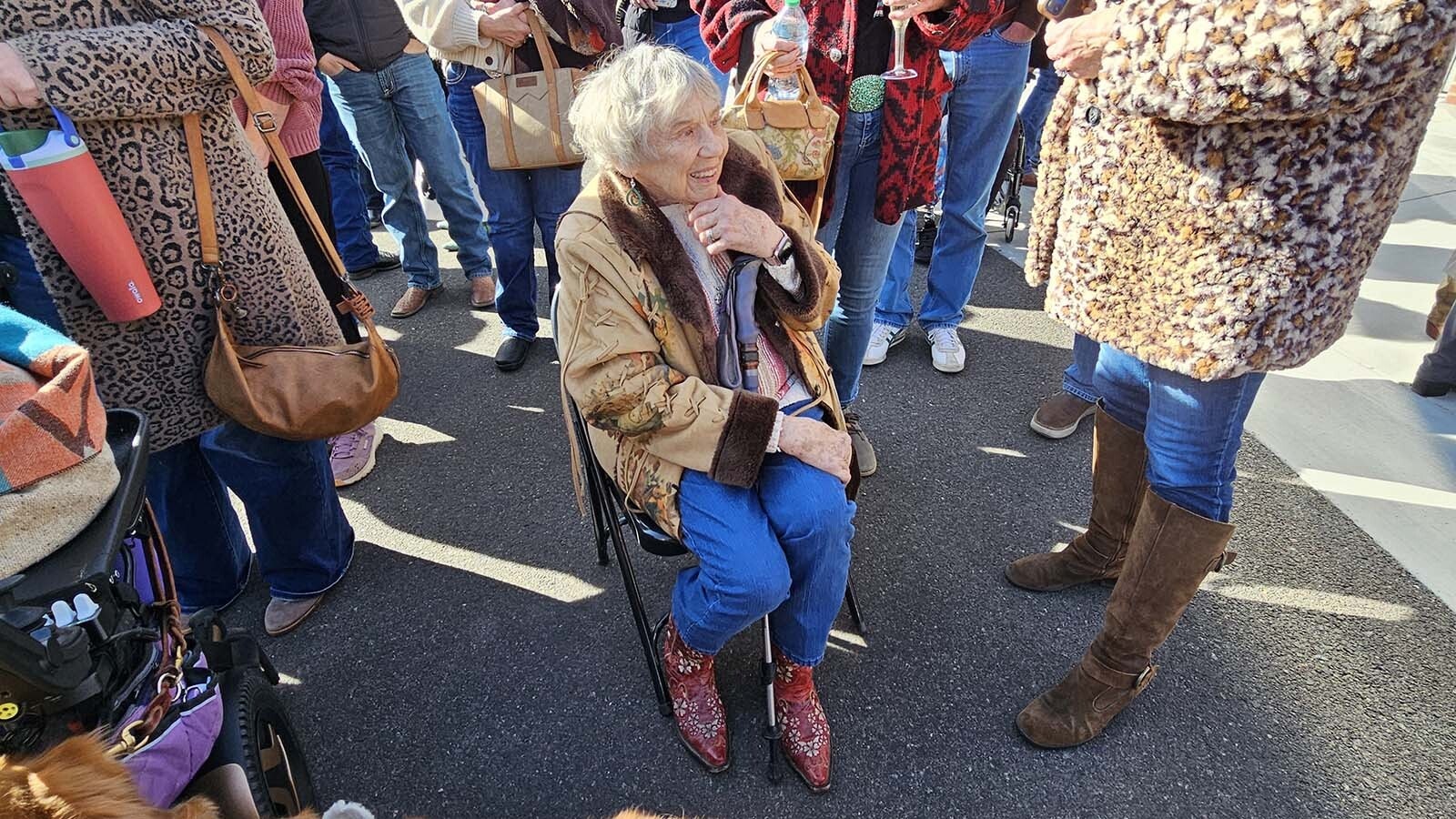
Jeanette Tyrrell Daly, seated, is surrounded by a crowd f well-wishers during the unveiling ceremony for Miss Frontier. Daly is the oldest living Miss Frontier, serving in the role in 1958. (Renee Jean, Cowboy State Daily) 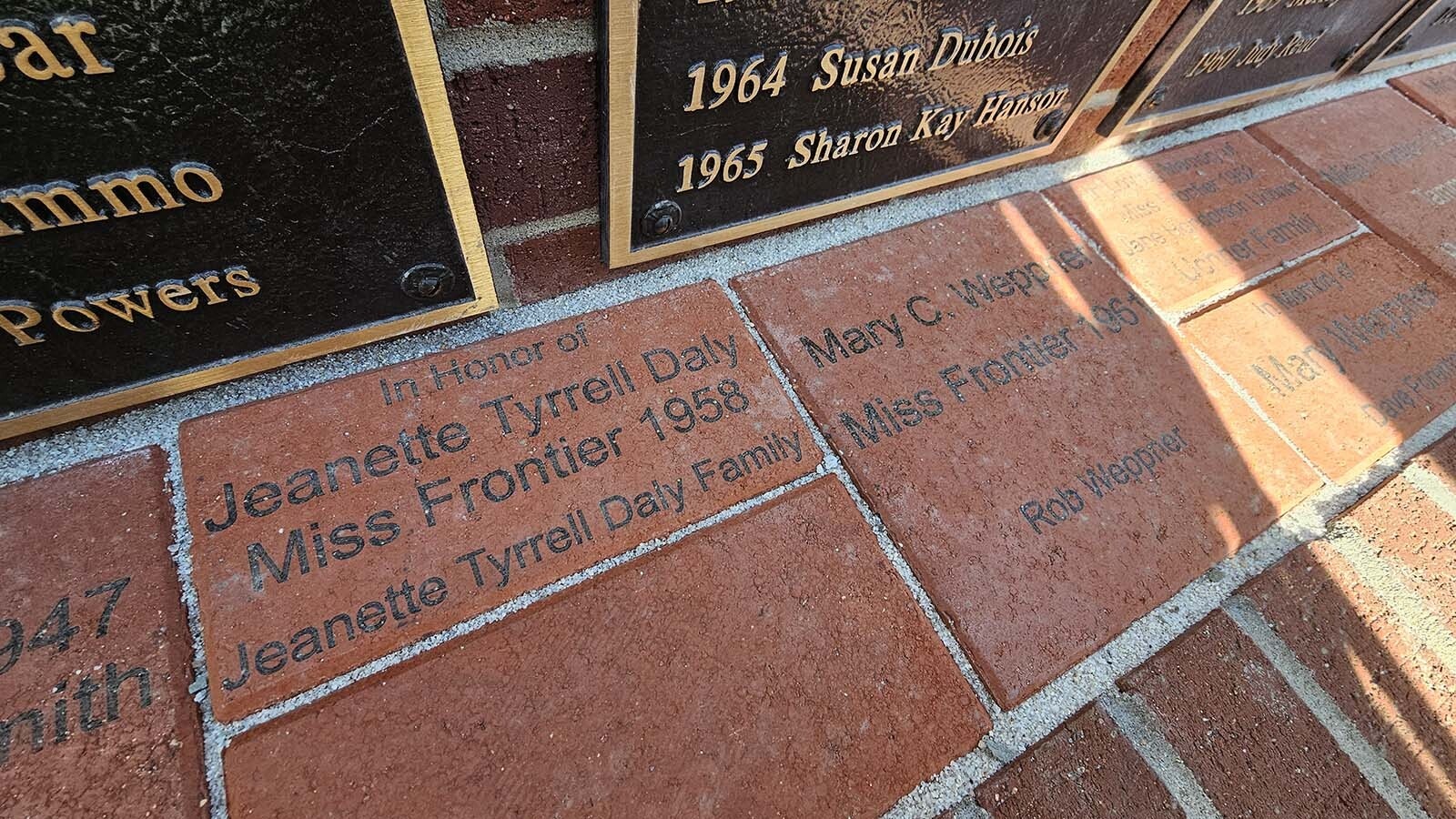
Jeanette Tyrrell Daly is the oldest living Miss Frontier. Her name graces one of the many family bricks that helped build a new bronze statue honoring Miss Frontier. (Renee Jean, Cowboy State Daily)
From Tragedy, New Life
The genesis of the Miss Frontier statue started from personal tragedy.
Two Miss Frontiers who had become dear friends died six years ago, one month apart from each other.
They were Lois Hofmann, Miss Frontier 1946, and her lady-in-waiting Ann Dinneen Smith, Miss Frontier 1947.
The two found they had a lot in common and became lifelong friends because of their service together.
Not only were they both former Miss Frontiers, they each had twin daughters.
Over the years, Smith talked about the Deaver twins often, Meier said.
It was natural after their mother died that the Smith twins and the Deaver twins decided to get together.
“They had been going through their mom’s scrapbook of Miss Frontier, and they brought it over to my mom’s house,” Meier said. “They wanted to know about the people in the scrapbook, because our families go way back, five generations or so of each of our families.
"And so, they wanted to know who was who.”
Everyone had a wonderful time going through the scrapbook, reliving old memories.
“We shared this wonderful moment and got to know each other,” Meier said. "After that, we would all just get together for coffee, the four of us.”
When the Deaver twins started talking about getting a banner to display in the Old West Museum to honor their mom, it inspired the Smith twins to do the same.
Everyone loved the banners so much, it inspired more of them.
The Deaver twins then pledged that by 2021, the 90th celebration of Miss Frontier, there would be a banner for each queen on display at the Old West Museum.
The Smith twins, meanwhile, wrote an anthem to honor Miss Frontier, incorporating the words of past Miss Frontiers.
Their inspiration didn’t end there though. They wanted to do still more, and that’s where the idea for a bronze statue began to take shape.
Enter The Bronze Mastermind, Stage Left
At first, Harvey Deselms, the Capitol Avenue Bronze Project’s mastermind, encouraged the twins to think about a downtown sculpture.
Deselms is already closing in on 100-some bronzes installed in Cheyenne.
“I was thinking it would be great to have a lot of cowgirls in downtown Cheyenne heading back up here (to Frontier Park),” Deselms said. “And it would be perfect to have along 15th Street, a whole bunch of cowgirls.
"I thought she could be on 15th Street, heading up Carey Avenue, up to the park, as a half life-size Miss Frontier.”
But half life-size wasn’t going to cut it, the twins decided.
“It was well, ‘She needs to be at the park,'” DeSelms said. “'So why don’t we do it life-size?'”
No need to twist DeSelms arm. The minute he heard life-size bronze, he was all in.
The twins just needed to raise a wee bit of money — $300,000 or so. That’s all. For that they brought in Dave Foreman, who Meier described as a “brilliant finance man” to help them with fundraising.
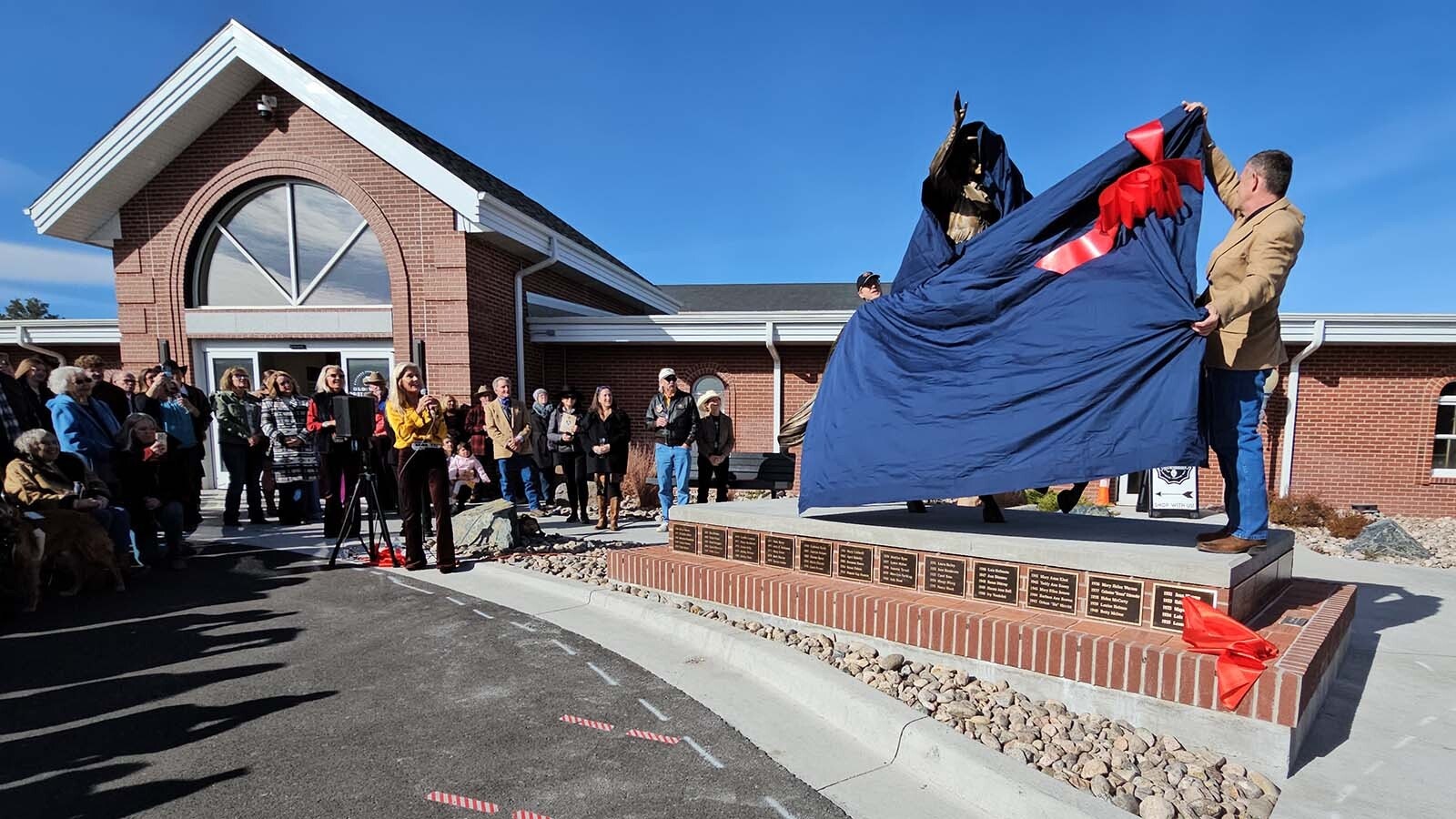
Harvey Deselms works to unveil Miss Frontier during a ceremony at Frontier Park in front of the Old West Museum. (Renee Jean, Cowboy State Daily) 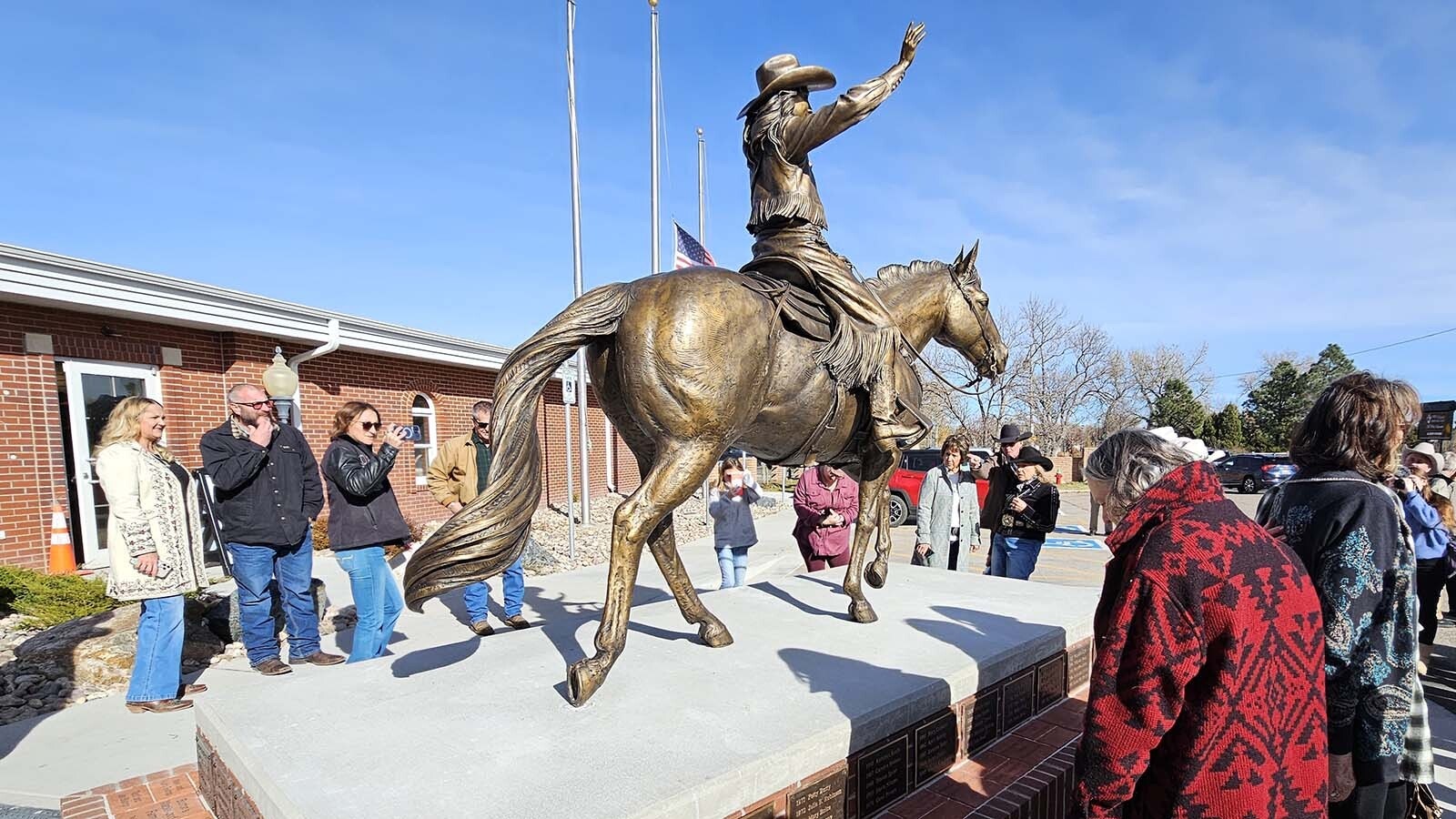
Miss Frontier, caught mid-ride, just as she might be during Cheyenne Frontier Days parade, perpetually waves at an adoring crowd in Frontier Park. (Renee Jean, Cowboy State Daily) 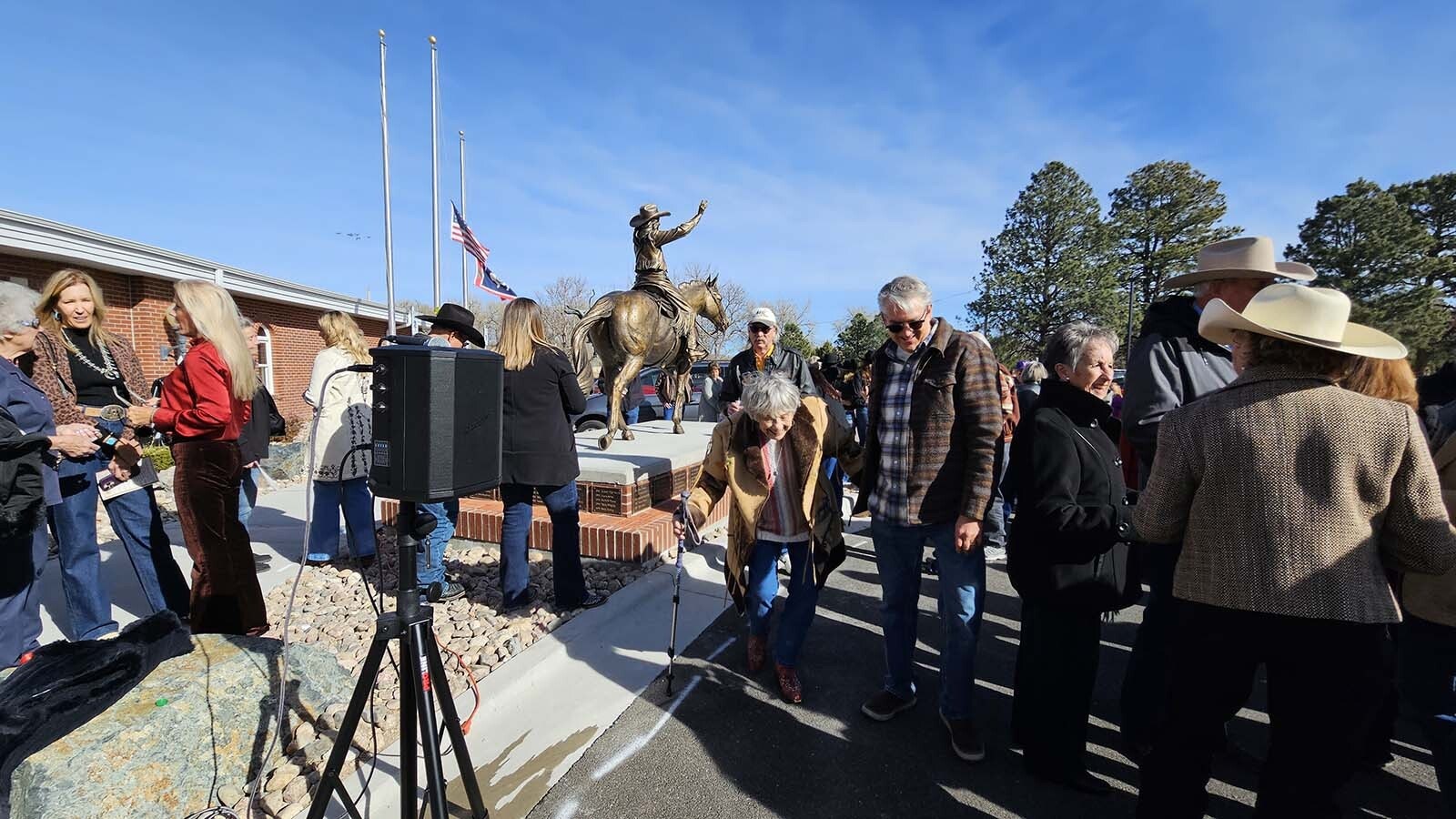
Jeanette Tyrrell Daly, center left, smiles as she returns from looking at Miss Frontier up close. Daly is the oldest living Miss Frontier, serving in the role in 1958. (Renee Jean, Cowboy State Daily) 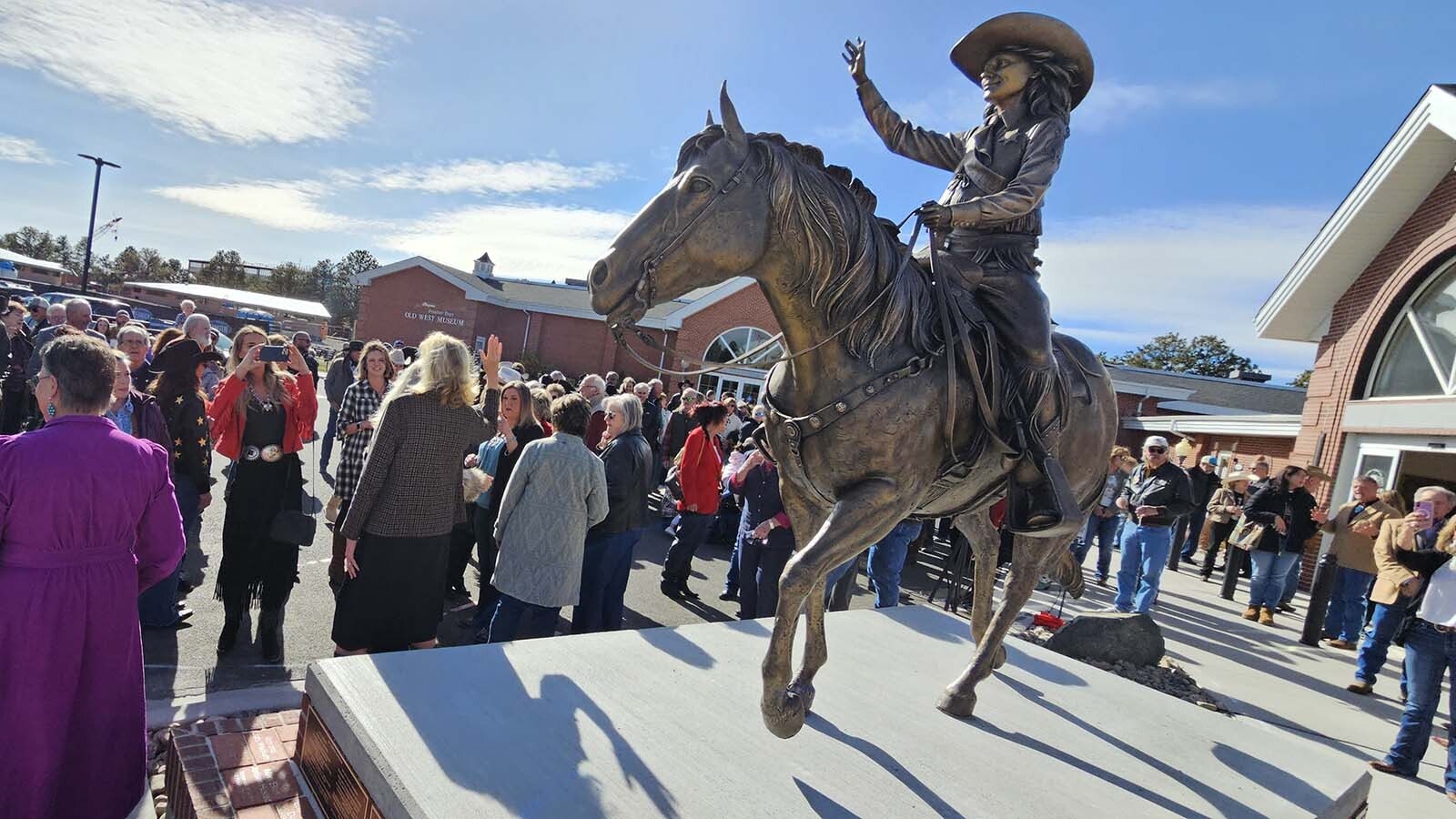
Miss Frontier perpetually waves at the entrance of the Old West Museum in Frontier Park. (Renee Jean, Cowboy State Daily) 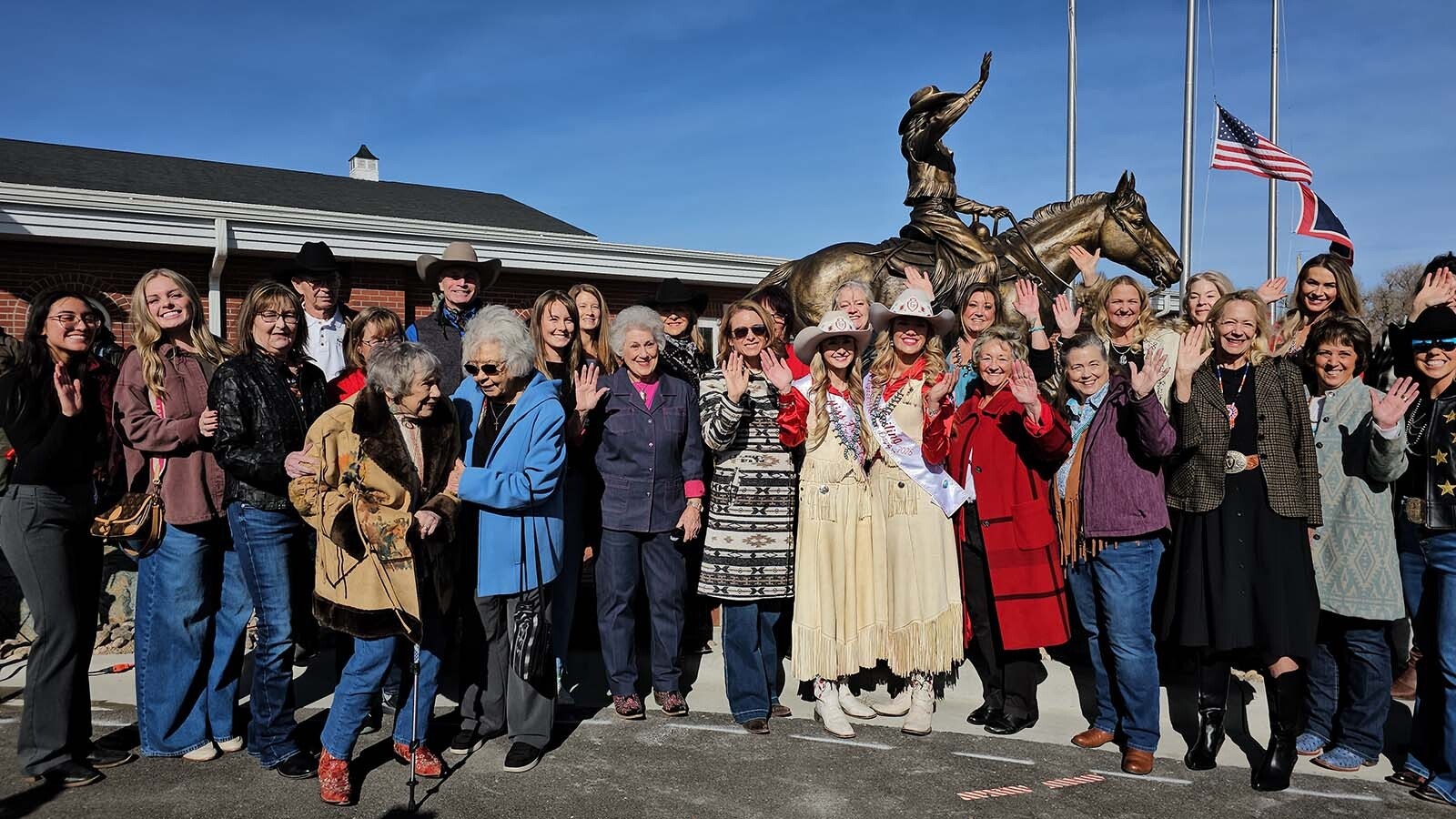
Miss Frontier gathers with members of the crowd, including other former Miss Frontiers, for a shot of them waving back at an adoring crowd. (Renee Jean, Cowboy State Daily)
Riding Into The Wind
To create Miss Frontier, Bainer told Cowboy State Daily he didn’t rely on any one particular horse or any one particular Miss Frontier.
Instead, he channeled all of them into one design, drawing on every period of history and weaving them all together.
“Every Miss Frontier can look at this and see a piece of themselves and their cohorts,” he said. “I wanted to really make something timeless that will inspire generations to come and won’t be stuck in a certain time period.”
That meant looking at photograph after photograph of Miss Frontier in all eras, drawing on a buckle from this time period and a butterfly on the boot from that time period.
“The hat was kind of a trick because it just had to be a quintessential cowboy hat,” he said. “And when you look in the museum at all the banners, there’s so many different types of hats and some of them date more than others.”
Dated wouldn’t cut it.
For Miss Frontier to be truly immortal, he had to have a timeless hat, one that would speak to future generations just as much as the past ones.
“This was like a big stewpot with everyone’s opinions and ideas,” Bainer said. “And they were all valuable and unique. It’s not right or wrong.
"So, I tried to stir all those up and cook them down.”
To prepare the horse, meanwhile, Bainer videotaped horses going at the right speed, then used stop-action to find good poses.
“It’s not exactly one pose from — if you looked at my photos, it’s kind of a culmination to get that moment in time.”
From there, Bainer decided Miss Frontier should be riding into the wind, symbolizing changing times.
“That’s what Miss Frontier is all about,” Bainer said. “Every year there’s a new PDQ.”
Laramie County Daughters Are A Force
PDQ is short for Past Damn Queen, Meier told Cowboy State Daily.
“Once you are not Miss Frontier, the day after, you become what they call a PDQ,” she explained. “And it became kind of a fond term.”
At one point, the PDQs had their own bank account, which past queens would donate to, so that there was always a little bit of money for something special, like a commemorative plate or a gift for queen anniversaries or other special occasions.
The account has gone by the wayside since then, Meier said, but the young queens still know the term, PDQ, and it’s one of the many unofficial networks of people who come together to help make Cheyenne Frontier Days strong year after year after year.
The first Miss Frontier was Jean Nimmo Dubois, chosen to represent the Cheyenne post of the American Legion in 1931 because she’d helped them sell the most event tickets.
There was no particular plan for Nimmo, who recalled getting two days off to be at the show and getting to spend a lot of time with the then renowned cowboy Bob Crosby, because he’d broken his leg.
It was a “truly wonderful and memorable ‘first,’" she is quoted as saying in the "History of the Queens," which includes a short biographical sketch of each queen.
Later, it took letters of recommendation to become Miss Frontier, Churchill said.
“That’s how I was chosen,” she said. “And there were no interviews, there was no riding tryouts. It was kind of, as most everyone knew, the pioneer families of Laramie County’s daughters at that time.”
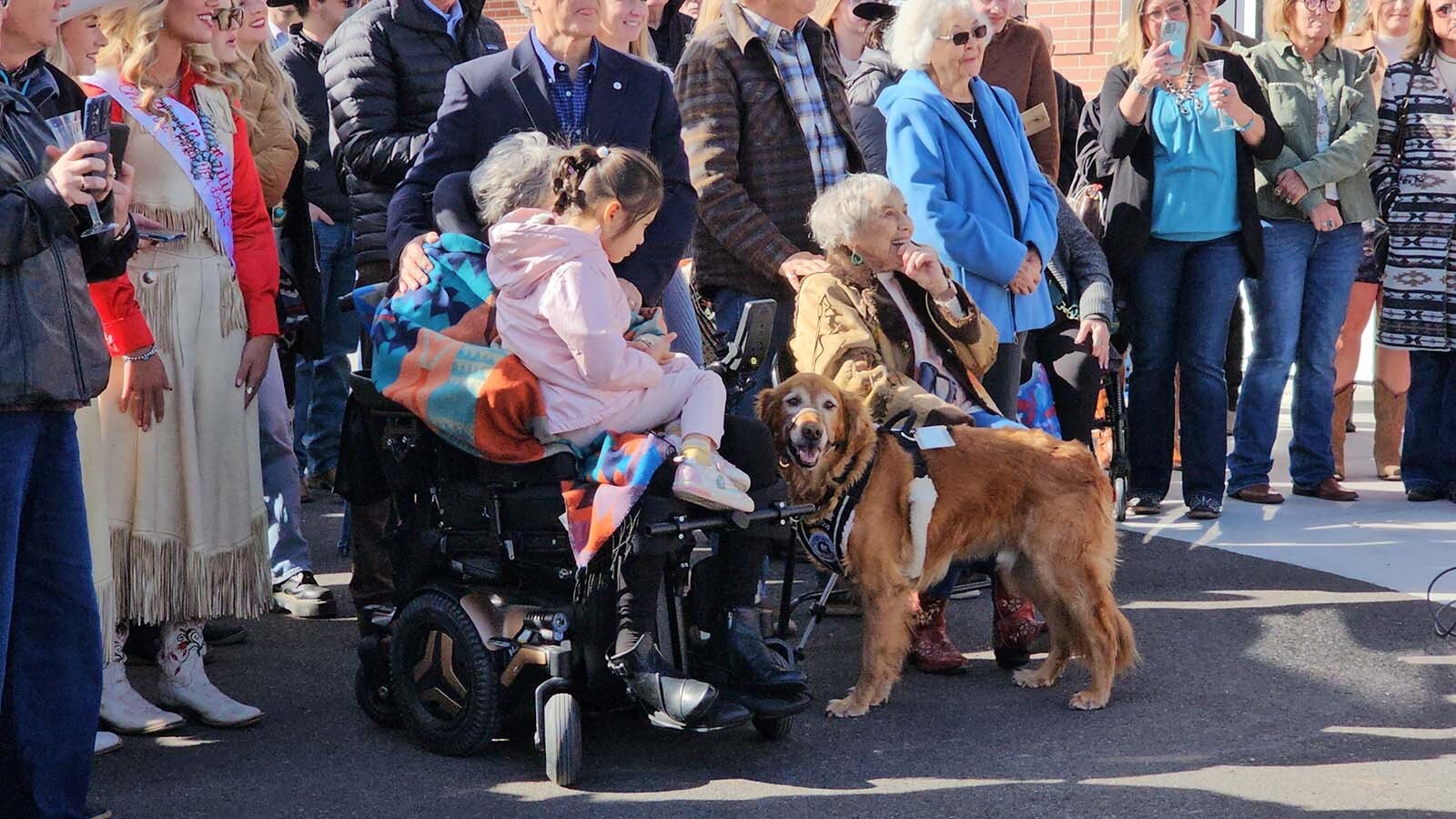
Janet Tyrrell Daly, seated on the right, smiles as she awaits the unveiling of Miss Frontier. Daly is the oldest living Miss Frontier, serving in the role in 1958. (Renee Jean, Cowboy State Daily) 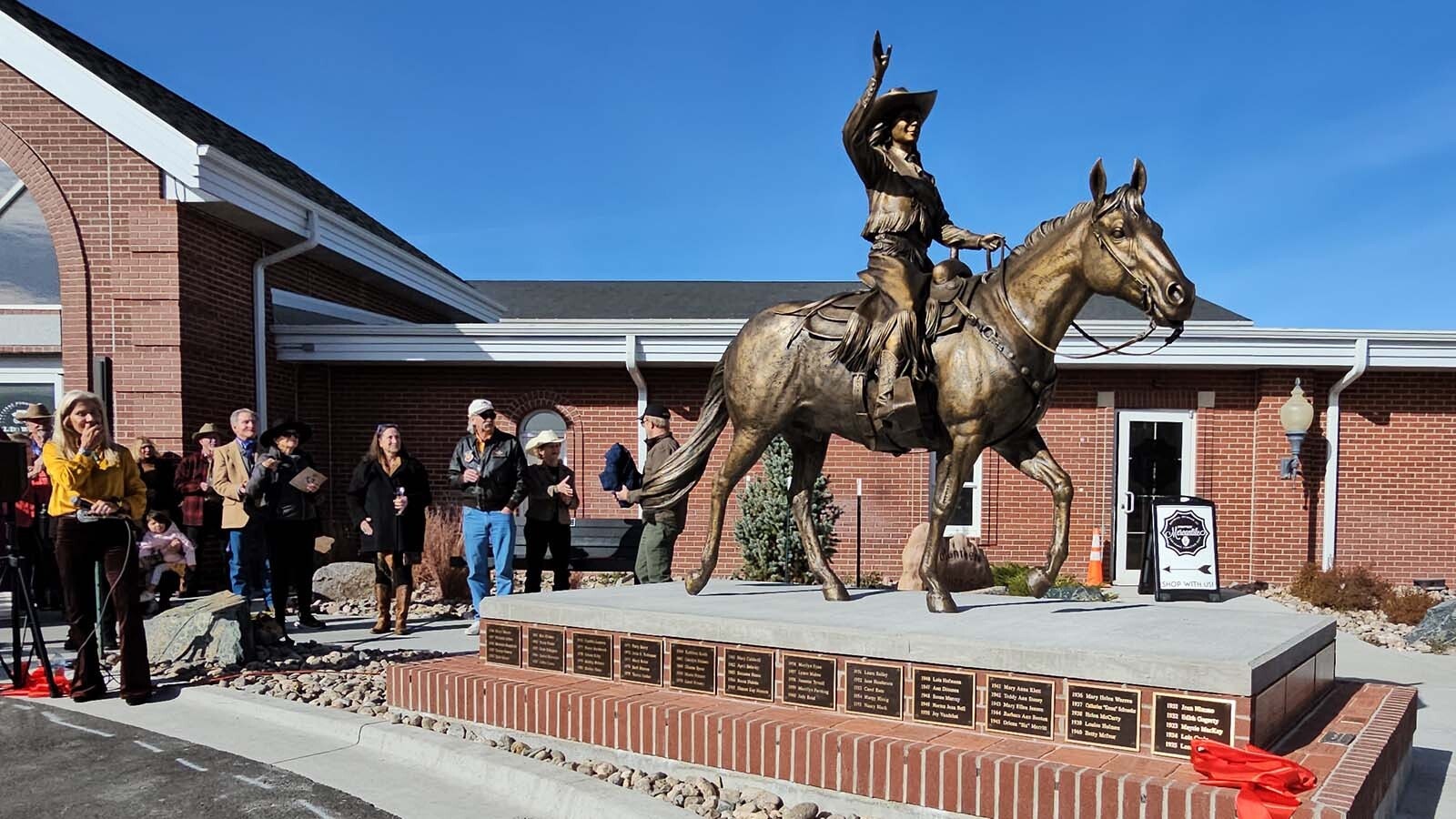
Miss Frontier, shortly after she was unveiled at Frontier Park in front of the Old West Museum. (Renee Jean, Cowboy State Daily)
Not Just A Pretty Face
In Jeanette Tyrrell Daly’s time, horsemanship was somewhat taken for granted in Miss Frontier. She served in the role in 1958.
“I grew up riding,” she told Cowboy State Daily. “But I would have preferred my own horse than the ones we got in the parade. Those could be a little unpredictable.”
Daly is the oldest living Miss Frontier.
She was crowned by Milward Simpson, then governor of Wyoming, and recalls everyone dancing to the music of Leonard Mayer.
Daly’s buckskins are still hanging up in her bedroom, her daughter Linda Golden told Cowboy State Daily and she was pretty excited to learn there was going to be a Miss Frontier statue honoring her and all the other Miss Frontiers.
“It was an honor,” Daly said, gesturing toward the Miss Frontier statue with a smile on her face. “This means a lot because we were kind of behind the scenes for a while. This was very well done.”
Well done is how Holmes, too, would characterize the statue.
“It’s a beautiful tribute to the legacy of Miss Frontier,” she said. “It gives her a lasting place here in the park because she’s been so instrumental in being a part of the show for so many years as the goodwill ambassador and kind of the face of Frontier Days, the feminine face.
"So, I just think it’s a wonderful tribute to not only the past, but the present and the future.”
Churchill still enjoys looking at the scrapbook photos of her aunt.
“Some of the beautiful photographs of her with the chiefs in their head dresses are just outstanding,” Churchill said. “And the photos of her on horseback among the teepee village here, and then in the old pavilion here.”
Raising Wyoming Legends
Churchill doesn’t agree, however, with any suggestion that the early Miss Frontiers weren’t recognized.
Her aunt, who was Miss Frontier in 1939, had a very prominent role, she said.
“There used to be like an old pavilion … open-sided, open-aired but with a roof, and it was the dance hall,” Churchill said. “Everyone came and bought a ticket to dance with Miss Frontier. And they led the parades, and they danced with Indians down at the Plains Hotel.
Over time, Miss Frontier’s role did grow ever more prominent. Churchill recalls taking trips to help boost rodeo attendance.
“We would go up and down the Front Range with the native Americans and we would be in the Citadel Mall, and they’d be in full regalia, and we’d all be in our buckskins,” she recalled. “And they would start drumming and singing and dancing, and you talk about drawing a crowd.
"Then we girls would speak and hand out the literature with some of the PR people, inviting the Front Range to come up.”
Churchill also recalls being deputized as a sheriff’s deputy when she became Miss Frontier, an honorary role, but one she took seriously.
It’s something she believes speaks to the serious nature of Miss Frontier’s role during Cheyenne Frontier Days.
It still happens to this day, she added, though now it’s with the chief of police rather than the sheriff.
Meier, too, feels that there is a weight to the Miss Frontier legacy that’s growing in power over time.
“I write the history of each queen,” she said. “Mom, before she died, said, ‘I want you to carry this on. I want you to carry on this queen book. It’s called the Queen Book.
"And so, each year, I interview the Miss Frontier, her legacy, and what happened during her reign.”
Meier’s mother knew all of the Miss Frontiers going back to the very first, Jean Nimmo Dubois, in 1931.
“And so, I keep the Queen book up,” Meier said. “I meet them and get to know them, and they’re just amazing women. The journey to become queen, and then the stories after that, their lives. We stay in touch a little bit.”
The statue was one way to channel all of that into one magical moment in time that will now stand eternal in Frontier Park.
It's a lasting tribute not just to the Smith and Deaver twins' own mothers, but to all the mothers who have served in a role whose mission has long been growing and preserving Western heritage in Wyoming.
Renée Jean can be reached at renee@cowboystatedaily.com.