WASHINGTON, D.C. — U.S. Sens. John Barrasso and Cynthia Lummis of Wyoming do not want their Republican colleagues to throw out the legislative filibuster, the tool Senate Democrats have used repeatedly to prolong the government shutdown and which the minority party might also employ to block major bills ahead.
President Donald Trump urged Senate Republicans on Wednesday to use what is known as the nuclear option — getting rid of the filibuster to pass all bills on simple-majority votes, including a measure to end the shutdown.
But Barrasso — the second-ranking Senate Republican — and Lummis confirmed to Cowboy State Daily on Thursday that they remain opposed to the idea. They cited the specter of Democrats’ retaliation in the future. Senate Majority Leader John Thune of South Dakota has said he, too, is against it.
Other Senate Republicans have wavered over the past day or two in the wake of Trump’s appeal. But Lummis said Thursday: “There just aren't the votes within the GOP conference to remove the filibuster. … The votes to eliminate the filibuster just don't exist in our conference.”
The legislative filibuster is a tactic for the minority party in the Senate to block a bill. Under the rule known as cloture, 60 votes are required to end debate on a bill — overcoming a filibuster.
Trump wants the cloture rule scrapped so that 51 votes would suffice to move any bill — in effect, killing the filibuster. Democrats would then be helpless to stop any legislation, because Republicans hold 53 Senate seats as well as a majority in the U.S. House, which has never allowed a filibuster or similar mechanism.
Changing or eliminating any Senate rule requires only a simple majority of senators’ votes. That means Senate Republicans alone could scrap the filibuster — and then, proceed to pass anything, as long as they remain mostly unified.
When Shoe Is On Other Foot
Barrasso and Lummis are mindful that if there is no filibuster when the Republicans are next in the Senate minority, while at the same time the Democrats control the U.S. House and the presidency, the floodgates would be wide open to the GOP’s detriment.
Barrasso has said the Democrats could expand the Supreme Court, packing it with liberal justices.
He and Lummis have both said the Democrats could grant statehood to Puerto Rico and the District of Columbia, boosting Democrats’ power in Congress.
Lummis has also cited the specter of Democrats’ tax and energy priorities becoming law.
“The Democrats in the future would weaponize the lack of a filibuster to ram through their radical agenda, making D.C. and Puerto Rico a state to rig the Senate map in their favor for generations,” Lummis told Cowboy State Daily on Thursday.
Further, the Democrats would “increase taxes on working Americans and forcing through their job-killing green climate change fantasies that would devastate our economy again,” Lummis said.
Laura Mengelkamp, a Barrasso spokeswoman, told Cowboy State Daily on Thursday that Barrasso’s view is “unchanged” from what he expressed in an Oct. 21 interview on Fox & Friends.
“No, that’s not going to be the case,” Barrasso said in that interview when asked about scrapping the filibuster. “There aren’t the Republicans that would want to support it.”
He added, “The Democrats would love for us to do that,” explaining that the Democrats in the future would try to pack the Supreme Court and make states out of Puerto Rico and D.C., among other things.
Shutdown-Ending Bill, Other Legislation
The federal government shutdown is now the longest ever, dragging out to 37 days on Thursday.
Senate Republicans want Democrats to vote for a short-term funding extension that the House passed on Sept. 19. The stopgap measure is called a continuing resolution, or CR.
Democratic leaders are making demands, including an extension of Obamacare tax credits, in exchange for their votes to reopen the government. GOP leaders say the Democrats must vote to end the shutdown before any such talks will take place.
Senate Democrats have thus far used the filibuster 14 times to defeat the CR. There was no vote on Thursday.
Trump hosted Republican senators at the White House on Wednesday, calling on them to employ the nuclear option.
“It’s time for Republicans to do what they have to do, and that’s terminate the filibuster,” Trump said in the televised portion of the meeting. “It’s the only way you can do it. And if you don’t terminate the filibuster, you’ll be in bad shape. We won’t pass any legislation.”
Trump went on to say he wants Congress to pass bills requiring voter identification at polling places, and a ban on mail-in voting. He said Senate Democrats would likely use the filibuster to block such measures.
Trump said the Democrats’ refusal to go along with the CR shows the depth of the party’s stonewalling.
“This is the first time they haven’t done an extension,” Trump said. “Extensions are supposed to be easy, but if they won’t do an extension, they won’t do any bill, even a simple bill. We should do our own bills.”
Not all types of bills are subject to the filibuster, instead requiring only simple-majority votes. In the current Congress, Senate Republicans have used these other kinds of measures to pass major legislation, frustrating Democrats.
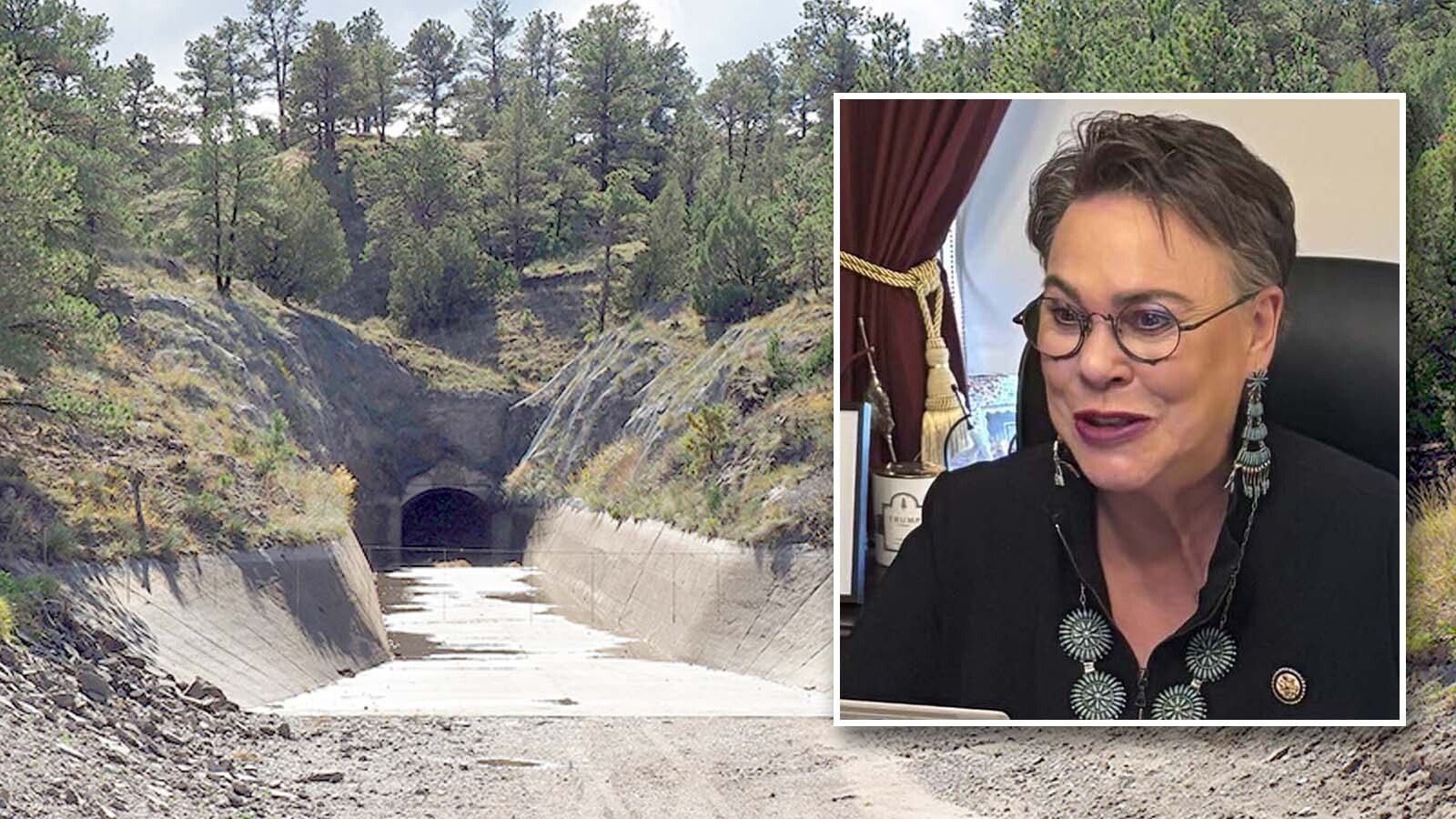
U.S. Rep. Harriet Hageman, R-Wyoming, did not reply to a request for comment on the filibuster.
Filibuster History
Before 1917, there was nothing to stop a single senator from blocking a bill. That year, the cloture rule was established, enabling a supermajority of 67 senators’ votes to advance legislation, overcoming a filibuster.
The rule was changed in 1975, lowering the vote threshold from 67 to 60 to end debate on a bill. But it remains a powerful tool for the minority because it is very rare for either party to hold 60 Senate seats.
“Whether praised as the protector of political minorities from the tyranny of the majority, or attacked as a tool of partisan obstruction, the right of unlimited debate in the Senate, including the filibuster, has been a key component of the Senate’s unique role in the American political system,” the Senate website’s section on the chamber’s history states.
The first Senate filibuster occurred in the first term of Congress in 1789, according to the website.
Sean Barry can be reached at sean@cowboystatedaily.com.