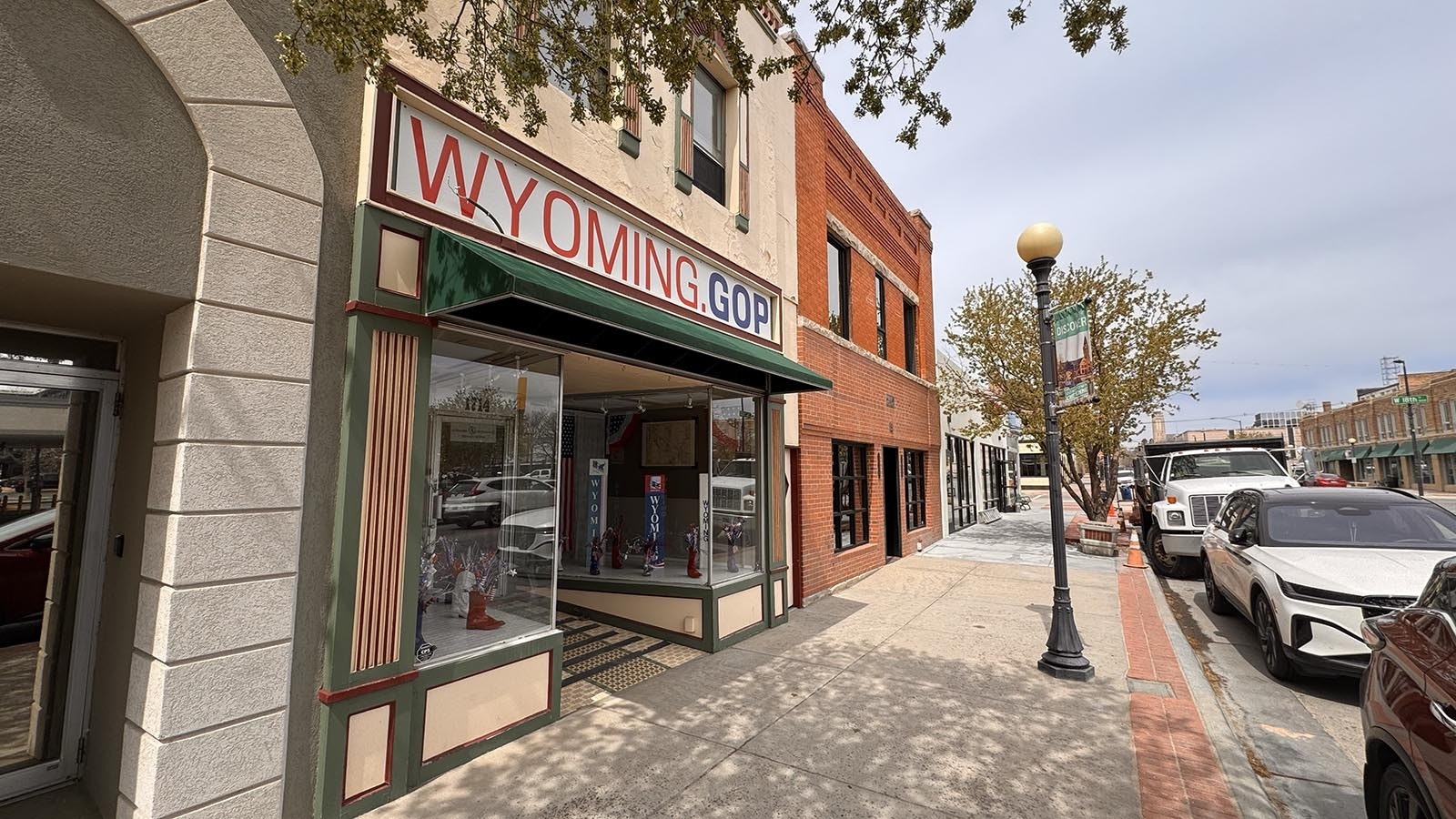
Saying court actions threaten its organizational autonomy, the Wyoming Republican Party on Tuesday sought numerous changes to state laws that restrict it.
But ultimately, the legislative Corporations, Elections, and Political Subdivisions Committee adopted one small tweak to the body of law addressing major parties as it met in Cheyenne on Tuesday.
Wyoming Republicans and Democrats at the ballot box choose precinct committee people — members of their own party, from within their neighborhoods, to vote within their county political parties.
If it becomes law, the change the committee advanced Tuesday would let party members who haven’t been elected vote at county party meetings — as long as they were appointed in line with party’s bylaws and registered with the Secretary of State’s office.
The tweak means that the county party chairman and other officers wouldn’t have to be elected by the people of their local precincts to vote at party meetings. They could be chosen in accordance with the party’s rules instead, under the bill.
The proposed change now advances to the state’s lawmaking session, which opens Feb. 9.
Detractors, like Gail Symons, of lobby group Civics 307, said the bill tweaks one portion of law without addressing the whole, and tries to dodge broader public involvement — despite the state party’s use of publicly-funded elections and its involvement in filling public office vacancies.
In the current system, “local voters choose their representatives. Authority stays close to the people,” said Symons.
But in practice, she added, “decisions are being concentrated at higher levels of the party…. Unelected insiders (are voting) in leadership elections, undermining grassroots accountability.”
Wyoming Republican Party Chair Bryan Miller, conversely, said loosening restrictions on the state party will preserve its autonomy as a group, and curb “lawfare” by ill-intentioned people seeking to meddle with its work.
That's a reference to recent lawsuits against the party - one of which resulted in a legal setback for the party last week.
Sen. Brian Boner, R-Douglas, was not present for the meeting.
All committee members present voted in favor of the bill except Sen. Dan Dockstader, R-Afton, Rep. Mike Yin, D-Jackson, and Committee Co-Chair Sen. Cale Case, R-Lander.
‘Probably’ Violated Law
Both Symons’ and Miller's claims echo the arguments in an ongoing court case.
Uinta County District Court Judge James Kaste ruled last week that the Wyoming GOP "probably" violated state law while upholding non-precinct committee members’ post-election votes for the Hot Springs County Republican Party’s leadership this spring.
Those late votes changed the outcome of the county party’s leadership elections.
Kaste also found the GOP’s actions harmed the ousted county party leaders.
But the judge stopped short of undoing the election maneuvers, saying that would upset the status quo.
For a judge to use words like “probably” or “likely” at this stage in litigation is appropriate and widespread: Kaste was weighing a mechanism of law by which the plaintiff – in this case the ousted leaders – can receive a temporary, court-ordered pause of someone’s actions by showing that the person “probably” will lose the case, and that the actions harmed the plaintiff.
If the bill passes, it won’t turn back time and change the way the party’s election unfolded, nor the laws that applied to it at the time, the ousted leaders’ attorney Clark Stith told Cowboy State Daily on Tuesday.
Stith declined to opine on whether the bill is good or bad policy. It’s in the legislature’s purview, he said.
“But you can’t make it retroactive, right - because you can’t change the rules of an election after the election is over,” said Stith.
The Ask
Miller asked the committee on Tuesday for a more exhaustive revamp of the state’s restrictions on the major parties, but the committee did not pursue that.
“I just want to caution everybody, and you too, Mr. Miller,” said Committee Co-Chair Sen. Cale Case, “I just want to stick to the bill that’s been properly noticed to the people.”
Miller, conversely, had said Wyoming is “way more restrictive” than a vast majority of other states on its major political parties.
He referenced a federal judge’s recent rulings in Westenbroek v. Kappa Kappa Gamma, the case of a sorority whose University of Wyoming chapter inducted a transgender member – prompting six other members to sue.
That judge ruled that the sorority has a private association right under the First Amendment, to admit whom it wants without court interference.
The state GOP wants similar autonomy, its Tuesday testimony and court arguments of last week indicate.
It shouldn’t have it, Symons countered, because the state major parties play a huge civic role: nominating people to vacancies for many major elected offices – offices whose figureheads serve Wyomingites of all party affiliations.
Some of Miller’s requests included broadening the specifics that define the three delegates each county party must send to the state central committee; and specifying elsewhere in law that none of the county’s elected officers need to be county central committee members.
The latter change would reaffirm what is already the reality: that the statewide party delegates don’t need to have been elected by their neighbors.
No one from the state Democratic Party addressed the committee on the bill during Tuesday's meeting.
Yin said he didn't want to legislate the major parties without hearing from both of them.
But Why Should Everyone Care?
When anyone in the U.S. Senate, or anyone in statewide elective state offices except the governor, or any state legislator or county official leaves his seat vacant, the incumbent’s party chooses three nominees to fill the seat.
From those, the governor or the county commission (depending on the office) chooses one appointee.
U.S. Sen. John Barrasso was first appointed after the state GOP nominated him.
State Sen. Taft Love, R-Cheyenne, was appointed this way in August.
Clair McFarland can be reached at clair@cowboystatedaily.com.