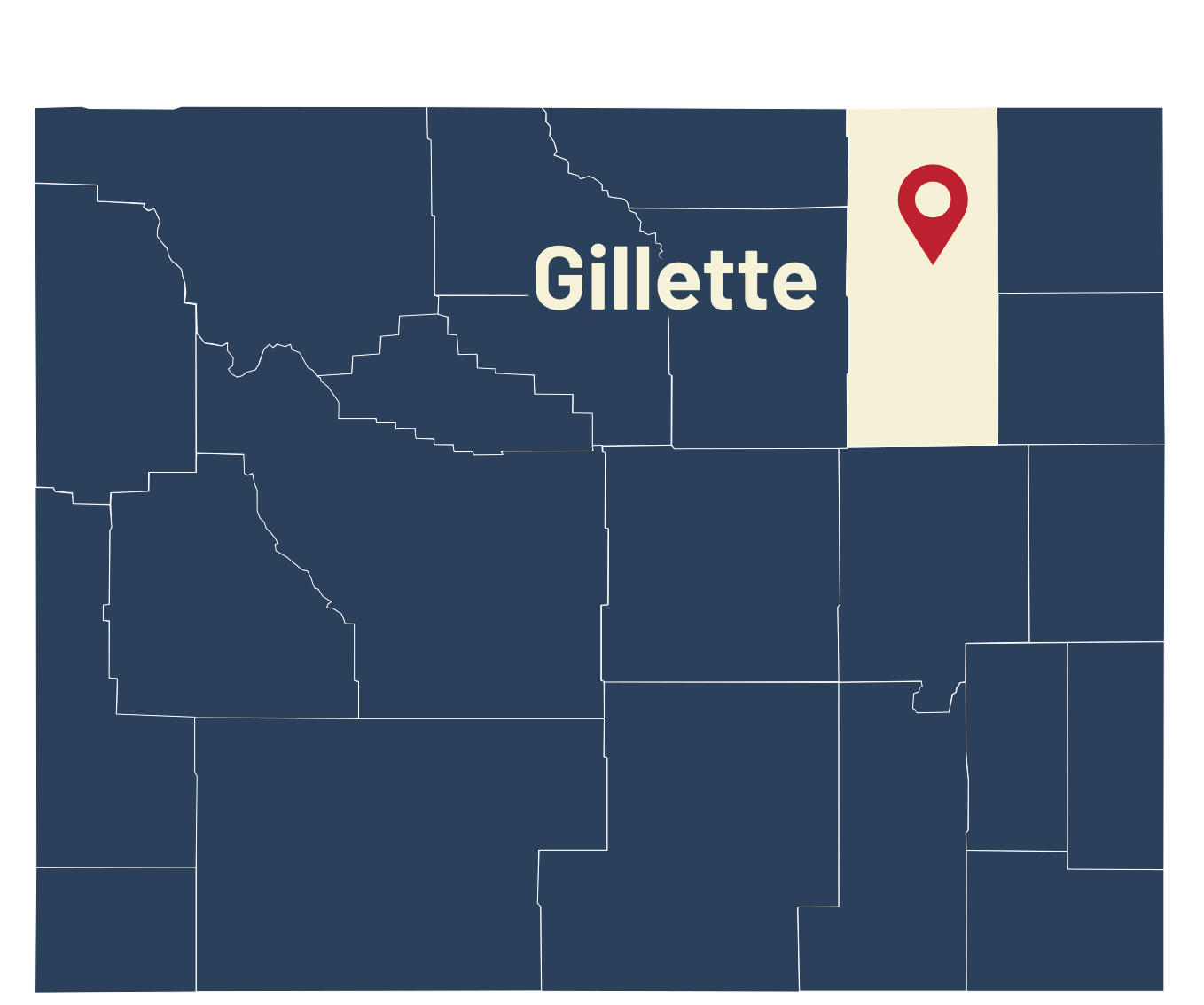

A Gillette man who was sentenced to three life sentences without parole for his involvement in killing two people when he was 19 does not get a chance to earn a better sentence, the Wyoming Supreme Court has ruled.
Presenting science behind the idea that 19- and 20-year-olds are comparable to juveniles in mental development, Christopher Hicks, now 39, asked the high court to consider his triple life sentence cruel or unusual punishment in light of his youth when sentenced.
Even if the science backs that theory, those arguments are for the Wyoming Legislature to consider, not the courts, Justice Robert Jarosh wrote in a unanimous Oct. 21 opinion for the state’s high court.
The Eighth Amendment to the U.S. Constitution bans “cruel and unusual punishment,” language by which jurists over the years have barred not just torture, but also disproportionate sentences.
Wyoming’s Constitution puts an is arguably more protective, banning “cruel or unusual punishment.”
Using “or” instead of “and” makes cruel punishment unconstitutional on its own. The same goes for unusual punishment.
The Eighth Amendment protects juveniles from being sentenced to mandatory life in prison without parole. It also protects them from capital punishment.
But even if it is more protective than the Eighth Amendment, the Wyoming Constitution’s cruel or unusual punishment provision doesn’t go so far as to limit the state’s ability to put a 19-year-old away for his entire life, the Wyoming Supreme court concluded.
“Although we commend Mr. Hicks for his personal growth and development while serving his sentence, we find the district court did not err when it denied Mr. Hicks’ motion to correct his sentence,” the opinion says.
Even if the science supports that people ages 18-21, or “emerging adults,” are on par with juveniles mentally, the Legislature hasn’t adopted that view.
It’s drawn a bright line at age 18 for different sentencing parameters under the murder laws, one that Hicks failed to show is arbitrary in light of other laws, tradition and the Constitution, the high court wrote.
“We understand Mr. Hicks disagrees with the Legislature’s decision to draw the line between adults and juveniles at 18 years of age,” the opinion says. “But we cannot say that line was drawn arbitrarily.”
The Legislature changed its laws in 2013 to comply with the 2012 U.S. Supreme Court case Miller v. Alabama, which forbids life without parole for juvenile offenders.
Lawmakers carved out a softer category for juveniles convicted of first-degree murder: they would be punished by life in prison and eligible for parole after 25 years in prison.
First-degree murder for adults remains punishable by life in prison or the death penalty in Wyoming.

‘Disappointed’
Hicks’ appeal attorney Lauren McLane delivered a somber comment in a Monday phone interview with Cowboy State Daily.
“We’re extraordinarily disappointed that a court that has been desperately wanting to engage in independent state constitution analysis seems to have avoided that altogether,” said McLane. “There’s no real guidance on what Article 1, Section 14 of what the Wyoming Constitution actually means.”
That’s a reference to the “cruel or unusual” clause.
This case bore so much “unrebutted science that Chris and other emerging adults — that their brains are nearly identical to juveniles’,” she said.
To then lose to the state’s procedural arguments is “disappointing to say the very least,” McLane added.
First, The Facts
Hicks was sentenced in 2006 to three consecutive, or back-to-back, prison terms without the possibility of parole, for two murders he helped commit when he was 19.
He grew up in Arizona and moved to Gillette with his parents in the ninth grade. He had trouble adapting, dropped out of school and joined the military, which medically discharged him for an injury while he was in basic training.
He returned to Gillette and started drinking and using drugs.
He moved into a home with 40-year-old Kent Proffit Sr. and three other men ages 18 and 19: Kent Proffit Jr., Jacob Martinez, and Jeremy Forquer, the opinion relates.
Hicks at age 19 was planning to bring a large quantity of marijuana to Gillette and asked Martinez to help him sell it, but the plan “supposedly went bad,” the document says.
The elder Proffit offered to help because he was “connected,” and he led both youths to believe he’d fixed their problems.
To repay him, Proffit Sr. said the two men owed him “favors,” the document says.
They were to kill a 16-year-old boy whom Kent Proffit Sr. was accused of sexually assaulting. They were also to kill Forquer because, according to the elder Proffit, Forquer was “working for the cops.”
Proffit coached Hicks on how to act like he was demonstrating a chokehold on Forquer, but then to choke him to the point of death.
As planned, Hicks acted like he was demonstrating the chokehold move on Forquer, but Hicks “indicated he was getting tired” after Forquer passed out, the opinion says.
The elder Proffit directed Martinez to get a rope and choke Forquer to death with it.
Proffit, Hicks, Martinez, and a 15-year-old “frequent visitor to the home” were all present.
The men cleaned up the kitchen, loaded Forquer’s body into the trunk of Hicks’ car, and dumped it along the interstate west of Gillette.
Or I’ll Kill You
The elder Proffit then reminded the youths he wanted to kill his alleged rape victim.
He told Hicks, Martinez, and the “frequent visitor” teen that he’d have them killed if they didn’t kill the boy.
“Together,” wrote Jarosh, “they decided to shoot (the teen).”
With Hicks alongside, Martinez shot the boy inside the boy’s home on the day after Thanksgiving.
He and Hicks hid empty bullet casings in another man’s garbage can, hoping authorities would suspect that man in the boy’s murder. They put the gun in a septic tank.
The boy’s mother later found his body, the document says.
Hicks faced the death penalty for two of his first-degree murder variation convictions, one for conspiracy and the other for being an accessory, but the jury didn’t choose it.
Wyoming has bifurcated death-penalty trials, where after convicting a man, the jury also must decide whether to send him to his death or life in prison.
This is unique from most sentencings, where the judge chooses the defendant’s sentence from within the range the legislature has allowed. Sometimes that range is narrowed further by a plea agreement.
The case judge then sentenced Hicks to one more consecutive life sentence for the other conspiracy first-degree murder charge of which he was convicted.
The Science
Scientific developments since his 2006 sentencing have shown that the brains of “emerging adults” essentially match those of juveniles, argued Hicks in his 2024 appeal, for which subject-matter experts submitted evidence.
Hicks asked District Court Judge Stuart Healy III to let him have a new sentencing in light of the new science.
The state’s attorneys urged Healy not to grapple with the case at all, saying the question of Hicks’ sentencing has already been handled and shouldn’t cross the court’s threshold a second time.
Healy saw fit to scrutinize Hicks’ request, however.
But he ultimately found that the law doesn’t support Hicks getting a redo sentencing hearing.
Jarosh’s unanimous court agreed, and ruled that Healy judged correctly.
Within The Jails
Hicks didn’t just invoke the Wyoming Constitution’s “cruel or unusual” clause.
He also invoked Article 1, Sections 15 and 16.
The first says “the penal code shall be framed on the humane principles of reformation and prevention.”
The second says no person confined in jail shall be treated with “unnecessary rigor.”
Taken altogether with Section 14, Hicks argued, these call for more protective rights for emerging adults.
The high court disagreed.
Section 15 limits the Legislature, not judges and juries sentencing people within the parameters the lawmakers have set, the opinion says.
And Section 16 addresses the conduct of jails, not the decisions of sentencers, it adds.
The Wyoming Constitution also has wording justifying Hicks’ tough sentence, wrote Jarosh.
Article 3, Section 53 says the Legislature “may by law create a penalty of life imprisonment without parole for specified crimes.”
The high court also hesitates to call Wyoming’s first-degree murder penalty unconstitutional, since such laws are presumed constitutional, Jarosh wrote.
Wyoming’s early Territorial Supreme Court warned the state’s future courts not to alter the legislature’s will without finding a law is “unconstitutional beyond reasonable doubt.”
The U.S. Supreme Court in the 20th century moved toward “a more active jurisprudential orientation” — a polite way of saying it’ll tweak legislative intent with less cause.
But states don’t have to follow that playbook since they run on different constitutions, and Wyoming courts in particular have a tradition of deference, Jarosh wrote.
Another place the Wyoming Supreme Court doesn’t have to follow the U.S. Supreme Court’s lead, says the opinion, is in adopting the federal “evolving standards of decency” approach to Eighth Amendment rulings.
“This Court does not blindly adhere to federal precedent when interpreting our constitution because the Wyoming Constitution is ‘a separate and independent source of protection’ for its residence,” wrote Jarosh, quoting a 2005 Wyoming Supreme Court case.
Under the Wyoming Constitution, the opinion says, Hicks’ triple life sentence is not cruel or unusual.
“We find that Mr. Hicks has not demonstrated the harshness of his penalty is disproportionate to the seriousness of his offenses,” the opinion says.
Clair McFarland can be reached at clair@cowboystatedaily.com.