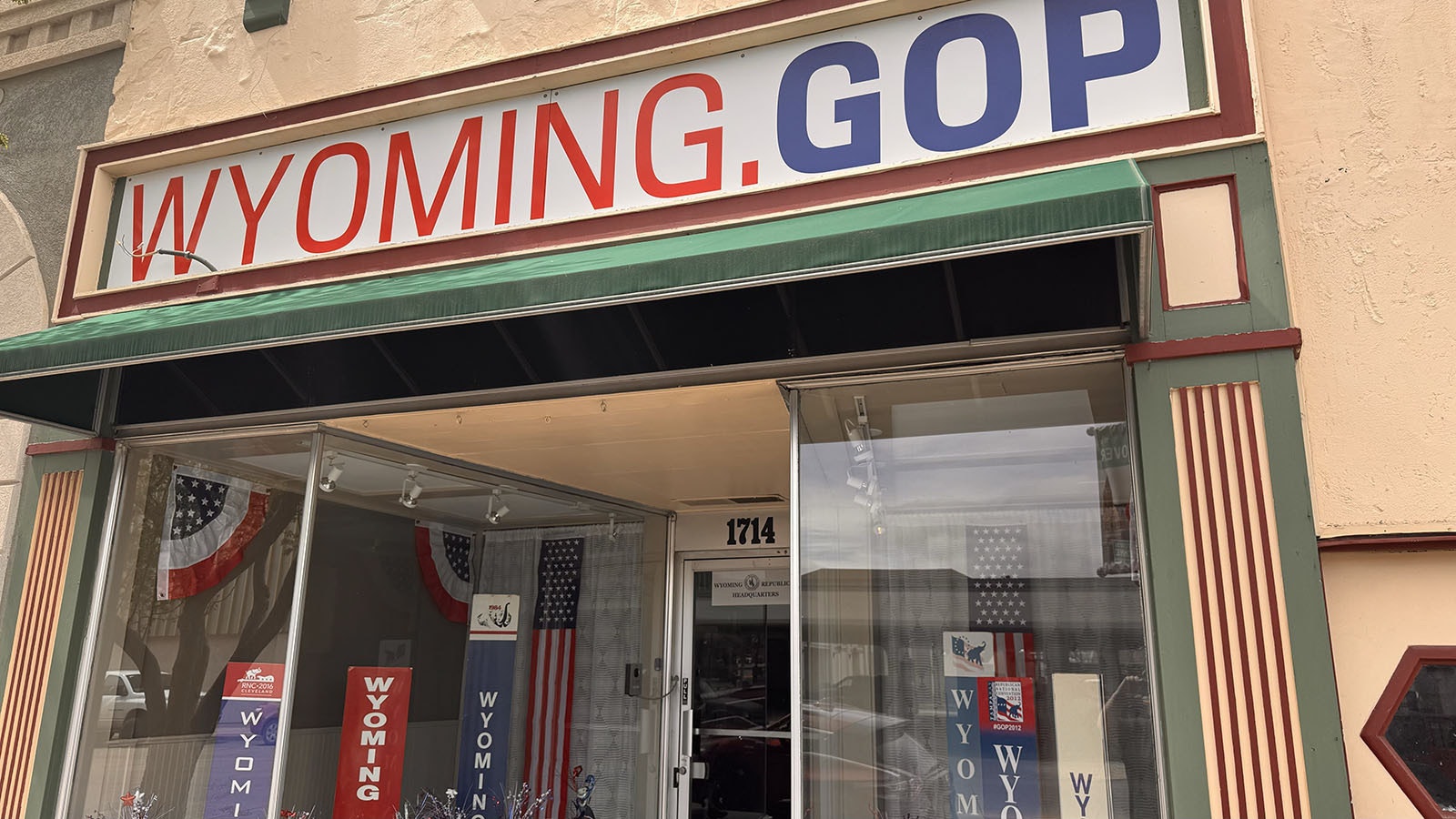
An Evanston-based judge on Monday declined to dismiss a legal challenge by Thermopolis Republicans accusing the Wyoming GOP of waging backroom power plays to thwart state law and cheat people of fair representation.
Hot Springs County Republican Party members who were elected to leadership positions in April saw their elections undone when people who aren’t part of the central, or voting, committee within the party were allowed to enter “provisional ballots” casting late votes for other candidates, court documents say.
State law says only precinct committee members who are elected at the primary election can vote for the state party delegates.
When the ousted county party leaders sought relief, the Wyoming Republican Party had its Dispute Resolution Committee conduct an “arbitration," at which the ousted members’ lawyer was not allowed, the plaintiffs say in court documents.
Uinta County District Court Judge James Kaste cast this as problematic and said the plaintiffs, represented by their attorney Clark Stith, probably have a sounder legal argument than the state party.
Also, two of the plaintiffs — Joe Martinez and Phillip Scheel — were harmed by being stripped of posts to which they were reportedly elected, the judge indicated.
The party had argued that its First Amendment right to associate freely should discourage the court from getting involved.
That right exists, Kaste countered, but it must be weighed against the people’s right to “fair and orderly” election processes managed by state laws, he said.
“Here, I do not think that the statutes at issue impose severe burdens on the parties’ associational rights,” said Kaste. "They do not dictate who gets to be a member of the party, or who gets to serve in management roles, just that there is a fair and orderly process for selecting the state central committee members that reflects the will of the party members who voted in the primary election, rather than the dead-hand control of entrenched party insiders.”
No Block On That Re-Vote
But Kaste stopped short of reversing the allegedly illegal re-vote.
The judge voiced a reluctance to upset the “status quo,” even though it appears to have been forged by “this thing that was called an arbitration and yet looks nothing like it.”
Though he wouldn’t take the “extraordinary” remedy of ousting the county party leaders accused of ascending to their posts on an illegal election, this case should be resolved quickly, said Kaste.
He ordered Stith and state Republican Party attorney Caleb Wilkins to file motions for summary judgment by Jan. 12. He said he’d hear arguments about those motions on March 11.
A motion for summary judgment amounts to asking the judge to end the case early in one’s own favor, rather than hearing it out at a trial.
Treat Us Like That Sorority
Wilkins had asked Kaste to dismiss the ousted partisans’ legal challenge. He cited various cases and the doctrine of “abstention” — the idea that judges should leave internal operations of voluntary organizations alone, and not substitute their own rules for groups’ bylaws or agreements.
Wilkins said the party will be challenging parts of Wyoming’s election code if Kaste “(wades) into these constitutionally fraught waters”
He invoked the group’s First Amendment right to free association.
The U.S. Supreme Court has ruled generally that private voluntary groups can dictate their own terms without government interference under the right of association.
A Wyoming-based federal judge, District Court Judge Alan B. Johnson, upheld that right in a case where a group of women sued the Kappa Kappa Gamma sorority for inducting a transgender member, on its University of Wyoming campus.
The Wyoming Republican Party asked Kaste to treat it the way Johnson treated that sorority — by leaving it alone.
“To the extent that a sorority in Laramie’s rights of association and self-governance prohibited a court from engaging in a review of its bylaws, I’d posit to the court that the rights of Wyoming Republicans … are greater than those of any such sorority,” said Wilkins.
‘I’m Really Stunned’
Stith said he was “really stunned” at portions of Wilkins’ argument, which he saw as undermining the role that major political parties play in state and county governance.
When a vacancy surfaces the office of U.S. senator, and any of the five statewide executive branches except for governor, the state major party whose incumbent left the vacancy gets to choose three nominees to fill it.
The governor chooses the new official from among those three.
In county elected seat vacancies, the county party chooses the three nominees and the county commission chooses from among them.
Longtime Republican U.S. Sen. John Barrasso "was appointed through this process, in the state central committee in 2007,” noted Stith. “It launched his career as a U.S. senator. That’s a big deal.”
Gov. Mark Gordon was nominated by the state party to serve as state treasurer, which propelled him toward his office, Stith added.
To that Wilkins countered that the plaintiffs aren’t claiming a vacancy-filling process was warped by faux leadership.
Stith argued back that those vacancy-filling processes last just 15 days and it would be difficult for a court to remedy such a process while it was ongoing, as this case’s six-month timeline has already demonstrated.
And the Wyoming Senior Assistant Attorney General Megan Pope argued, simply and briefly, that the state’s election laws are constitutional.
‘What We’re Gonna Do’
Kaste discouraged the lawyers from digging into the minutiae of how that election unfolded. This case hinges on questions of law, he said.
The “hands-off approach” for which Wilkins is asking is limited when state law is implicated, the judge said.
During his questions to the lawyers, the judge kept asking whether it’s relevant that Wyoming governments pay for and run the parties’ community-facing elections when primary-ballot voters choose precinct committee men and women from their local neighborhoods.
Because the questions involve state law, the court “may not and should not” abstain from getting involved, he said during his later ruling from the bench.
“There is a substantial body of corporate law out there that says essentially a bylaw that is inconsistent with any statue or rule of common law is void,” said Kaste. “That seems like an important rule of law here because there’s a whole bunch of stuff in the Republican Party bylaws that seem to be the opposite of what the Uniform Arbitration Act provides.”
Neither attorney argued on the terms of the Uniform Arbitration Act. Kaste voiced surprise at that, indicating that it seems relevant here.
“I don’t really think it’s disputed,” added Kaste, that the Dispute Resolution Committee didn’t follow the state laws on which party members can vote for their state delegates.
The arbitration order says the state party group believed it didn’t have to follow those laws because it finds them unconstitutional, he said.
To the constitutional sorority-case argument specifically, Kaste said it appears that Wyoming’s laws don’t violate the party’s right of association and he will "probably" uphold them.
Hedging terms addressing probability and likelihood are common at this early, preliminary-injunction phase of civil cases.
Clair McFarland can be reached at clair@cowboystatedaily.com.