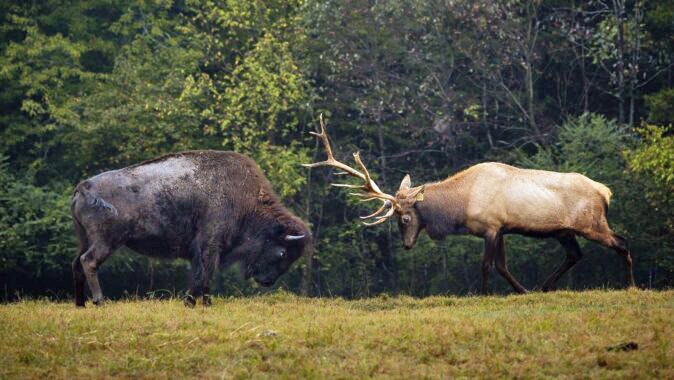
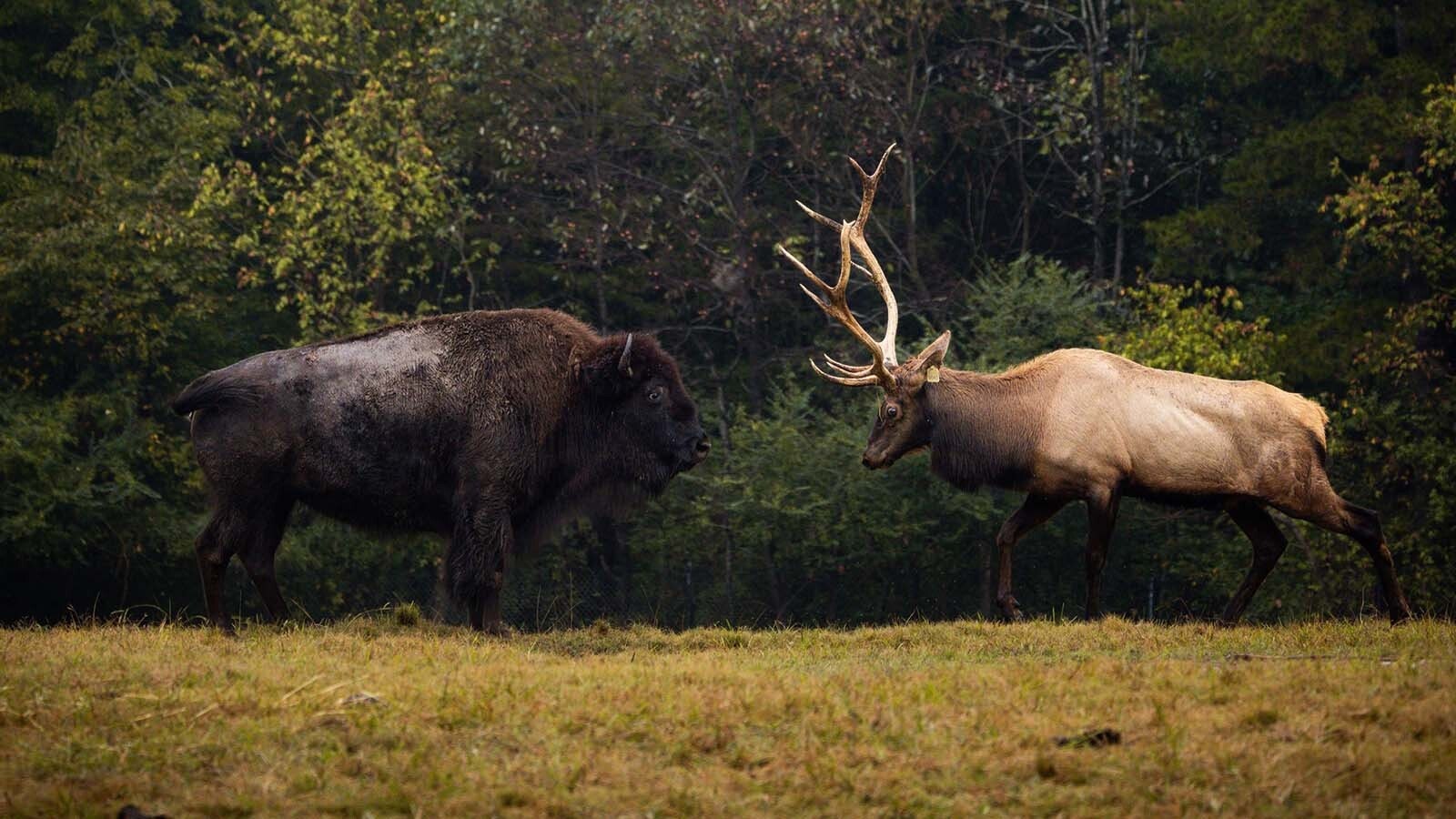
A face-off at the North Carolina Zoo had two of Yellowstone’s most iconic animals squaring off with each other in what would be a one-sided fight in the wild.
The North Carolina Zoo in Asheboro is the world's largest natural habitat zoo, with over 2,800 acres and 1,700 animals. The zoo’s Prairie habitat is home to small herds of American bison and elk.
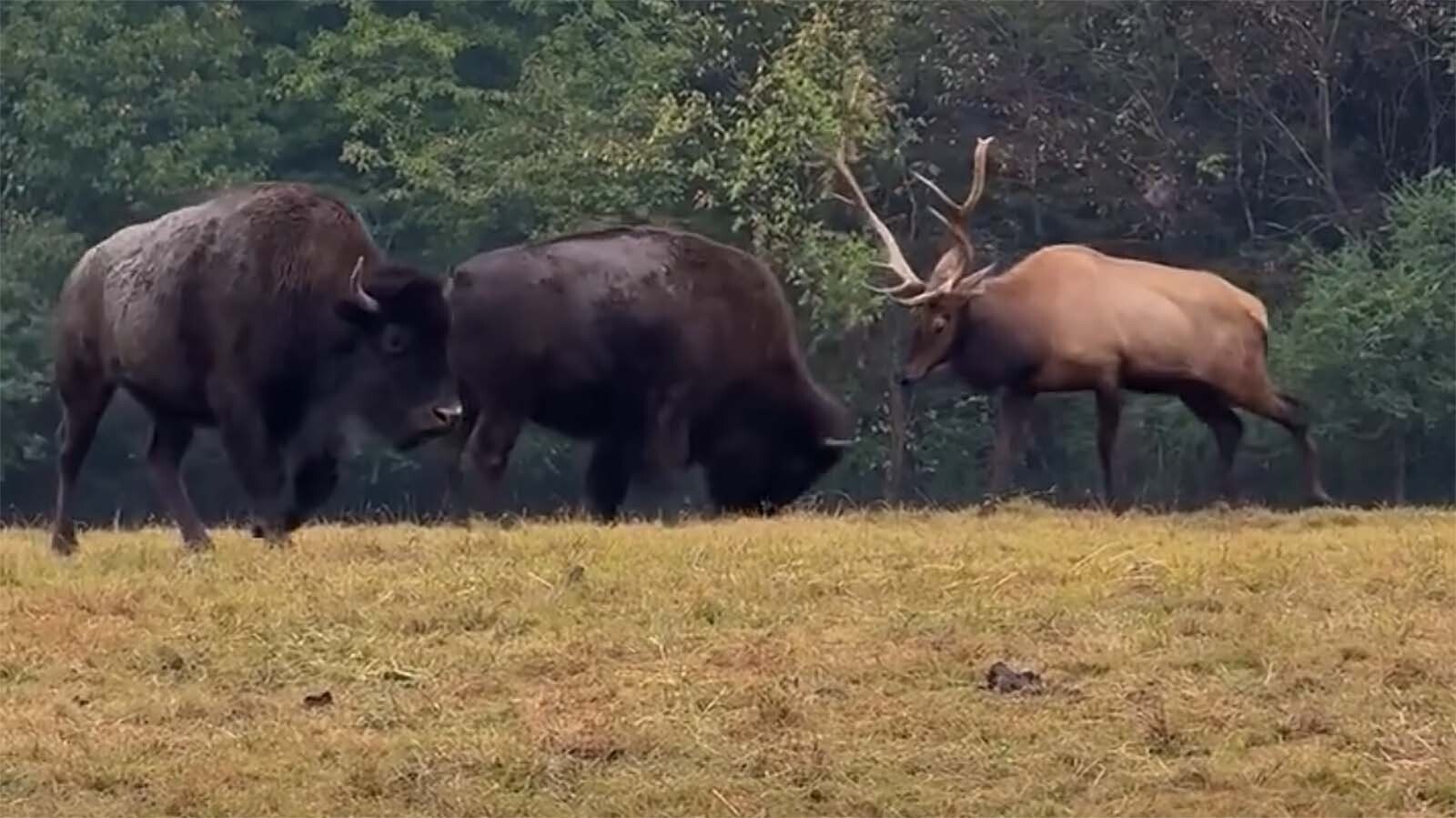
“Tommy,” the bull elk in the Prairie habitat, decided to do some macho-posturing with a cow bison, lowering his impressive antlers in an attempt to engage in some tussling. The bison seemed to be sizing up the competition, but was soon sent running, with Tommy victoriously bugling as it tore away.
No charismatic megafauna were harmed in the showdown, and a video of the encounter has been viewed over 3 million times. However, this “arena match” doesn’t reflect the likely outcome of what would happen in the wilds of Wyoming.
No Contest
Bison and elk have peacefully cohabitated in the Greater Yellowstone Ecosystem for hundreds of thousands of years. But if they ever come into conflict, the showdown at the North Carolina Zoo isn’t an accurate representation of what would happen.
A mature bull elk can weigh between 700 and 1,200 pounds, while an average cow elk weighs around 1,000 pounds. Between their bulk and build, even a maximum-sized bull elk would have little chance against a bison.
Ecologist, author, and bison advocate George Wuerthner believes the circumstances of this encounter can’t be ignored. The zoo’s 11-acre enclosure is a far cry from the vast expanse of Yellowstone National Park.
“When you have a fenced enclosure, the animals don’t have the ability to choose where they can go to avoid conflict,” he said. “In a more open situation, as you would have in the wild, they can separate without being in direct competition.”
Bison and elk can cohabitate because they have plenty of space to spread out as they forage for food. In Wuerthner’s experience, they tend not to intermingle.
“You don’t see elk grazing in the middle of bison herds,” he said. “Herd animals don’t have territories, like wolves, because they’re feeding on plants that are widely dispersed. You might see bison and elk grazing in the same field, but they’ll be hundreds of yards apart.”
Tommy the bull elk might have decided that antagonizing a bison might have been a great way to impress his harem of cow elk, or perhaps he was just bored. That’s the safety that comes from a cushy zoo life.
Grass Is Always Greener
If bison and elk ever came into direct competition, it would probably be over food. Everybody likes grass.
“There's quite a bit of dietary overlap between bison and elk,” Wuerthner said. Bison are primarily grass eaters. Elk can eat other things, like willows and shrubs, but they prefer to eat grass.”
According to the National Park Service, grasses, sedges, and other grass-like plants make up 90% of a bison’s diet. They will occasionally eat woody plants and “browse,” like leaves and stems, but that’s a fraction of their dietary intake.
Elk, meanwhile, eat anything from grasses, herbs, and shrubs to tree bark, conifer needles, and aquatic plants. While they are primarily grazers, they have a more generalized diet than bison.
Wuerthner said that’s one of the reasons why elk are more abundant than bison. Their broader dietary options mean they can thrive in areas that bison would tend to avoid.
“When (The Great Fire of 1910) burned through northern Idaho, it killed a lot of the mature trees, and the regrowth was all sorts of shrubby vegetation,” he said. “That led to a massive increase in the number of elk in those areas, because they could utilize that for food. Bison would eat those shrubs, but they’re far more preferable to grass.”
Elk can also traverse rougher terrain than bison. While bison prefer grazing in flat, open areas, elk can ascend into high-elevation, mountainous areas to feed on whatever’s growing there.
“That’s why there is less direct competition between elk and bison,” Wuerthner said. “Elk are nimbler than bison, and they can tap into the food they aren’t going after. There's always more grass just up the next hillside.”
Gluten Grazing Intolerance
Wyomingites are more likely to encounter elk than bison in the Greater Yellowstone Ecosystem, but that’s not only because of their dietary preferences and habitats. Elk are, overall, wanted and tolerated more than bison.
If there’s a lot of dietary overlap between bison and elk, there’s tremendous overlap between bison and domestic cattle. According to Wuerthner, that overlap dictates where bison are allowed to exist in the Cowboy State.
“Grazing livestock is not allowed in Yellowstone, so (ranchers) are trying to bottle up bison in the park,” he said. “If bison were allowed on national forest lands outside of Yellowstone, which are open to grazing, that would inevitably lead to a situation where forage becomes a competition between livestock and bison.”
While elk can freely roam throughout and outside of the Greater Yellowstone Ecosystem, bison are more rigidly controlled. Ranchers and agencies like the Montana Department of Livestock are concerned that bison would directly compete and interact with livestock for grazing.
One of the most common reasons for these restrictions is the fear of brucellosis, but Wuerthner categorized that as “a cover” for the real reason.
“In Montana, almost every example of brucellosis being transmitted from wildlife to cattle has been from elk,” he said. “To me, the real reason brucellosis is brought up is to prevent bison from being widely established and to prevent forage competition.”
In that sense, the public may have already taken a side in the fight. When it’s elk versus bison, everyone’s behind the elk.
Push Comes To Shove
When put into direct competition, an elk probably wouldn’t stand much of a chance against a bison. However, it’s mostly a hypothetical discussion.
“That's not to say something like that doesn't happen once in a while, but it's certainly not the norm,” Wuerthner said.
Wuerthner said the only time bison and elk would be drawn into direct competition is during winter. When large herbivores are seeking the same limited resources in the snow-covered landscape, they could come into conflict.
“Harsh winters affect everybody equally,” he said. “Bison and elk are both looking for the remaining food, which might put them into direct competition over limited resources.”
At the North Carolina Zoo, the showdown was more about posturing and the projection of strength. Tommy might have beaten a bison, but he’d want to reconsider that confidence if he ever found himself in the wild.
“I have never seen an elk challenge a bison (in the wild),” Wuerthner said. “You usually don’t see direct physical competition between the two, but if you did, I think it’d be a pretty good assumption that the bison would win.”
Andrew Rossi can be reached at arossi@cowboystatedaily.com.