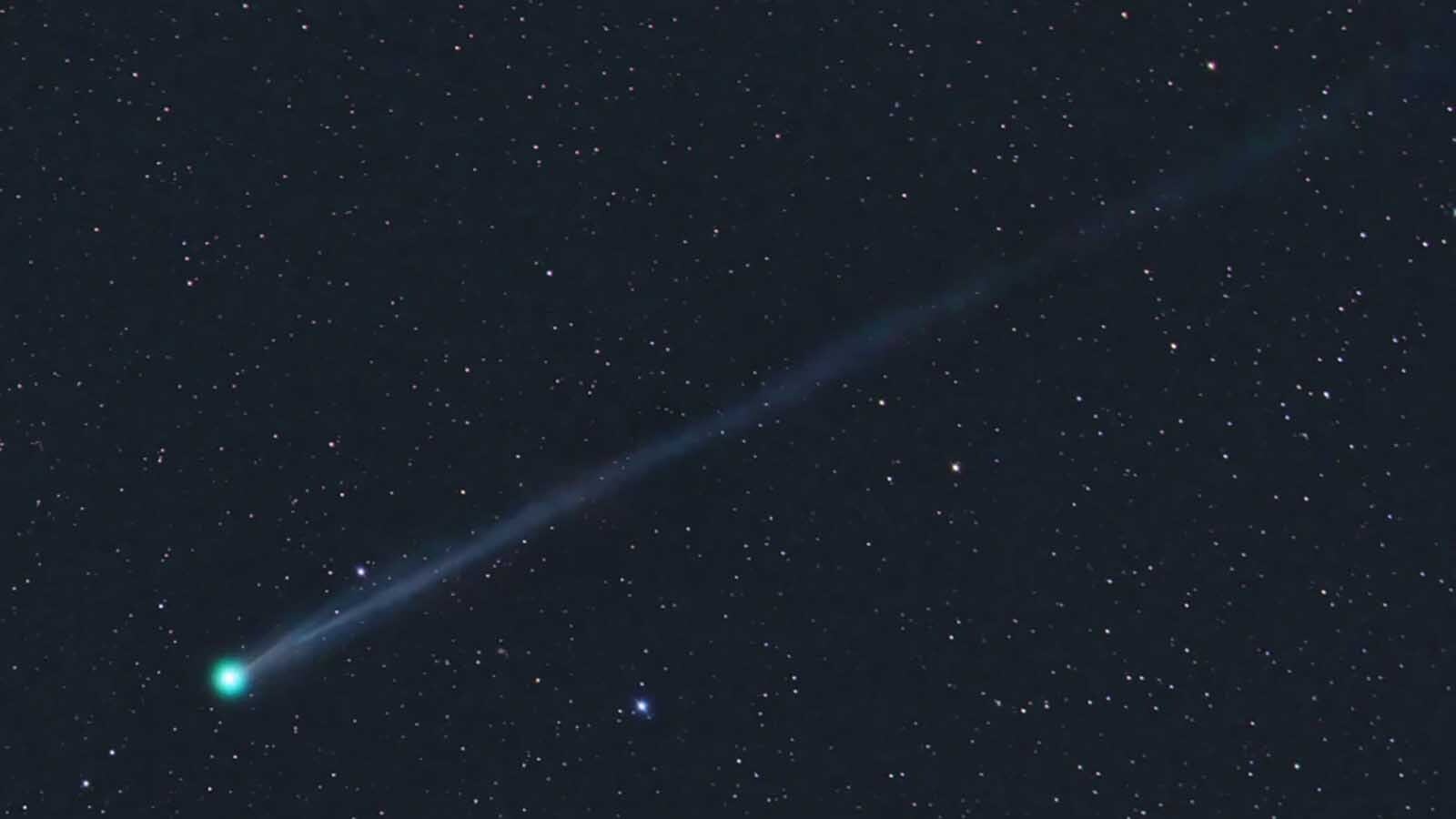
There’s a newly-discovered comet streaking across the night sky, and any Wyomingite with a good pair of binoculars can see it for the next month.
Comet C/2025 R2 (SWAN), the “SWAN Comet,” was discovered by an amateur astronomer on Sept. 11. Its current stellar magnitude is 7, slightly above the threshold of what's visible to the naked eye, making it relatively bright for a newly discovered comet.
Max Gilbraith, planetarium coordinator at the University of Wyoming, encourages Wyomingites to find the SWAN Comet while it’s visible. It might be a while before there’s another comet we can see from Earth.
“It’s hard to say, but we could have a drought until Halley’s Comet comes back in 2061,” he said.
Another New Comet
Most of the comets seen over Wyoming in the last several years, like Comet Tsuchinshan – ATLAS, have been recent discoveries. They’re smaller and less spectacular than Halley’s Comet, but modern technology makes them easier to spot.
Gilbraith said Comet SWAN is significant because it’s not from our neighborhood. Astronomers believe it originated from outside our solar system.
“It’s the third time we've ever discovered something coming from outside of the solar system,” he said. “We’ve found a string of objects that suggest we’re passing through an interstellar debris field or passed through one 200 years ago. If you ran the odds, the SWAN Comet might be once in a lifetime, but we've seen three of these comets in eight years.”
According to the website EarthSky, Australian comet expert Michael Matiazzo captured an image of the comet on Sept. 14. Its trail was 2.5 degrees long, which is five times larger than the diameter of the moon.
The SWAN comet is still low on the western horizon, which makes it difficult to see. Over the next few weeks, the view will get better.
“When a comet’s close to the Sun and really low on the horizon, the amount of air mass we're looking through reduces its brightness, quite a bit past where the naked eye can see it,” he said. “The viewing angle will get better as we get into October, so it'll be easier to see it.”

During The Drought
Drought is a year-to-year concern for farmers and ranchers, but Gilbraith said Earth has been in a “comet drought” for decades. The fact that we’ve seen so many recently is an exception to a generational rule.
“From our records, we get a nice, bright comet every decade or so,” he said. “That’s when you can expect one, historically. But we’ve had a big drought of comets in the last decade.”
Halley’s Comet last passed Earth on Feb. 9, 1986. The comet reached its perihelion, the furthest point of its orbit, on Dec. 8, 2023.
The comet is currently hurtling back toward Earth, but it’ll take 37 years for it to get here. According to Gilbraith, that might be the next best comet that’ll be easily visible.
“The cool-looking comets have to be in our neighborhood and pretty close to the sun at the same time for us to see them,” he said. “Most of those comets are currently on the far side of the sun, or way out by Mars or Jupiter. They're just not really that bright and impressive to us now.”
What, When, Where
Wyoming’s view of Comet SWAN isn’t great at the moment, but it should still be visible, close to Mars, with a telescope, binoculars, or a camera with a long exposure. It will pass through the constellation Libra on Sept. 28, and move into Scorpius by Oct. 10
One of the best times to see any comet is when it makes its closest approach to Earth. Comet SWAN will reach that point on Oct. 20.
“It’ll nearly be a new moon that night,” Gilbraith said. “If you’re in a clear dark spot, you might catch it above the constellation Sagittarius, near the Milky Way.”
The comet’s tail probably won’t be five moons long by that point, as it’ll be further from the sun. Its stellar magnitude is anticipated to be around 5.8, just at the threshold of what’s visible to the naked eye.
Comet SWAN won’t hold a candle to Halley’s Comet, but you don’t see a comet every night. Gilbraith thinks Comet SWAN is worth a look, if only because there might not be another visible comet until Halley’s Comet gets back.
“As far as the naked eye goes, the beautiful comets that put on a spectacular show in the night sky are still a once-in-a-decade occurrence,” he said. “There's lots of fun stuff to look at in the night sky with binoculars, and while you're scanning around, you might spot this little comet with a tail.”
Andrew Rossi can be reached at arossi@cowboystatedaily.com.