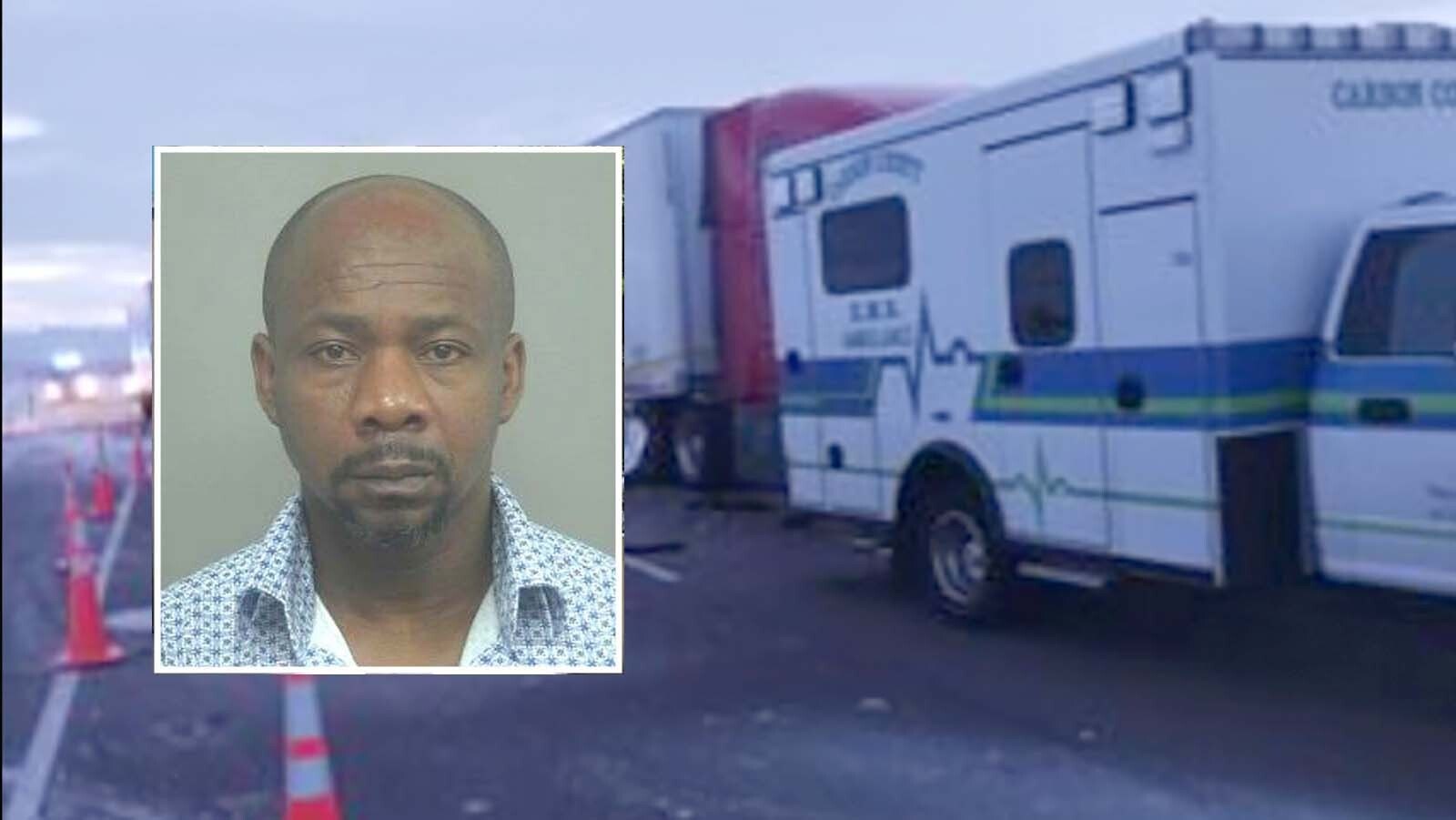
In day four of the vehicular homicide trial of a Haitian trucker accused of recklessly killing one EMT and severely injuring another with a commercial truck on Interstate 80, the driver took the witness stand Thursday in his own defense.
Saviol Saint Jean, 46, faces one count of aggravated vehicular homicide, another of aggravated assault, and a third for not moving over for emergency vehicles. He faces up to 30 years in prison if convicted.
On Tuesday he ascended to the witness stand, swore to tell the truth, and through an interpreter said that when the Vamar commercial truck he was driving collided with Tyeler Harris and Tiffany Gruetzmacher — killing Harris — he had failed to respond to the chaotic light and shape patterns cast by emergency lights where their ambulance was parked on the road.
Then he braked and tried to stop, but it was too late.
“After the accident I began to call onto God — saying ‘Oh my God, oh my God, what happened?’” Saint Jean testified.
Gruetzmacher was taken to emergency care with back, neck, head and hand fractures and other injuries.
Background
Before 4 a.m. on Dec. 21, 2022, a red Ford F-150 hauling a trailer jackknifed across Interstate 80 in Sweetwater County near the Carbon County line.
A commercial truck driven by Osvaldo Herrera-Pupo hit the truck and trailer, sending the truck into the left-side median off the road and leaving trailer debris across the interstate, court documents say.
Herrera-Pupo’s truck came to rest in the right lane, leaving both lanes blocked: one with trailer debris, and one with Herrera-Pupo’s truck.
A double-trailer combo driven by Utah-based trucker Andrew Gibbs maneuvered around the crash onto the left side, where it got stuck.
Other cars passed on the right shoulder, according to court testimony.
The ambulance arrived and parked west of the overturned, wrecked trailer — mostly or entirely within the left lane, lights blazing.
Saint Jean approached, switched from the right lane to the left and collided with the ambulance.
On The Witness Stand
Saint Jean testified Tuesday that he lived in Haiti until he was 41.
He’d received training as a diesel mechanic, but then worked as a police officer for his last nine years in Haiti, he said.
Saint Jean said he worked at a “fixed” station, or a post where he had to monitor a set region for suspicious activity.
He moved to the United States on Feb. 16, 2020, after he and his wife considered their daughter and the impending threat of armed groups that wanted to target him for being a police officer, he testified.
“We decided to come here. Because I wasn’t safe there as a police officer,” said Saint Jean via his Creole-English translator.
First he tried to join the U.S. Army, he said. At first his age wasn’t an issue to the recruiter, but the recruiter wanted a green card. Saint Jean already had a work permit, he testified.
Getting a green card took longer during COVID, and by the time he had it, he was 42 and his age had become an issue, Saint Jean testified.
COVID also delayed his learning of English, and he said he resorted to using Facebook and YouTube instructors.
In 2022, Saint Jean took commercial driving courses in Miami, Florida.
Saint Jean received his commercial driver’s license that year and started driving for Vamar a haul route stretching from Chicago, Illinois, to Portland, Oregon, and back, alternating with a co-driver.
The Political Firestorm
Here, Saint Jean’s defense attorney Joe Hampton touched on a political hot topic with his questioning: the licensing of commercial drivers who are not proficient in English.
It’s a longstanding federal rule that U.S. commercial drivers should be able to converse with the general public, follow law enforcement orders, fill out log books and read signs in English. President Barack Obama’s administration paused that rule in 2016, so that highway inspectors could not pull truckers from the roads for breaking it.
President Donald Trump revived the rule this year.
Under Hampton’s questioning, Saint Jean testified that he took the CDL courses and test in English, not Haitian Creole.
He would later testify, however, that he believes Rawlins Police Department Sgt. Christopher Craig misunderstood him during a post-crash interview Dec. 21, 2022.
That was due to the language barrier, and trauma was also a factor, Saint Jean added.
Herrera-Pupo, who was driving the first truck that collided, needed his co-driver to interpret English speech for him, the co-driver testified Thursday.
U.S. Immigration and Customs Enforcement told Cowboy State Daily in a Tuesday email that it “has no involvement” with either man at this time.
As I Approached
Saint Jean testified that as he approached the jackknifed truck and trailer, the semitruck that had hit it, and the ambulance parked just beyond both wrecked vehicles, he wasn’t sure what he was seeing.
“As I’m getting closer, I was maneuvering the car so I can make a decision on what to do,” the translator related for Saint Jean. "It wasn’t very clear to me where the light was coming from.”
Saint Jean was operating on the presumption that emergency lights come from the right, since that’s where emergency vehicles often handle incidents, he testified.
He also saw the light to his right, he said. It seemed to be moving.
The light’s origin was in the left lane, where the ambulance was parked.
Saint Jean testified he was traveling around 50 mph.
Sweetwater County Attorney Daniel Erramouspe later challenged him on this during cross-examination, saying Saint Jean “volunteered” in his day-of interview with Craig that he was going 55-60 mph.
“The (question) from Sgt. Craig was, ‘OK, OK — um, can you tell me what happened tonight?’” said Erramouspe. “And your response was, ‘I was moving about 55-60.’”
The defense team’s crash analyst testified later Tuesday that Saint Jean could have been moving as slowly as 47 mph before he started skidding. This opinion disagrees with the Wyoming Highway Patrol’s investigative conclusion that he was going around 55 mph.
Both analyses have possible shortcomings. The Wyoming Highway Patrol’s crash reconstruction data included a misplaced skidmark marker.
The defense’s crash analysis firm used a 3D scan which, Erramouspe learned on cross-examination, had few fixed points in the barren Red Desert on which to base its reconstruction.
‘I Began To Call Onto God’
As Saint Jean got “very close,” he noticed the debris of the overturned, wrecked trailer.
“But by that time I was braking, and the truck would not stop because it was skidding,” he said.
He used the foot brake and the engine brake both, Saint Jean added.
Before the impact, he said he noticed a man in a “black T-shirt” going “from left to right.”
Saint Jean hit the ambulance, then learned later he’d hit Gruetzmacher and Harris.
That was when he started calling out to God, he said.
He saw a man come and remove Gruetzmacher from underneath the front of Saint Jean’s truck, where she’d been lodged.
According to prior testimony, that man would have been Andrew Gibbs, a trucker who escaped collision with the jackknifed truck prior to the ambulance’s arrival by swerving his double trailer combination into the left-side median and getting stuck in the snow.
“Part of me wanted to get down. Part of me was a bit afraid and scared just by the way he was speaking. I was fearful he would hit and strike me,” said Saint Jean.
Saint Jean later tried to get out of the car.
“But then he yelled at me and told me to sit down. And I sat down,” he said.
Gibbs dragged Gruetzmacher out from underneath the truck and went looking for Harris.
Gibbs found Harris under his own trailer in the landing gear of the frontmost trailer.
Harris had died on scene.
Cross
Under Erramouspe’s questioning, Saint Jean conceded that ambulances in Haiti are similar to those in the United States. They have emergency lights on the top of them.
Other bits the prosecutor elicited included Saint Jean’s statement that yes, he had to “pay attention” to work as a police officer.
When Erramouspe’s office filed criminal charges against Saint Jean in 2024, the latter was working as a security guard.
“And as a security guard, you have to pay attention to your surroundings as well, would you agree?” asked the prosecutor.
“Yes, I do agree with this, although we are still human,” countered Saint Jean.
Saint Jean also confirmed that the ambulance had passed him on the interstate some time before he crashed with it.
He couldn’t say for sure how many minutes elapsed between the two events.
“If an ambulance is stopped, it’s fair to think that possibly, the people in the ambulance are outside the ambulance; would you agree with that?” asked Erramouspe.
Saint Jean said he agreed, but wanted to elaborate.
Erramouspe told Saint Jean multiple times during cross-examination to respond with yes or no answers; and if he needed to elaborate, he could do so during Hampton’s redirect questioning.
“Obviously, people who drive ambulances are going to help people who may be injured; would you agree with that?” asked Erramouspe.
“Oui,” answered Saint Jean in Creole for “yes."
“And in order to help people they have to get out of the ambulance, to see if they’re hurt?” the prosecutor asked.
“Oui,” came Saint Jean’s answer.
Erramouspe emphasized differences between Saint Jean’s interview with Craig and his testimony Tuesday.
Nowhere in Saint Jean’s testimony with Craig did Saint Jean mention the lights moving, or a glare on his windshield, as he had Tuesday, Erramouspe noted.
That stemmed from trauma and language difficulties, as well as the fact that his company told him not to go to a follow-up interview with Craig, Saint Jean countered.
An expert witness for Saint Jean, biomechanics expert Lauren Eichaker, testified that based on the intense and chaotic stimuli — including the lights reflecting off of other vehicles as they moved — Saint Jean was driving "attentively" before the crash, albeit with a "suboptimal" outcome.
Redirect
Hampton let Saint Jean elaborate during redirect questioning.
“Prior to this incident, had you ever come upon people working in the roadway without some kind of advanced warning, like traffic cones, a cordon, a person directing traffic?” asked the defense attorney.
“That’s never happened to me,” answered Saint Jean. “Usually they have some type of uniform; they have signs — signs to direct people.”
The EMTs were wearing dark clothing, but with reflective striping, according to Gruetzmacher’s testimony last week.
Hampton has asked every witness of the scene to speak to how high the overturned trailer debris in the left lane was.
Saint Jean said he didn’t have an exact estimate, but knows his right-side mirror was damaged.
Erramouspe has countered this line of questioning by playing dash camera video from the car of the first trooper to respond after the ambulance crash.
Though the trooper approached the scene at 120 mph and Saint Jean’s Vamar truck sat crunched against the ambulance, the lights still are visible from a distance in the video, the prosecutor has emphasized with his questioning.
Saint Jean’s trial is scheduled to continue Wednesday.
Clair McFarland can be reached at clair@cowboystatedaily.com.