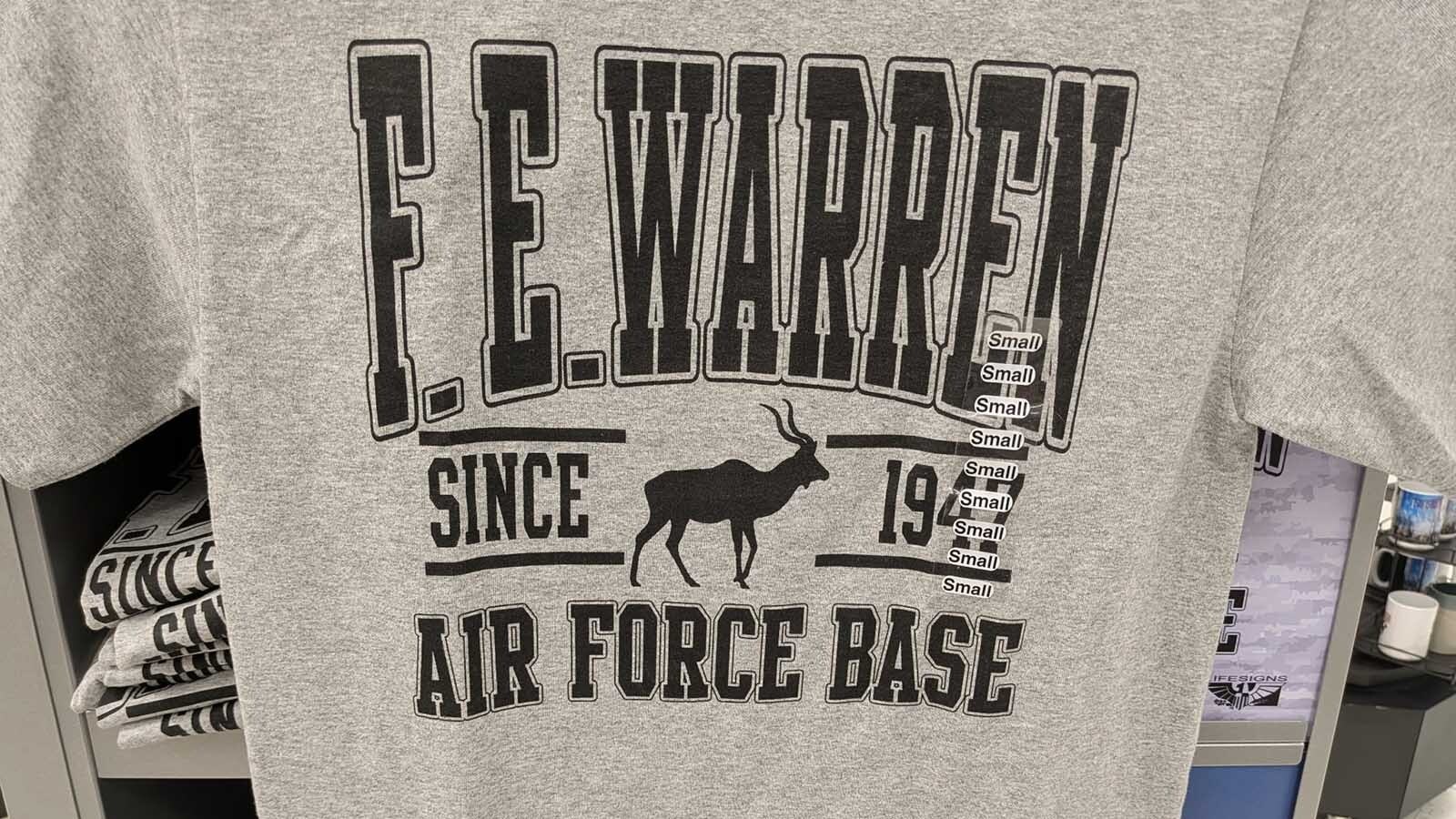
When Cheyenne resident Warren Burgess was looking around the F.E. Warren Base Exchange store Monday, he did a double take when he saw the silhouette of an African antelope on T-shirt commemorating the Wyoming air force base.
Turns out, it was simple miscommunication between the store’s staff and a shirt-maker when the store put in an order for roughly 50 shirts with an “antelope” on them.
The staff was thinking of Wyoming’s pronghorn, while the manufacturer apparently thought they meant the African species and put the silhouette of an antelope known as a greater kudu, which isn’t found in Wyoming. The kudu has a hump on its back and long, curly horns.
Critter Mix-Up
Pronghorn frequent the Francis E. Warren Air Force Base in Cheyenne. Folks in Wyoming and elsewhere in the West commonly call those critters “antelope.”
The store’s staff thought that was a universally understood term, but apparently it’s not.
The shirts were delivered last fall, Jolyne Rhodes, a manager at the base exchange, told Cowboy State Daily on Thursday.
“After I ordered and we got them, I realized it was wrong, and we were stuck with them,” she said.
A similar batch of T-shirts, calling for an image of a bison, came in as ordered.
“That’s what kind of caught my eye,” Burgess told Cowboy State Daily. “The bison looks like a bison. The ‘antelope,’ I thought that might have been a mistake.”

“Antelope” Aren’t Really Antelope
In the West, “antelope” is common term from pronghorn. They’re also colloquially called “speed goats.”
They’re not actually antelope or goats — or anything else that’s currently living.
Wildlife biologist Rich Guenzel of Larmie previously told Cowboy State Daily that pronghorn are a uniquely North American species, with no living direct relatives.
“There’s no fossil evidence of pronghorn anywhere outside of North America,” said Guenzel, who worked for the Wyoming Game and Fish Department from 1986 to 2011.
At one time, perhaps as recently as 13,000 years ago, there were as many as 13 species in the pronghorn family.
But the rest died out, leaving only the pronghorn we see today.
The evolutionary history of the pronghorn family of species still isn’t exactly clear, Guenzel said.
Deep in their past, they shared a common ancestry with giraffes, he said. And so, giraffes are their only remaining cousins — albeit distant cousins.
The ancestor species of pronghorn likely arose in central Asia and eventually made their way into North America across the Bering Land Bridge between what are now Russia and Alaska.
‘People Are Enjoying Them’
The “antelope” T-Shirt order was meant to be a nod to the numerous pronghorn that frequent the base, Rhodes said.
“They’re everywhere,” but nobody seems to mind them, she said.
Since she couldn’t send back the T-shirts with African antelope on them, she decided to make the best of it.
“We just had to laugh about it,” she said.
She added that “people really do enjoy them” as a novelty item.
She added that the store will be more careful, and more specific, the next time it orders antelope/pronghorn shirts.
Burgess said that he’s on the fence about whether to buy one of the African antelope T-Shirts, but is leaning toward not doing so.
“My sister said I should buy one, because it might become a collector’s item,” he said.
“I don’t know. I think it is something that would just get stuck in my closet,” he said. “I have a picture of it now, and pictures last forever.”
Mark Heinz can be reached at mark@cowboystatedaily.com.