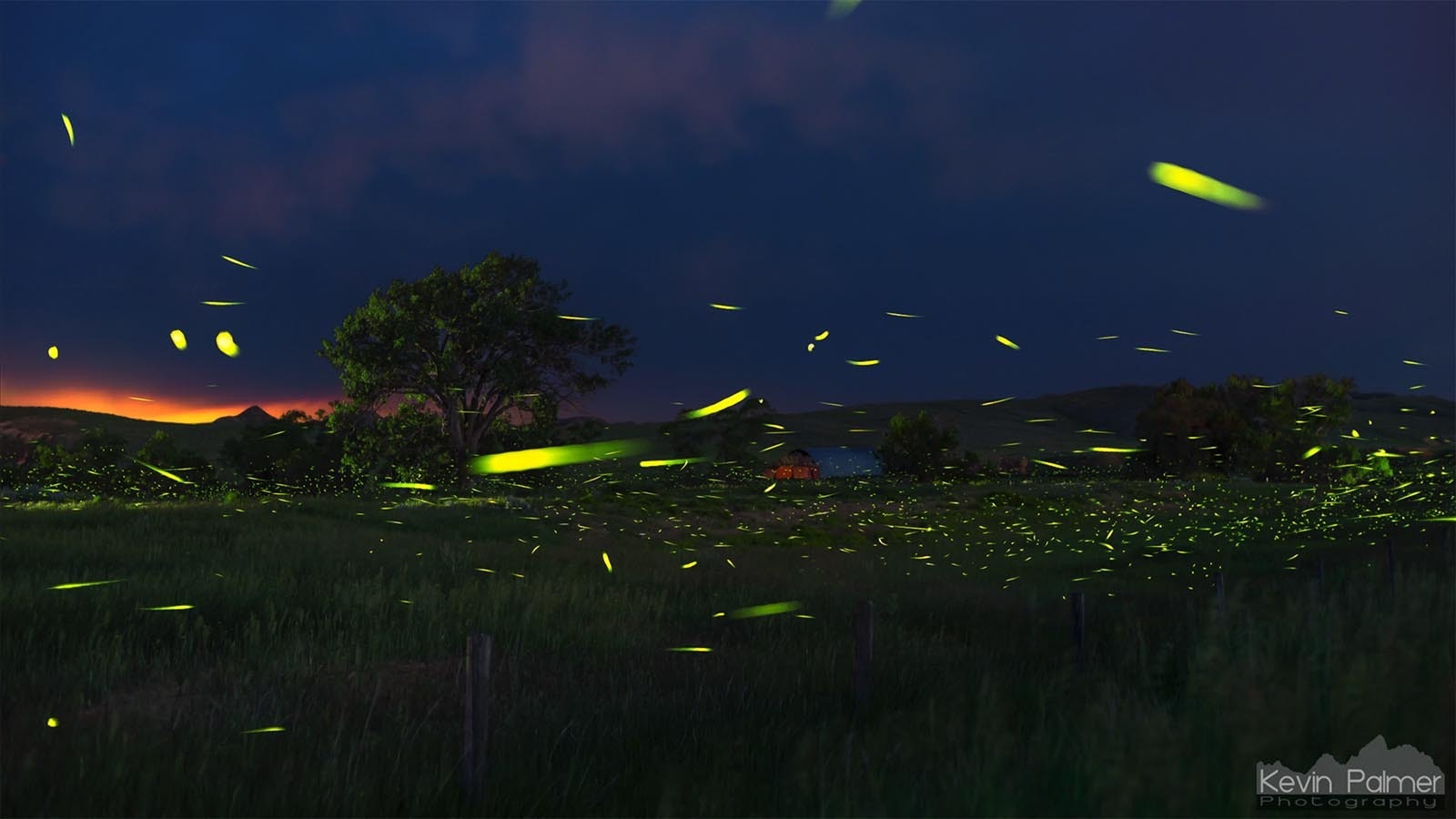
A Wyoming photographer spotted lightning bugs, or fireflies, in a northeastern corner of the state Saturday and took a photograph to prove it.
Kevin Palmer, of Sheridan, went out to Clear Creek near Clearmont, Wyoming, in his 4Runner on Saturday to shoot photos of lightning, he told Cowboy State Daily in a Monday interview.
A photographer who focuses on nights and storms, Palmer spends much of his free time escaping light pollution.
He sat alone on the road and waited for lightning to split the indigo clouds. It was about 10 p.m. The creek was running high.
“I started seeing these little green lights instead,” Palmer recalled. “I wasn’t sure at first – there were only a few – but then I just started seeing a lot more of them, and I knew what they were.”
Palmer hails from Illinois, so he’s seen the luminescent beetles before.
Wyoming is a dry state and prone to drought, while lightning bugs are associated with muggy nights. But it has been humid in that area over the past week, said Palmer. Each bug blinked about every five seconds, though some were more sporadic.
Palmer shot about 400 photographs over the course of 38 minutes and stacked those images together to make a dusky wetland scene blotted with neon, yellow-green tapers.
Lightning flashed in the distance.
‘That’s Awesome’
Douglas Smith, an entomologist at the University of Wyoming, was amazed at the sighting.
He’s heard other entomologists talk about a lingering lightning bug habitat near Glenrock that they believe survives because the landscape hasn’t been altered by dams and diverted waterways like much of the state.
But Smith has never seen any lightning bugs in Wyoming himself, he said.
“That’s awesome,” said Smith upon hearing the news of Palmer’s sighting. “Wyoming is full of wonders.”
The bugs survive winter as larvae or pupae and only live as adults for a few weeks. That’s when they mate, and that’s why they flicker, said Smith, adding that not all light up, however.
Marshy water, and soft creatures like snails and slugs that teem in it, are the main factor of their existence, said Smith, adding that the larvae are “voracious predators.”
The climatic factors of what Smith called an “early spring” appear to have let the lightning bugs have a population boom, and to perform their mating ritual — of flashing lights — a little early, in his experience.
In other states Smith will typically see the mating ritual in July, he said.
The bugs emerge around a half-hour before dark and remain for about an hour after dark. Some lights will flicker throughout the night – sporadically, he said.
The Mating Dance
The bugs are just as fascinating on the inside as they are on the outside, he said. They have an organ called a lantern, which is translucent. They can control their bioluminescence – its range, color, intensity and frequency, using internally-crafted proteins called luciferin and enzymes called luciferase, he said.
The luciferase eats the luciferin, making the light.
“And they can control that,” said Smith. “They repeat their flashes and length of time of flashes – even the color of flashes.”
In one species of lightning bug, the female is a trickster: she flashes to imitate a different species, and when the male comes at her call, she eats him, said Smith.
“That’s really fun,” he said with a chuckle.
On the other hand, some of these beetles don’t light up. They don’t all follow the rules and stereotypes that surround them, said Smith.
“That’s the world of entomology,” he said. “They don’t read the books we do.”
What I Miss
Palmer in a May 2024 entry on his website wrote a guide for how to view fireflies, and what climates they like. In it, he pined for the bugs, which he hadn’t yet seen in his new home state of Wyoming at the time.
“Even though I’m partial to the western US, fireflies are one of the things I miss most about the Midwest,” wrote Palmer. “Chasing fireflies on a warm summer night is one of those childhood memories that stays with you. They are one of the most beloved insects.”
Clair McFarland can be reached at clair@cowboystatedaily.com.