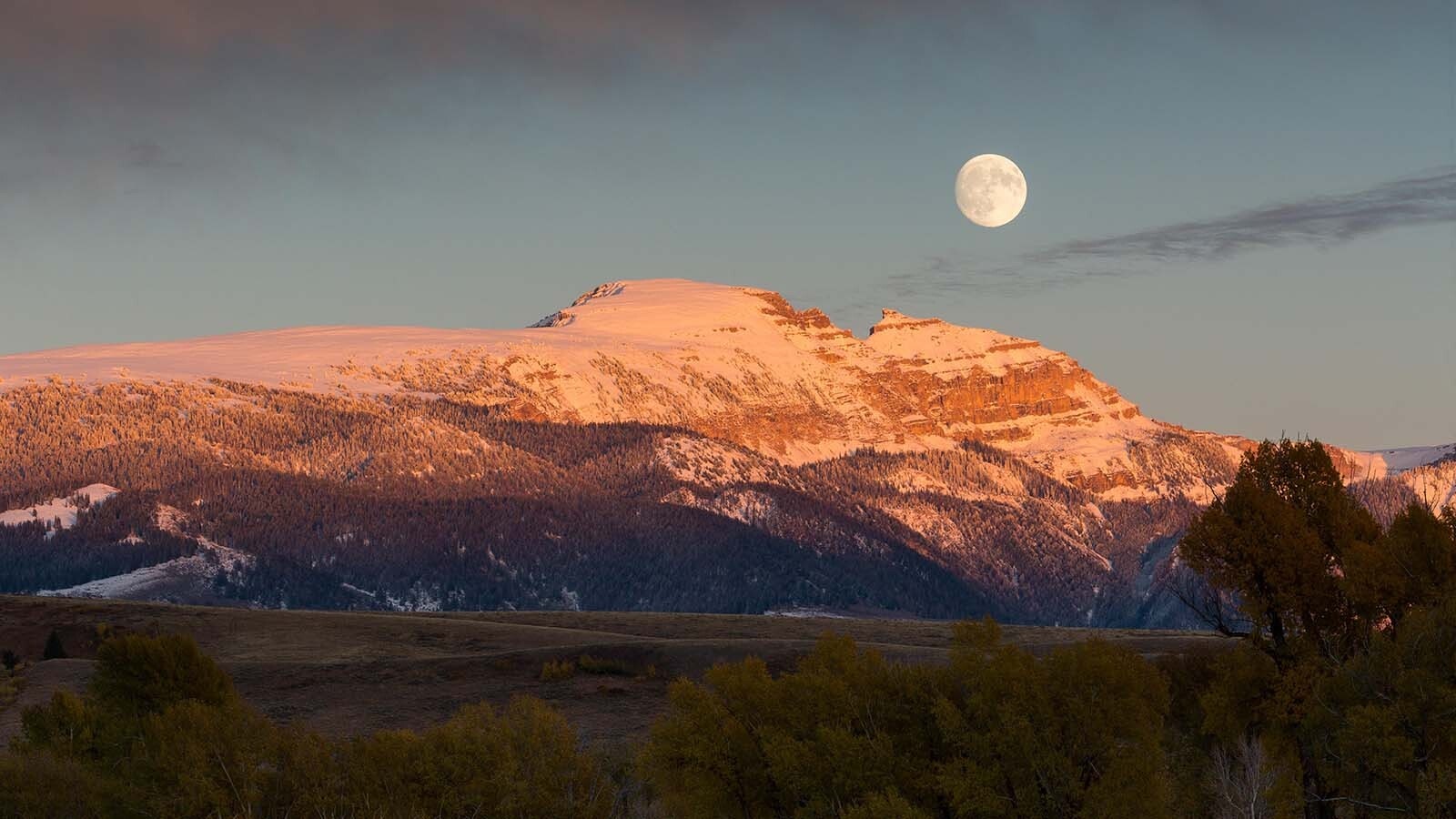
A strawberry moon rises over Wyoming on Tuesday evening, and when it does, it will be at its lowest point in a 37-year span from 2006 to 2043.
The full moon this month will rise only 21 degrees above the horizon in the southeast sky, which is about as low as it can go over the Cowboy State.
That’s not unusual for this time of year, but a full moon this low hanging only happens once every few decades.
“Summer moons are always lower than winter moons, but this one’s different,” said Max Gilbraith, planetarium coordinator at the University of Wyoming. “When the sun’s high, the moon’s low. It’ll be in its most anti-eclipse position.”
Low-Hanging Fruit
Each full moon has an informal name. The full moon of June is called “the strawberry moon” because it’s (allegedly) when wild strawberries start to ripen.
The moon consistently rises over Wyoming, but that doesn’t mean it’s always in the last place you saw it. Mid-June is when the moon is at its lowest point.
“The Earth's not being perfectly aligned with the orbit of the sun or the moon,” Gilbraith said. “If you are sort of able to think about the solar system in 3D, the sun's really high for us in the Northern Hemisphere because of the tilt of the Earth.
“The moon, being opposite the sun, tends to get lower in the sky as it passes through that plane.”
That’s part of the reason why this month’s full moon will be at its lowest point in 19 years. But it’s also part of an observable cycle of the moon and its position in the sky relative to Earth.
Last June, the moon began a period called a “lunistice.” It’s like a solstice but on a much longer timeline.
“It's caused by the misalignment between the lunar orbit around the Earth, which is tilted around 5 degrees, and the Earth orbits around the sun, which our equator or our North Pole, which is 23.5 degrees relative,” Gilbraith said. “If you process that around, you get this 18.6-year cycle.”
This is also called a “lunar standstill,” when the moon reaches its lowest and highest points in the sky in a six-month period.
Gilbraith said Wyomingites watched the same saga play out in June and December 2024, although the moon will be lower this year than last.
“If the full moon were to occur on the summer solstice, it would be at a perfectly low spot,” he said. “That would be its lowest point in the sky. Since it’s not perfectly aligned with the summer solstice on June 21, it’s about three degrees higher than it would be.”
Not A Bad Moon Rising
Gilbraith said Wyomingites can expect to see the strawberry moon rise around 7:40 p.m. on Tuesday. It will transit across the sky while hugging the horizon, reaching its highest point right after midnight, and set at 4:26 a.m. Wednesday.
“That’s nine hours of moonlight, way below average for a full moon,” he said.
Wyoming is low enough on the globe that it will always see a full moon rise and set. However, Gilbraith said this full moon will be so low that people living further north might not see it.
“Those poor folks in Fairbanks won’t see it at all,” he said. “It’ll be so low that it won’t even rise. All the polar bears will be moonless. No strawberries for them this June.”
The moon isn’t circumpolar, which means the Earth’s magnetic poles don’t determine its orbit. That’s why it doesn’t appear in a fixed place on a fixed schedule, month after month.
Nevertheless, the low-hanging moon is part of an observable and well-documented lunar cycle that lasts decades rather than weeks or months.There’s nothing alarming or unusual about it.
Then there’s also the occult to look out for.
Occult Of The Anti-Mars
One thing that Gilbraith and other astronomers are looking forward to is the occultation that will happen when the strawberry moon rises.
An occultation is when a celestial body, typically the moon, passes in front of a planet or a star, occluding it from our earthly view.
Gilbraith said the moon will occult Antares, the “not Mars star,” when it sets early Wednesday morning.
“Antares is a star that appears almost as bright as Mars,” he said. “The moon has occulted Mars in the last few years. It looked like a little zit on the side of the moon, disappeared, and then reappeared on the other side as another little zit.”
Gilbraith mentioned the occultation of Antares because you won’t need a telescope to see it. Anyone who wants to wake up and step outside can see it as clear as day, relatively speaking.
“It’ll be a fun opportunity to see an occultation with the naked eye,” he said.
Strawberry Fields For A Night
The moon and the sun never change color. The colors seen as they rise and set result from their light shining through the atmosphere, which creates a tapestry of gorgeous colors from our perspective.
The strawberry moon didn’t get its name because of its color. Nevertheless, it will briefly appear like a low-hanging strawberry in the sky as it rises, which Gilbraith believes might be the best time to step outside and see it.
“In addition to being so low, the strawberry moon will get some extra reddening when it rises,” he said. “Thanks to our atmosphere, especially if it’s hazy or foggy, it’ll make it look redder, because we’re looking at it through more air on the horizon.”
With the red planet Mars nearby and its occultation with Antares (a red giant star), the strawberry moon will be covered in and surrounded by a lot of red on Tuesday evening.
This could be the best strawberry moon for a generation, especially if we must wait until 2043 for another opportunity. Gilbraith believes this could be the best time for amateur astronomers to go strawberry picking.
“It’s all an optical illusion, but a fun observation,” Gilbraith said. “It complements the strawberry moon. Because it’s so low in the sky, it’ll look redder to us on Earth.”
Andrew Rossi can be reached at arossi@cowboystatedaily.com.