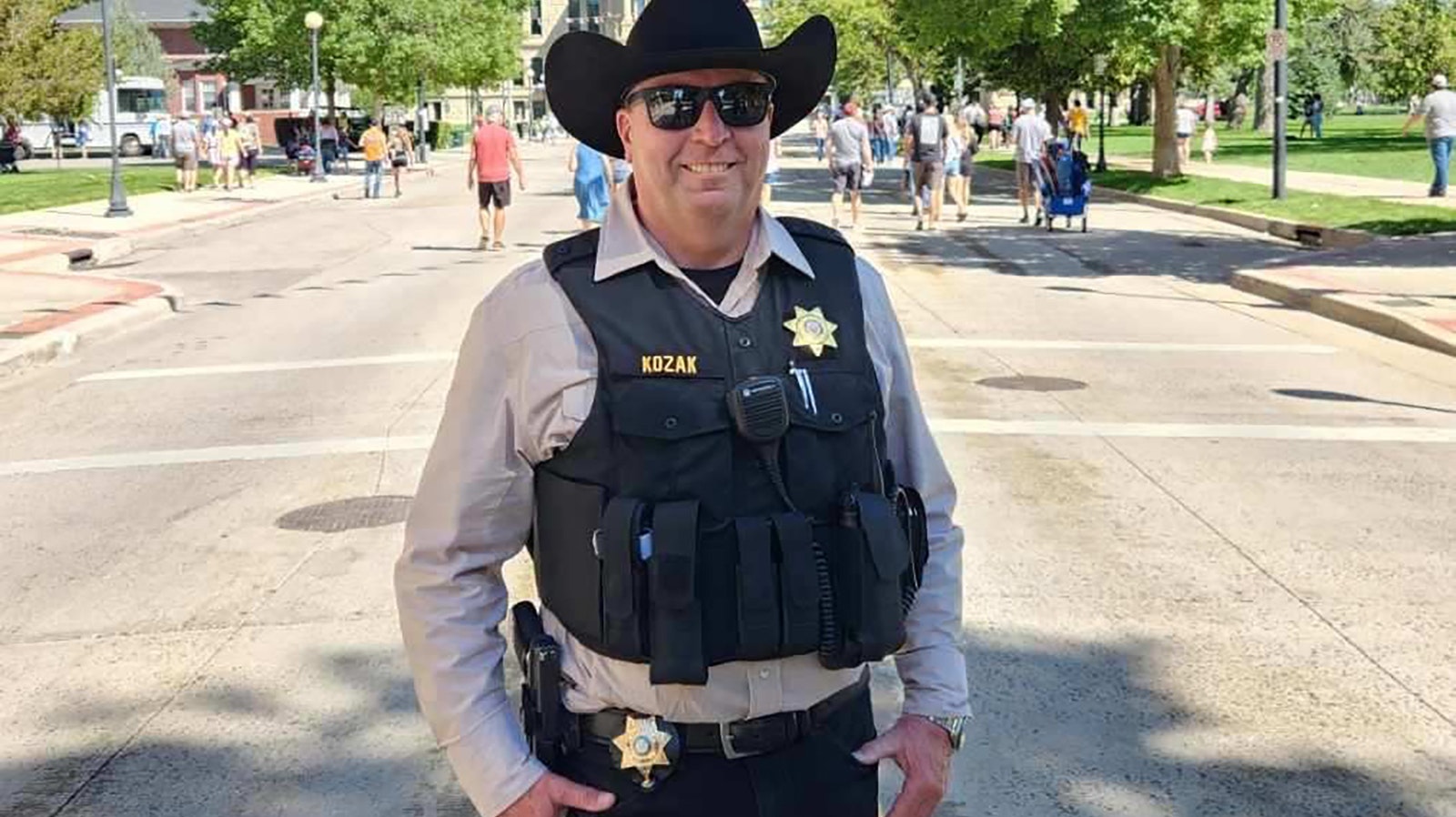
After months of working toward the goal, the Laramie County Sheriff’s Office has finalized the first of the three contracts it has been developing with U.S. Immigration and Customs Enforcement.
That’s the jail-enforcement model, which allows the sheriff’s jail deputies to conduct immigration investigations on inmates within the jail.
Three deputies are now undergoing ICE background investigations. Two are native Spanish speakers, said Kozak. They’re scheduled to attend a four-week federal training course in South Carolina in August, he added.
Kozak said ICE is paying for the deputies’ board and expenses associated with training, under the agreement.
The county is working on a separate agreement toward housing ICE detainees for longer than 72 hours, which is not yet finalized, he said.
Kozak said his office is also pursuing a “task force model” agreement, as well as a warrant service officer agreement (to enact immigration warrants) with ICE.
And That’s A Problem, Says ACLU
The task force model, which Kozak has not yet finalized, is problematic, according to American Civil Liberties Union of Wyoming senior staff attorney Andrew Malone. That type of agreement existed prior to 2012 but was halted that year “because there were so many issues of racial profiling connected with it,” he said.
Under the Obama administration, ICE said it discontinued the program because task forces “have proven to be a less efficient means of identifying priority individuals subject to removal compared to other enforcement programs.”
The model was revived by one of President Donald Trump’s executive orders.
“It’s disappointing to see the sheriff’s office wanting to engage in something like that,” said Malone. “(It has) a really disappointing history.”
Malone also voiced a concern that local undocumented immigrants — including crime victims and witnesses — will be less likely to report crimes if they know the local law enforcement are working with ICE. That goes for any type of agreement, not just the task force model, he said.
“(People may be thinking), ‘They’re going to come after me because I tried to do the right thing.’”
The local agency is likely liable in the case of a civil rights breach, such as holding a person who’s in the country legally for ICE by mistake, Malone added.
No, Don’t Do That
Kozak countered, saying his deputies aren’t to be racially profiling people, and avoiding that outcome is a matter of “hiring the right people.” He said he believes he has chosen the right deputies for the task force program.
Drawing on his work as police chief of a Colorado ski town, Avon, in the early 2000s, Kozak said it’s his hope that by giving immigration investigation powers to his own deputies, he can localize what otherwise may be a less discerning enforcement effort.
He said he believes putting local agents on immigration enforcement will help focus those operations onto illegal immigrants who are victimizing other people – including people within their own communities.
When in Colorado he took a more active role in immigration cases, people in the immigration community started to trust law enforcement more, he said.
“I know that sounds odd. But prior to that happening, that community was being victimized by their own,” he said. The local officers were able to point ICE toward the criminally problematic residents, he said.
Three deputies have been selected to serve as ICE-aligned task force agents, working interdiction on Interstates 80 and 25, said Kozak. Two of those speak Spanish, he added.
“We’re looking for drug interdiction, and human trafficking interdiction,” he said of the interstate focus. “We want to be able to make sure deputies have all the tools available – including filing federal charges for immigration.”
The agreement says ICE is responsible for installing and maintaining an information technology system for the project.
The sheriff's office will provide salaries, benefits, local transportation for the missions, and salaries, overtime and other personnel costs during training. The sheriff's office is responsible for providing all administrative supplies, necessary for normal office operations, and security equipment like handcuffs and shackles.
ICE will provide instructors and training materials. ICE will furnish the deputies' travel expenses during training, plus housing, per diem, and other transportation costs associated with getting to and from training, the agreement says.
The Trend
Kozak is one of multiple Wyoming sheriffs establishing or striving toward ICE agreements.
The Sweetwater County Sheriff’s Office was the frontrunner, with its warrant service officer agreement dating back to 2020, a jail enforcement model established in March and a task force model finalized in April.
The Natrona County Sheriff’s Office established a task force model agreement last month and the Campbell County Sheriff’s Office established a warrant service officer agreement in February, according to ICE’s website.
The Carbon County Sheriff’s Office is working on its warrant service officer agreement, says ICE’s data.
Clair McFarland can be reached at clair@cowboystatedaily.com.