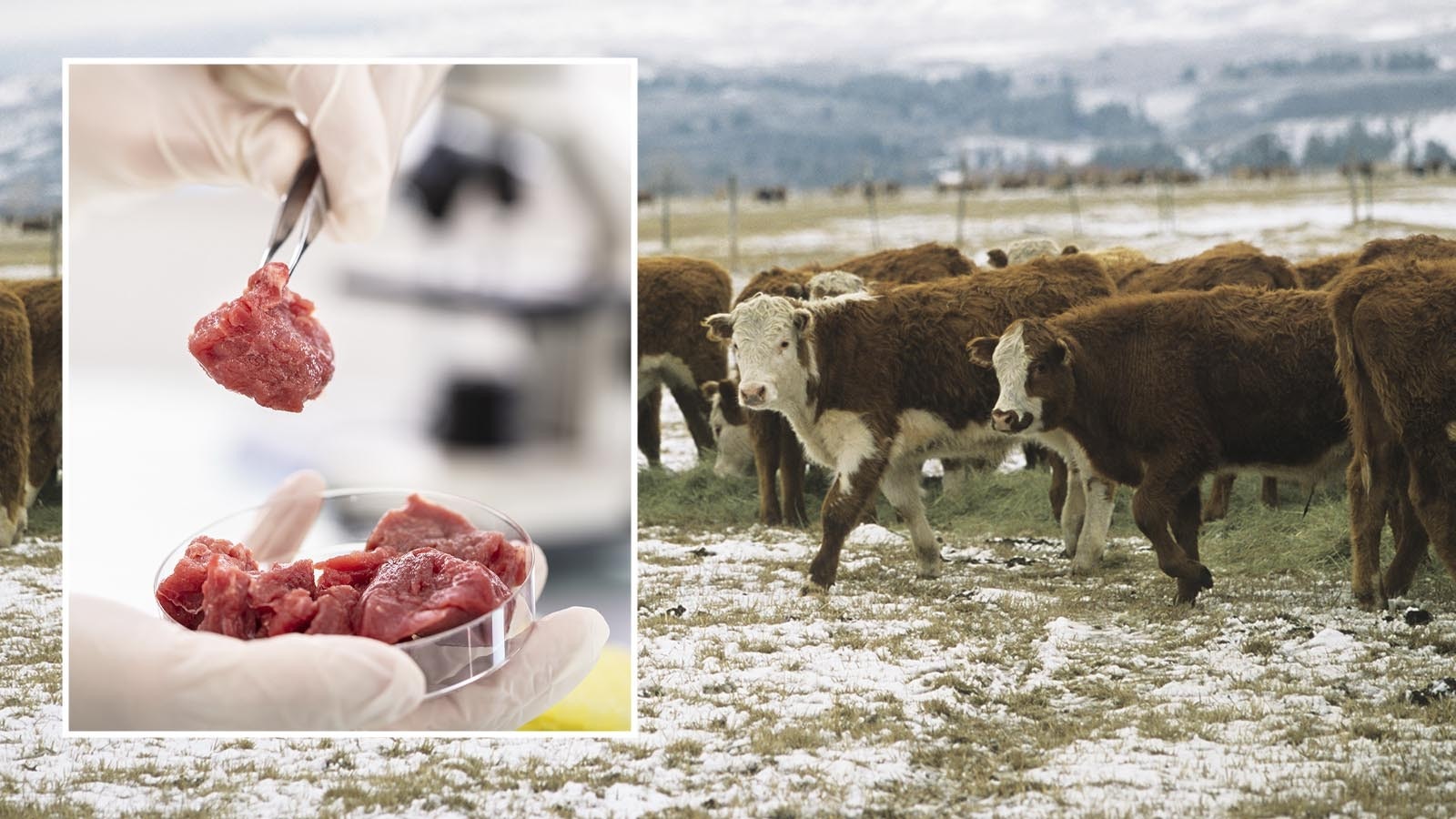
Lab-grown meat isn’t being sold in any U.S. grocery stores or restaurants yet, but six states have already hopped on a red-state bandwagon to ban it, with Nebraska and Montana being the latest.
It doesn’t appear, however, that the Cowboy State will join this bandwagon any time soon. That’s not because Wyoming ranchers lack widespread distaste for the very idea of lab-grown meat.
In fact, last year there was an almost successful effort to ban cultivated meat, House Bill 168.
The bill passed the House relatively easily but grounded out in the Senate. Votes on the issue showed the measure split both parties and caucuses, with an overall 12 “yea” to 19 “no” votes.
Rep. John Eklund, R-Laramie, said he is considering whether to run the legislation again, but wants to first visit with members of the Senate to better understand why it failed there.
“I ran it as a food safety bill,” he told Cowboy State Daily. “And I may run it again. It had broad support.”
None of the other lawmakers listed as a cosponsor of the legislation returned Cowboy State Daily’s phone calls and texts inquiring about their position on future efforts to ban the product.
Lobbyist Jim Magagna, who is Wyoming Stock Growers Association’s executive vice president, offered some insight on the matter.
“We think it’s a horrible product,” Magagna told Cowboy State Daily. “But at this point, it’s really the consumer that’s almost banning it, because they’re not stepping up to a plate and purchasing it in any meaningful volume.”
Lab-Grown Meat Isn’t Actually Yet Available
While two California companies, Upside Foods and GOOD Meat, do have FDA approval to sell cultured meat in the United States, neither have yet produced it in any great quantity.
It was briefly offered for sale at two high-end restaurants, but the item is no longer on the menu.
Part of the issue has been the price point. It is still quite expensive to produce lab-grown meat, though the industry believes solving that is a matter of time.
Magagna believes, regardless of high or low-price points, that the best way forward for Wyoming agriculture is proper labeling.
“We are very supportive of legislation that strictly controls how it can be labeled, that it can’t be called meat, and it can’t be called beef,” he said. “And (the label) needs to specify that it’s lab produced, and what all the ingredients are and what was used in the production.”
It’s Not Really Meat
That’s a position National Cattlemen’s Association agrees with, according to Wyoming’s Mark Eisele who is both past president and a current member.
“We don’t like fake meat,” he said. “But we know it’s got a following. And states can take the banning approach, but what we would really like to see, because we think it will hold up better than a ban, which will probably be defeated in court, is labeling. We need to have fair and equal labeling talking about that it’s not meat.”
The beef industry isn’t going to make the same mistake the milk industry made, Eisele added.
“Milk is the poster child example,” he said. “Because milk did not protect their trade name of milk. Now you have soy milk and oat milk and all kinds of fake milk. And they’re not milk. So that is why we’re so protective of beef and the beef label.”
Eisele said his group will advocate for restrictions on any term related to meat in labeling of the product.
“It’s a substitute,” he said. “It’s an alternative. But they can’t make a direct comparison to meat, and consumers need to be highly cognizant of that.”
Lab-grown meat not only goes through a highly industrial process, it has ingredients real meat doesn’t have, Eisele added.
“It’s not healthy, despite what they say,” he said. “The amount of sodium in it is nuts. It’s extremely high. So, it’s not a really great substitute. That’s how we feel, and that’s our official policy.”
Some Ranchers Are For A Ban
Some ranchers would go for a ban, like Laramie County’s Kiel Harding with Harding Ranch, who sells some of his products direct to consumers.
Backlash against agriculture over a lab-grown meat ban could be a slight concern, he said, but states like California also rely on agriculture, so he doesn’t think backlash to such a ban would gain any traction.
“You find even the most Liberal people in the world who are pushing an agenda will still go to a steakhouse and eat a very good steak,” he said. “So, I don’t think you’re ever going to eliminate entire states from people who want beef.”
To him, a ban would send the right message.
“Wyoming is one of the few states that has true cowboys left,” he said. “Why would we want to diminish that and hurt the Wyoming cowboys who are left by replacing what they’re trying to do with a lab-grown product?”
Other Ranchers Have Questions
While hating the thought of lab-grown meat just as much as Harding, Fremont County rancher Tyler McCann feels uncomfortable with the idea of a ban.
“I understand (Nebraska’s) thought on it, but I see the duality of it,” he told Cowboy State Daily. “If we start banning everything, is that going to get turned around and ban something for us in traditional agriculture?”
Almost any rationale that might be used for a ban, McCann suggested, could be turned around and used against traditionally produced agricultural products, pointing out there are already factions in the U.S. claiming beef is unhealthy.
Crook County rancher Tyler Lindholm agreed with McCann’s misgivings.
“It’s easy to throw out a piece of legislation and act indignant down at the state capitol,” Lindholm said. “But when it comes down to the principles of what they’re proposing that’s where it gets tough.”
He also feels it goes against the freedom-loving grain that runs through Wyoming. Lindholm, as a former lawmaker, helped sponsor the state’s Food Freedom Act, which has helped make more local food options available.
“I understand that this is a cattle state — I raise cattle for a living — but we’re a state known for its food freedom,” he said. “For them to take the stance that we’re going to start banning types of food just because we don’t like it, that is a tough road to go.”
It’s also, in his opinion, a big overreaction.
“It’s authoritarian as hell,” he said. “You’re telling people what they can and cannot eat. That’s not different than when the left banned horse slaughter in the United States and said, ‘No you can’t eat horse meat anymore.’ Yeah, horse meat’s not for me just like lab-grown meat is not for me. But I’m not going to tell somebody else what they can and cannot do with their own digestive tract. That’s a bridge too far.”
Lindholm doesn’t believe a ban will help Wyoming’s economy either.
“Generally, the people who are eating lab-grown meat are doing so for some type of perceived health reason, or politically, they’re not aligned with animal slaughter,” Lindholm said. “Those are not hardcore voters for folks on the right, so there’s just not a lot of those people in the state. It’s a messaging bill that affects nothing. It will move the needle for the economy in the state of Wyoming 0%.”
Schools And Labels
McCann would like to see a prohibition on cultured proteins in schools.
“That’s a large market for these cultured proteins to try and take over,” he said. “So, I’d like to see that regulated to make sure that’s not included in school lunches. One, to keep it an equal playing field for traditional proteins and two, until we have some long-term studies on the health effects.”
But what both Lindholm and McCann feel is the better solution for their issues with lab-grown meat is proper labeling.
That will enable cattle ranchers to compete on a fair and even playing field, Lindholm suggested, and win in the free market, as opposed to government choosing winners and losers.
“I think the more people actually learn about lab-grown meat, I think the more turned off they’ll be by it. I mean, the impetus behind lab-grown meat for some folks on the left is that there’s no slaughter involved. But if you get into looking at lab-grown meat and how it’s actually developed, a large portion is being produced with fetal bovine serum. That’s just horrible.”
Labels that are clear will help consumers make the choices that are right for them, McCann said. And that’s something he personally would like to see extended to countries of origin.
“If your main concern is buying a $5 ribeye, as long as you understand that will not be a product that was born, raised and slaughtered in the U.S., you have the ability to go out and choose whether that’s a Brazilian or an Argentine product,” he said. “I think you should have that freedom. If you want to know that you’re getting the highest-quality American raised (beef) I think you should be able to see that on the label, similar with these cultured products.
COOL Complications
That kind of transparency is more complicated to achieve than it sounds, though, Eisele said.
“There’s a push for mandatory country of labeling that will never fly,” he said. “You still have to electronic ID to make a mandatory country of origin labeling work.”
That issue has left country of origin labeling (COOL) in the voluntary territory, Eisele said.
“It’s complex, because we’re relying on imports for like our hamburger,” he explained. “Because we have such good beef, we have to bring in leaner beef to make hamburger work for Americans that are at a better price.”
The recent shortage of cattle, in part due to nationwide drought, has forced additional imports, to cover a shortage of American sources of beef. That’s going to take a year or two to equalize, Eisele said, because it takes time for ranchers to rebuild their herds.
“Mandatory COOL is just a bad idea,” he said. “It’s unenforceable and, if you go back to labeling, it still has to be labeled correctly. I am completely behind voluntary COOL.”
Renée Jean can be reached at renee@cowboystatedaily.com.