A Massachusetts-based federal judge on Thursday blocked the president’s two-month-old executive order slashing the U.S. Department of Education in half, ordering the reinstatement of terminated department employees.
The preliminary injunction order that U.S. District Court Judge Myong J. Joun filed Thursday does not grant a win to the several states, school districts and unions that sued President Donald Trump’s administration.
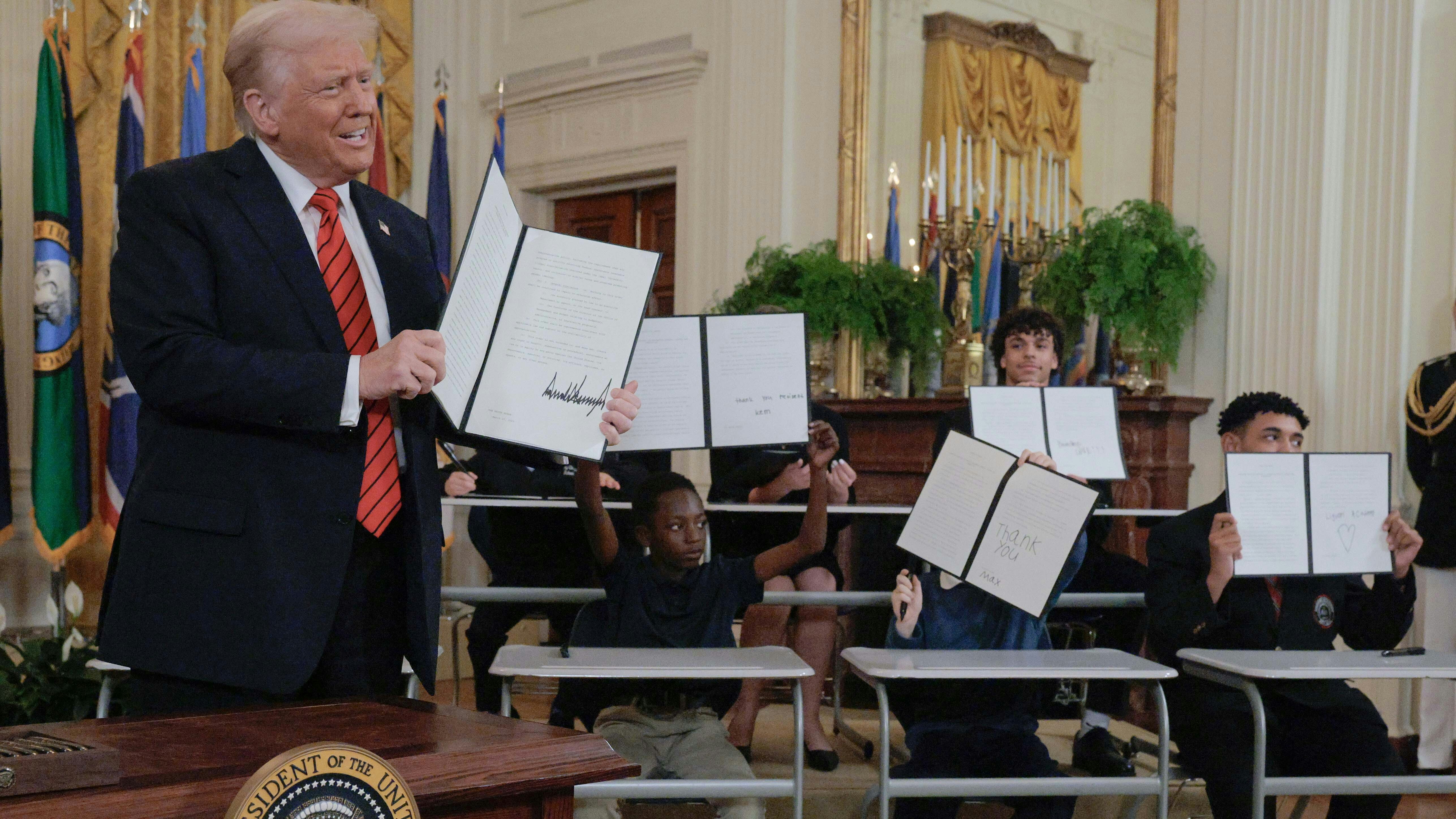
On March 11, he cut the Department of Education’s workforce by half, and a March 20 executive order directed the Secretary of Education to “take all steps necessary to facilitate the closure of the Department of Education.”
The order merely blocks those actions while the case is ongoing.
But Joun’s order signals a strong likelihood that the plaintiffs will win the case by outlying constitutional and legal errors the judge found in the order’s implementation, and by pointing to what he deemed irreparable harms wrought by it.
The states waging the lawsuit are Delaware, Massachusetts, California, Colorado, Connecticut, Hawaii, Illinois, Maryland, Michigan, Minnesota, Nevada, New Jersey, New Mexico, New York, Oregon, Rhode Island, Washington, Wisconsin and Vermont.
Wyoming’s top education official, conversely, cheered the president’s efforts to downsize the department.
Superintendent of Public Instruction Megan Degenfelder was among a handful of officials chosen to witness Trump’s signing of the order at the White House on March 20.
She’s long voiced a hope that the federal government could shutter the Department of Education but preserve its funding streams for states and allow state governments to administer those directly.
“Under President Trump’s leadership, we’re taking education decisions out of the hands of unelected officials and giving them back to parents, teachers and local communities,” Degenfelder told Cowboy State Daily after Trump’s March 11 reduction. “The DOE isn’t ‘closing,’ it’s relocating back to the people who actually educate our kids. That’s real reform.”
The Promises, The Counter Claims
Eliminating the Department of Education was one of Trump’s key campaign promises.
After he issued the order to work toward its closure — a maneuver only Congress could complete — Trump promised that the department’s federal student loan portfolio and special needs programs would still be administered to the states’ schools, but transferred into other departments.
For example, Trump said he planned to move the student loan portfolio administration to the Small Business Administration, and the “special needs” functions to the Department of Health and Human Services.
For the plaintiffs, these are mere Band-Aids to an unconstitutional, illegal, authoritarian and harmful move, the judge’s order indicates.
“The massive reduction in staff has made it effectively impossible for the Department to carry out its statutorily mandated functions,” wrote Joun, reflecting on evidence the plaintiffs supplied. “It is only reasonable to expect that a (force reduction) of this magnitude will likely cripple the Department. The idea that Defendants’ actions are merely a ‘reorganization’ is plainly not true.”
Trump cannot have it both ways, Joun wrote: He can’t tell the court that slashing the department is a managerial move while telling the public he’s on a mission to dismantle it.
What’s Impacted
Dismantling it without congressional action is a violation of the Constitution’s mandate of separated government powers, as well as other federal laws, wrote Joun.
The judge said he hasn’t found evidence in this case that Trump is working with congress toward his end goal.
“Not only is there no evidence that Defendants are pursuing a ‘legislative goal’ or otherwise working with Congress to reach a resolution, but there is also no evidence that the (reduction) has actually made the Department more efficient,” the judge wrote.
Since the order the plaintiffs have reported difficulty in working with federal funding administrators, the crippling of the Office of Civil Rights and other obstacles, the judge’s preliminary injunction order says.
A key problem with Trump’s order is that it prevents the Department of Education from doing things that Congress has required it to do throughout many law changes since its formation, wrote Joun.
The judge listed some of those:
• Administering funds for the Elementary and Secondary Education Act (which dates back to 1965, pre-DOE, but the funds for which are funneled through the department).
• Administering funds for the Individuals with Disabilities Education Act (IDEA), which funds special education services for school-aged children.
• Administering money for the Higher Education Act (another one dating back to 1965 but appropriated through the department).
• Administering money for the Rehabilitation Act of 1973.
• Enforcing federal civil rights laws so that people who are discriminated against in schools don’t have to wage private lawsuits to get justice.
• Enforcing privacy laws, like the Family Educational Rights and Privacy Act (FERPA).
Clair McFarland can be reached at clair@cowboystatedaily.com.