Now in her third season of working at the Yellowstone National Park’s Old Faithful Inn, Stacy O’Nell thought she’d seen just about every kind of critter in the park.
But while driving near Old Faithful last week, she noticed a bicyclist had stopped to gawk at something near the roadside. So she slowed down to take a look for herself, and couldn’t believe what she saw.
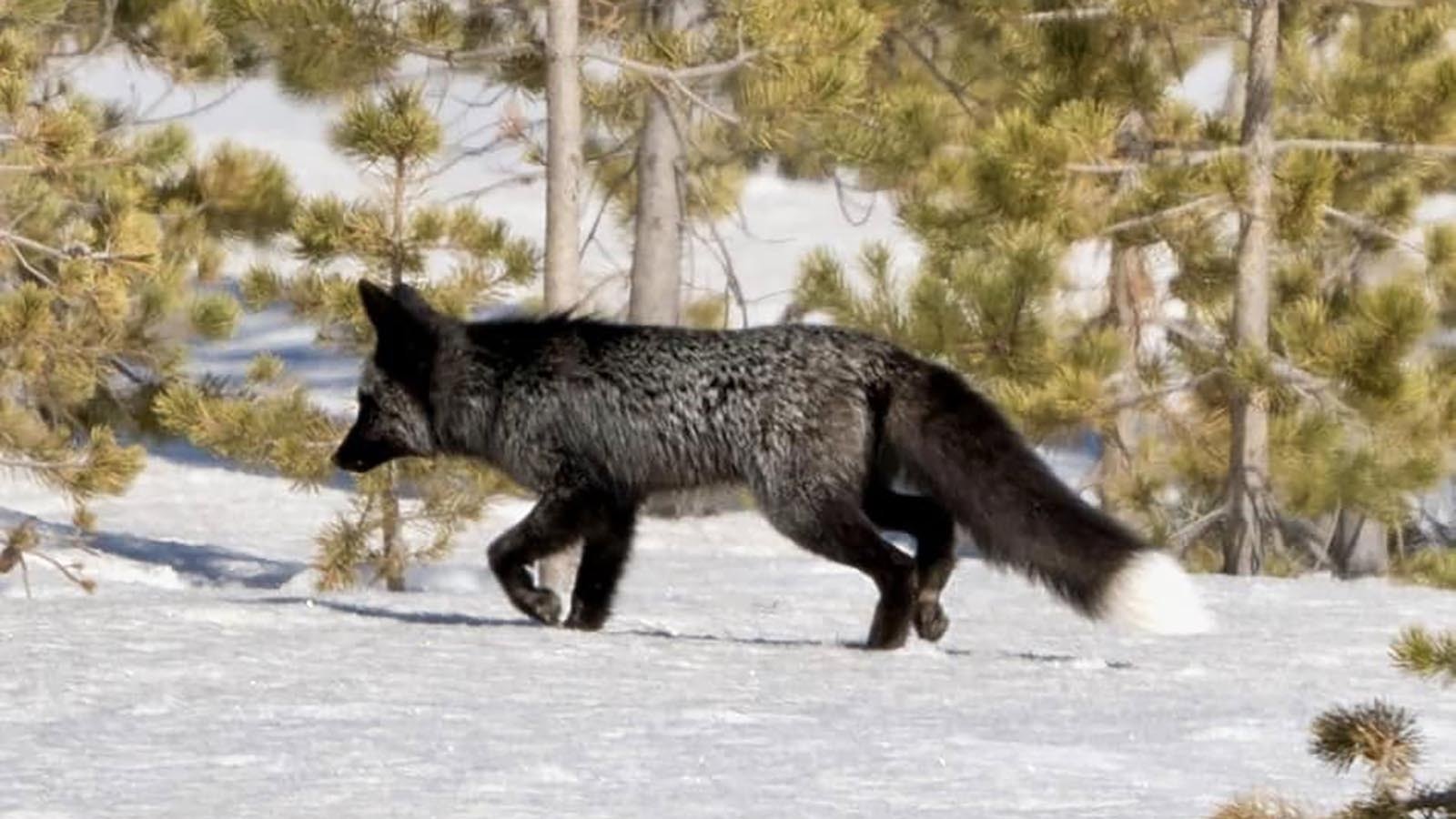
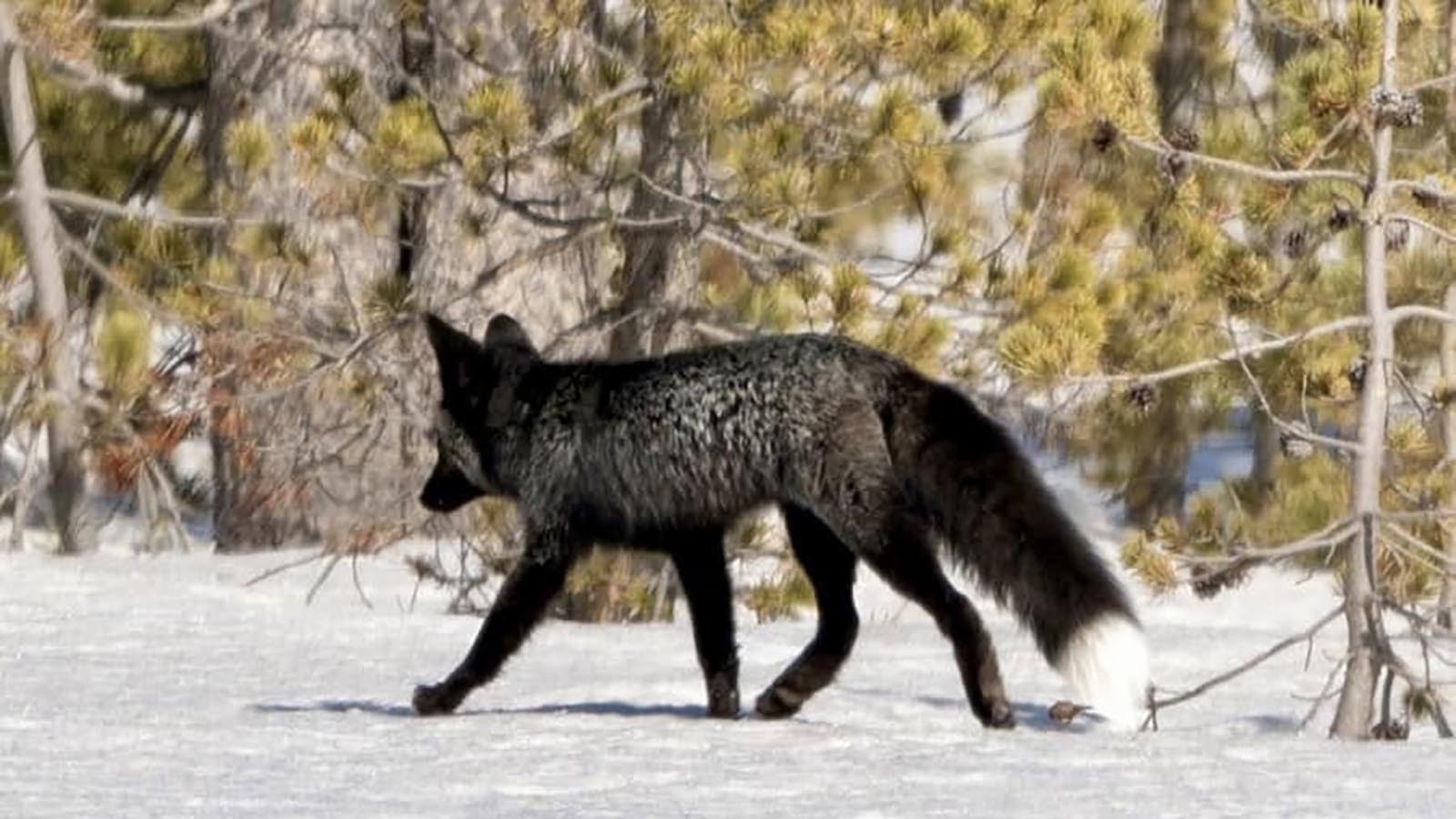
A black fox, with smatterings of white and silver in its fur, was hanging out in plain sight.
“I didn’t think they (black foxes) really existed,” she told Cowboy State Daily. “And now everyone is talking about him.”
O’Nell is also a wildlife photographer, and the fox stuck around long enough for her to get a few pictures of it, before it dashed back into the timber and out of sight.
Other than its odd coloring, the fox appeared to be alert and healthy, O’Nell said. She did some checking and discovered the little canine’s coloring was probably because of a condition called melanism.
In simple terms, melanism is essentially the opposite of albinism – which can cause some animals and birds to have rare white skin, fur or feathers.
Other than turning animals unusually dark, or even full black, melanism isn’t considered to be a harmful condition. It occurs in several species, some of which include barn owls and deer.
Melanistic animals aren’t to be confused with species that are naturally dark, such as black panthers.
Fox Color Varies By Elevation
Wildlife researcher Gary Beauvais agreed that melanism is probably the best explanation for the fox near Old Faithful looking the way that it does.
“Yes, the black phase of the red fox (Vulpes vulpes) is considered an example of melanism. The red fox is known to exhibit several color phases, including black, silver, and ‘cross,’” he told Cowboy State Daily.
Red foxes in Wyoming are usually the classic red color when they live in the low country, added Beauvais, who is the director of the Wyoming Natural Diversity Database at the University of Wyoming.
“In the low elevations of Wyoming, the typical coloring is the classic orange body, dark legs and white-tipped tail. All color phases have the white-tipped tail. It is a good field characteristic and allows positive identification, versus coyotes in brief and/ or distant sightings,” he said.
“At higher elevations most individuals have a noticeable grayish cast on the body, and there is some information suggesting that red foxes at high elevations in western North America form a distinct subspecies,” he added.
Fur Farm Escapees?
Dark-colored foxes have made a few appearances over the years, Beauvais said.
“In the 1990s, a pair of dark – possibly black, possibly silver-phase – red foxes were repeatedly sighted and reported near Chimney Park (in the Jelm, Wyoming, area),” he said.
And several years ago, a “full-black phase” female fox raised a litter of kits in her den near the Wyoming Game and Fish office in Laramie – much to the delight of local photographers, Beauvais said.
There’s also speculation that “off-color” phases in foxes have become more common recently, he said.
That could be because of foxes that escaped or released from fur farms, years ago, he said.
“Apparently fur farms, in which specially colored furbearers were deliberately bred and raised, were more common in the region in the past. Some animals occasionally escaped, and some people speculate that when some farms failed as businesses, they released remaining animals into the wild, increasing the frequency of off-color genes in local populations,” Beauvais said.
“It would be an interesting thing to research and confirm or refute,” he added.
‘He’s Caused A Stir’
O’Nell said that ever since her encounter with the dark fox, she’s been keeping her eyes peeled for the unusual animal.
“I circled back around a couple of times (to the spot where she saw the fox) and he wasn’t there,” she said.
“I’m going to keep looking for him. He’s caused a stir around here,” she added.
Contact Mark Heinz at mark@cowboystatedaily.com
Mark Heinz can be reached at mark@cowboystatedaily.com.