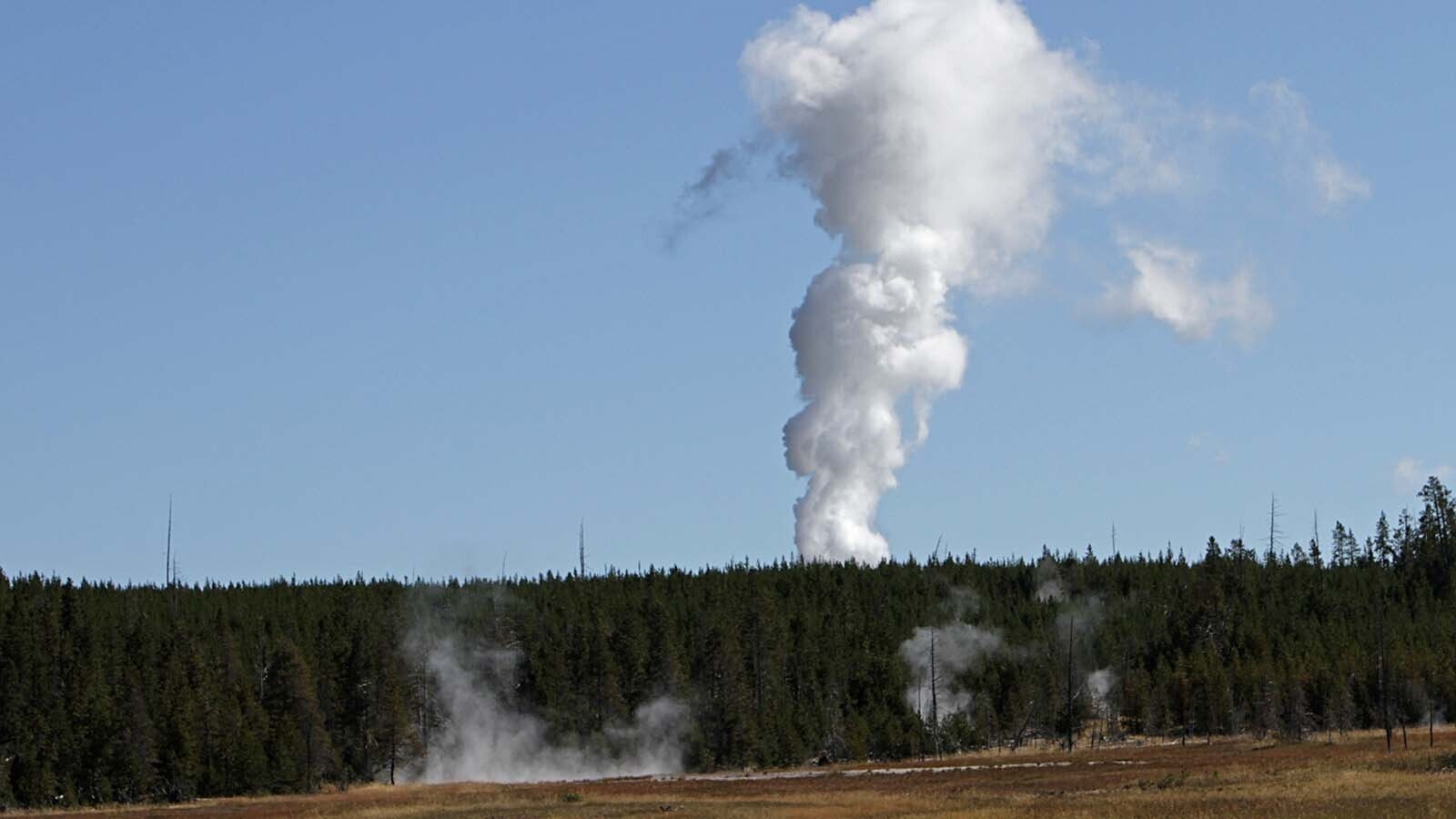
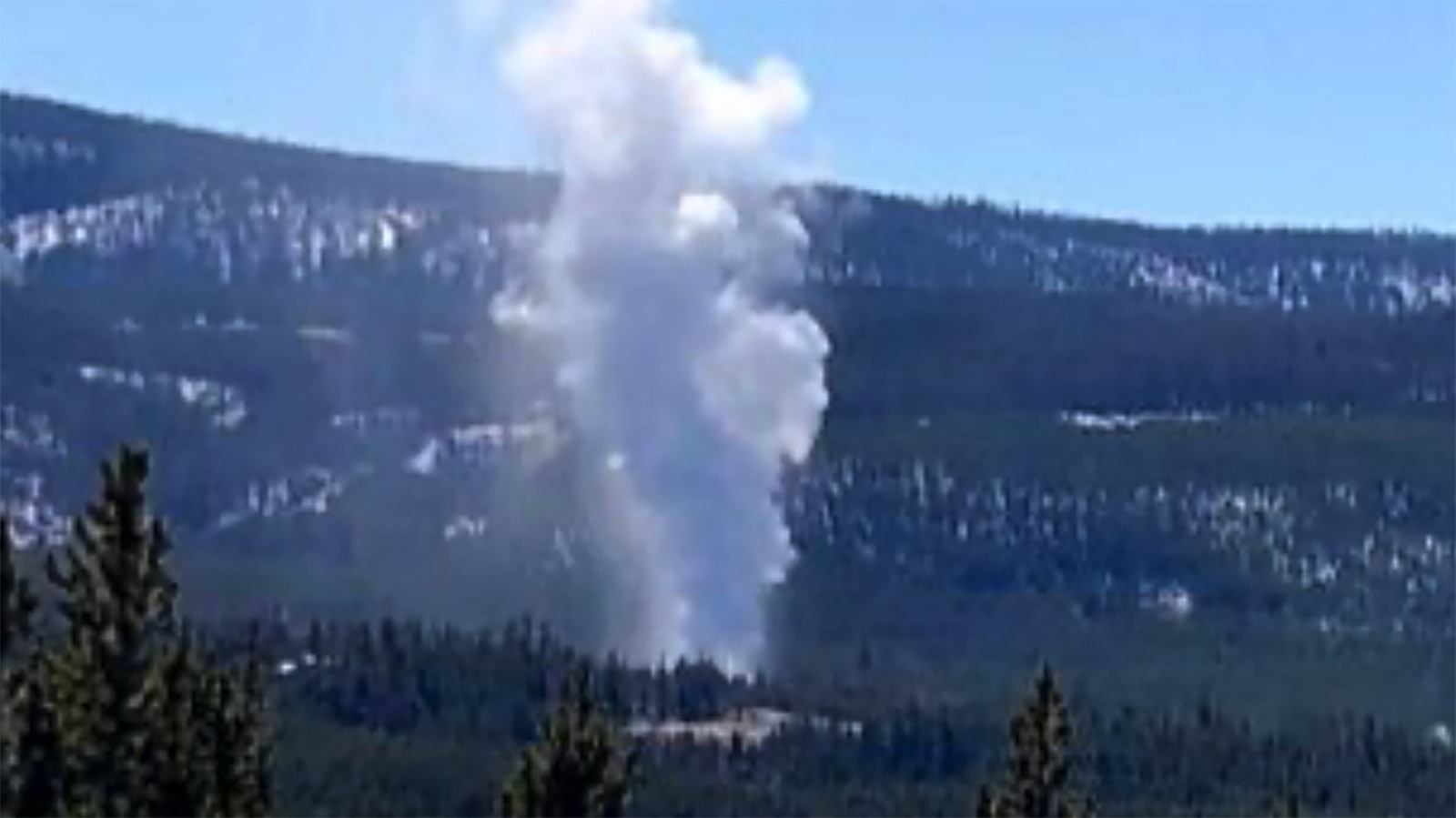
Steamboat Geyser, the tallest active geyser in the world, erupted at 11:05 a.m. Monday in Yellowstone National Park. It was the geyser’s second eruption of 2025 and 69 days since its last eruption on Feb. 3.
After entering an extremely active period, with over 20 eruptions each year between 2018 and 2021, Steamboat’s eruptive frequency has steadily decreased over the last four years. Scientists believed the geyser was slowly entering another period of extended dormancy, as it has in the past.
Except, it isn’t. Or, at least, it doesn't seem to be.
Steamboat Geyser might be taking longer than usual to wind itself down, or it could be revealing its “new normal” to visitors and scientists.
“There's no way to predict what ‘normal’ for a geyser even is,” said Mike Poland, scientist-in-charge of the Yellowstone Volcano Observatory. “Steamboat seems like it’s winding down, but it’s maintained this low level of activity for a few years now. An eruption every few months might be the new normal for Steamboat.”
Dramatic Then Dormant
An eruption of Steamboat Geyser can last over an hour and send mineral-rich water over 400 feet into the air — high enough to splatter mud and water on vehicles parked in the nearby lot. Its behavior has always been erratic, but scientists have observed a trend over the last century: periods of frequent eruptions followed by decades-long dormancy.
The geyser never goes fully dormant, but the period between eruptions — only a few days during its active periods — can stretch to almost a decade. Similar patterns were observed in the 1960s and the 1980s when Steamboat frequently erupted for a short period of time before quieting down and only erupting once every few years.
“With the exception of Old Faithful or Lone Star Geysers, which have been consistent for a long time, a lot of these geysers can change their behaviors in ways that are difficult to anticipate,” Poland said.
Steamboat Geyser erupted 32 times in 2018 and 48 times in 2019 and 2020. After that, the geyser’s eruptions became less frequent year after year: 11 eruptions in 2022, nine in 2023, and six in 2024.
What makes this period of Steamboat’s eruptions intriguing is that the “wind-down” is taking much longer than it had after its previous active periods. Eruptions are less frequent now, but the longest gap between an eruption from 2019 and 2025 was only 89 days.
That’s noteworthy for Poland. If Steamboat is entering another period of extended dormancy, it’s definitely taking its time to wind down.
“I don't think I could say whether this is a new normal of fewer eruptions per year or part of a very slow wind-down,” he said. “This is different from its previous episodes of activity, but we don’t have a lot of examples to work from.”
What’s Changed
Steamboat Geyser sits on the eastern edge of the Norris Geyser Basin, one of the most dynamic thermal basins in Yellowstone because of its high activity and rapidly changing nature. But nothing has been observed in Norris that would indicate anything’s changed at Steamboat in the last decade.
“Everything else at Norris is behaving as it always has,” Poland said. “When Steamboat became active in 2018, various people said big changes were happening at Norris. But the change was only at Steamboat – just affecting that geyser. The other geysers nearby had no change in activity.”
Poland cited Echinus Geyser, which is just down the boardwalk from Steamboat. Despite its proximity to Steamboat, Echinus Geyser has only erupted six times since 2018, and it’s been over four years since it last erupted on Dec. 17, 2020.
Steamboat might be the largest geyser in the world, but it doesn’t domineer over the Norris Geyser Basin as one might expect. The only thermal feature directly impacted by Steamboat is Cistern Spring, which gets drained of water whenever the geyser erupts.
“When Steamboat erupts, Cistern is the only thing that responds,” Poland said. “Other features nearby don't change at all, so Steamboat is pretty independent.”
If anything has changed at Steamboat, Poland believes the answer lies in the complicated subterranean plumbing system that feeds 160-degree thermal water through its vent during eruptions. Even a tiny change in the plumbing could permanently change a geyser’s behavior.
“There are a lot of geysers in Yellowstone that have that sort of behavior,” Poland said. "Geysers may be active for a while, then change their style of activity or go completely dormant, then wake up after a period of dormancy. It’s part of the dynamic nature of geyser activity in general and Yellowstone overall.”
Poland believes it's entirely possible that something changed in Steamboat's plumbing, facilitating this period of frequent eruptions. Exactly what that change is and what caused it is impossible to say.
"It's just a function of what the geyser's plumbing system looks like now, which is probably a little bit different than it would like what it looked like a few years ago," he said.
Tooling Around The Environment
A large variety of sensors, gauges and other equipment monitor the activity of Yellowstone’s thermal basins. Advances in technology have provided incredible insights into the complex geologic and hydrothermal world that can’t be seen from the surface.
An acoustic sensor was installed at Steamboat in 2023, which allows scientists to monitor the geyser’s activity through acoustic energy. A stream gauge monitoring the flow of Tantalus Creek can measure the quantity of the water ejected by Steamboat post-eruption.
“All of the water from North Geyser Basin goes through Tantalus Creek and then empties into the Gibbon River,” Poland said. “The stream gauge is installed on Tantalus Creek before it reaches the river. Around 90 minutes after Steamboat erupts, we can monitor the volume of water it ejected before it goes into Gibbon River.”
However, none of these tools are 100% foolproof. Strong winds can dupe the acoustic sensor, and the stream gauge isn’t very reliable if Steamboat erupts when it’s raining.
“We have a seismometer in the Norris Geyser Basin Museum, roughly a quarter mile away from Steamboat, to measure the seismic energy,” Poland said. “We can record Steamboat quite well during the summer, but when there's a lot of snow in winter, the seismic signal is suppressed because the snow muffles the ground.”
Poland emphasized that while technology has improved immensely, trying to understand or anticipate geyser activity is still an incredibly complex science. Plenty of information is being gathered on Steamboat Geyser's activity, but interpreting or drawing any conclusions from that data can take years.
“Environmental factors matter,” he said. “There are ways to look at Steamboat’s activity, but you've got to be very conscious of the environment and make sure that you're not picking up some environmental change instead of geyser activity.”
We’ll Know When We Know
Has Steamboat Geyser entered a “new normal” of a significant eruption every few months, or is it just having a hard time getting to bed? Based on its current activity, Poland gives it a 50/50 chance.
“It could be either with equal probability at this point,” he said. “It’d be really neat if Steamboat entered a phase where it erupts every two or three months. That would be a departure from what it has done in the previous 100 years, but that's how geysers in Yellowstone work.”
From Poland’s perspective, the real value is the wealth of data collected on Yellowstone’s geologic and hydrologic activity. This data is informing ongoing research and will provide valuable insight for future analyses.
The most predictable thing about Steamboat Geyser is its unpredictability – nobody can be sure what it's doing until it does it. Still, the anticipation is already building for the next eruption.
If Steamboat erupts sometime in May or June, it could indicate that the world’s tallest geyser might be somewhat predictable for the first time in recorded history. Or it could be another jolt of excitement before it settles down for the next decade.
“Steamboat’s erupted 176 times since 2019, so there’s a lot of data we can work with,” he said. “We might be in a new normal where we get an eruption every few months, or we might not get another eruption this year. It’s impossible to say what it's doing at this point.”
Andrew Rossi can be reached at arossi@cowboystatedaily.com.