Paleontologists at the University of Wisconsin-Madison are investigating a 230-million-year-old crime scene they discovered near Dubois. It could be the earliest known case of “boiling frog syndrome,” depending on your interpretation.
A new research paper describes a bonebed from the Popo Agie Formation in Wyoming, a little-known but increasingly exciting rock formation from the Late Triassic Period. Fossils from this formation include Ahvaytum bahndooiveche, Wyoming's newest and oldest dinosaur, which was announced in January.
Aaron Kufner, a graduate student and lead author of the paper, has been studying a mass grave of massive salamanders that died en masse at one moment in time, 230 million years ago. He described it as the “first monodominant metoposaurid mass mortality assemblage” from the Pope Agie Formation.
“There are at least 19 individuals from this site, and there are certainly more we haven’t prepared yet,” he told Cowboy State Daily. “All of these animals were living at the same time and died within a few months of each other. We don’t know the cause of death, but they were all dying around the same time.”
Toilet-Headed Temnospondyls
Kufner’s paper presents a scientific analysis of several skeletons of the same animal: the 10-foot-long amphibian Buettnererpeton, a large, primitive amphibian from a group called the metaposaurids.
Kufner said Buettnererpeton and other metaposaurids look like “giant salamanders with heads shaped like toilet lids.” Even though they were amphibians, they lived and hunted like modern-day alligators and crocodiles.
“They would probably sit on the bottom of waterways waiting for something to swim by so they could snap it up into their toilet lid-shaped jaws,” he said. “Some metaposaurid skulls are over two feet long, and the whole animal could grow around 10 feet long.”
Buettnererpeton and its Triassic brethren had shorter, stumpier bodies than modern salamanders but had much larger heads in proportion to the rest of their bodies.
Metaposaurids belong to a diverse family of large amphibians called temnospondyls, which were widespread for millions of years during the Carboniferous, Permian, and Triassic Periods. Paleontologists aren’t sure if they are the ancestors of modern amphibians or part of an extinct group with no living descendants.
Kufner’s research is a new discovery of an old animal. While the first fossils of Buettnererpeton were described in 1931, this is the first time this particular metaposaurid has been found in Wyoming.
“There are only two known species of metaposaurids in the Popo Agie Formation,” he said. “This is the first report of Buettnererpeton, the older of the two, from this time and place in Wyoming.”
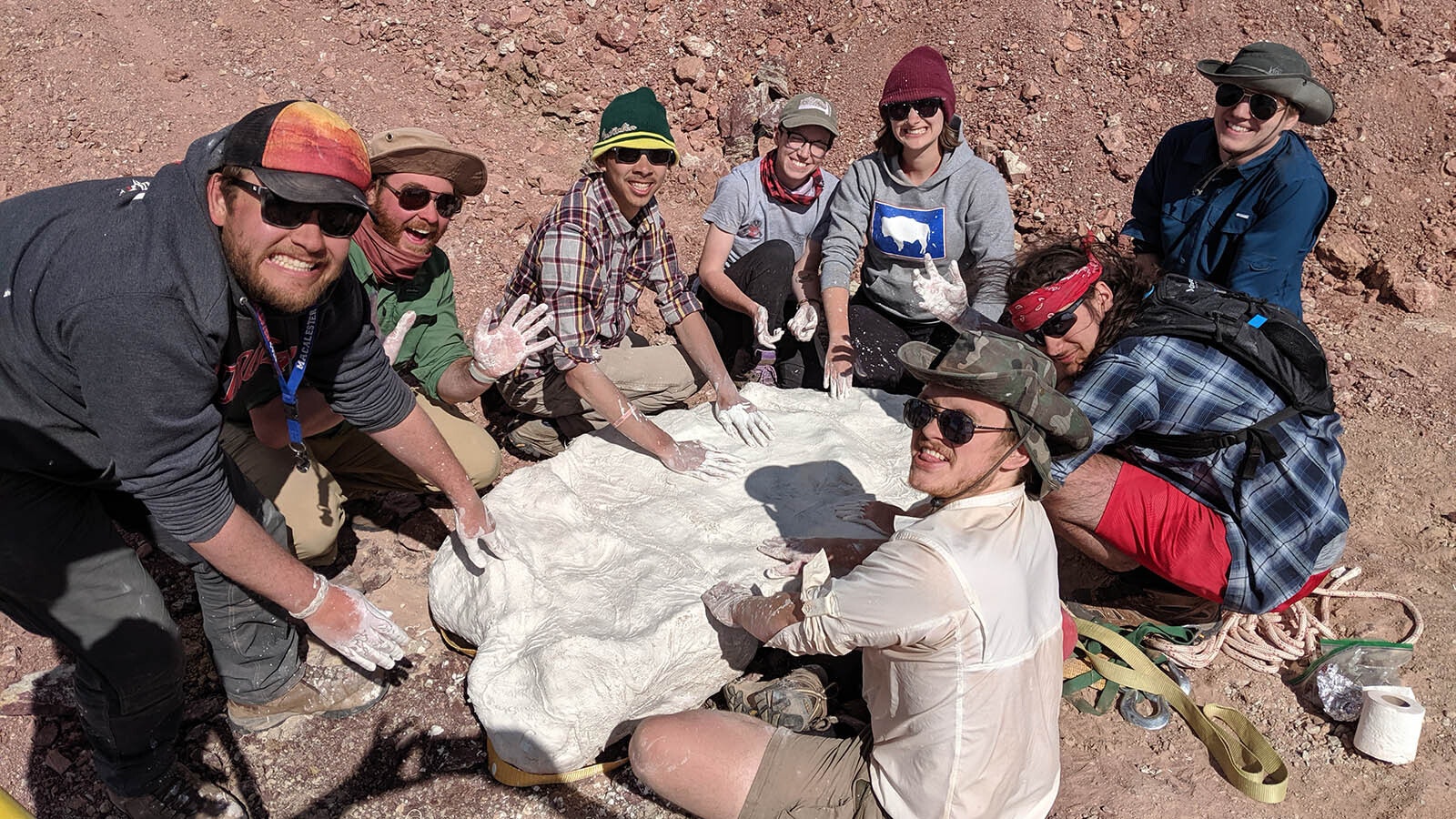
Paleontologists uncovered a bonebed containing more than 19 giant amphibian skeletons from the Popo Agie Formation near Dubois, Wyoming. The bonebed is a smorgasbord of skeletons, dense with dismembered heads, chests, hips and tails. (Courtesy Photo) 
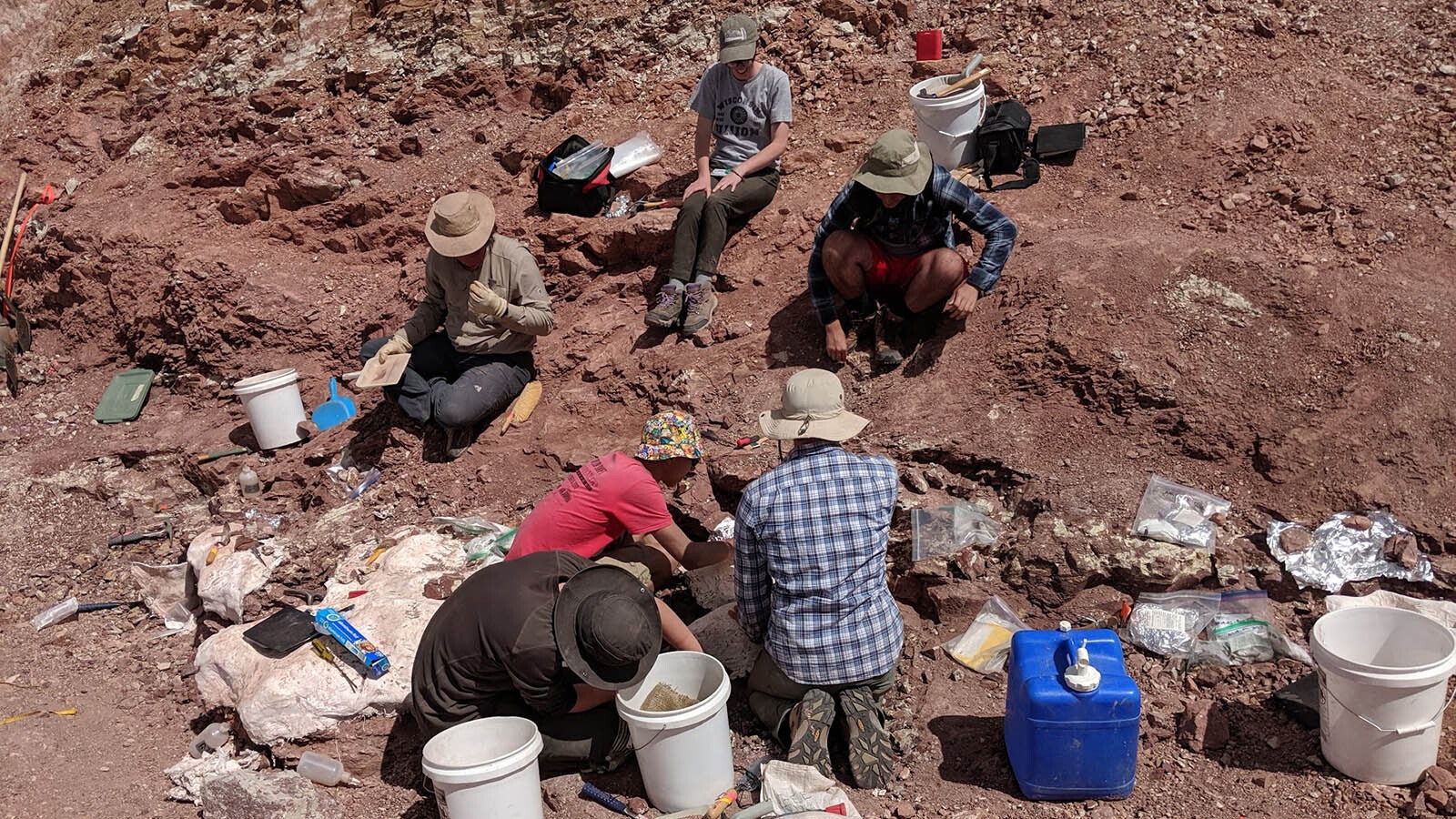
Paleontologists uncovered a bonebed containing more than 19 giant amphibian skeletons from the Popo Agie Formation near Dubois, Wyoming. The bonebed is a smorgasbord of skeletons, dense with dismembered heads, chests, hips and tails. (Courtesy Photo) 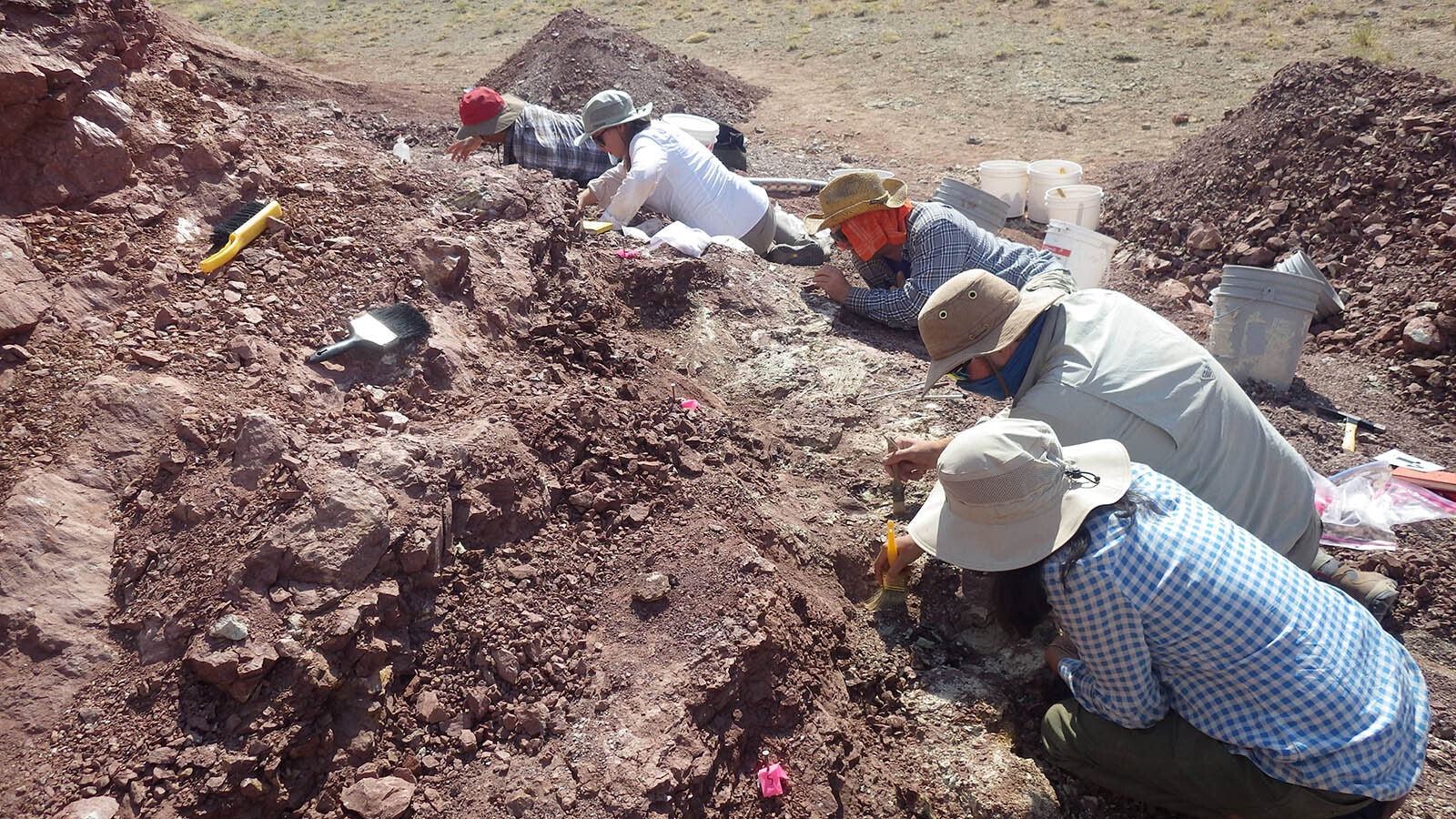
Paleontologists uncovered a bonebed containing more than 19 giant amphibian skeletons from the Popo Agie Formation near Dubois, Wyoming. The bonebed is a smorgasbord of skeletons, dense with dismembered heads, chests, hips and tails. (Courtesy Photo) 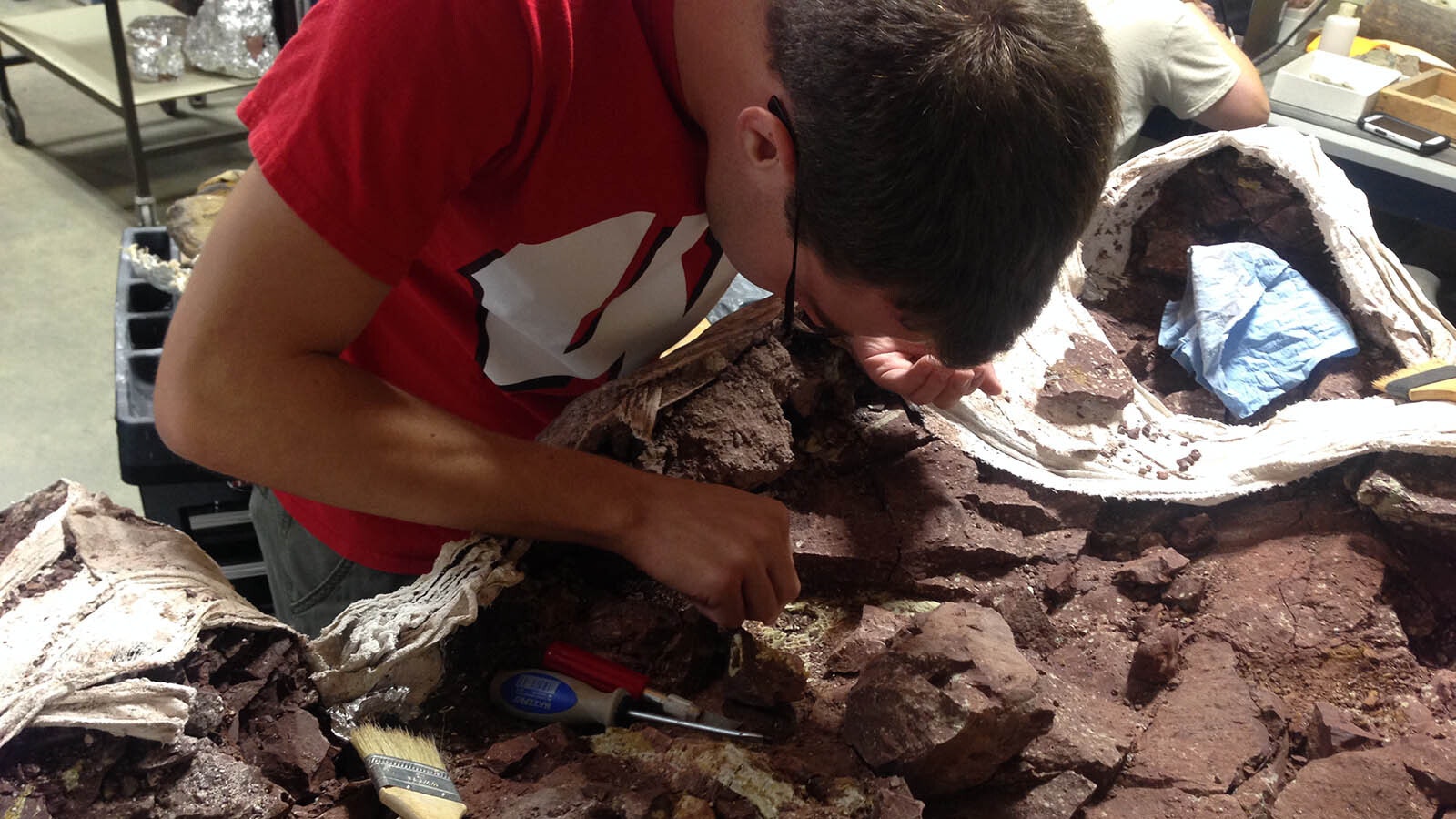
Paleontologists uncovered a bonebed containing more than 19 giant amphibian skeletons from the Popo Agie Formation near Dubois, Wyoming. The bonebed is a smorgasbord of skeletons, dense with dismembered heads, chests, hips and tails. (Courtesy Photo)
Monodominant Mass Mortality
The fossils Kufner has been studying were excavated from the Nobby Knob bonebed, a site in the Popo Agie Formation near Dubois, between 2014 and 2019. The bonebed is a smorgasbord of skeletons, dense with dismembered heads, chests, hips, and tails.
“We’ve found every part of the metaposaurid skeleton that’s known,” he said. “There are parts of their skeletons that don’t fossilize, so as far as we know, we don’t have any of those. But we’ve found every other part of the skeleton.”
Among the fossilized bounty were several complete skulls. That helped identify the specimens in the Nobby Knob as multiple Buettnererpeton, the oldest known metaposaurid in North America.
“Monodominant” is a term used by paleontologists to describe a fossil site where most of the fossils come from a single kind of animal. Since the vast majority of fossils from Nobby Knob are from Buettnererpeton, that led Kufner to the conclusion that they had uncovered a mass mortality site.
“We can say these animals were probably all dying around the same time,” he said. “This wasn’t a place where bones and skeletons accumulated over time. We can constrain the time of death.”
This isn’t the first site of metaposaurid mass mortality from the Late Triassic. In the 1930s, a similar site was found near Santa Fe, New Mexico, and subsequent excavations have revealed thousands of fossils of Anaschisma, another species of king-sized killer salamander first described from fossils found in the Popo Agie Formation of Wyoming in 1905.
Establishing a cause of death is difficult when the only evidence is fossilized skeletons from 230 million years ago.
Kufner said it’s possible that these Buettnererpeton died by drying out during a drought. Amphibians need to keep their skin moist to survive, and droughts have always been death sentences for amphibians worldwide over the last 400 million years.
Kufner also found that the preservation of the fossils showed little “hydrodynamic sorting.” That suggests the mass grave was a spot with placid water, like a pond or oxbow lake, and the dead Buettnererpeton were buried right where they dried and died.
“They were aquatic predators that died within a few months of each other, possibly from drying out or disease,” he said. “We don’t know the cause of death, but we do know they died around the same time.”
Purple Pieces, Plants, And Poop
While the vast majority of fossils from the Nobby Knob site are Buettnererpeton fossils, Kufner said several other fossils from other Triassic creatures have been found in the monodominant mass mortality site.
“We have a couple of teeth from archosaur-morph reptiles, which was the lineage of reptiles that would give rise to crocodilians, dinosaurs, and birds,” he said. “We also found partial skeletons of redfieldiiform fish that were probably scraping algae from the rocks with a weird tooth-covered bone on the front of their face.”
Other fossils from the site include the molds of freshwater bivalves, possible plant material, and trace fossils that Kufner has identified as coprolites, a.k.a. fossilized feces.
“Wherever you have animals, you're going to find their poop, and we have some of that too,” he said.
Every fossil from the Nobby Knob site is exciting because they’ve come from a layer called “the Purple Unit” that was previously believed to be barren of any fossils.
“Quite a few fossils are known from the layer below the Purple Unit, and all the historic species we know from the Popo Agie Formation are from above the Purple Unit,” he said. “We didn’t have a good idea of what was going on between these two units, but now we’re getting a clearer picture of the transition between these layers.”
The fossils of Ahvaytum were also found in the Purple Unit of the Popo Agie Formation. This chicken-sized dinosaur was the first found in the formation and the earliest dinosaur from North America.
Dinosaurs were the new kids on the block during the Late Triassic, competing with and being eaten by Buettnererpeton and other large amphibians and reptiles that would disappear by the beginning of the Jurassic Period.
Fossils from the Purple Unit can help reveal what happened during the Late Triassic that led to the mass extinction that allowed dinosaurs to conquer the world.
“Having a high density of vertebrate fossils from a unit of rock that's not super well known in North America is really exciting,” Kufner said. “We have a better snapshot of the types of animals that were living at this place and time.”
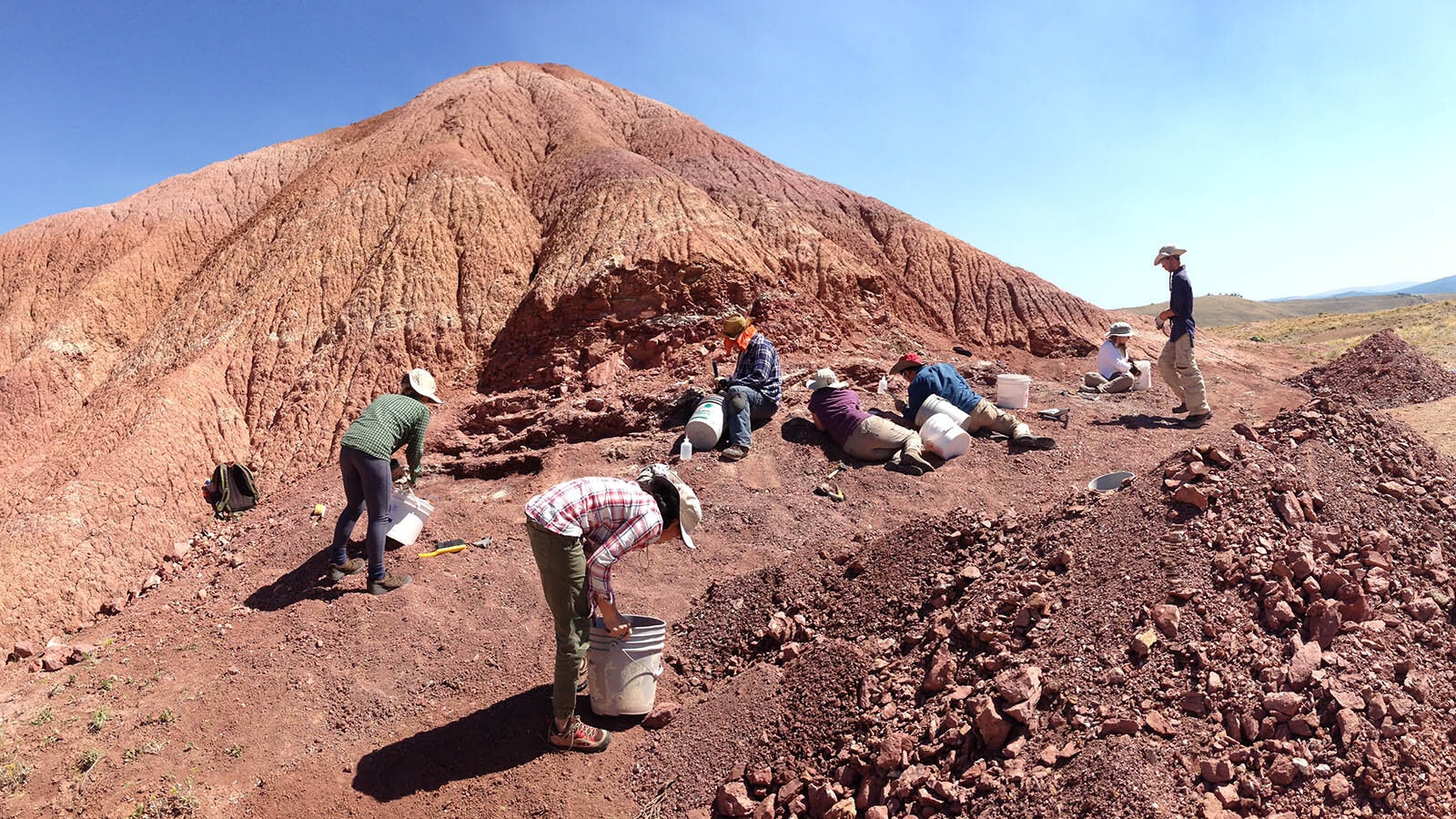
Paleontologists uncovered a bonebed containing more than 19 giant amphibian skeletons from the Popo Agie Formation near Dubois, Wyoming. The bonebed is a smorgasbord of skeletons, dense with dismembered heads, chests, hips and tails. (Courtesy Photo) 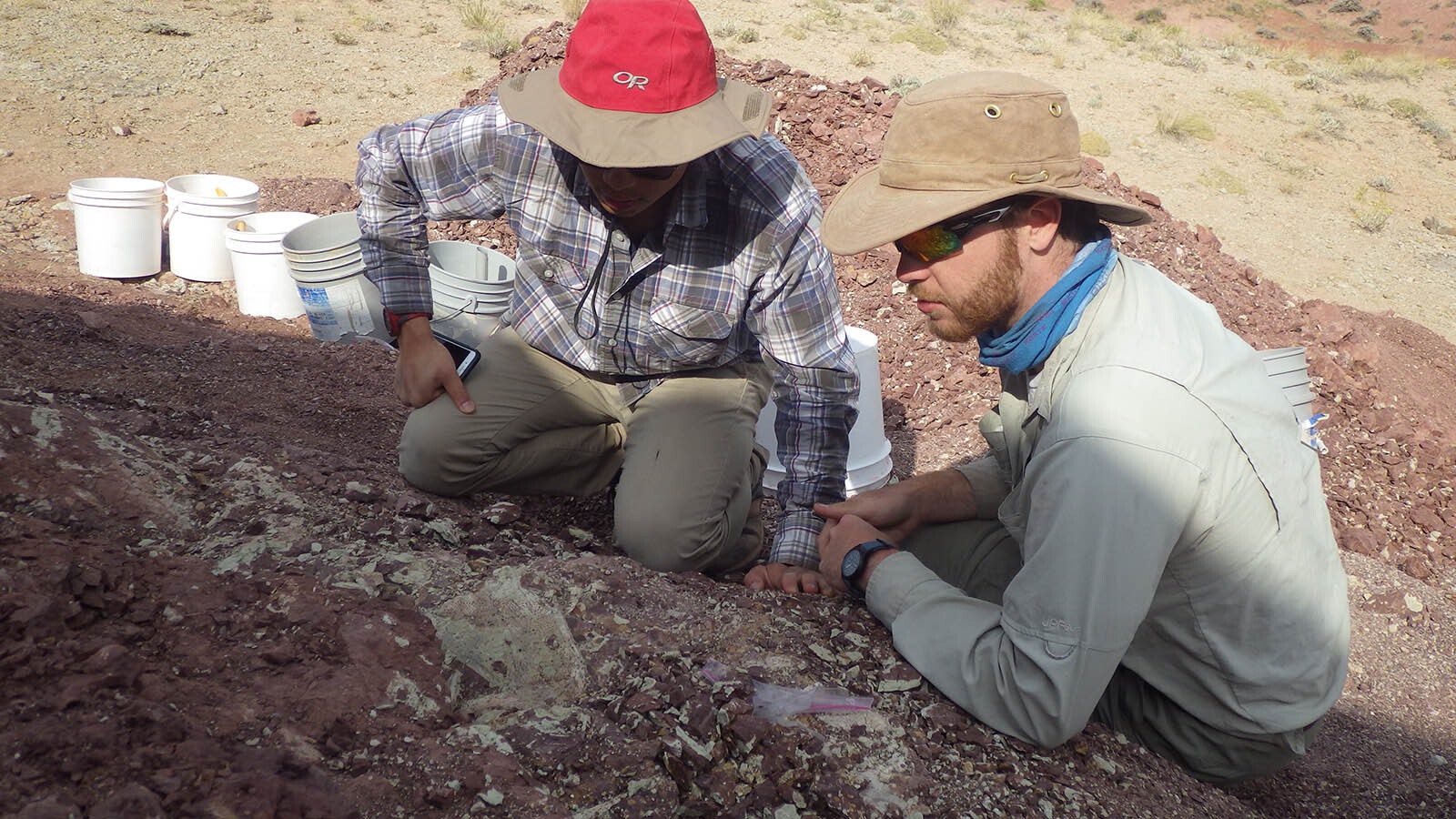
Paleontologists uncovered a bonebed containing more than 19 giant amphibian skeletons from the Popo Agie Formation near Dubois, Wyoming. The bonebed is a smorgasbord of skeletons, dense with dismembered heads, chests, hips and tails. (Courtesy Photo)
Exploring The Exciting Unknown
Ahvaytum and the monodominant metaposauird mass mortality site are just the beginning of the ongoing research into the largely unknown Popo Agie Formation. Kufner said a wealth of additional fossils are waiting to be studied in the collections of the University of Wisconsin-Madison.
“We have several unprepared field jackets we’ve collected but haven’t gotten to yet,” he said. “This is just the first publication from this site, and we’ll be able to go back and update what’s been published so far as we continue.”
Meanwhile, Kufner is looking forward to two weeks of fieldwork in the Popo Agie Formation in east-central Wyoming. Nobody knows what they’ll find in these new locales, in rock below the Purple Unit, but any paleontologist will say the uncertainty is part of the thrill.
“When you dig up a new site, it's exploratory,” he said. “You don't exactly know what you're going to find, so you gear your studies based on what you find.”
Kufner hopes they’ll find a more complete skeleton of another Late Triassic dinosaur but is tempering his expectations. Even if they come back empty-handed, there’s plenty more to do with the dozens of Buettnererpeton from Nobby Knob.
In the future, Kufner wants to cut into the metaposaurid bones and remove thin slices for bone histology studies. He thinks the bones might contain a clue to solve the mystery of the mass mortality.
“It’s possible these metaposaurids had to restrict their metabolism at some point during the year,” he said. “You can determine that by looking at growth markers inside the bone. That would tell us that these amphibians lived in a harsher seasonal environment, which is what we’d expected to see if the site was a dried-up pond they all died in.”
Kufner admitted his favorite part of his new paper was compiling a list of all the known species of fish, amphibians, and reptiles from the Popo Agie Formation. Several species on this list have been discovered within the last decade, all from the ongoing research at the University of Wisconsin-Madison.
Kufner and his peers have turned one of Wyoming’s overlooked rock layers into a bevy of exciting and ongoing research projects. The Popo Agie Formation preserves a weird and fascinating moment in Earth’s history, and Kufner can’t wait to see what else is waiting to be found.
“Most of the work in the Popo Agie Formation was done over 100 years ago, and people have mostly left it alone since then,” he said. “Other sites in Arizona, Texas, and New Mexico have rightfully received a lot of attention, so we’re excited to see what else the Late Triassic of Wyoming has to offer.”
Andrew Rossi can be reached at arossi@cowboystatedaily.com.