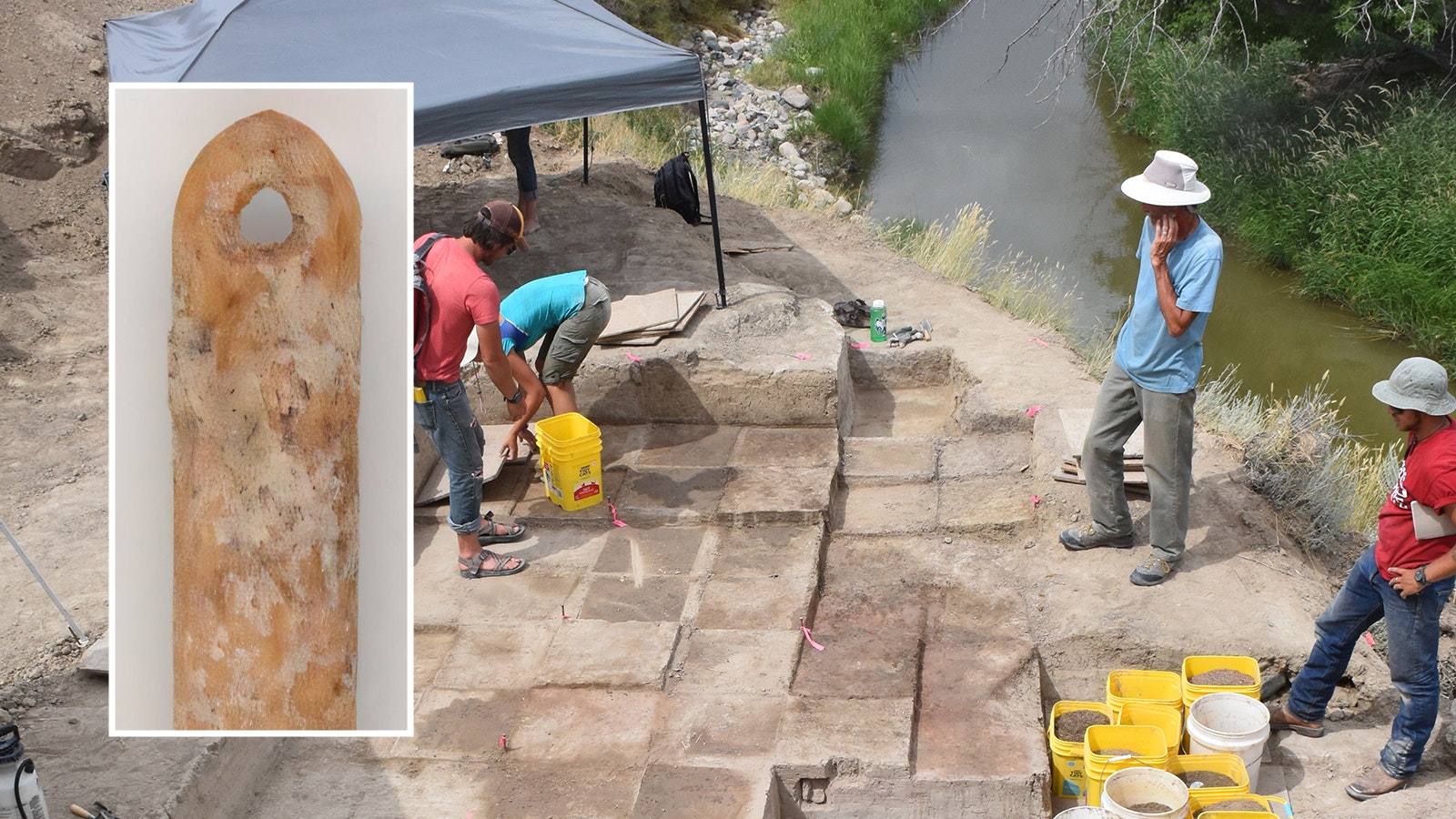
Wyoming’s famous La Prele Mammoth site near Douglas continues to give up discoveries that could challenge or rewrite the history of early man.
Earlier this year, a tiny bead from the site helped open wide a new window on early North American life from a time just shy of 13,000 years ago. That became an international sensation.
Now Wyoming Archaeologist Spencer Pelton is unveiling another finding from the site that’s likely to make new international waves.
He’s found 32 bone needles at the site, which he’s proven through a novel approach came not from mammoths, as researchers had previously thought, but from smaller mammals like red foxes, hares or rabbits, bobcats, mountain lions and lynx, or American cheetahs.
To prove this, Pelton extracted collagen from the bone needle fragments. Then he compared the amino acid chains from his bone fragments to those from collagen extracted from other animal bones of the time period to see which ones match.
“Really, the larger implication here is that people were trapping like foxes and cats at the time,” Pelton said. “That was super surprising. I mean, we’re making that assumption, right, but you don’t really go out with a spear to kill a bobcat. It’s just not that easy.
“So, this is probably pretty good evidence that people were trapping during this time, and that’s not something we’d ever considered, so it’s one of the more interesting aspects of the study.”
The Site
The La Prele site is located on a tributary of the North Platte River near Douglas, and it’s a site Pelton has worked on for the past 10 years.
He started that work when he was in the process of working on his doctorate with a thesis around clothing — notoriously difficult, because so far, there aren’t even any examples of clothing dating back to early American time periods like Clovis man, who lived from 13,050 to 12,750 years ago.
Among the oldest known examples of clothing is from Otzi the Iceman. He was wearing clothing made from hide, leather and braided grass. That only goes back 5,300 years or so, though, Pelton said.
Then there’s the Fort Rock sandals, which were dated to between 10,400 to 9,100 years old. Fragments of the sandals were found in a cave, beneath a layer of volcanic ash.
Pelton’s thesis looked at what might be around in the archaeological record that could be associated with clothing production for early Clovis man. Among those items would be bone needles.
“So, I kind of had bone needles in my mind, and some other tools associated with clothing production,” he said. “Scrapers and things like that.”
Because of the age of the site and its size, Pelton decided that archaeologists really should do a very difficult procedure that’s not often done in the field, a process called water screening.
“You have to set up near a creek or body of water and you put all the sediment through these screens,” Pelton said. “Then you dry the screens out and put all the stuff in the screen in a bag and stick it under a microscope in the lab.”
The process is time intensive and boring, but in this case it really paid off.
“We started finding these tiny, little, odd cylindrical objects in the water screen,” Pelton said.
When he saw the first one, Pelton dismissed it as an overactive imagination or wishful thinking.
But then they found several more.
“I had to accept that we started finding bone needles,” Pelton said. “I had stared at enough photos of them that I kind of had an idea what we were seeing when they started coming out of the screen.”

Bone Needles Are Uncommon
Globally, bone needles are super rare, Pelton said.
“There’s only a few dozen places where they’ve been found, but Wyoming has the highest density of these things of any state in the United States, I’m pretty sure. I mean, we have at least four or five sites that have produced these bone needles now.”
Pelton thinks other sites may have had these types of bone needles but, given the large and laborious investment water screening takes, they probably are under-represented in archaeological digs around the world.
“If you don’t have to do it, or you don’t have any good reason to think you have things like bone needles at the site, people typically won’t do it,” he said. “But La Prele is a very important site.”
Literally tens of thousands of artifacts have come from the site, Pelton added, and the surprises are certainly not over.
The dig itself concluded this summer, so the focus will move to examining all the pieces that have been found.
“We haven’t yet done things like look at all the animal bones,” Pelton said. “There could be some interesting surprises in the animal bones that we were not expecting. We know we have a mammoth there, and we know we have some bison there. Now we know we have some hares, canids and cats. But it’s always possible there’s a few other critters in there.”
There were all sorts of interesting critters living in Wyoming 12,600 years ago, Pelton said, the time period when researchers believe the La Prele site was built by North American Indians. Among these critters were camels and horses.
“We did have camels in Wyoming,” Pelton said. “A couple of camel bones have been found in archeological sites. George Frisson found one at a site up by Gillette. And one of my colleagues, Marcel Kornfeld, found a sloth, a giant ground sloth tooth, at the Hell Gap site in Wyoming two summers ago.”
Pelton said a decade is an awfully long time to spend at one site.
We could dig there for a really long time and never run out of things to find,” he said. But you don’t necessarily want to do that, or at least, I don’t want to do that. Other people might come along in 100 years with new ideas. You want to leave something for them. They could have new technology, so archaeologists typically don’t like to excavate sites in their entirety for a lot of those reasons.”
Wild West Is Calling
What Pelton has his eye on now is a little nearer in history. He’s hearing the call of the Wild West, and the Overland Trail.
“That is an under-explored aspect of Wyoming’s archeological record, and it just fascinates me,” Pelton said. “It’s kind of that archetypical Wild West period in Wyoming’s history, true cowboys and Indians kind of stuff, and I just really like that time period.”
Pelton also sees a lot of tourism angles with that line of research, and he’s really excited about what the future might hold for discoveries along the Overland trail.
“It’s really publicly engaging in a way that prehistoric archaeology isn’t,” Pelton said. “I mean it’s fascinating, obviously, for the people who are into it. But so many people can relate to the historic cowboy era stuff, and it’s easy to get folks jazzed about it.”
Recently, Pelton’s been invited to explore another site very near the Overland Trail stage stop where he’s been excavating, which could provide further insight to the time period.
“The city of Laramie bought this property west of town called HartRanch, and they basically bought it for water rights,” Pelton said. “It’s not on the Overland Trail stage stop, but it’s the first ranch in Albany County.”
Charles Hutton founded the ranch in 1866, which is the same timeframe as the Overland Trail stage stop.
“So, he’s basically a guy who was hanging out in this era, working on the telegraph line and working as a freighter,” Pelton said. “He decided to settle down and started this ranch, becoming one of I think the first ranchers in the state. I mean, the mid-1860s, that’s super early for ranches in Wyoming.”
Renée Jean can be reached at renee@cowboystatedaily.com.