A Wapiti, Wyoming, man is trying to get the federal government’s machine gun ban overturned.
Jake DeWilde announced in a Friday court filing that he’s appealing to the 10th Circuit Court of Appeals, after U.S. District Court Judge Scott Skavdahl rejected his effort to have the nation’s general ban on machine gun possession declared unconstitutional under the Second Amendment.
This was DeWilde’s second time suing the U.S. Bureau of Alcohol, Tobacco, Firearms and Explosives (ATF) in Wyoming’s federal courts system. He has represented himself without an attorney both times.
The first time DeWilde sued in January 2023, he had just been denied an ATF permit to make his own machine gun.
Skavdahl dismissed DeWilde’s case that July, saying DeWilde didn’t have standing because he merely voiced a desire to make a machine gun; he didn’t demonstrate a concrete plan to make one, and he didn’t allege any imminent harm like the possibility of being jailed for it.
So DeWilde came back to court in April, armed with his own step-by-step plan for making a machine gun and recent case history in which other Wyoming men have been convicted and penalized for having the weapons.
This time, neither Skavdahl nor the ATF disputed that DeWilde had shown “standing,” or a good reason to sue.
Yeah, But …
But Skavdahl dismissed DeWilde’s newer case on its merits Wednesday, calling his arguments unsustainable under prior Second Amendment cases.
Specifically, the 2008 case District of Columbia v. Heller says that machine guns aren’t under the Second Amendment’s umbrella. They weren’t “in common use when it was written,” the judge’s order notes.
DeWilde had argued that the U.S. military uses machine guns and that makes them common.
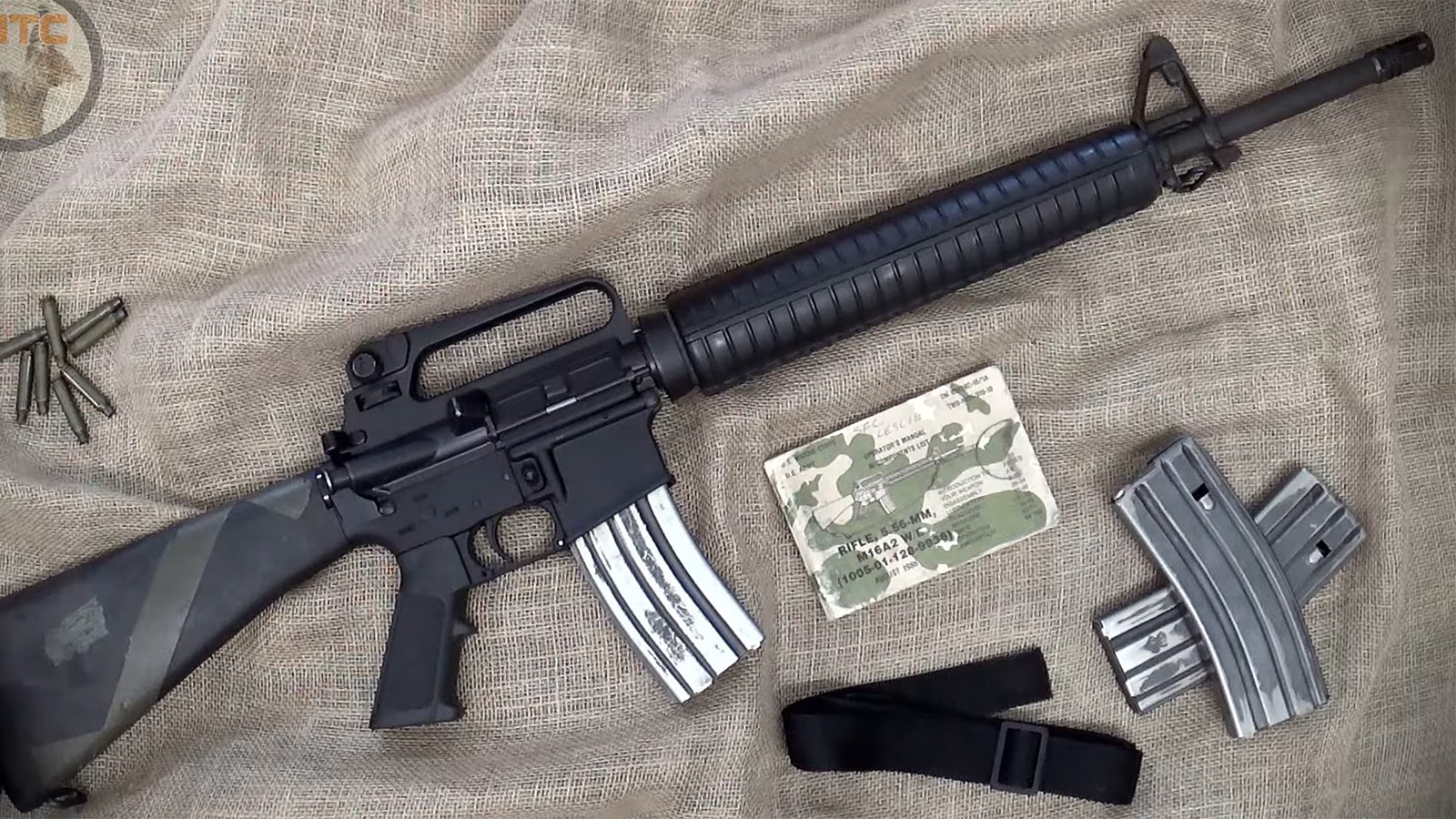
The M16 is also “the quintessential rifle for use in the modern militia, just as the musket was the quintessential rifle for use in the militia of the colonial and revolutionary war era,” he argued.
DeWilde referenced the 2022 case New York State Rifle & Pistol Assn. Inc. v. Bruen in which the U.S. Supreme Court clarified that when the government restricts one’s Second Amendment rights, it must justify that regulation by showing it is consistent with the nation’s historical tradition of gun regulation.
But Bruen didn’t overrule Heller.
Skavdahl relied on Heller, primarily, in dismissing DeWilde’s case.
Firstly, the judge declined to call the law altogether, or “facially,” unconstitutional because it also applies to arms one cannot “bear” in one’s hands, like an aircraft-mounted cannon.
So even if DeWilde’s objections to the machine gun ban held up in court, they wouldn’t negate the law altogether, which has a broader scope than banning machine guns, Skavdahl reasoned.
As-Applied
Secondly, Skavdahl rejected DeWilde’s arguments that civilians should be able to make M16s, that the military having them makes them common and that they are fitting for civilian-formed militias.
“(That’s) misguided and incorrect,” wrote the judge.
When the nation was founded, people strongly disfavored standing armies and preferred militias made of citizens, but now standing armies are necessary to protect the country, he added.
And thirdly, wrote Skavdahl, the government would win a challenge against its machine gun ban anyway, because the nation has a “historical tradition” of regulating the keeping and bearing of “dangerous and unusual weapons.”
Skavdahl wrote that he had little difficulty finding that an M16 is a dangerous and unusual weapon.
“They are unusual because they are uncommon to society at large,” he wrote.
It’s A Little Circular
DeWilde has waged “respectable arguments,” but probably will lose his case in the end, David Kopel, senior fellow at the University of Wyoming Firearms Research Center, told Cowboy State Daily.
Machine gun possession and transfer has been generally banned since 1986, though machine guns crafted and possessed before that date are grandfathered in as legal possessions.
This means that the federal government made machine guns “uncommon” with its own legislation and now defends its legislation by calling them uncommon.
“There’s a circularity to that,” Kopel said. “And it’s fair to criticize it. But you know, what I keep coming back to is just what Heller says. And lower courts are going to overwhelmingly follow that.”
The Heller case says machine guns aren’t protected by the Second Amendment.
“If that sentence in Heller had never appeared, the current case would be a much closer case,” said Kopel.
Clair McFarland can be reached at clair@cowboystatedaily.com.