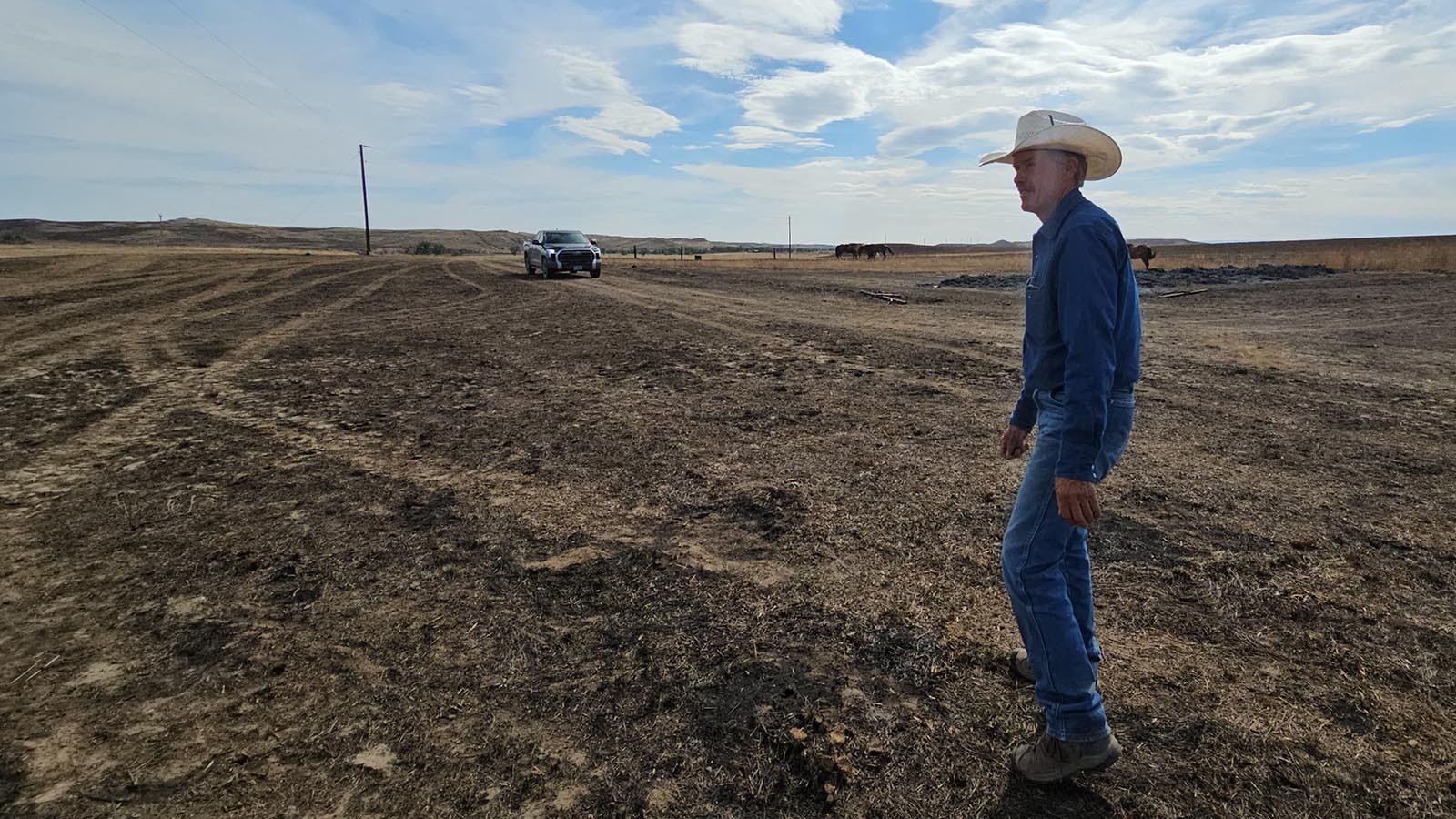
BUFFALO — Dust devils are sometimes the only life David Belus can see on his Johnson County ranch as he looks out over miles and miles of scorched earth.
“Right after the fire, the (dirt devils) were huge,” Belus said. “In some areas, there’s so much ash that it’s actually like drifted snow along the road.”
Even when the wind is light and gentle, the dirt devils are out and about, tap-dancing across the nearly 50,000 acres of burnt pastures on Belus’ ranch. Sometimes, they are the only signs of life in a field where antelope and cattle used to roam.
Their presence, though, is anything but merry.
They’re a disquieting sign of the erosion Belus knows is happening across not only his land, but across all the other acres upon acres that have burned up in the House Draw and Remington fires, as well as the other large wildfires that have scorched northeast Wyoming this summer.
“Within a 100-mile radius of here, 500,000 acres have burned up,” Belus said. “Conditions were just right everywhere. We didn’t have enough of a green buffer anywhere to stop it. It was, as people refer to it, a perfect storm.”
For Belus and his operation, it was the House Draw Fire, which has burned nearly 175,000 acres of prime ranchland since it was discovered Aug. 21.
Hundreds Of Years Of Topsoil At Risk
While the fire activity now is minimal, that perfect storm isn’t anywhere near over for Belus and other ranchers.
“It’s going to take a couple of years for things to get back to normal, and it will be a new normal,” Belus said. “Things won’t be the same as they were.
“But for things to get back into a kind of smooth operation, it’ll take two years to get our cows back, to get all of our fences rebuilt, to get back into the rotations that we are used to. It just takes a while.”
Help from the community has been generous, Belus said.
Relief funds have been set up, and government agencies are working hard to help the affected ranchers design management plans to deal with the aftermath.
“The community is doing all they can for us, helping out where they can,” he said. “Everybody from the NRCS (Natural Resources Conservation Service) to the FSA (Farm Service Agency) has been helpful. And they’re like us. They all had a job, and now they’ve got two jobs. They’re spending a lot of overtime hours trying to help us out. We’re thankful for that.”
But the help these ranchers need most right now isn’t help that anyone in the community can give. What they need most right now is rain.
“In a perfect world, what we’d like to get 6-8 inches of rain or snow that came straight down,” Belus said, looking out over the bare, blackened hills. “A nice slow rain.”
That way, the rain doesn’t exacerbate the erosion that’s already stealing hundreds of years of topsoil from the land.
So far, though, rain hasn’t been happening.
Instead, it’s just wind picking up ash and dirt, swirling it around to the heavens in what looks, from a distance, like another heart-stopping fire.
For now, Belus can only watch what is for now a slow-motion disaster unfold.
At First, Just Another Typical Day In The Life Of A Ranch
The morning of the fire, Belus was in the meadows on the west side of his ranch, baling hay.
It was a typical morning, or so he thought.
“I did see the thunderstorm go down,” he said. “And then I saw some lightning cracks.”
There was a thought tickling the back of his mind that lightning right now might not be such a good thing.
But right then, his mind was focused on the yearling cattle sale. He headed out for Sheridan, not giving the thunderstorm any more thought.
Just as the sale was starting, though, Belus’ phone began to ring. He almost didn’t answer. He really needed to concentrate on the sale at hand.
But something made him pick up the line.
“Man, you’ve got a fire on you,” he heard a voice on the other end of the line saying. “You’d better get down here.”
Belus knew instantly what started the fire. It had been the lightning he’d seen that morning.
Still, he wasn’t worried. Fire at this time of the year isn’t all that unusual. Almost every year, 100-200 acres burns.
As he drove back to his ranch, he was thinking about where all the trouble spots might be, what was most vulnerable and who to call first.

David Belus in his truck taking Cowboy State Daily on a tour of his ranch. (Renee Jean, Cowboy State Daily) 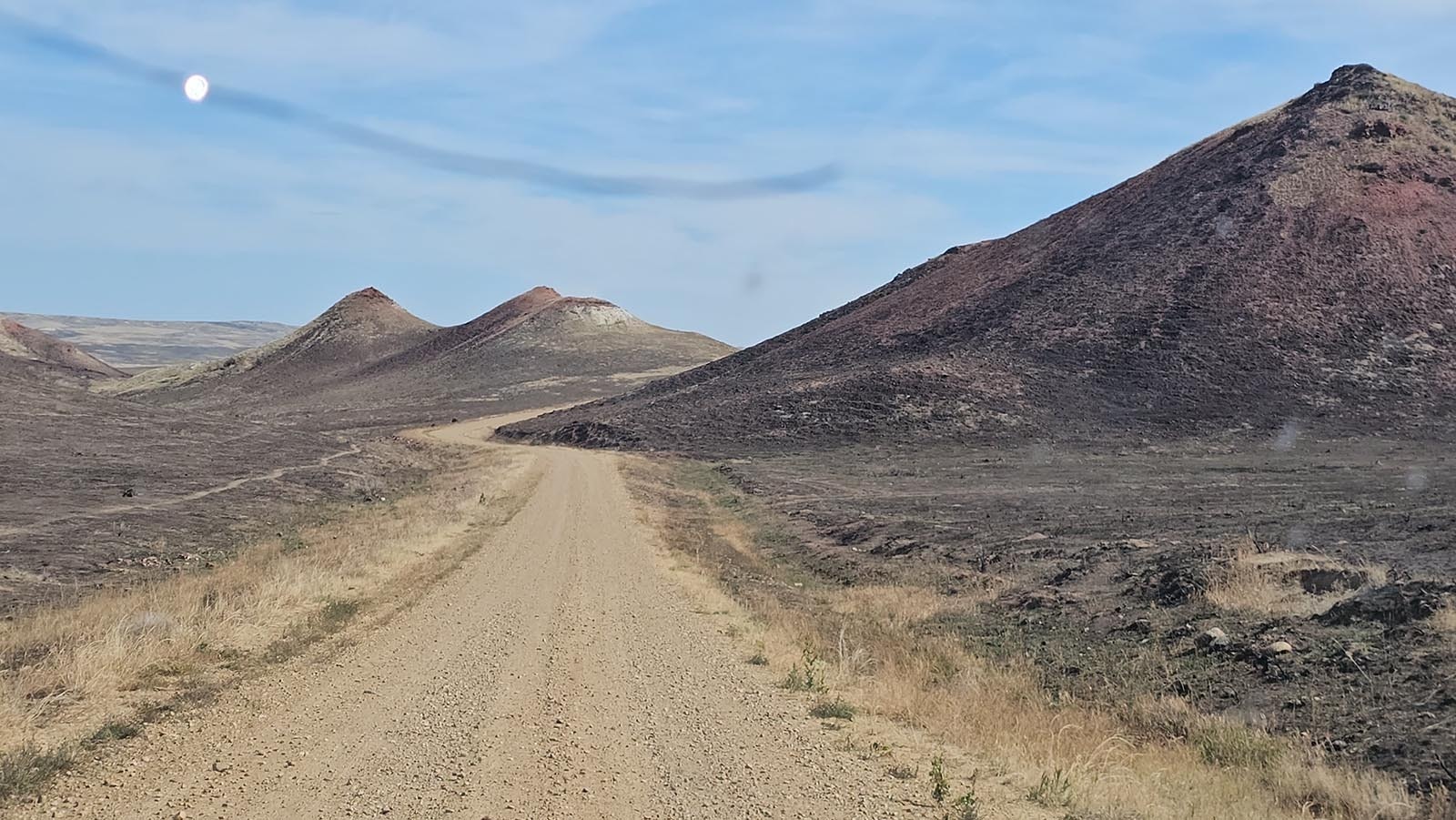
The burned land stretches on for miles and miles. (Renee Jean, Cowboy State Daily) 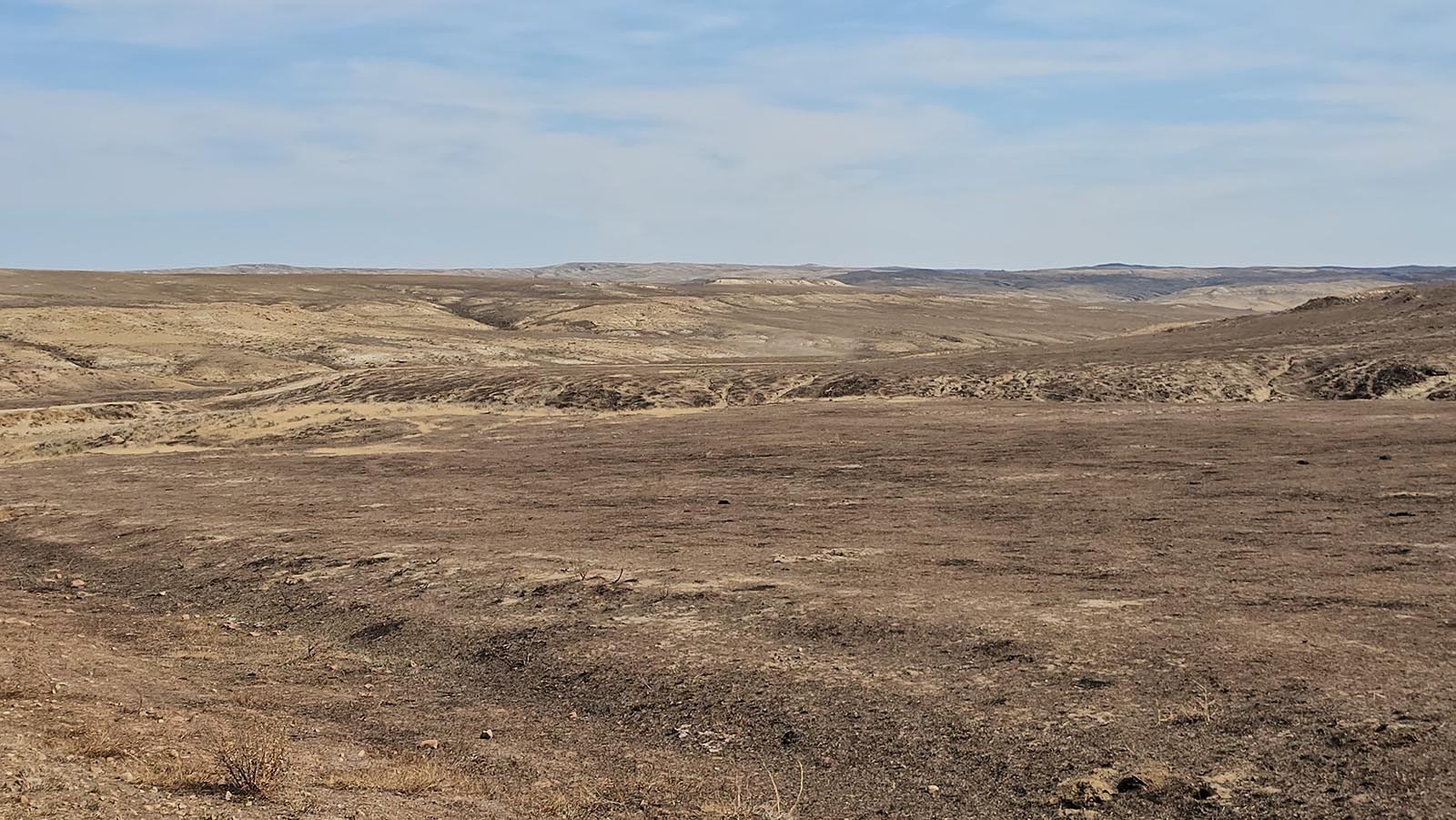
The lighter color of the soil suggests fire was hotter here, and may require preemptive spraying for cheat grass. (Renee Jean, Cowboy State Daily) 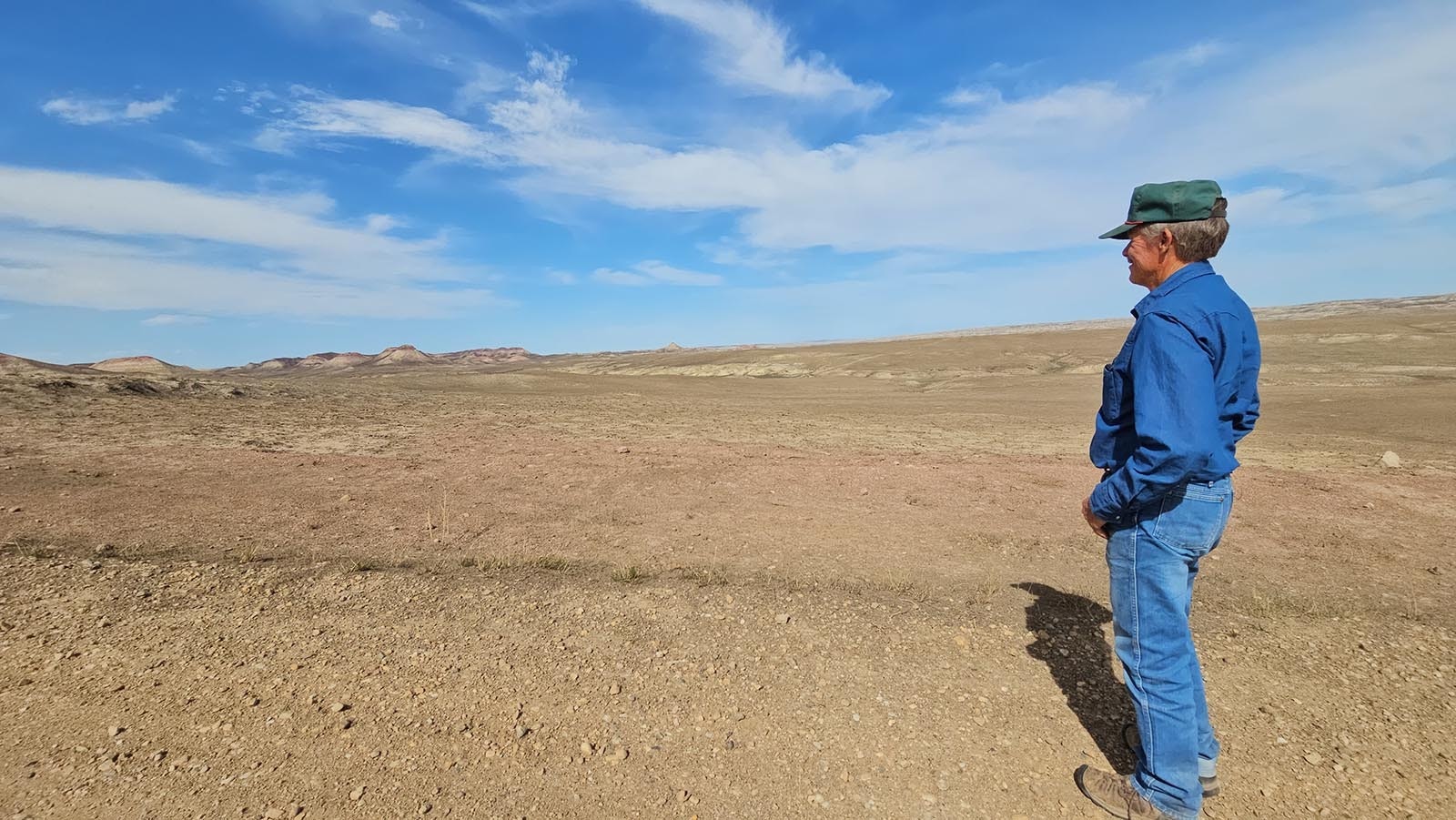
David Belus is hoping for rain to help heal his ranch after 50,000 acres of it went up in smoke in Johnson County. (Renee Jean, Cowboy State Daily) 
Black as far as the eye can see, with drifts of ash on top. Even the light wind was picking up dirt devils — erosion happening before David Belus' eyes on his ranch, where nearly 50,000 acres went up in smoke. (Renee Jean, Cowboy State Daily) 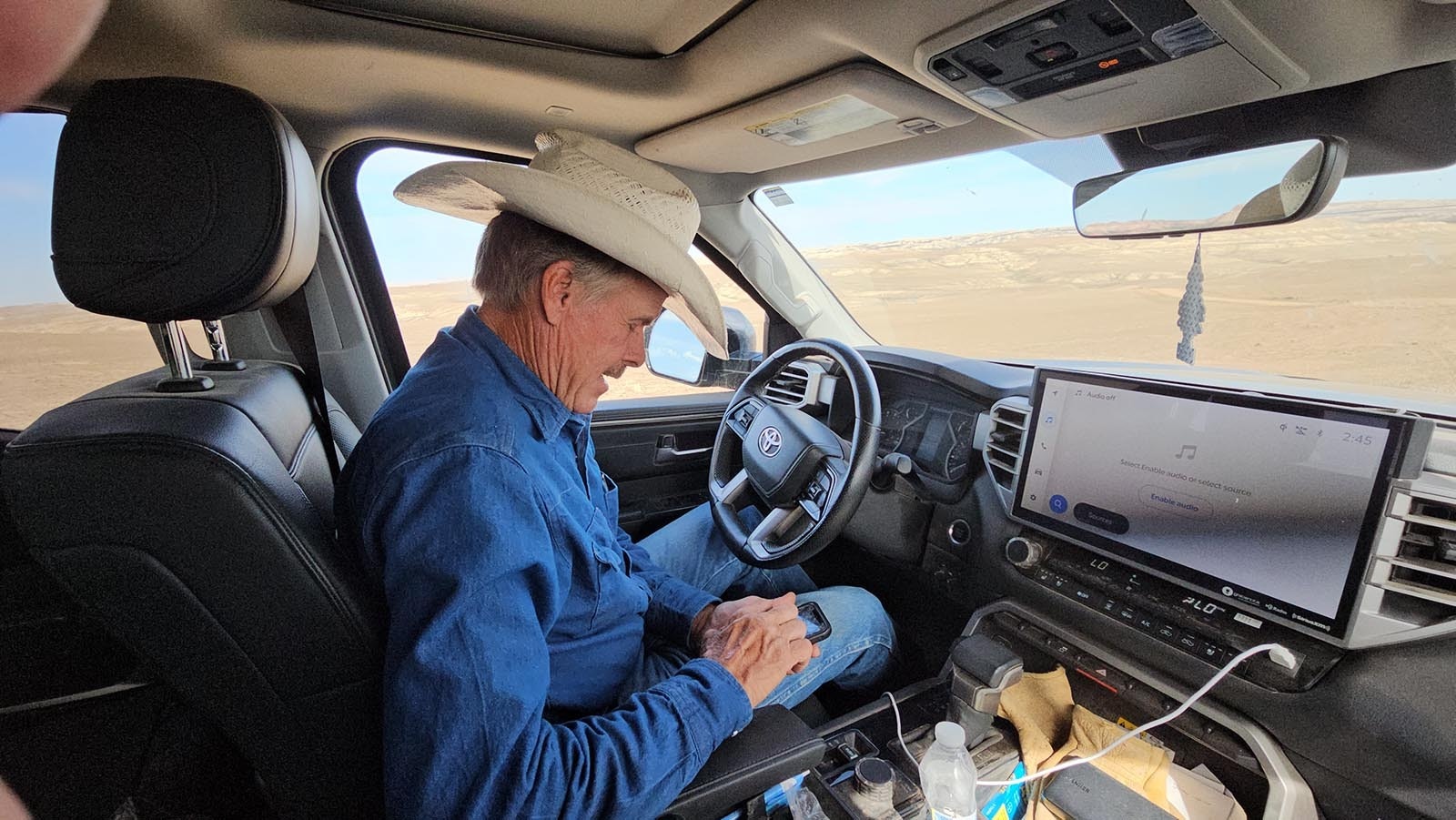
David Belus looks at photos he took of the devastation on his ranch, days after nearly 50,000 acres went up in smoke. The photos include dead cattle, as well as yearlings who were so burned they had to be euthanized. (Renee Jean, Cowboy State Daily) 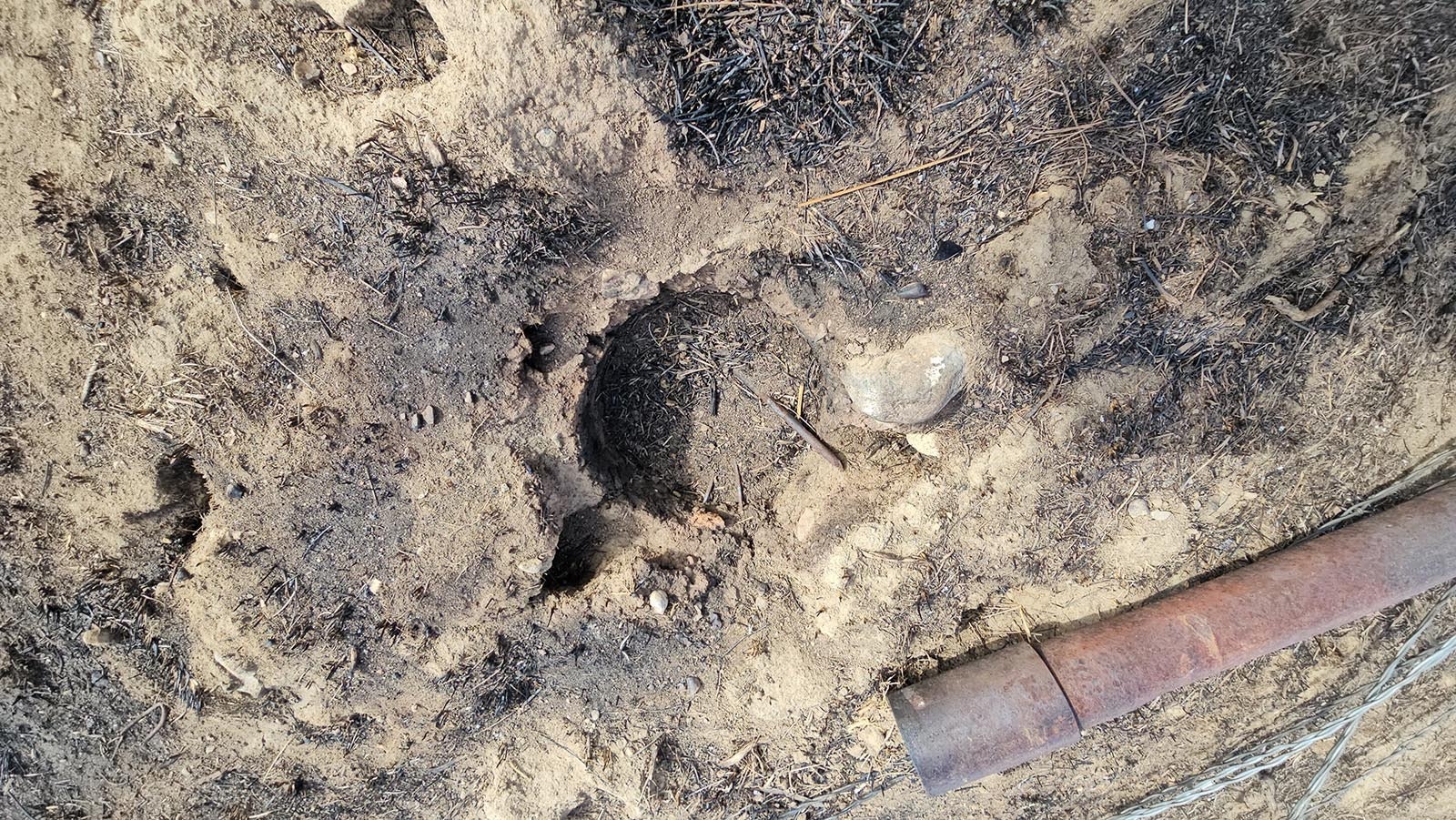
All that's left of this fence are post holes and nails and metal cross pieces. The rest went up in flames. (Renee Jean, Cowboy State Daily)
‘This Was A Monster Fire’
When he topped the hill and saw a huge plume of smoke consuming the sky, his heart dropped into his stomach. This was not going to be a little 200-acre fire.
“This was a monster fire,” Belus said. “So, I got down here as fast as I could, and I went to my daughter and son-in-law’s first to get the grandkids out of the way.”
Then the rush was on to gather as many of the yearlings he’d been trying to sell as possible and get them out of harm’s way.
“We went from here to the Teardrop (Ranch),” Belus said. “Just trying to make sure that structures were getting saved, that gates were open and that cattle had a way to get out of the pastures.”
The Teardrop Ranch includes some of the leased acres that make up part of Belus’ overall ranch.
Belus was on the phone as he went everywhere, asking his people what they needed, whether the gates were open, and had the fence corner been cut where the cattle were probably huddling up.
“I know they had the fire department call me and say, ‘You’ve got a bunch of cattle against this fence, and the fire’s coming,’” Belus recalled. “’Do you want us to open the gates?’”
“By all means,” Belus recalled telling them. “Otherwise …”
Here Come The Weeds
Dead antelope still lay on the nearly 50,000 acres of ranch land Belus has lost, and nearly 135 miles of fence are down.
That fence will likely have to be rebuilt from scratch, Belus said, because barbed wire that’s been burned in a hot fire can become too brittle to withstand cold temperatures.
Now and then, a surviving antelope lays alongside a dusty road on the ranch, chasing after stray patches of grass that escaped the fire. Sometimes, they seem not to have any energy to go anywhere else.
But as Belus’ truck draws near, they find a reserve somehow and scoot off into the brown fields, kicking up tiny clouds of dust as they go.
From there, they watch the curiously large blue critter on wheels, rolling past what is now a dry, dirt desert, devoid of vegetation.
Belus knows he faces millions of dollars in repairs, as well as millions of dollars for pesticide applications, necessary to stop cheat grass and ventenata.
Estimates are in the range of $13 million for weed control on all of the acres that have burned in the area. Fences are a similarly high number.
Weeds are something Belus has to be particularly cautious about.
As much as he’s praying for rain, he’s also got 78 square miles of dirt on his ranch that are now a blank canvas. He knows the instant it rains, every weed seed will spring to life alongside prairie grass. It’s going to take at least some chemical control to give the native grasses a fighting chance.
It’s too large an area to just indiscriminately spray, though. It’s going to take some scouting and some expertise that Belus himself doesn’t have.
That’s where he’s relying a bit on the help of government agencies, which are going to help him figure out which fields are likely to be the initial priority for weed control management. After that, it will be a matter of regular scouting to see what’s coming up where.
Counting His Blessings
Despite all the challenges ahead, Belus is still counting himself lucky that more was not lost, and everywhere he goes, he makes a point of highlighting the little silver linings, such as they might be.
Yes, the fences are destroyed, he will point out. But that means there’s no need to open and shut gates anymore, he’ll add with a chuckle.
“We all kind of joke around about, if you’ve got any trash on your place, like old buckets or wire, now’s a great time to pick it up,” Belus said with another chuckle. “Because you can see everything right now.”
As he says that, waving his hand across the barren landscape, a lone turkey vulture gives the dark blue pickup that Belus is sitting in a hard stare. Then it takes off, flying a short distance away to watch what it sees as a strange instance of rare life on a patch of burned-up prairie.
“On this particular ranch, I’ve got a little over 14,000 acres,” Belus said. “And there’s 200 acres, according to the NRCS, that didn’t get burnt.”
Still, things could have been much worse, Belus is quick to add.
“We only lost 35 yearlings, and I lost about 10 pair of cattle in Campbell County,” he said. “Now, having said that, we do have some burnt bags and some bad feet and stuff. Not a tremendous amount, but we do have some.”
But here and there, he added, a pasture or two were inexplicably spared.
It’s God’s grace at work, he suggests at one point.
Scorched earth can be seen all around those pastures. There’s no reason for them to have survived. And yet, somehow, they remained untouched.
“This is called Grub Draw,” he said. “I don’t know why it was spared, but I’m thankful it was.”
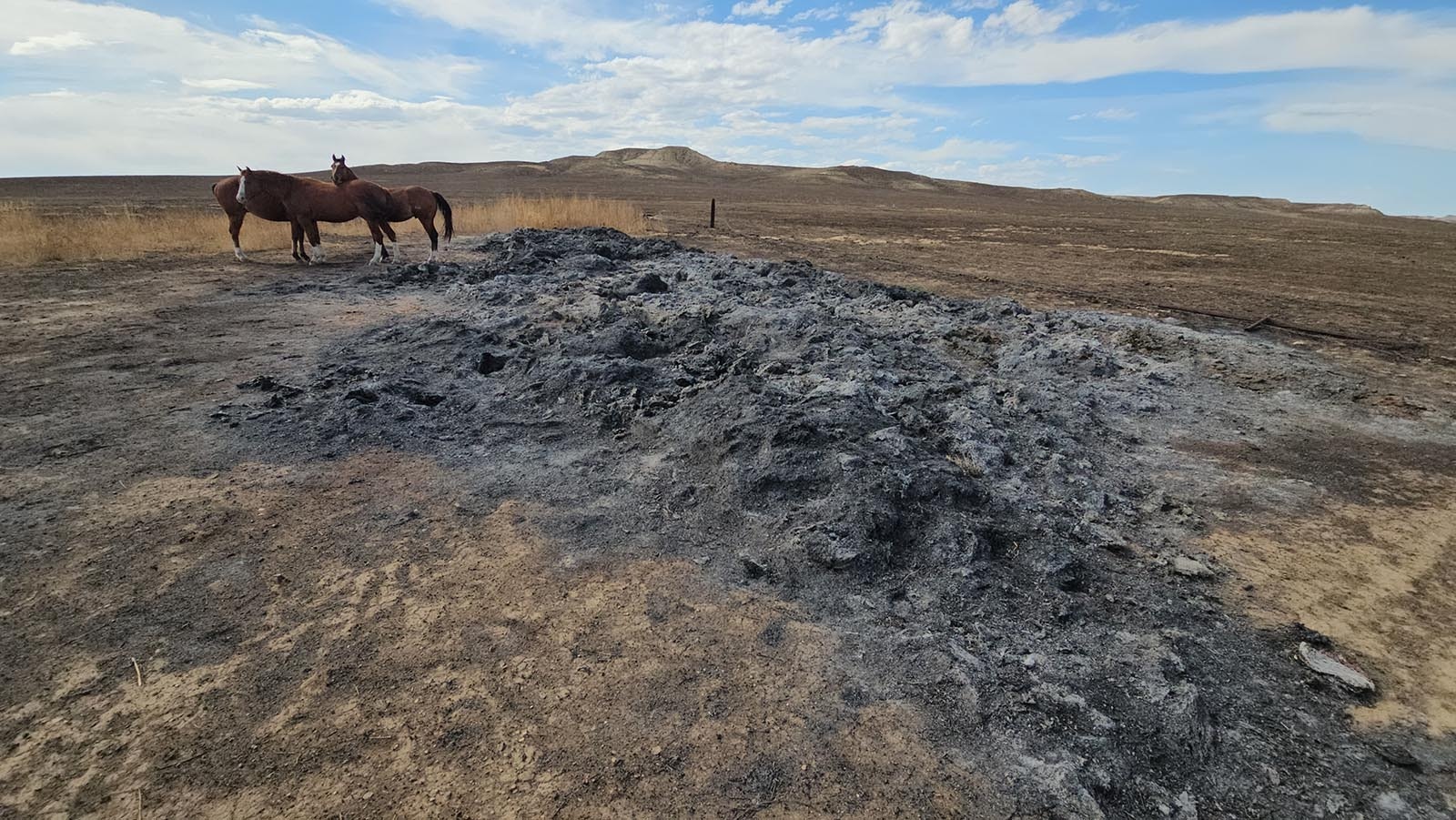
What used to be a pile of 76 hay bales has been reduced to ash. (Renee Jean, Cowboy State Daily) 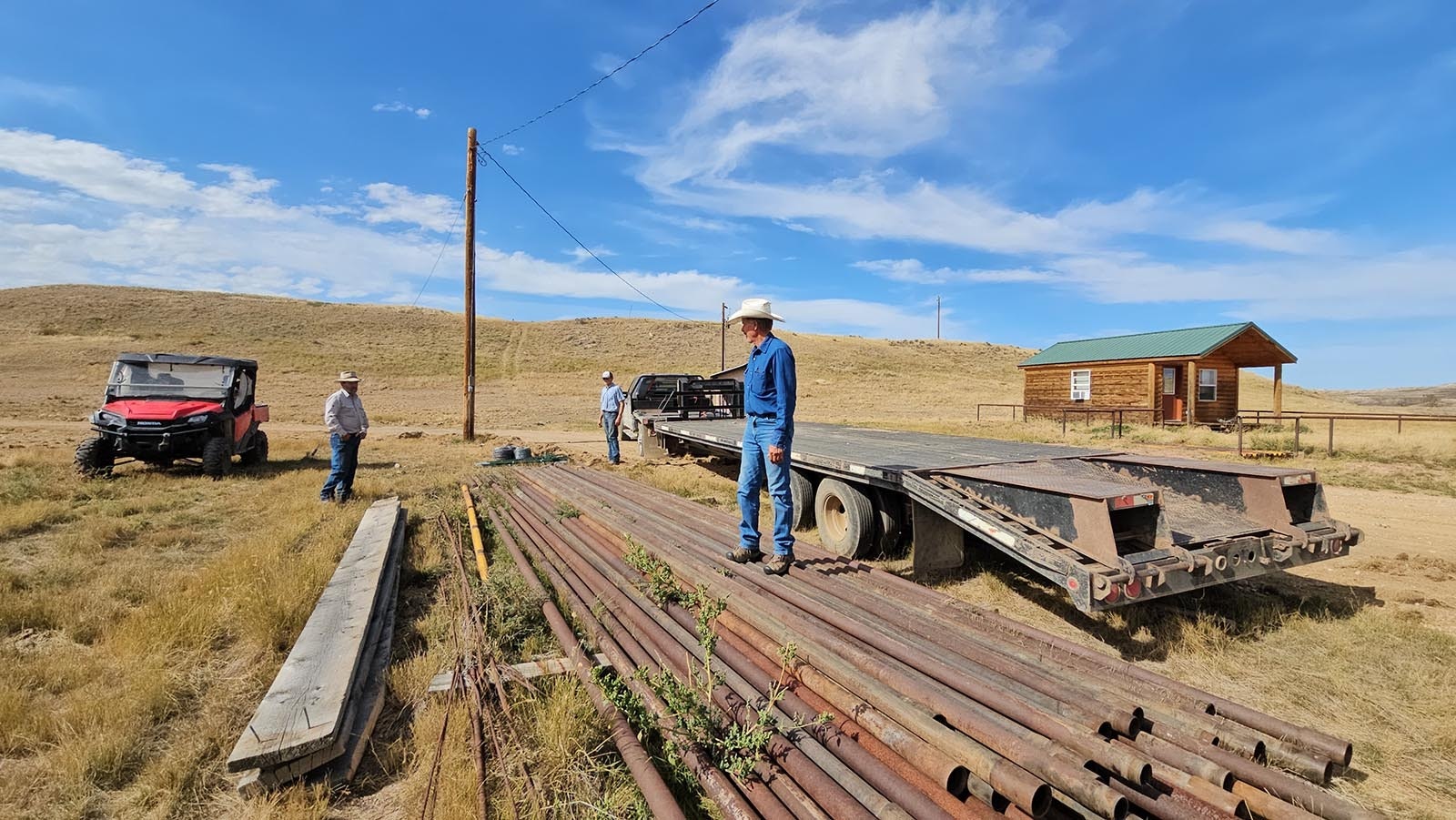
David Belus stands on top of some pipe he acquired to replace some of his fencing that was burned up. Metal doesn't burn, Belus said, so he plans to put in more metal fencing. (Renee Jean, Cowboy State Daily) 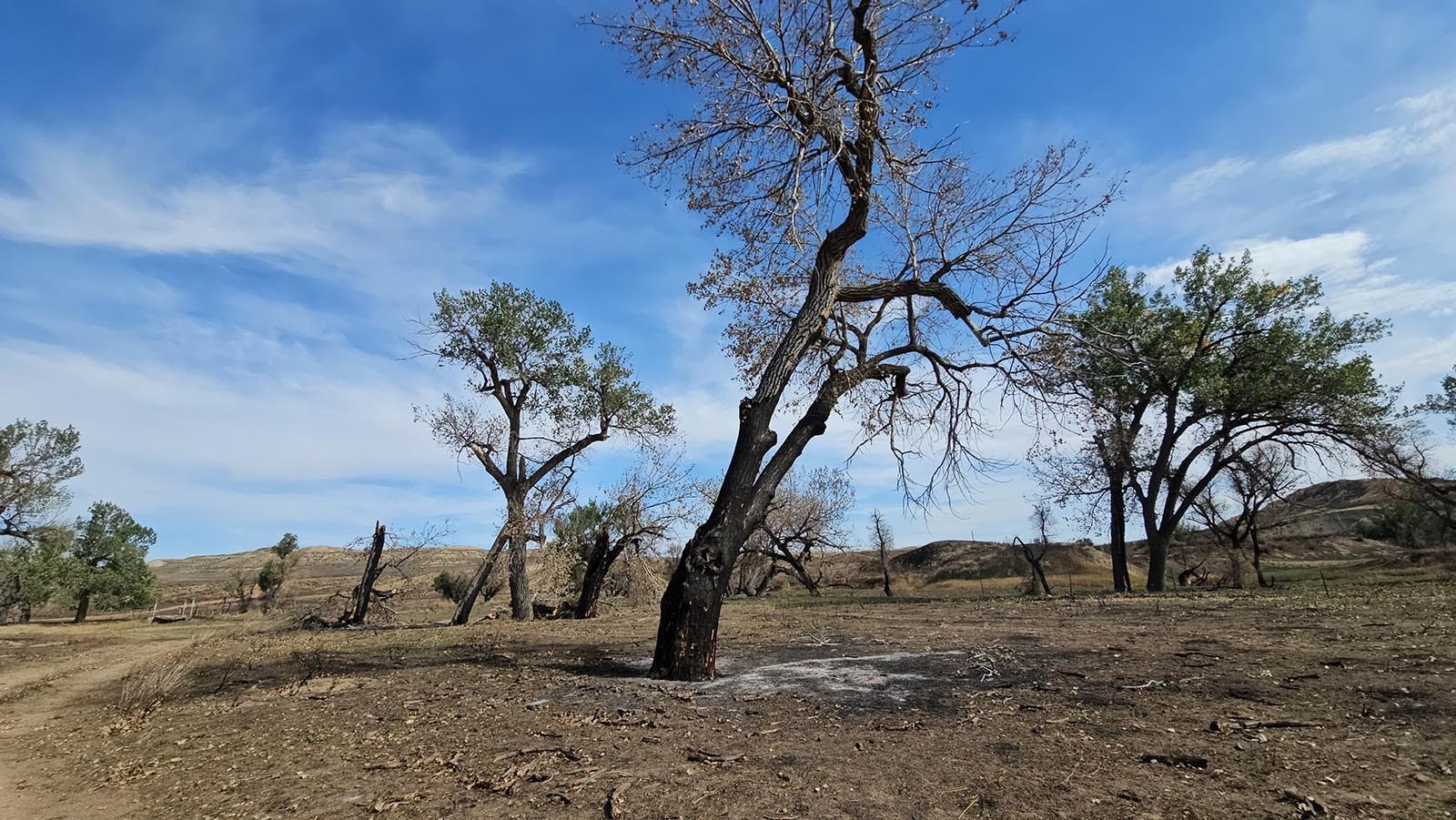
The scorched cottonwood trees were a favorite for cattle in the afternoon, a shady place to rest. They will all likely die as a result of a fire that torched nearly 50,000 acres of land on David Belus' ranch. (Renee Jean, Cowboy State Daily) 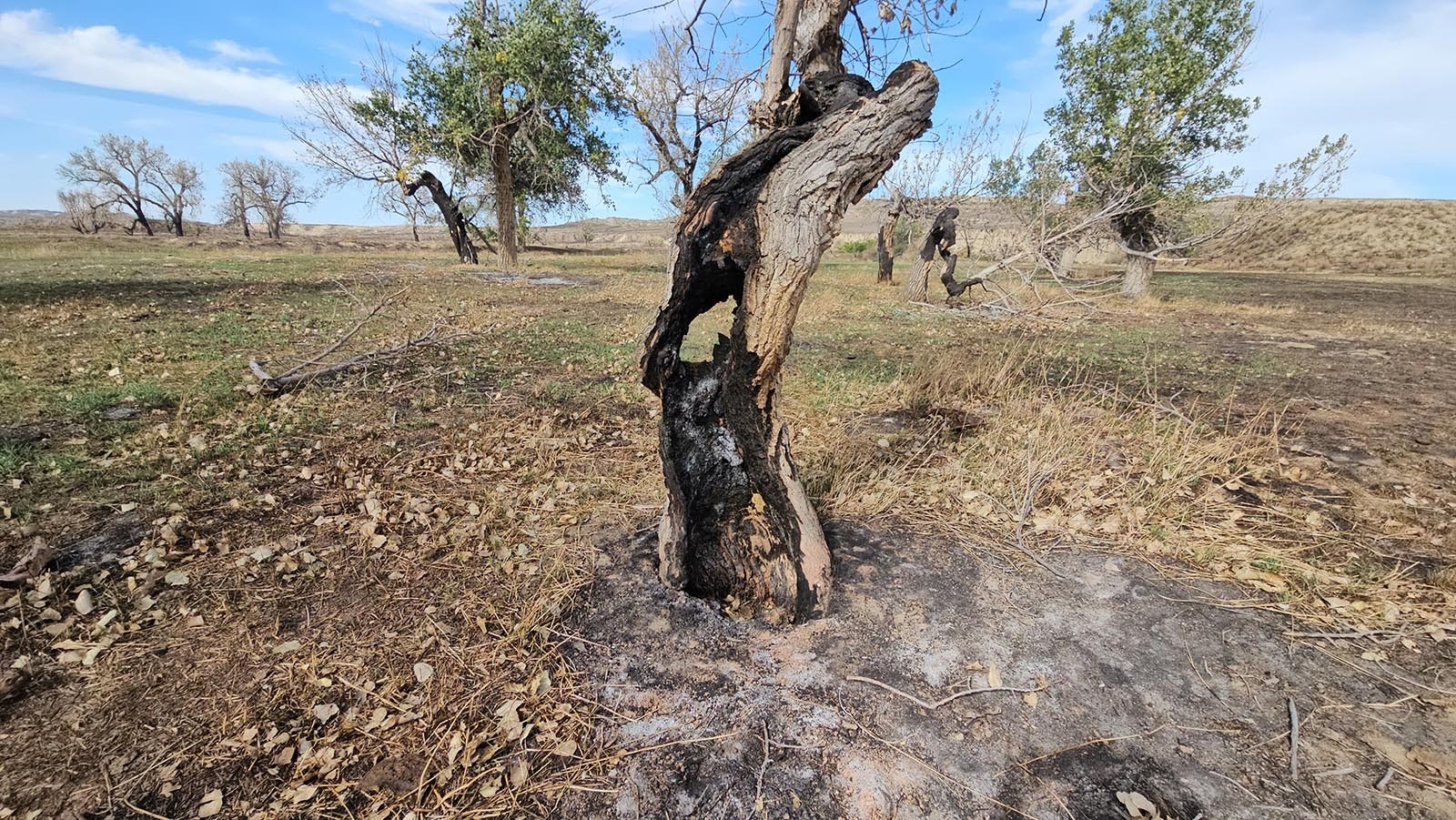
Fire burned a hole through this cottonwood tree, and scorched the trees behind it as well. The trees will all likely die before their time as a result. (Renee Jean, Cowboy State Daily) 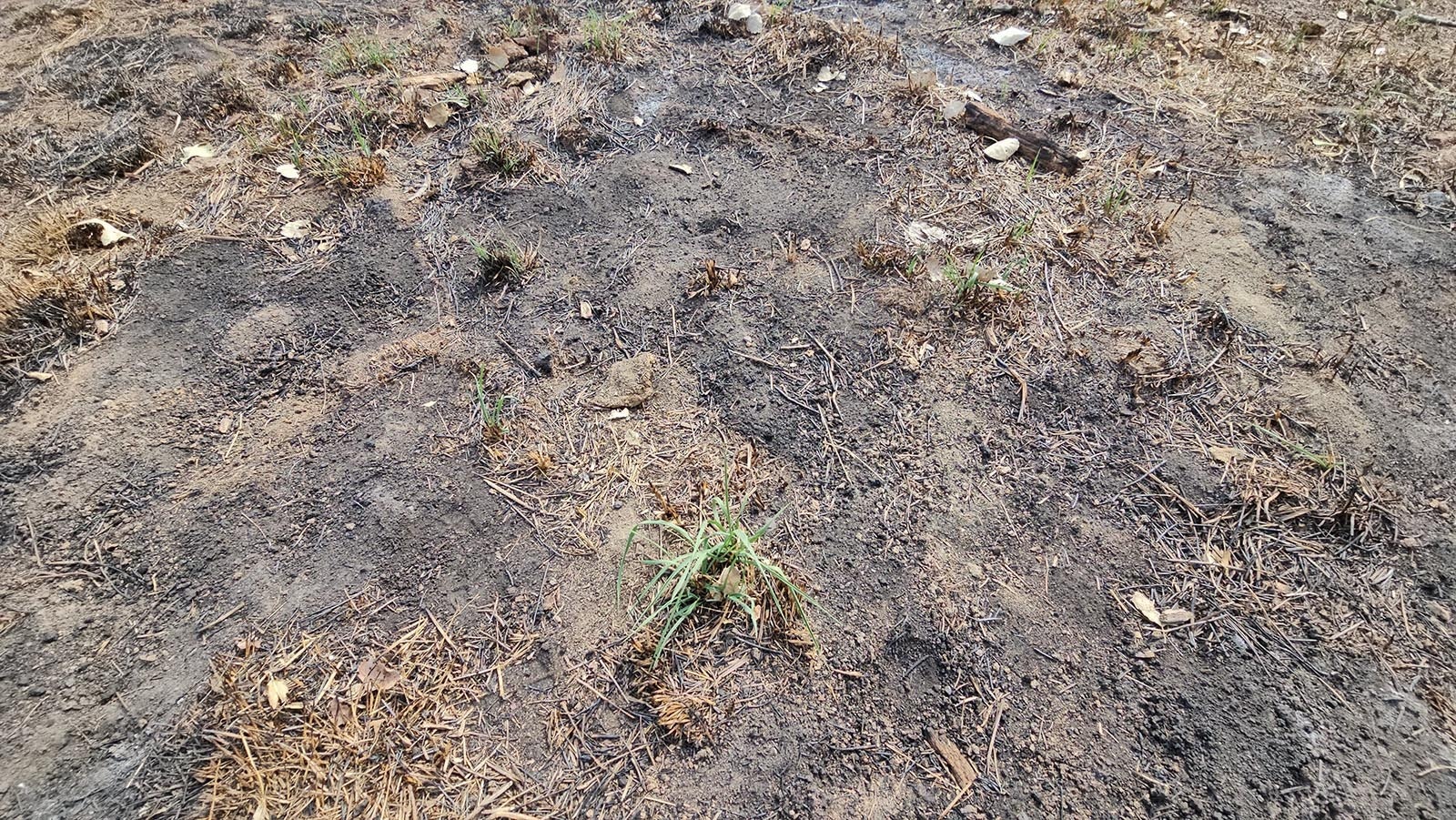
A tiny tuft of green grass struggles to remain living after a fire torched David Belus' ranch. (Renee Jean, Cowboy State Daily) 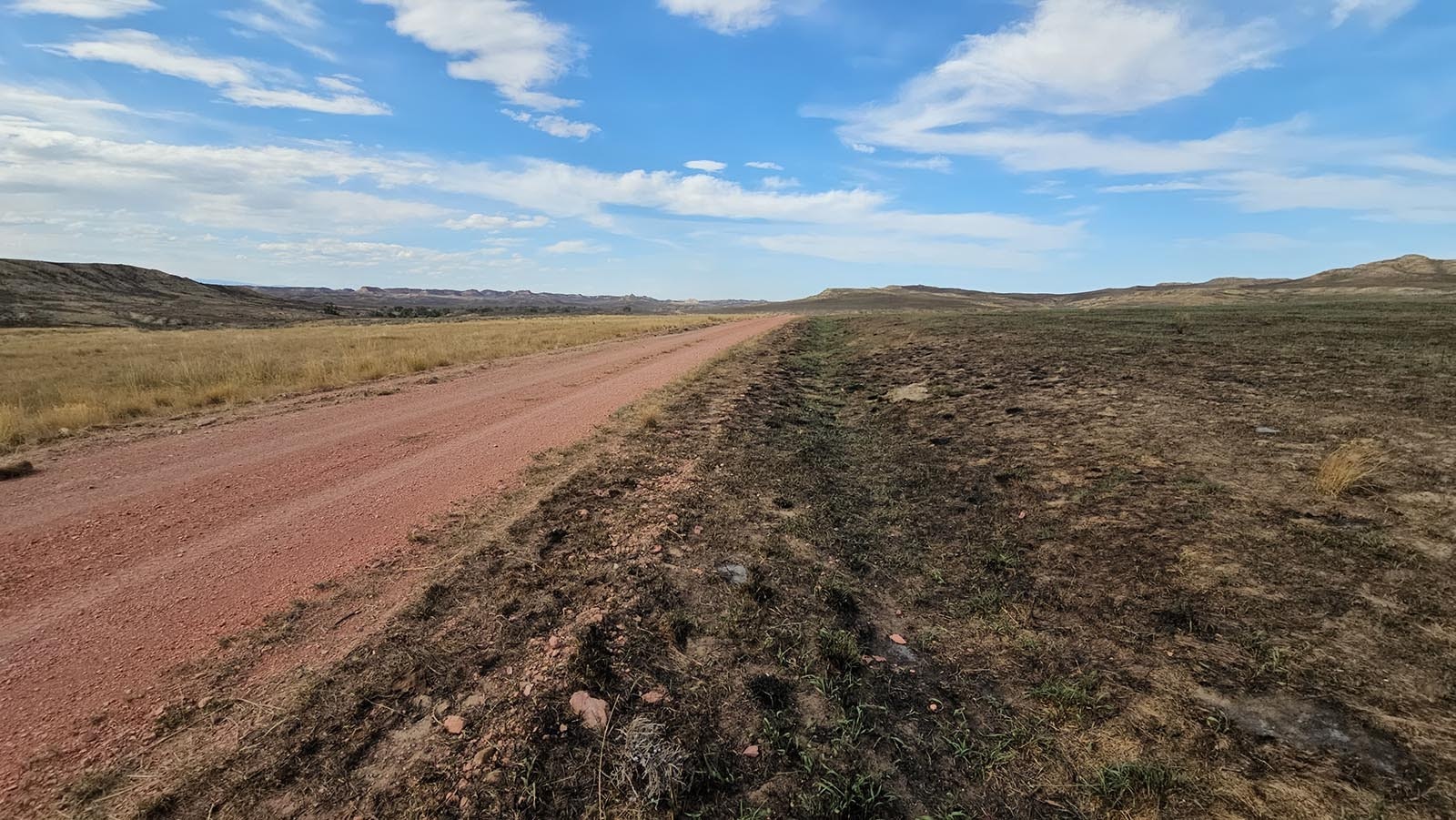
A red scoria road helped serve as a fire break, with burned pasture on one side, and saved pasture on the other. (Renee Jean, Cowboy State Daily) 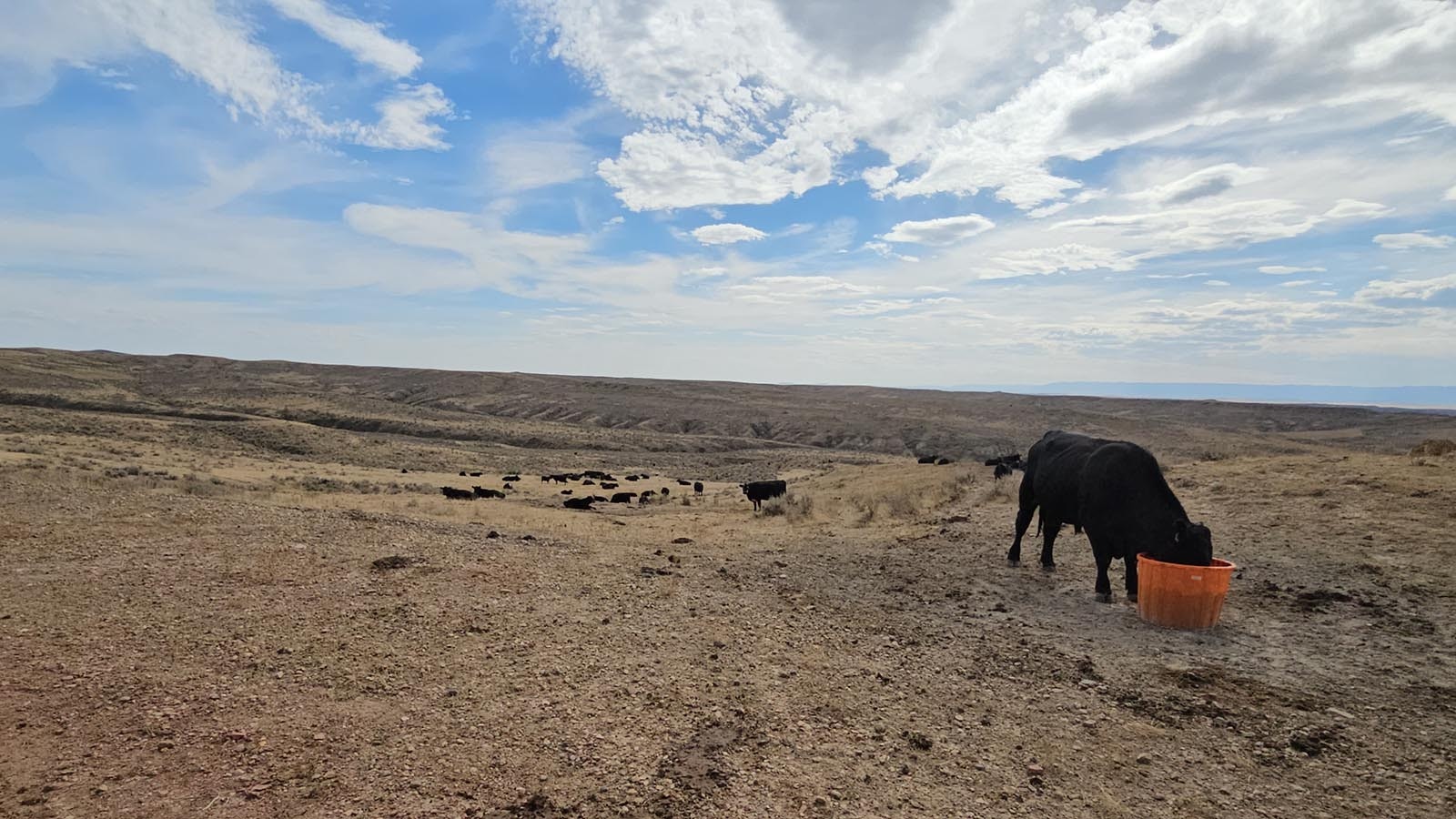
These mineral blocks were given to Dave Belus to help ensure his cattle are getting proper nutrition after a fire destroyed nearly 50,000 acres — 78 miles — of pasture on David Belus' ranch. (Renee Jean, Cowboy State Daily) 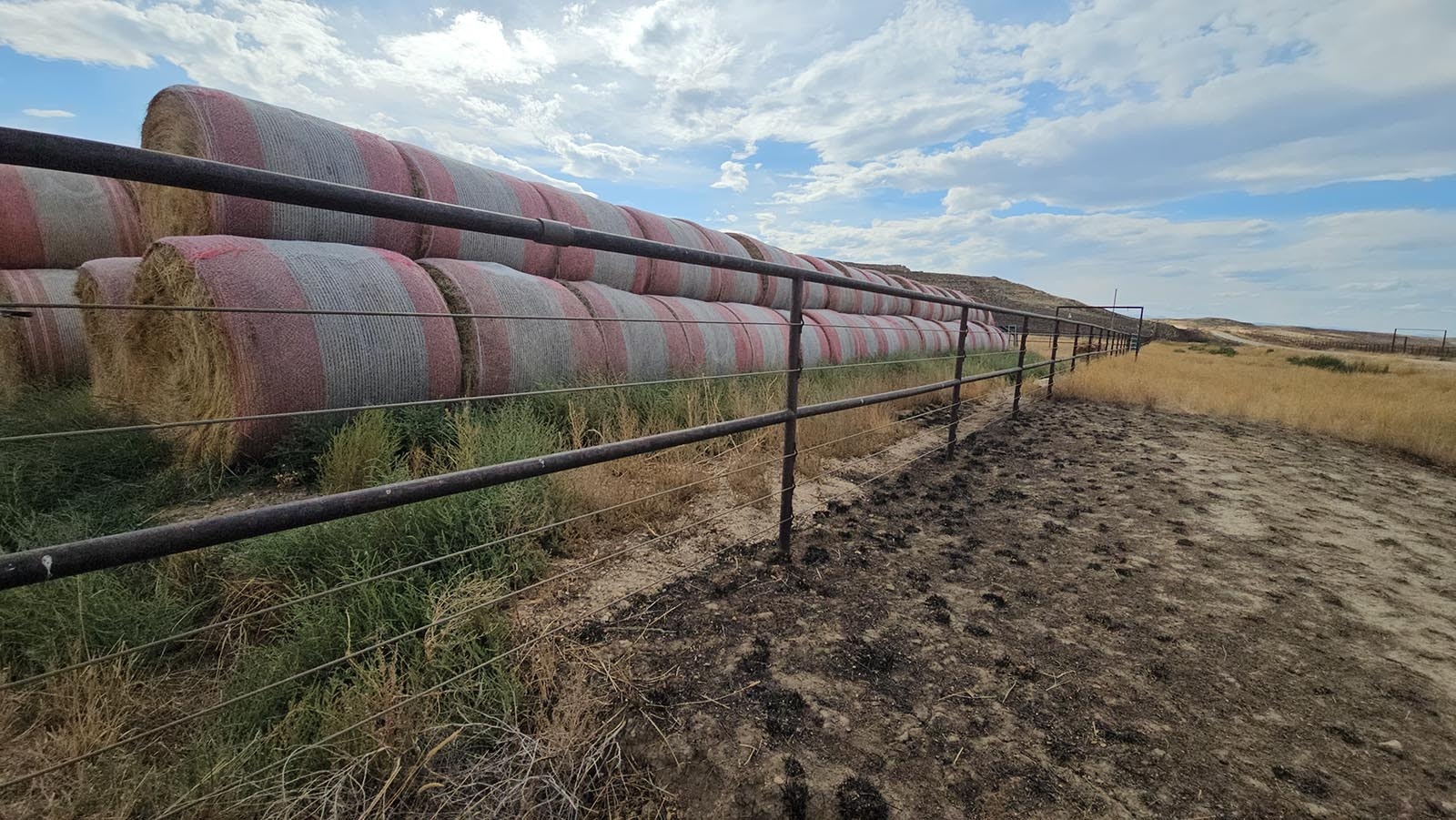
Fire burned right up to the edge of this hay pile, saving it. It's one of many things Dave Belus was counting as a blessing. (Renee Jean, Cowboy State Daily) 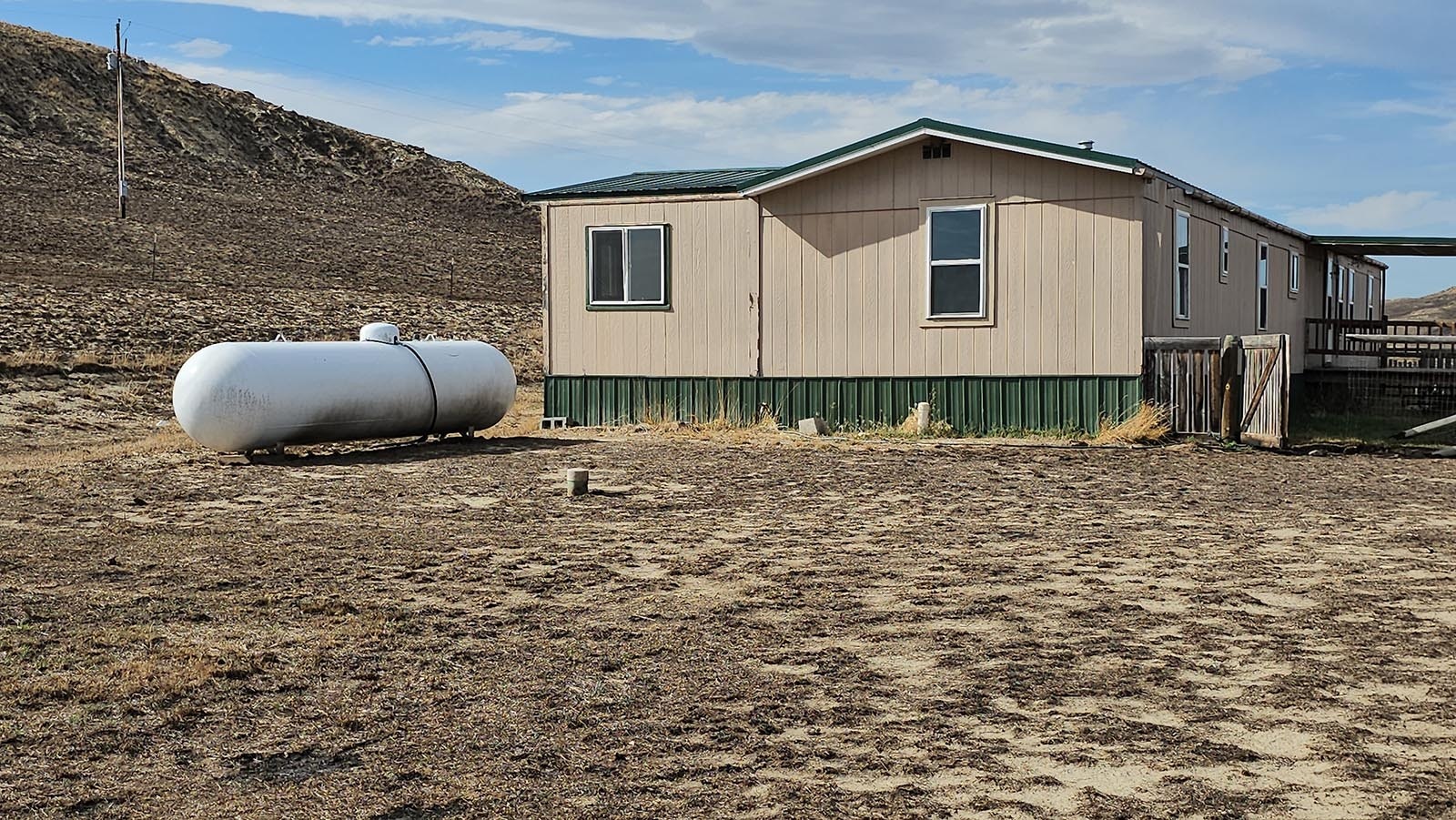
Fire went right up next to this mobile home, as can be seen from the smoky underside of the nearby propane tank. Firefighters kept it from exploding — just barely. (Renee Jean, Cowboy State Daily) 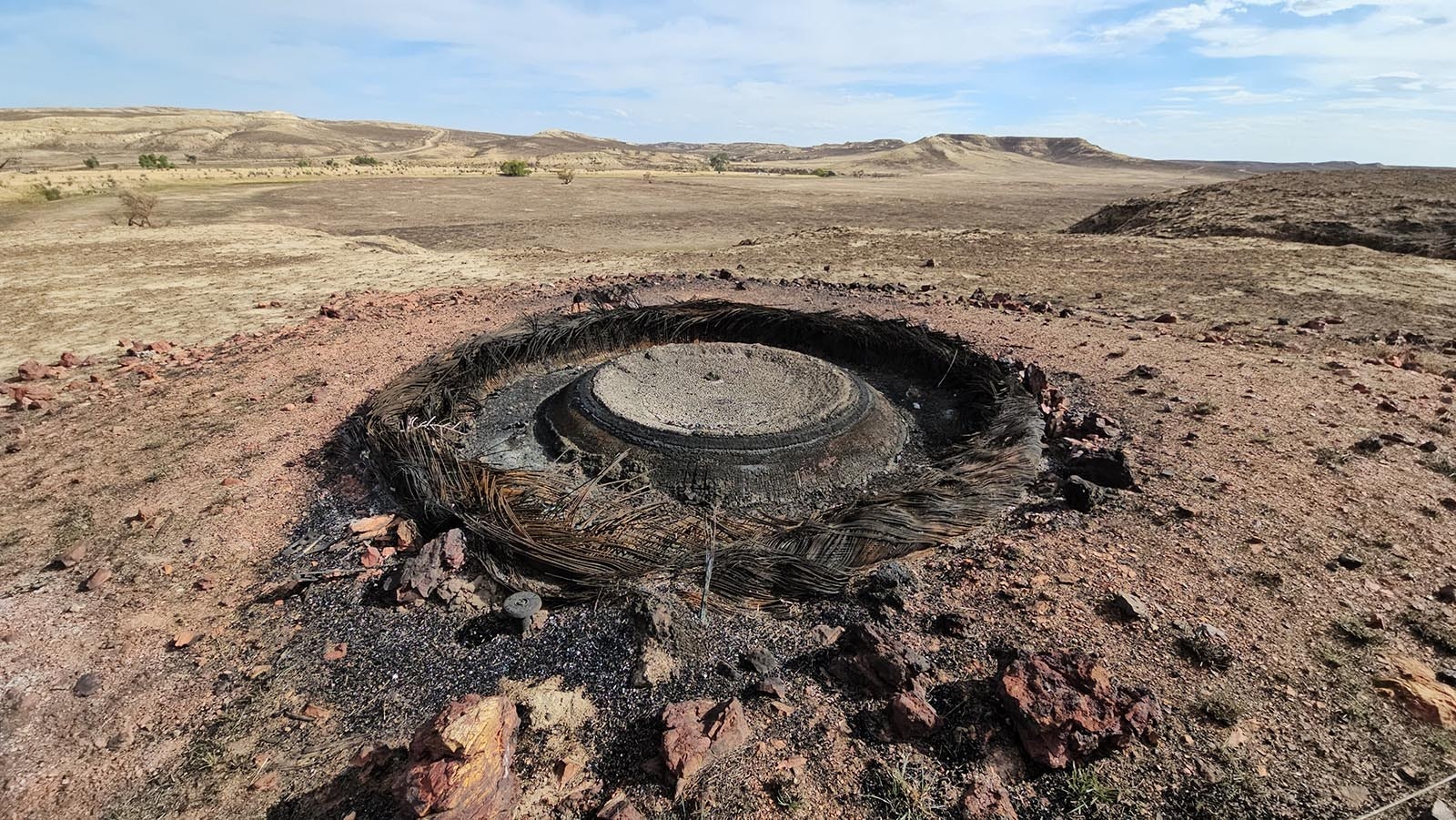
A water tank made out of a huge tire is among infrastructure burned up on David Belus' ranch in Johnson County. (Renee Jean, Cowboy State Daily) 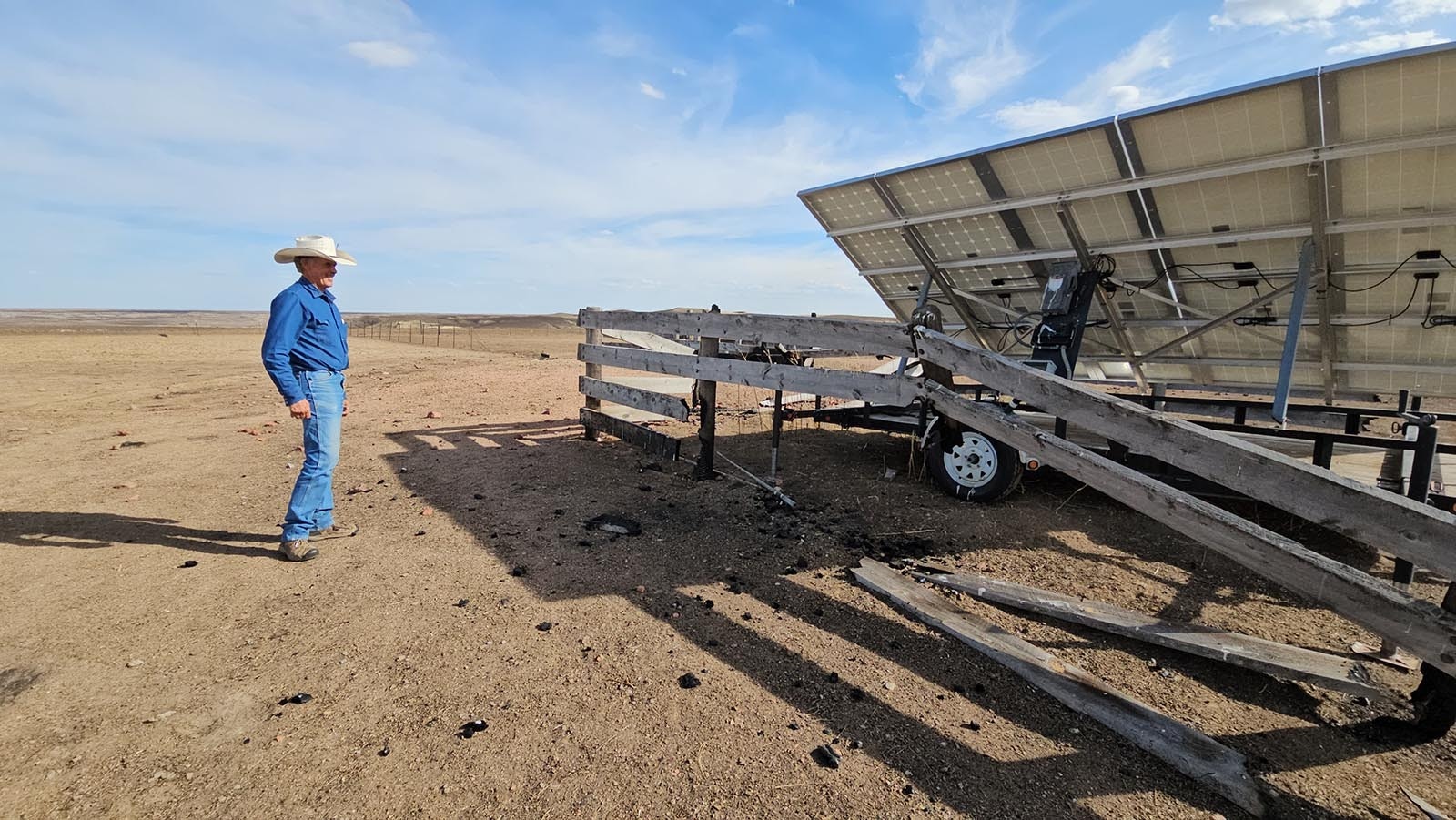
The solar panel that helps power a pump to water cattle is OK, even though fire burned down some parts of the fence around it. (Renee Jean, Cowboy State Daily)
Small Miracles
That particular spared pasture will probably be where Belus grazes cattle come spring. It’s just what he needs to spare the rest of his rangeland so it has the time it needs to recover.
“We’re going to precondition the yearlings tomorrow and put them in one of the remaining fresh pastures, and hope to get some increased weight gain before we ship them,” Belus said.
The short-term optimism, though, doesn’t mask the difficulties ahead.
Management wise, Belus expects that he must reduce the number of his yearlings to make more room for the cows that will regenerate this devastated ranch.
“I’m glad that most all of us are established ranchers,” Belus said. “Because if you were a beginning rancher, I think this could devastate you really easily.”
If next year turns out to be a dry year, though, things will be “really tough” for his ranch.
“If that happens, we’ll absolutely have to reduce our numbers,” he said.
As Belus shuffles through photo after photo of devastated land and scorched, dead cattle that died by fire, his eyes land on one particular photo, and a smile breaks out across his face.
It’s an old homestead cabin in the middle of nowhere that was somehow, miraculously, spared. No particular efforts were expended for the old cabin.
“It’s called the Morrison cabin,” Belus said, the bemused smile still on his face.
The land is blackened all around the sagging timbers of the old cabin, showing clearly that an inferno of fire raged through that very area.
“Yet it didn’t touch that cabin,” Belus said. “How can that be? I don’t know. It had some cattle around it, I guess, so there was a bit of dirt around the cabin. But why didn’t those flames or sparks ignite that old wood?”
It’s just one of the many things reminding Belus to be thankful.
“The silver linings are, we didn’t lose any houses, we didn’t lose any lives, we didn’t lose much for structures,” he said. “We’re not burying any of our neighbors. Those are the silver linings.”
Renée Jean can be reached at renee@cowboystatedaily.com.