When the people of Rawlins, Wyoming, find rattlesnakes in their back yards, they either call animal control or a woman named Ashlea Roberts.
And sometimes animal control also calls Roberts, who is always asking people for rattlesnakes.
“It’s officially snake season!” Roberts wrote Thursday in one of her upbeat Facebook posts urging Rawlins residents to text or call her, or call the police, if they meet a rattlesnake. “We will come get the snake.”
Roberts is not living on rattlesnake meat. She’s using the potentially deadly creatures in her rattlesnake avoidance clinic, one of her many obedience classes for dogs.
She’s been doing that “forever,” or at least since 2011. In the early days of her clinic, Roberts and a few close family members would go out into the sagebrush wilds of Carbon County to gather rattlers.
But about eight or nine years ago, Rawlins Animal Control caught on and started calling her when they’d capture a rattlesnake in town.
Rawlins Animal Control Officer Robert Valdez will capture roughly three or four rattlesnakes in town each summer. When he gets one, he calls Roberts to ask if she wants it. If she doesn’t, he’ll release it far beyond town, he said.
Last year, he captured one from his own yard on the city border.
But Valdez’s animal control partner isn’t as keen on snakes, so she’ll summon Roberts directly to wherever the unwanted pit vipers appear, he said.
Us, Giants
When she gets a call, Roberts rushes to the location.
Her dad, brother or husband will sometimes help. But her dad, former Carbon County Sheriff Jerry Colson, said Roberts usually goes to wrangle the rattlers by herself.
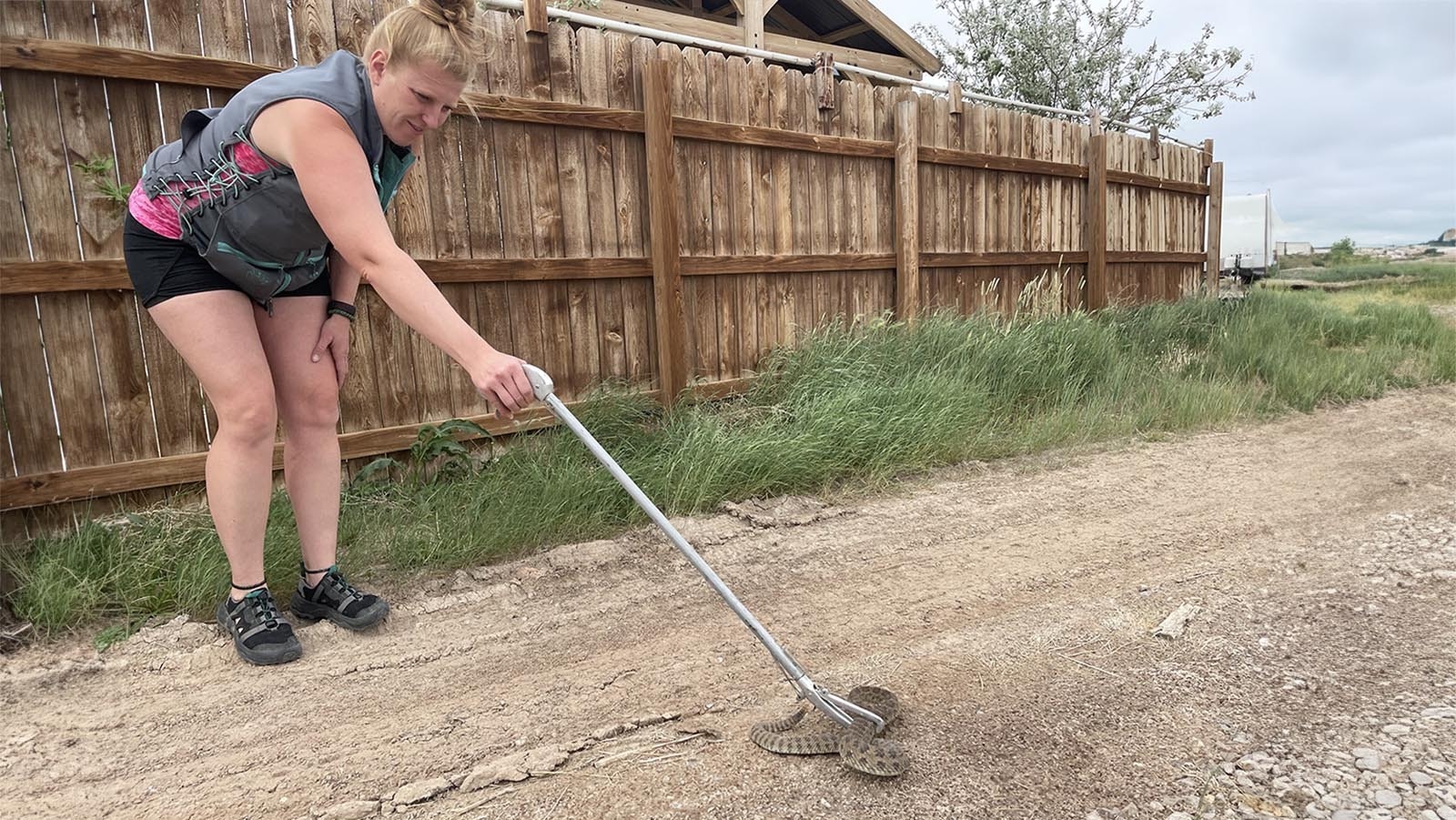
She uses extended tongs to pick up a snake and put it in a latching bucket with air holes in it.
How frightening this must be for the creatures, Roberts mused.
“They’re scared from being spotted by us giants,” she said. “And by being put in a bucket.”
Using mysterious — and proprietary — methods Roberts was reluctant to discuss, the crew sedates its catch, slightly trims his fangs and muzzles him with electrical tape.
Electrical tape adheres well to itself but doesn’t cling as viciously to the snake’s scales as other kinds of tape would, Roberts said.

‘Woah, It Makes Cool Noises’
When they have enough snakes, they place them at strategic points in an arena, usually at the Carbon County Fairgrounds, and invite humans and their dogs to walk among them.
Roberts gives a few words of explanation to the students, then sends them pair-by-pair into the snake-infested zone.
Often, Roberts’ mom Peggy Colson is on scene to help wrangle snakes and keep everybody organized.
Owner and dog approach a few different situations: a snake on a platform, a snake in the grass,a snake between dog and human. When faced with the first snake, Roberts tells the human to let the dog approach the snake, if he wants to.
Many dogs do.
“They’re like, ‘Woah, what’s that? It smells funny, looks funny, makes cool noises,’” said Roberts.
Then she zaps the dog with an electric collar jolt that she described as just strong enough to startle the dog out of his awful idea.
The collar is important, she said. If she chose the deterrent of having the owner pull the dog away from the snake, then the dog would think he could get away with meeting rattlesnakes whenever his owner wasn’t around.
“It’s just between the dog and the snake (this way),” she said.
After he meets, and regrets meeting, a snake on a platform and a snake in the grass, the dog then broaches the final test: a snake between himself and his owner.
“We want the dog to go the long way around,” Roberts said.
The owner calls the dog, but by that point in his training, the dog should know to circle around the snake to get to his owner.
Nine Dogs Bitten, One Dog Dead
Carbon County has a notable rattlesnake population. When University of Wyoming zoologists studied the vipers’ heat detection skills in 1988, they hunkered down in the county’s Haystack Mountains for four days.
Zack Walker, Wyoming Game and Fish non-game section supervisor and a herpetology expert, said he’s not sure if Carbon County is the rattlesnake capital of the world or even Wyoming, but the snakes populate roughly two-thirds of the county.
People can find them in areas below 7,500 feet elevation. If many are teeming in one area, it’s because a den is nearby. Walker has seen 100 snakes in one den, he said.
The Carbon County Veterinary Hospital sees about 10 rattlesnake-bitten dogs each summer, veterinary tech Amy Grant told Cowboy State Daily.
Last year, one of nine bitten dogs died.
“But other than that, yeah, they actually do really well if you seek out medical care quickly,” said Grant.
Veterinary personnel flush the dogs with fluids and antibiotics and treat them with steroids. Dog owners willing to spring for the $431 antitoxin can do so as well, said Grant.
Roberts encourages her clients to have their dogs vaccinated for rattlesnake venom, which she said helps mitigate symptoms and cut healing time.
About half the vet hospital’s patients are on the vaccine, Grant noted.
Grant said she’s taken her own dogs through Roberts’ avoidance clinic. And last year, Grant even got Roberts to put a rattlesnake in her back yard.
Grant’s dog heard the rattle. He knew something bad was back there and pointed toward it with his nose, but he remained rooted to the ground several feet away from it, said Grant.
“They learn really quickly, Ashlea does a good job with them,” she said. “And they definitely remember the sound.”

Be Free
Roberts releases the snakes several miles from town when she’s done with them. The direction she drives depends on the end of town in which she first found the snake, she said, adding that she tries to drop the snake in the general area of its den.
If it doesn’t find its den by winter, it will likely die, she said.
Walker confirmed that, noting that snakes are loyal to their dens.
The snakes’ fangs will grow back, Roberts said.
She chooses not to kill them because they help with rodents and keeping rodent-borne diseases down; and because they’re not as aggressive as some other venomous snake species, she said.
“We have caught some that have bad attitudes and they’re just spicy or rude,” she said. “But as far as snakes go, they’re pretty docile.”
‘In Her DNA’
Colson said his daughter has been catching water snakes since she was a child and has never been afraid of any animals.
Rattlesnakes require more precaution, but so far she’s handled them with the reverence they deserve, he said.
“She’s never been scared of any kind of animals or reptiles,” said Colson. “That’s just in her DNA, I guess.”
Clair McFarland can be reached at clair@cowboystatedaily.com.