Andrea Baratte, a wildlife biologist working with Yellowstone Adventure Tours, has led tourists through Yellowstone National Park for four years. And although this year’s summer season has barely begun, he’s already seeing tourists in midseason form behaving badly around wildlife.
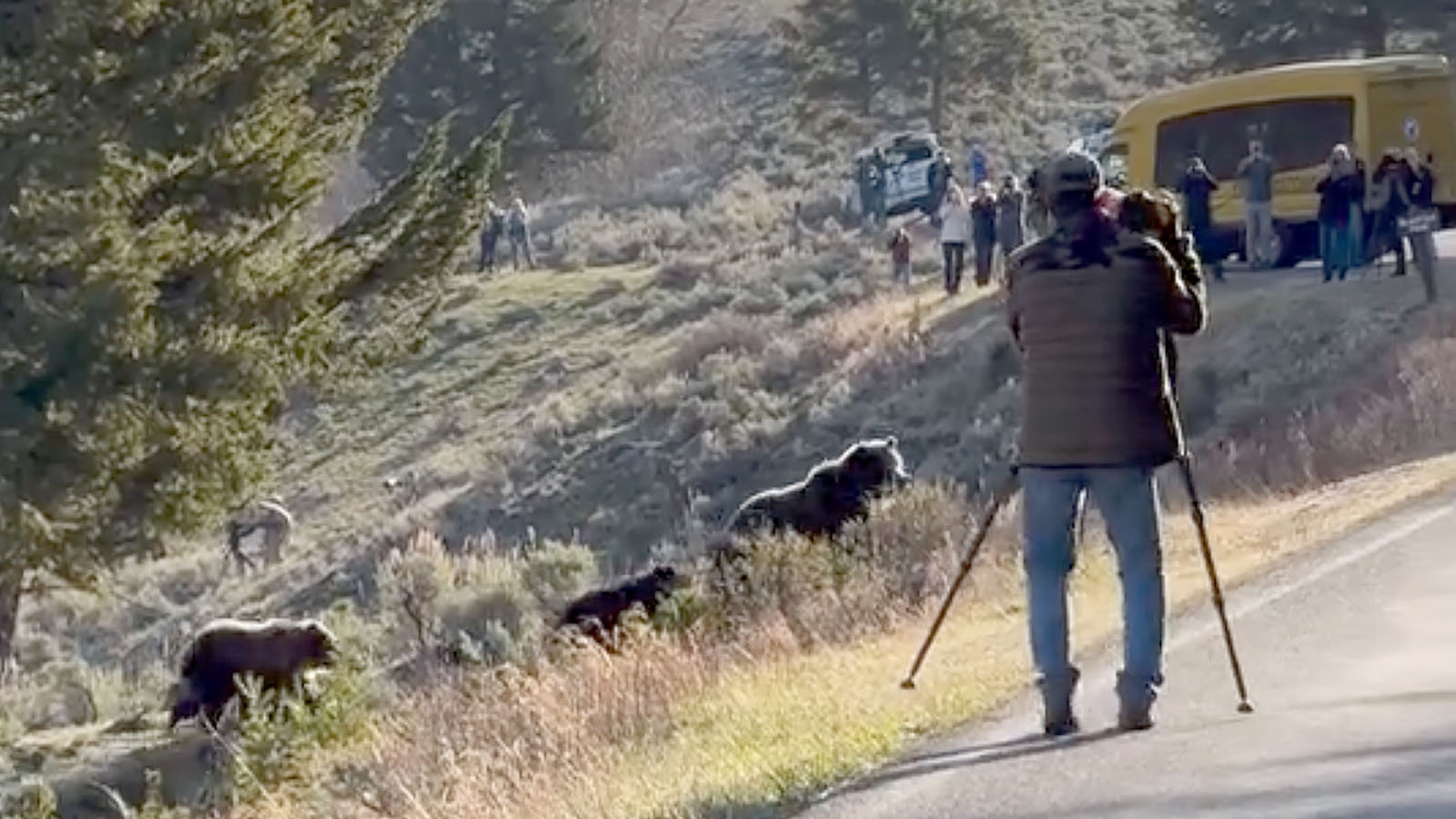
He captured a video of a mother grizzly leading her cubs across a road in Yellowstone on Tuesday. The road was lined with dozens of vehicles, and most people were observing from a safe 100-yard distance.
Others, however, were much closer, refusing to move — and some actually deliberately trying to get closer.
Baratte’s concern is that this wasn’t an isolated incident. It’s something he said is becoming an alarming pattern of willfully bad and dangerous behavior exhibited by Yellowstone tourists.
“In the short time that I've been guiding, I would say the crowds have been worse on a yearly basis,” he told Cowboy State Daily on Friday. “The behavior I've seen so far (this year) is unbelievable. And it’s only May.”
They Saw Them Coming
The spot where Baratte captured the video had been busy for several days. The mother grizzly and her cubs were feeding on a nearby carcass visible from the road, so vehicles and tour groups stopped to observe.
From Baratte’s perspective, everyone was respectful of the wildlife for the first several days the bears were there. The incident he captured and shared was driven by willful ignorance.
“I drove up right when she crossed in front of our vehicle,” he said of the mamma bear. “As I saw her getting close to us, there was a bunch of photographers standing in the road.”
Since they were within the 100-yard minimum distance needed between bears and people, Baratte approached the photographers and asked them to step back. They refused.
“I kindly (told them) they were a little bit too close and this could be potentially dangerous for them,” he said. “More importantly, you don’t want to get that bear habituated to the proximity and feel comfortable around people.
“They refused to retreat until the very last moment when she was actually in the road, maybe 35 yards away.”
Baratte knew they were taking a terrible risk, and their dismissive attitude was making it worse. All the factors were in place to escalate the road-crossing into a dangerous and potentially lethal encounter.
“If you look at the most serious incidents that have occurred with grizzly bears over the last decades, there is always food or cubs involved,” he said. “It was not a smart decision for that individual to be standing in the road.”
But the most alarming thing about the incident was that it wasn’t accidental. There was plenty of time for everyone to observe and predict the grizzlies’ movement and give them plenty of space to move freely through their environment.
“Everybody that stood there could see it coming,” he said. “It was not a secret passage that she was using or wasn't being seen until she showed up on the road. Everybody saw her progressively get closer, and they just refused to leave.”
Much Worse
Baratte wouldn’t say that was the worst incident he’d seen so far in 2024. It was the only one he’s been able to record.
“There are so many worse incidents,” he said. “When I tell people they’re too close or maybe they should step back, they smile or laugh at me. They think I'm the crazy one. It’s very frustrating.”
Baratte has even witnessed incidents in which the park’s ultimate authorities were disrespected and ignored.
“One group of tourists started arguing with a Yellowstone ranger when they were told to back up,” he said. “The ranger was telling them to leave, and they were refusing. This is not a single incident.”
Baratte isn’t alone in his pessimistic appraisal of visitor behavior so far in the young summer season. Numerous incidents, including a drunk man kicking bison, have been documented within the first few weeks of the season.
“We're already seeing new levels of stupidity this year,” Jen Mignard, owner of the Facebook page Yellowstone National Park: Invasion of the Idiots, has told Cowboy State Daily. “I suspect that with even more tourism, we're going to see a lot more really negative actions coming out of the park.”
Such behavior is infuriating enough along the park’s developed roads and corridors. Baratte’s concern is that these same things could also be happening in the wilderness.
“Yellowstone's front country is known to be a little bit more chaotic at times,” he said. “If you hike into the backcountry and behave like this, that could result in potentially dangerous situations.”
No Excuses, Real Consequences
Baratte grew up in Luxembourg and earned a bachelor of science degree in Wildlife Biology at the University of Montana in Missoula. He now lives in Bozeman with his family.
He understands how a Yellowstone visitor can become intoxicated by the beautiful world of Yellowstone to the point of potentially reckless decisions. But it’s not an excuse, and it doesn’t explain or excuse the behaviors he continually sees.
“I don't want to be unreasonable,” he said. “During a first-time visit to Yellowstone, you may get excited and carried away. I can see this potentially happening by accident. But (this incident) was very blatant. Multiple people told them, ‘Too close,’ but it was just a disregard for the rules and the wildlife in the park.”
When Yellowstone visitors get hurt by wildlife, they could be killed or severely injured. In Baratte’s view, the consequences of their actions have a much broader, deleterious effect on the park and the Greater Yellowstone Ecosystem.
“When things go sideways, it's a disaster for everyone involved,” he said. “It's a disaster for the National Park Service, for grizzly bears in general in the park, for everyone. They have to make a decision. What are we going to do with this bear that has become a problem? Even if their reaction was not caused by human error, they often paid the ultimate price.”
The best solution is personal responsibility, and most Yellowstone visitors make courteous, responsible decisions during their visits. However, it seems more people are becoming more blatant and discourteous, to the point of risking their safety.
“Everybody that goes into the parks gets a map and a newspaper with rules labeled right there,” he said. “A hundred yards is the park rule. Distance can be hard to gauge, but an elementary school child can tell 30 yards from 100 yards. We as visitors need to do better.”
Andrew Rossi can be reached at arossi@cowboystatedaily.com.