CODY — Preserving Wyoming’s unique Western history is something the folks at the Buffalo Bill Center of the West take seriously, as do other preservation organizations around the Cowboy State.
Big money is raised and spent to save, preserve and restore priceless and irreplaceable pieces of Wyoming history. And as technology advances, so do the techniques and equipment used to do that.
But sometimes, nothing beats old school. Take a good spit-shine of those go-to-church wingtips. Nothing finishes off a good shine like a little spit buff at the end.
Turns out, the same is sometimes true for preserving historic artwork.
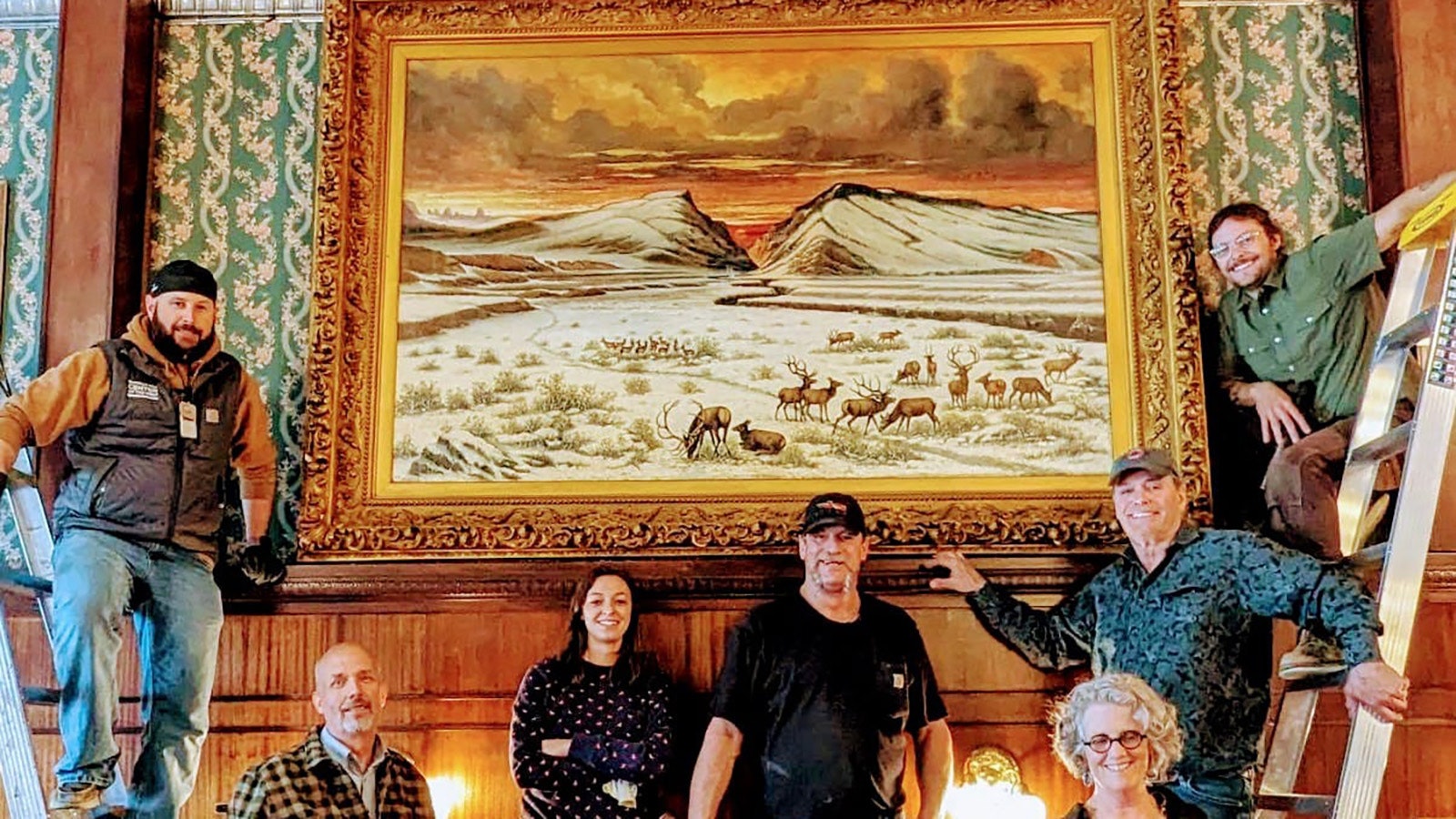
The Buffalo Bill Center of the West recently gave a trio of paintings from the Whitney Western Art Museum collection original to Cody’s Irma Hotel back to their home at the hotel, but first they got a good spit-cleaning.
Decades of cooking oil and tobacco residue were removed from the paintings by interns getting firsthand experience in object conservation.
“Each intern got to do before and after,” said Chief Conservator Beverly Perkins. “Conservators live for that.”
Yellow Snow
The three oil paintings by artist Henry H. Cross returned to the Irma Hotel were originally part of the Whitney Western Art Museum's collection. They were on loan to the hotel from 1972-2019.
That’s when the paintings were brought into Perkin’s conservation lab for some much-needed attention. The once-vibrant paintings showed the detrimental effects of decades hanging in a bar and restaurant.
“Shoshone Canyon,” the largest of the three paintings, depicts a winter view of the Rattlesnake and Cedar mountains on the eastern edge of Cody. Perkins said the once-white snow was covered with a layer of deep, disgusting yellow.
“It was really an air filter,” she said, explaining it had hung in a dining room for many decades and wasn't backed with anything. “It was just paint on canvas. So, the dust moved through the back and then through the front of the painting. It was dirty.”
Perkins has a master’s degree in art conservation and has worked with the Art Institute in Chicago, the Brooklyn Museum and the Victorian Albert Museum in London. She knew exactly how to clean the scene.
“In a conservation report, conservators call it ‘a mild enzymatic solution.’ But we all know what we're talking about. It’s spit cleaning,” she said.
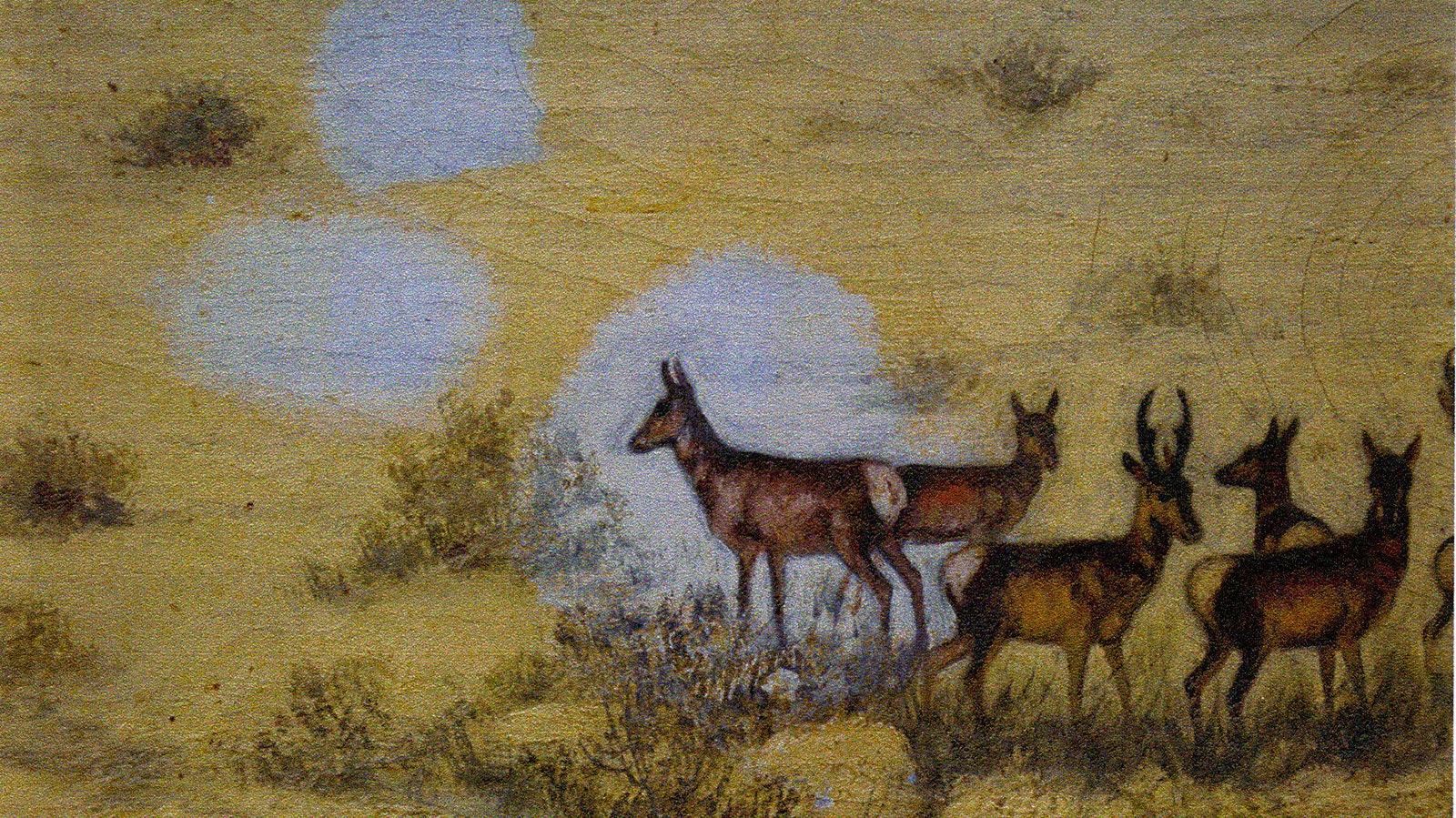
Close-up photo of the large painting titled "Shoshone Canyon," she shows the white snow stained and discolored from decades of oil, smoke and other contaminants gathered from hanging in a restaurant. (Courtesy Beverly Perkins, Whitney Western Art Museum) 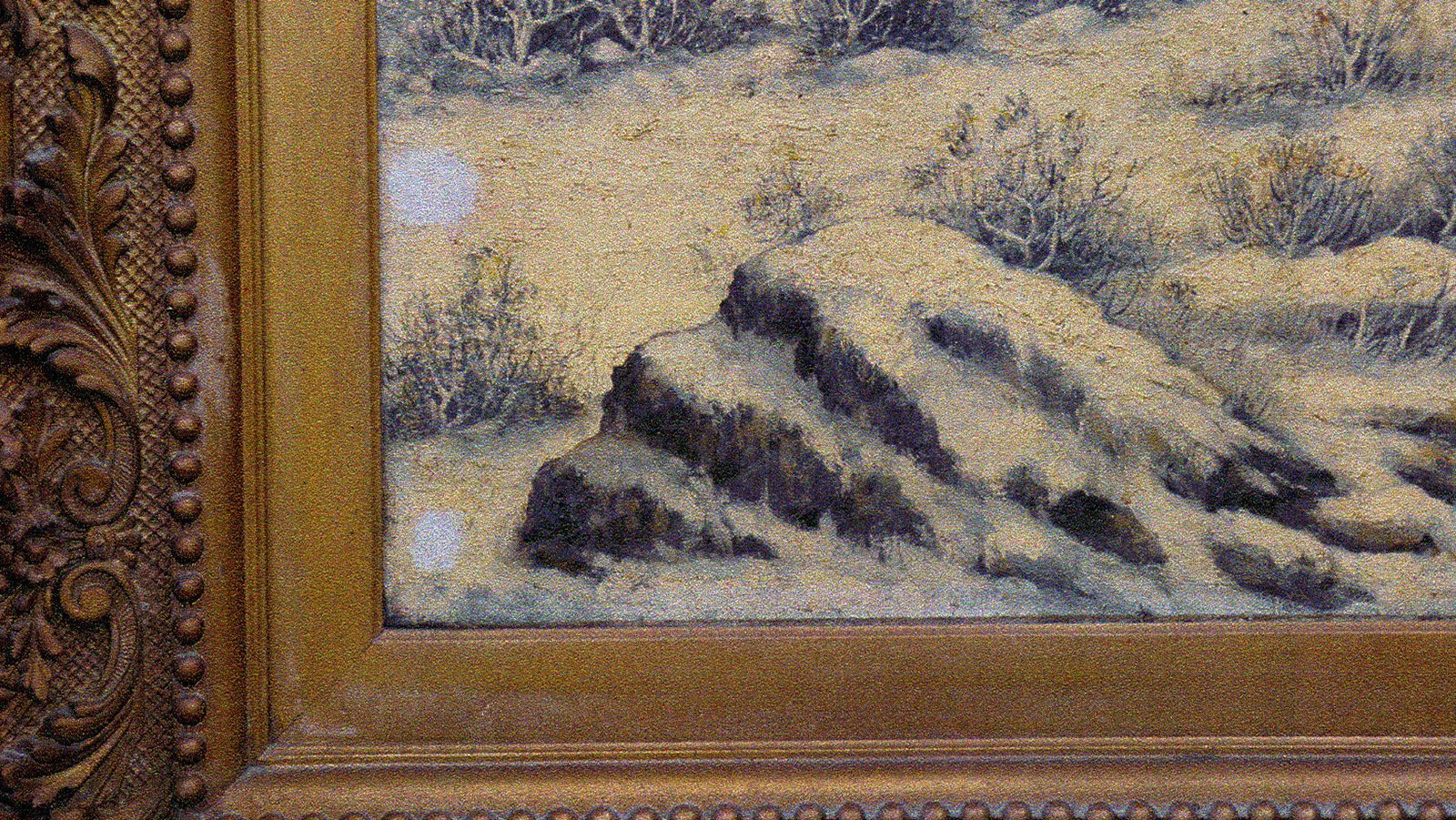
Close-up photo of the large painting titled "Shoshone Canyon," she shows the white snow stained and discolored from decades of oil, smoke and other contaminants gathered from hanging in a restaurant. (Courtesy Beverly Perkins, Whitney Western Art Museum)
Something To Spit At
Spit cleaning isn’t as unusual as it sounds. Perkins said human saliva has several admirable qualities that make it a valuable chemical in object conservation and restoration.
“Saliva is a really good solvent,” she said. “It's got an enzymatic solution that removes the tar from cigarettes, cooking oils and human oils. I was astounded the first time I saw it, but then I found that people use it on paintings all the time.”
But Perkins wasn’t going to save all the fun for herself. She knew the center’s interns would be salivating at the chance to salivate all over a historic oil painting.
The spit-cleaning technique isn’t too tricky, although suffering from dry mouth can complicate the process. Rather than spit directly on the painting, interns used a highly sophisticated tool: a Q-tip.
“You just put the Q-tip or cotton swab in your mouth, get enough saliva so that it’s moist and not dripping wet, and clean the surface of the painting,” Perkins said. “And it’s non-toxic. Great for interns.”
After conducting some surface tests, Perkins divided the oil painting into five sections, one for each intern. They spent long hours delicately swirling and dabbing saliva onto the oil painting.
It was, in Perkins’ view, a “fabulous intern project” that spit-shined the painting back to its original grandeur.
“They got to see before and after,” she said. “Before, it looked like a sunset. Now that it’s finished, it looks more like a sunrise.”

Letting Things Go
On April 30, several staff members from various departments at the Buffalo Bill Center of the West loaded the three paintings onto a U-Haul and returned them to their original places on the walls of the Irma Hotel.
When the paintings first arrived at the Irma in 1972, they were on long-term loan from the museum. This time, the museum decided to give them back, permanently removing them from its collection.
“It is like pruning a tree,” said Susan Barnett, curator of Western American Art for the Whitney. “Taking away branches that cross or duplicate or are not part of the desired shape. Sometimes good works that are not being displayed will better serve the public in another place.”
Perkins wasn’t sad to see the paintings go. They moved from being unseen in storage to prominent places where they can be seen and appreciated in a historic setting.
“’Shoshone Canyon’ is a huge painting,” she said. “It was nice to have it in the lab, but there was no good place to put it because it was so big. We're looking at our collection with a critical eye because our storage is limited, and we figured that the Irma would be the perfect place for such a dramatic painting.”
A Win-Win
With summer approaching, Perkins is preparing projects for two new interns who will soon arrive at the Buffalo Bill Center. Most interns will spend only a single summer in Cody, completing their projects while earning advanced degrees in museum studies elsewhere.
Summer is Perkins’ favorite time of year. She gets to share her expertise with the up-and-coming generation of object conservators through firsthand experiences with the Buffalo Bill Center’s extensive collection.
“They're not going to be bored,” she said. “We like to set them on projects they can own. They can help design and then complete them. And it’s rewarding for me because my lab becomes a teaching lab.”
Unfortunately, the interns won’t be doing any spit-takes this summer.
“We're creating a team of curatorial, conservation and registration interns to examine the Whitney's works on paper and assess them for condition and quality,” Perkins said. “Our findings will give the curator a better sense of what's in that collection.”
Barrett is looking forward to reviewing those findings. From her perspective, the cleaning and deaccession of the three Irma paintings is a testament to the skills of the museum staff.
“It is a win-win,” she said. “We have more space in the vaults and the paintings look wonderful in the Irma. It is a positive outcome for two Cody institutions and the public.”
Andrew Rossi can be reached at arossi@cowboystatedaily.com.