George Zeimens still remembers the day 25 years ago when the Wyoming’s tourism director made a presentation about how money from visitors was being spent.
All the time, all the money was going to the western part of the state and there was none for Goshen County in southeast Wyoming, butting up to the Nebraska border.
“And he said, ‘Look, folks, you don’t have anything here worthwhile for tourism. You’d be lucky if you could get some farmer from Holland to come over and visit one of your farms,’” Zeimens recalls him saying.
But Zeimens didn’t forget about Goshen County tourism over the years. In fact, as time went by, he was part of many archeological digs there that made him even more convinced than ever that the region has so much history and a lot to offer tourists, if some effort was spent on developing it.
“This is a really rich area archeologically,” Zeimens told Cowboy State Daily. “There are more sites here, and a higher concentration of sites than in other places (in Wyoming). And one reason for that is the North Platte River was a good route across the plains.”
At first, that just brought mountain men through the area to Fort William, which later became Fort Laramie. But as Westward expansion continued, Fort Laramie would become Grand Central Station for pioneers, mountain men, Native Americans, miners, cattle drives and more.
The Mormon Trail, the Oregon Trail, the Emigrant Trail, The Trappers Trail, the Pony Express Trail, the Texas Trail, the Cheyenne-Deadwood Trail — all of them passed through Goshen County, converging on Fort Laramie before radiating out to other parts of Wyoming and beyond.
The Bozeman Trail also started at Fort Laramie before heading north to gold rush territory in southern Montana.
Art Meets Achaeology
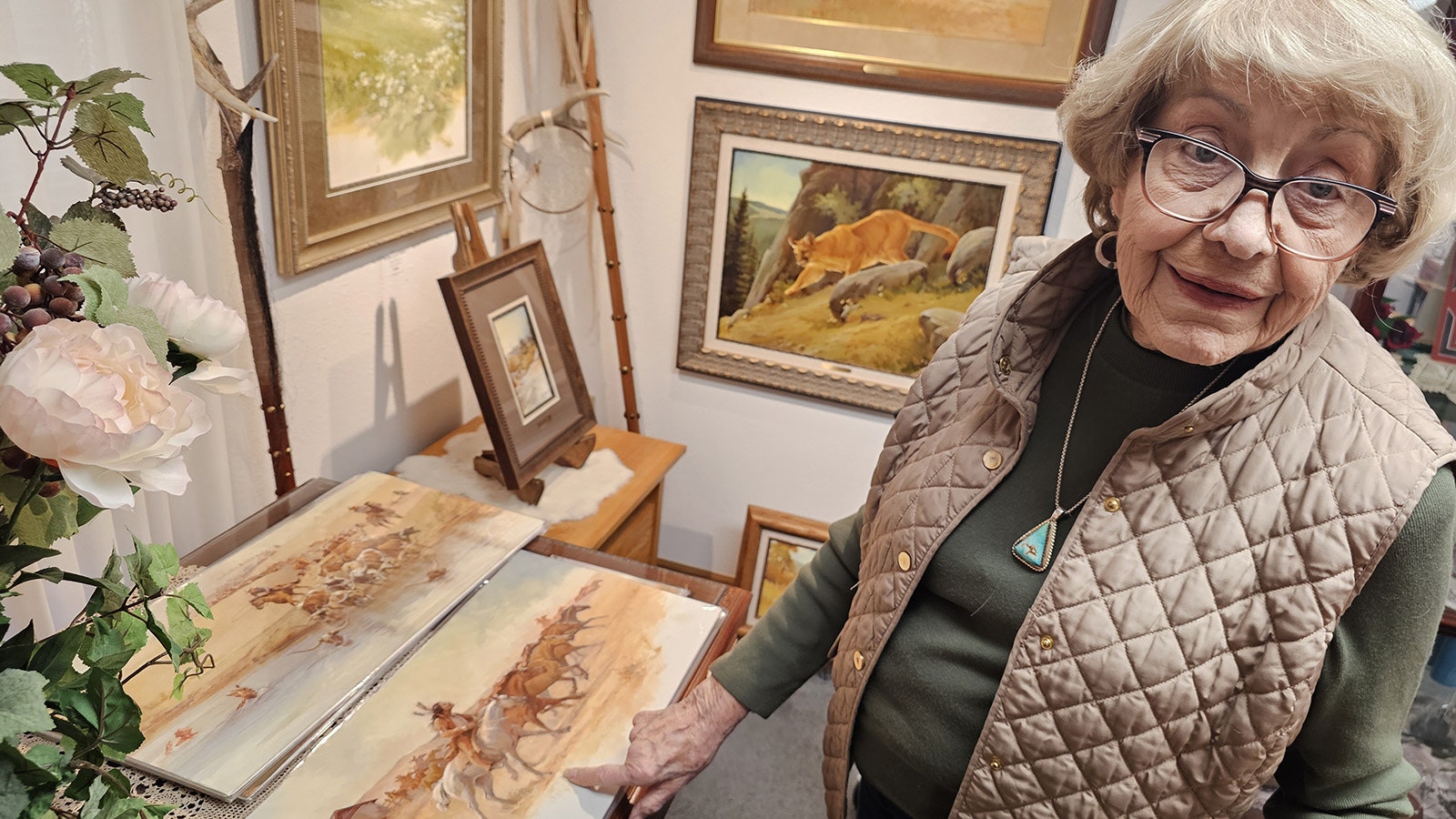
Some of that history is about to get a little recognition with a project spearheaded by Zeimens’ wife Geri. Working with painter Barbara Schaffner, of Wheatland, the Goshen County history that Zeimens’ archaeological work has uncovered is about to be highlighted like never before.
Five paintings by Schaffner, two depicting scenes that no artist has ever before rendered, have been placed at the Lingle turnout, 1.5 miles east of Lingle along U.S. Highway 26.
The paintings highlight Fort Bernard, where the Grattan Massacre happened, The Emigrant Trail, Rock Ranch and Ash Point, The Texas Trail and the Gratiot House, used to store gratuities offered to Native American tribes.
The public has been invited to attend an unveiling for the new interpretive signs at 2 p.m. May 2 at the Lingle Turnout, where Zeimens plans to talk more about the history in the paintings and why this part of Wyoming is so special.
Master Of The Arts, Master Of History
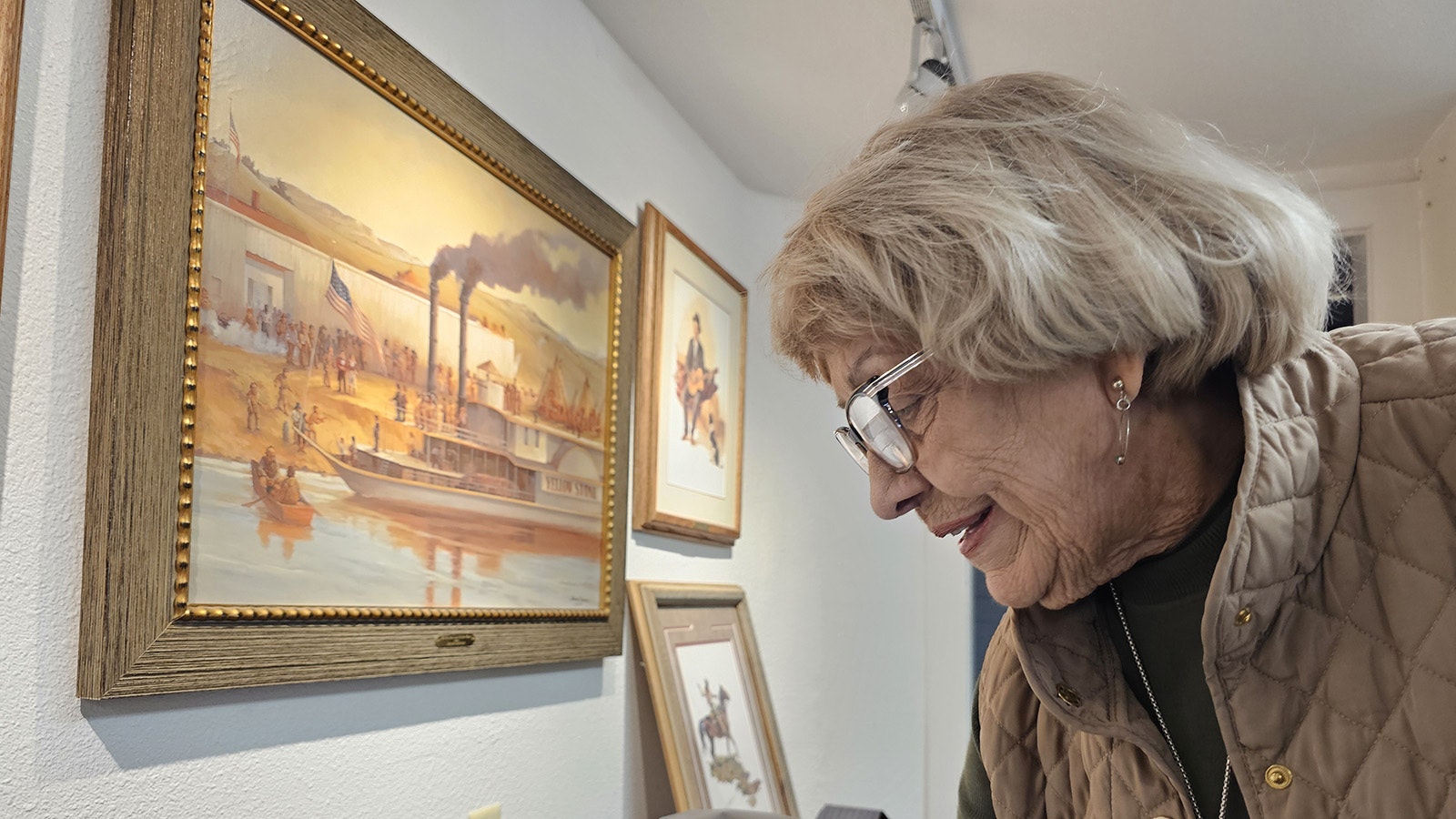
Schaffner has long been bringing history to life on canvas, but this is the first time the artist has worked with an archeologist to recreate scenes from history that have never before been captured on canvas or in photographs.
“George took me out to visit each one of these areas that he had been digging at and shared what he had learned and how the whole landscape worked into the scenarios that were happening,” Schaffner told Cowboy State Daily. “He shared the time of year and the findings at each site, which helped to add all kinds of little bits of interest to the stories.”
Zeimens also helped her understand the political atmosphere of the time, the people who lived in the area, and what was and was not found at each site.
“It was just an amazing experience,” Schaffner said. “I wish more people could have been there to share in what he was telling me. It was just like stepping back into the past.”
But Schaffner didn’t stop with just what Zeimens told her about the sites. To recreate a truly accurate visual image, she needed much more.
“When you do a historic painting, everything has to be accurate,” she said. “Every shoe, every gun, every bit of clothing, every brick and stone on the buildings — everything.”
That meant a mountain of research for each and every figure in each and every painting.
“I used books, I used journals, I found news articles,” Schaffner said. “We found letters, and I had stories from other historic things that I have worked on that seemed to work into these, too.”
She was able to find some drawings of the clothing, weapons and tools in use at the time from 1840 to 1890 to help her visualize what people were wearing in the scenes. But these drawings were all black and white.
To get the colors just so, she worked with the Smithsonian archives online and the Buffalo Bill Cody Museum of the West to ensure that every detail would be authentic and accurate, down to the tiniest of beads.
She also studied how the Native Americans tied up their ponies’ tails, how the bridles were placed on the horses and a million other details.
Once Schaffner had a good idea what should be in each painting, she shared the drafts with Zeimens so he could double-check her work and ensure she had not missed anything important.
That did result in some revisions — and often more research, to add new details to the paintings.
Where The Great Plains Indian Wars Began
All of the archaeological sites Zeimens helped excavate over the decades have been fun and interesting, but one that was particularly memorable was Fort Bernard, he said.
“We were able to find so many of the buildings and structures,” Zeimens said. “And that’s where the Grattan Massacre and all that history took place.”
Schaffner has titled that particular painting “A High Price To Pay For A Cow.”
“One of the cows wandered away from one of the Mormon travelers,” Schaffner told Cowboy State Daily. “And all the Indians were camped along the river. There were probably more than 4,000 Indians in the area at that time. They were all waiting for gratuities that had been promised to them by the government, and they were all hungry.”
When the Mormon discovered the Native Americans had eaten his lost cow, he went to Fort Laramie to request restitution. These matters were supposed to be handled by the Indian agent, who was due to arrive any time with the promised gratuities, from which the restitution could have been made.
But the Mormon was anxious to get moving along on the Oregon Trail, and young Lt. Lawrence Grattan, just graduated from West Point, was itching to prove himself and make his mark on the world.
So, Grattan was sent down to the Indian tribes to arrest the Indian who Mormon witnesses had seen shoot the wandering cow. His name was High Forehead.
The Indians’ chief, whose name was Matho Wayuhi, or Conquering Bear, told Grattan and his men, who numbered 29 plus one drunken interpreter, that he would not hand over the brave who had taken the cow. And since the cow had already been eaten, he could not offer them that either. But he could give a horse from his own personal herd.
While the lieutenant and the chief were arguing about just compensation for the lost cow, someone got impatient and shot off a gun.
“Immediately when that happened the Indians — there were just 29 of the men from Fort Laramie and there were probably 2,000 Indians (at that particular encampment) and they were in the middle of the (encampment) — so immediately, within 10 minutes, all of (the Fort Laramie men) were dead,” Schaffner said.
Chief Conquering Bear was mortally wounded during the fighting and died nine days later by the Niobrara River.
Both Red Cloud and Crazy Horse were teenagers at the time and witnesses to this part of history. The two Sioux would eventually become daring warriors and important chiefs for their people, and it was their military tactics that would eventually drive the defeat of General Custer.
The massacre itself touched off the First Sioux War fought between the U.S. Army and Lakota Sioux warriors. Conflicts arising from that would continue across the Great Plains for a quarter of a century after the Grattan Massacre.
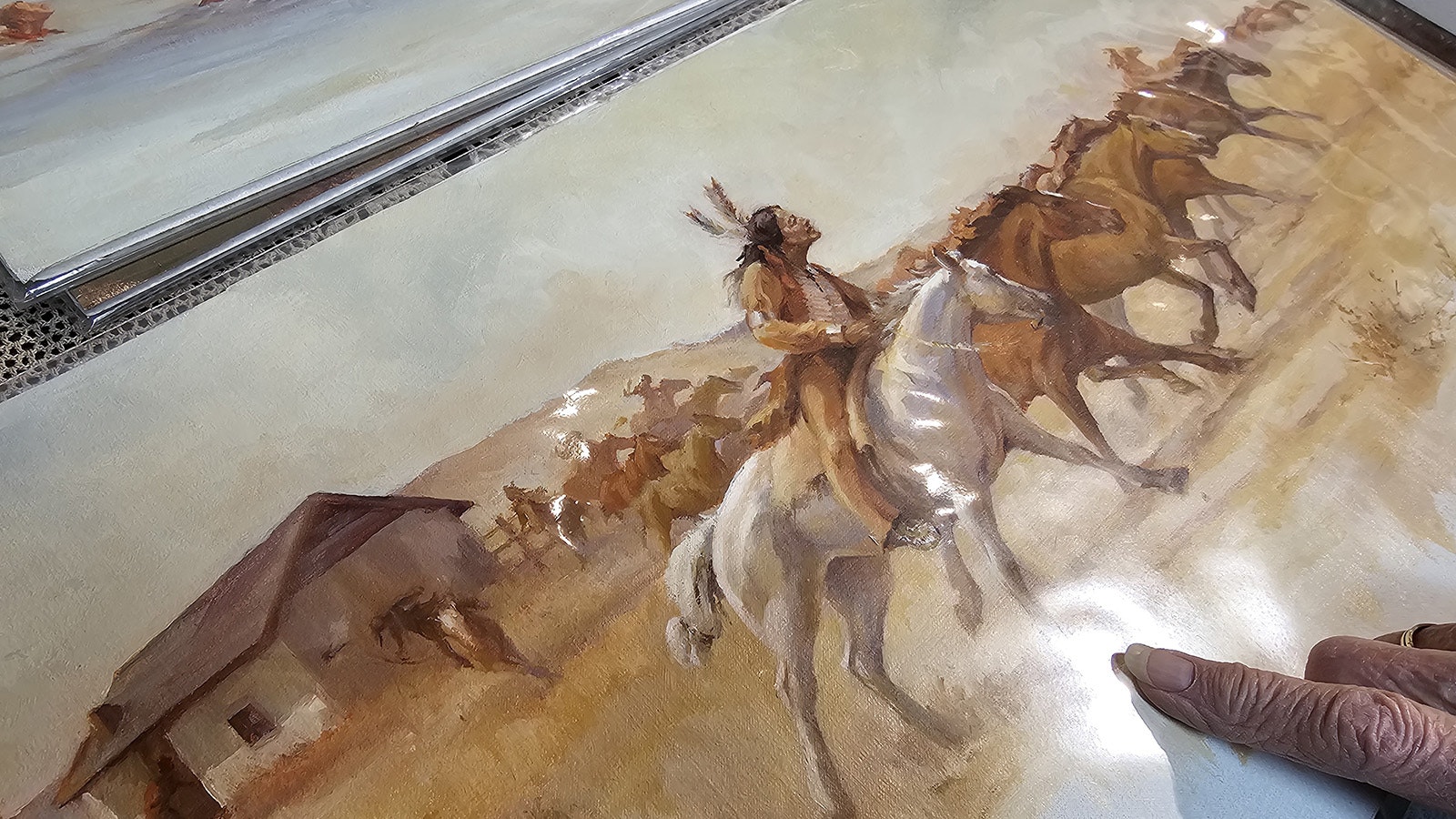
See how the horses tails are tied up? It's just one of the many historical details Schaffner took care to get right in a series of historical paintings she made for interpretive signs at the Lingle turnout. (Renee Jean, Cowboy State Daily) 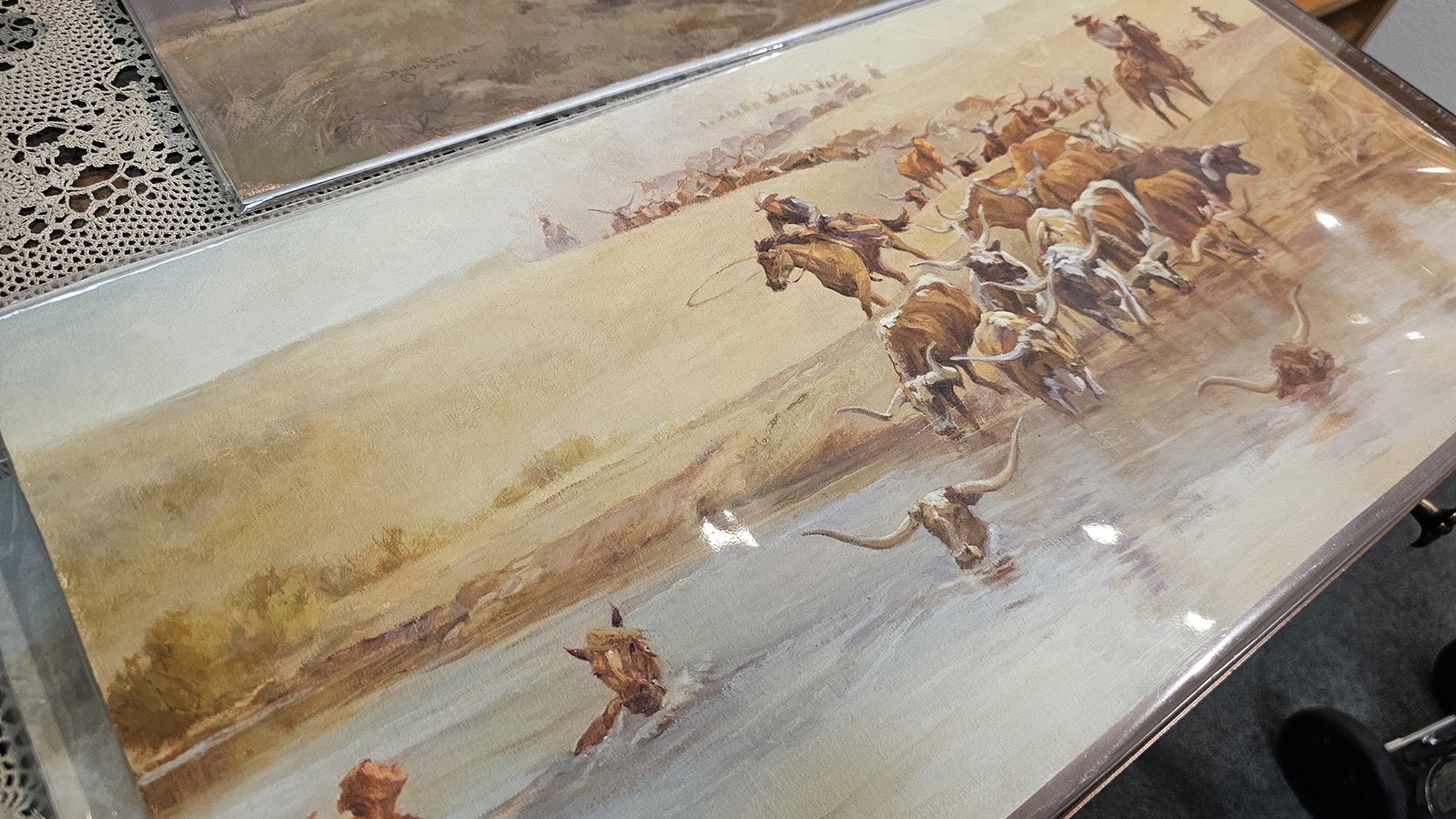
Many a cowboy and many a steer drowned crossing the river on the Texas Trail, which traveled right through Goshen County. The painting is one of five prepared by Barbara Schaffner of Wheatland. (Renee Jean, Cowboy State Daily) 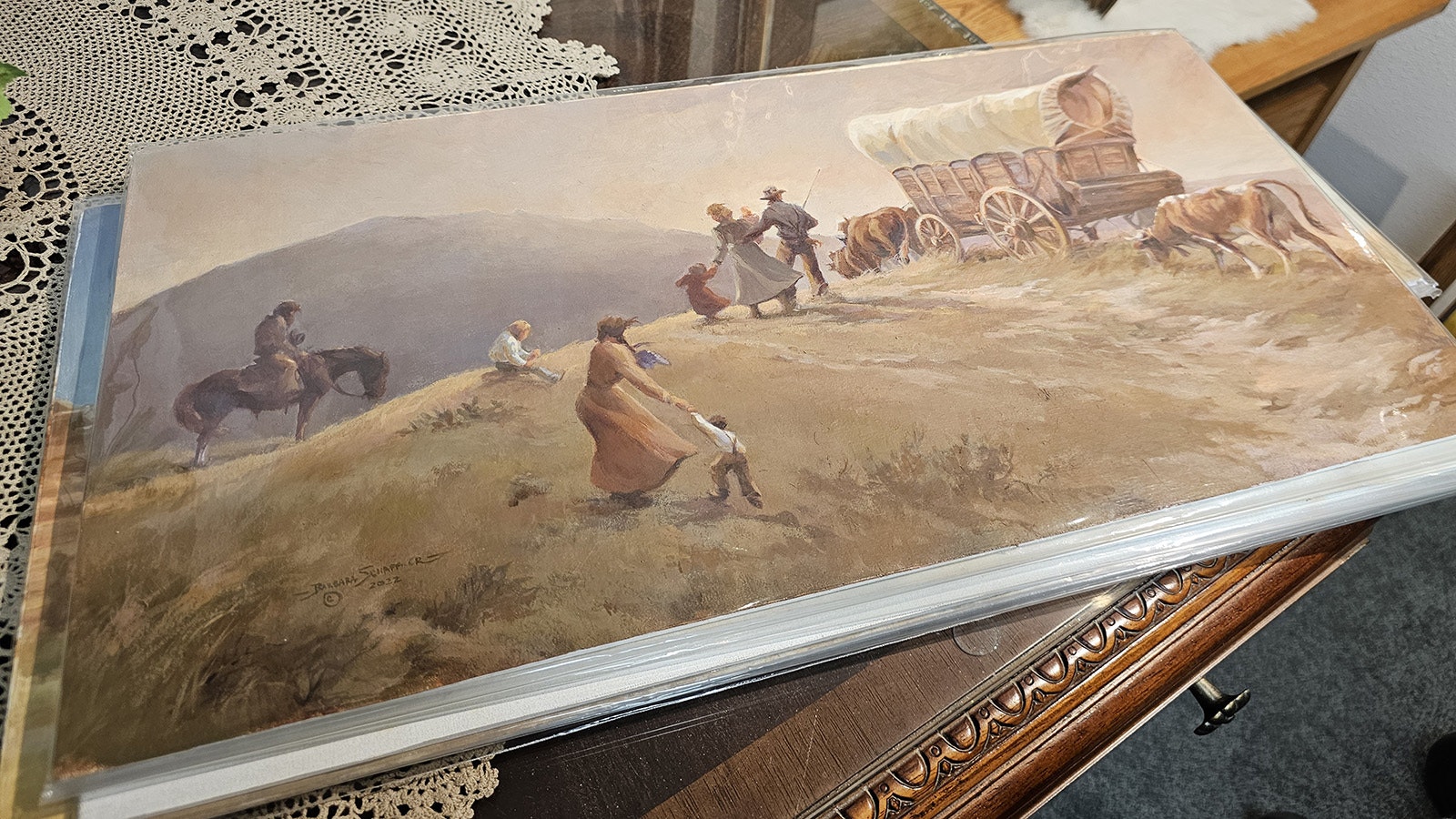
The painting "One Step At A Time," portrays a family's first sight of Laramie Peak. It was at this point that the family knew the hardest part of a journey that had already been hard was about to begin. (Renee Jean, Cowboy State Daily)
A Convenience Store Every 5 Miles
One of the reasons Goshen County has so many archeological sites is because it was at a convenient spot along the Oregon Trail.
“By the time the settlers got this far west, their wagons were worn out, their clothing had worn out, they were out of supplies and their animals were worn out,” Zeimens said. “So, this was a good place for people to set up a convenience store, so to speak, for these people who came in to get work done at a blacksmith shop on their wagons and to get resupplied, and to trade their sick animals for fresh animals.”
As a result, there was a trading post about every 5 miles in Goshen County.
“And they charged exorbitant prices,” Zeimens said. “So, they were real money-making enterprises.”
Travel on the Oregon Trail was seasonal to the summer, which made room for the hide trade business during other months of the year.
“That was also very lucrative,” Zeimens told Cowboy State Daily. “You know, there’s accounts of $40,000 for (a trainload of) hides being shipped from Fort Laramie back east at one point in time. That was a lot of money in those days.”
Competition between the trading posts themselves was quite fierce, Zeimens added.
“They burned each other out,” he said. “And they all had to sell liquor — whiskey — because if they didn’t, then the Indians would go to the one that did. It was illegal, of course, but they still had to sell whiskey to stay in business.”
A big part of Zeimens’ work has been to identify all of the old historical trading posts, putting as many as possible on the map.
“There’s still a few we haven’t found, but through archaeology, eventually we can,” Zeimens said. “All these historic and prehistoric sites are a tremendous resource for the area, if they could be developed for tourism and educational purposes, and that’s what we’re trying to do.”
Contact Renee Jean at renee@cowboystatedaily.com

Renée Jean can be reached at renee@cowboystatedaily.com.