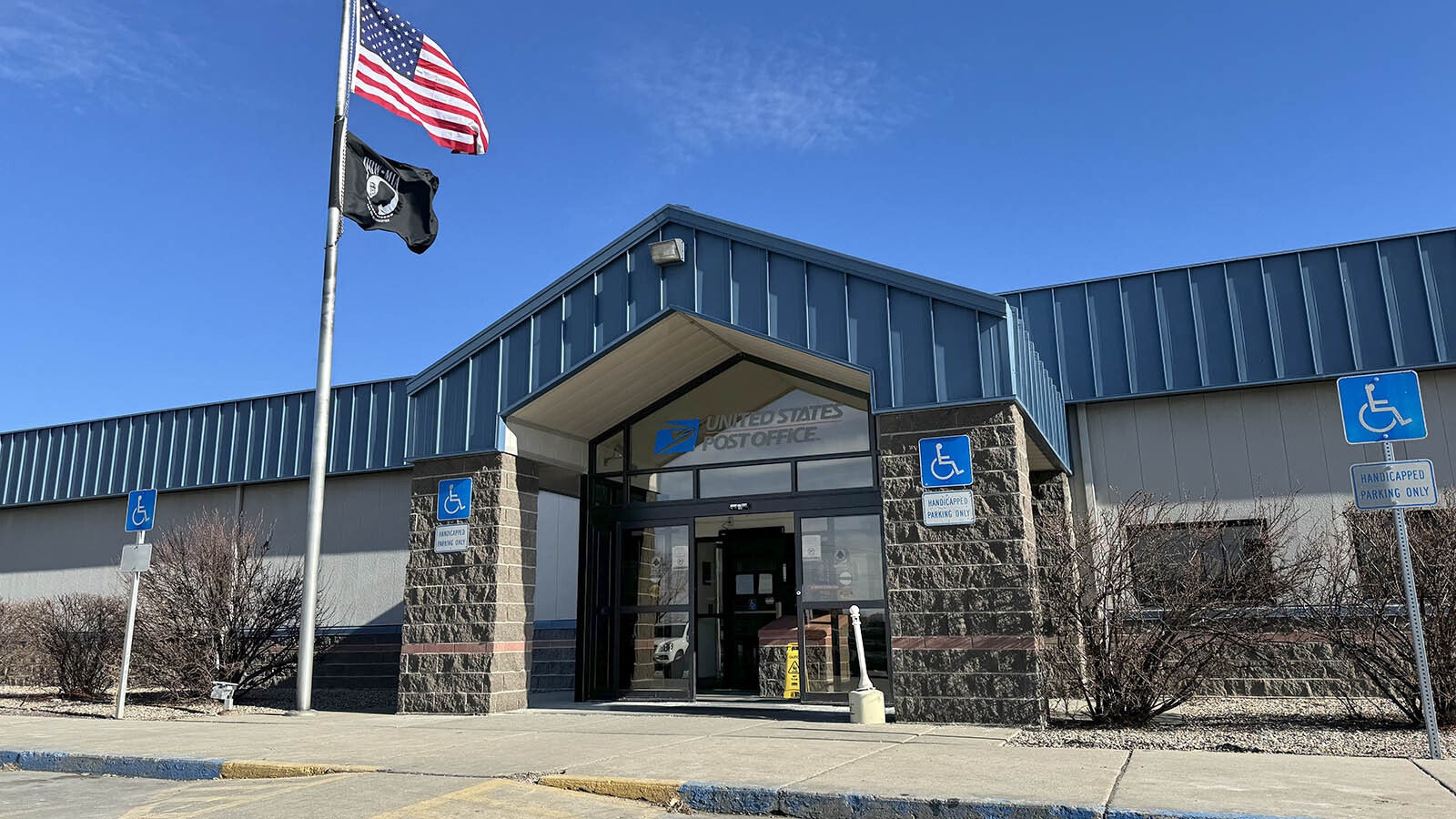
Despite a packed house in Casper with locals railing against the U.S. Postal Service’s plan to downsize the city’s mail processing facilities, the agency is going ahead with its plan to move the bulk of Casper’s mail sorting to Billings, Montana.
"We will continue to sort inbound mail in Casper and we will continue to sort inbound mail in Cheyenne," USPS spokesman James Boxrud told Cowboy State Daily in an email. "It’s just the outgoing mail — the vast majority of it leaves the local area anyway. We currently sort that mail in Casper and then put it on a truck to Billings or Denver anyway. We’re simply taking out that expensive and inefficient first handling."
The USPS made the announcement in a press release issued at a little after 5 p.m. Tuesday.
That mirrors a similar decision for the Cheyenne Post Office, leaving the Cowboy State without a major mail processing and distribution facility.
“The announcement comes following a thorough business review and solicitation of public feedback on the facility’s future,” the media release states. “In addition to determining the facility will remain open and modernized as a Local Processing Center, the business case supports transferring mail processing outgoing operations to the Billings P&DC in Billings MT.
“Currently, a majority of the mail is destined outside the Casper area to the rest of the world.”
Agency Says It Will ‘Improve Delivery Services’
Under its plan, the Postal Service says it will invest up to $5.7 million in the Casper facility to provide better workplace amenities, such as new lighting and renovated bathrooms and restrooms.
“To help improve delivery services, investments totaling $3.9 million will be made to locate a Flex Rover Sorter Quad into the facility,” the email goes on to say.
The press release doesn’t explain what one of those is, and questions about the media release were unanswered. Information posted to the USPS website describes the Flex Rover as a robotic system that will help sort mail, bundles and sacks.
In addition to a robot sorter, the USPS will add Smart Lockers to the Casper facility, the release says, which it describes as a “keyless, self-service delivery solution that allows package shippers and package recipients to send and receive packages direct to a Post Office Smart Locker location.”
The release goes on to say that no career employee positions will be lost as a result of the changes, and suggests that the Postal Service anticipates increased plant activity in the future as a result of the changes, which will likely mean more “support” is needed.
The email doesn’t say if that support would be additional human jobs or more robots. It also doesn’t explain how downsizing the Casper facility would increase its activity.
Bad For The Entire State
The Postal Service’s decision ignores the overwhelmingly negative feedback from residents of the Cowboy State, who fear the plan will mean further delays in their mail, particularly for rural areas.
U.S. Sen. Cynthia Lummis has told Cowboy State Daily that these decisions are particularly frustrating, given the amount of negative feedback Wyomingites have expressed about the plan.
“When USPS closed the Rock Spring sorting facility, I experienced delays and interruptions due to mail being processed out of state,” she said at the time, adding that, “Wyoming mail needs to be sorted in Wyoming.”
Wyoming state representative for NPMHU Local 321 Bob Jacknitsky has told Cowboy State Daily that attempts to characterize the changes as an improvement are deceiving. And despite claims mail will arrive “on time,” it’s likely to arrive later than it does now.
“It’s important for Wyoming residents to understand that it will take longer to receive their mail,” he said. “It is bad for the entire state.”
Gray: Bad For Elections Too
One of the big concerns with the Postal Service plan is what will happen to ballots that are mailed in, which is a question Wyoming Secretary of State Chuck Gray said he’s been asking.
In December, he wrote Postmaster General Louis DeJoy a letter demanding that Wyoming ballots be isolated for local processing.
Gray told Cowboy State Daily in an email Tuesday that he strongly disagrees with the decision to move all mail processing operations out of the Cowboy State.
“I’ve expressed my concerns that processing Wyoming election mail outside the state of Wyoming would delay delivery of absentee ballots and otherwise impede the integrity of the upcoming 2024 election and future elections,” he said in the email. “I view these related and disturbing efforts to move mail processing outside the state of Wyoming as detrimental to Wyoming elections and the people of Wyoming. The Postal Service should withdraw these efforts.”
Primaries in Wyoming will be held in August, according to the Wyoming Secretary of State’s website, and the General Election is set for Nov. 5.
The USPS was sent an inquiry about how Wyoming ballots will be handled, but did not respond as of the time this story was posted.
When asked that question in regard to the decision to move Cheyenne mail processing to Denver, Boxrud told Cowboy State Daily in an email that “as in years past,” the Postal Service would employ “extraordinary measures for election mail.”
“The details of those measures will be outlined closer to election,” he said.
Gray said he doubts those "extraordinary measures."
"I’m deeply concerned that processing Wyoming mail outside the state of Wyoming will delay the delivery of all mail," he told Cowboy State Daily in an email. "I’m also concerned that this will delay delivery of absentee ballots and otherwise impede the integrity of the upcoming 2024 election and future elections. I view these repeated and disturbing proposals to move mail processing outside the state of Wyoming as detrimental to Wyoming elections and the people of Wyoming. Wyoming mail should be processed in Wyoming."

Report Card On Delivering For America
Testimony on Capitol Hill on Tuesday may give something of a preview into what Wyomingites can expect to happen with their mail delivery services once the Delivering for America Plan is implemented.
In his testimony, U.S. Postal Regulatory Commission Chairman Michael Kubayanda slammed the U.S. Postal Service’s performance in 2023, calling it alarming.
“Based on the numbers reported by USPS, service performance, financial results, mail volume and efficiency are moving the wrong direction,” Kubayanda testified. “I do think USPS can make improvements, but its leadership must acknowledge these problems and be transparent with stakeholders, Congress and oversight bodies while attempting to address them.”
A graphic of delivery times for first class mail letters and cards destined for delivery within the Atlanta metro area shows a dramatic drop in performance for 2024 vs. 2023, stating at the end of February.
By March 15, only 10% of the mail was delivered on time compared to the previous more usual stat of 92% on time.
“Atlanta and Richmond, Virginia, are home of new regional processing plants deployed under the March 2021 Delivering for America DFA plan,” Kubayanda testified. “Hopefully, poor service in Atlanta is an extreme outlier and will rebound soon. But national performance has been subpar and trending in the wrong direction.”
Not Saving Money
Like the Cheyenne decision, the Casper plan hasn’t been cast as a money-saving maneuver in the U.S. Postal Service’s press release.
But, as it did for Cheyenne, the final study document on the change outlines total annual savings of around $2.4 million to $3.2 million.
According to Kubayanda’s testimony, the relaxed standards, operational changes and the change to slower standards for “on time” delivery have not yet resulted in any cost savings.
“A recent Office of Inspector General audit report on the new USPS plant in Richmond, Virginia, noted that the new facility has not produced anticipated savings, despite dealing with lower mail volume in the region served by the new plant,” he testified.
Furthermore, the Postal Service’s own metric, called Total Factor Productivity or TFP, has shown a decline of 4%, according to its annual report to Congress in 2023.
“If this figure is verified, it appears to be one of the largest annual drops in the history of TFP in the postal sector,” Kubayanda testified.
In 2020 and 2022, despite USPS receiving a combined boost of more than $100 billion from Congress and the Commission through a reduction in retiree health benefits payments and increased revenue from new pricing authority, Kubayanda testified that the agency still reported a loss of more than $6 million.
“And it is on track to lose another $6 billion or more this year,” he said.
Renée Jean can be reached at renee@cowboystatedaily.com.