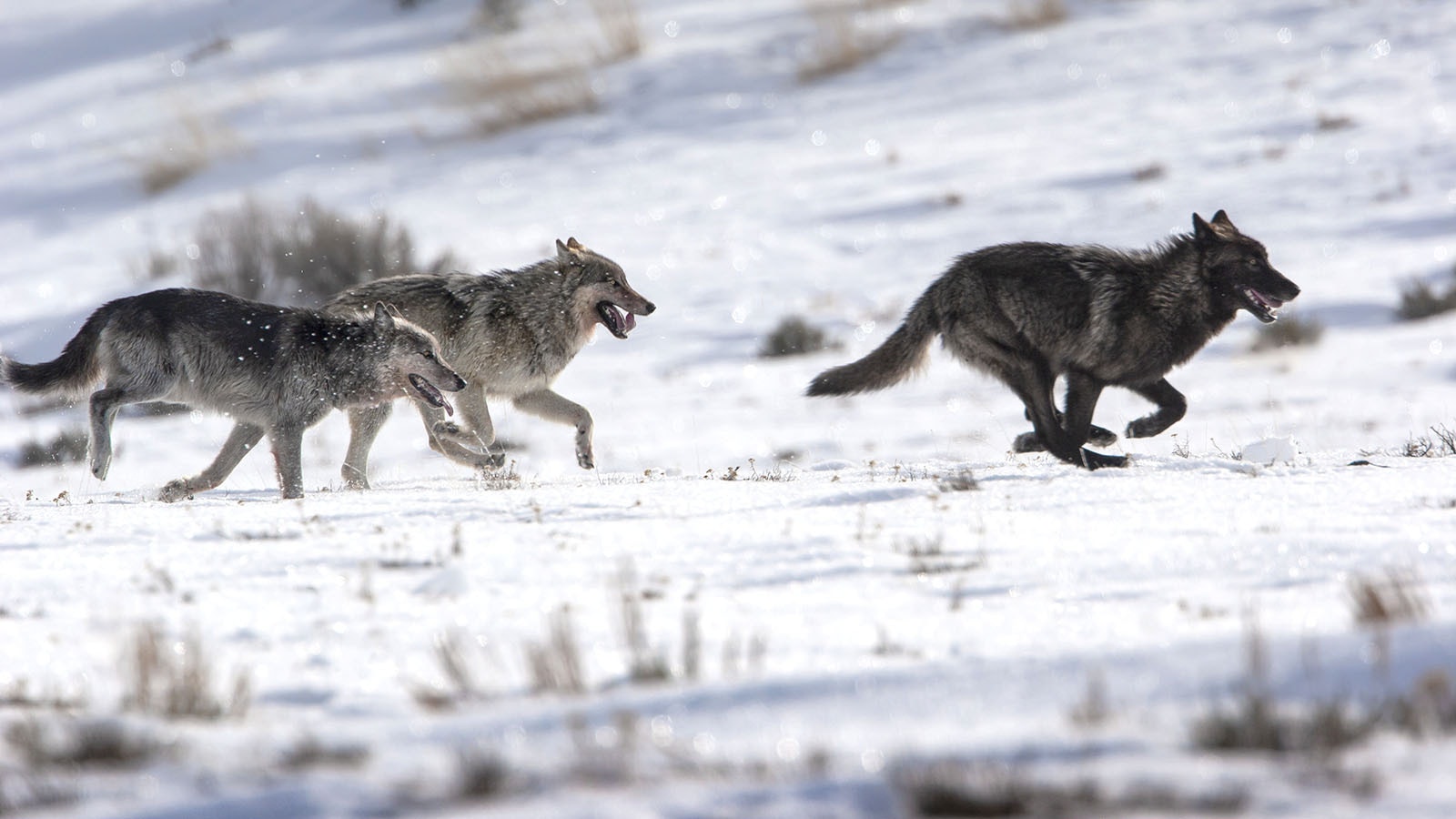
A coalition of environmental and animal protection groups was already pushing to have wolves in Wyoming, Montana and Idaho put back under federal protection when news broke of a wolf being captured, tortured and killed in Sublette County.
That story bolsters the case to have wolves re-listed as endangered, and management taken away from the states and handed back over to the federal government, a spokesman for one of the groups said.
“I think it absolutely puts gas in the tank (of the re-listing effort). This illustrates Wyoming’s attitude and management policy toward wolves,” Nick Gevock of Butte, Montana, told Cowboy State Daily.
Gevock is the Sierra Club’s field organizing strategist for Northern Rockies wildlands and wildlife, including Wyoming, Montana and Idaho.
States’ Wolf Plans Flawed?
The coalition announced this week that it is suing the U.S. Fish and Wildlife Service (USFWS) for denying an earlier petition to protect wolves in the Northern Rockies under the Endangered Species Act. The groups include the Center for Biological Diversity, Humane Society of the United States, Humane Society Legislative Fund and Sierra Club.
Gevock said one argument in favor of re-listing wolves is that the states’ wolf management policies have failed. And the viral story of a wolf being tormented, then killed behind a bar in Daniel strengthens that argument.
“This absolutely reflects Wyoming’s attitude toward wolves,” he said. “The states are managing for an absolute bare minimum of wolves.”
However, retired USFWS game Warden Tim Eicher of Cody said he thinks the states’ management plans have a proven track record of striking a balance between wolf conservation and wolf hunting.
“There is no state management plan that would satisfy them (environmental groups) that allows the hunting of wolves, just like they banned mountain lion hunting in California,” Eicher said. “You can look at the wolf population estimates and they’re fine, and the wolves are dispersing. Just like grizzly bears. They’ve recovered and they’re dispersing.”
Eicher first came to Cody in the mid-1990s, when wolves were first reintroduced into Yellowstone National Park. At that time, they were under federal protection, and therefore under his jurisdiction as a UWFWS game warden.
Wolves were de-listed from federal protection and jurisdiction in Montana and Idaho in 2011, and in Wyoming in 2012.
Gevock said he isn’t opposed to the principle of state wolf management, it’s just that the approach in Wyoming and the other states has been too heavy-handed.
“We agree, the goal of the ESA (Endangered Species Act) is to recover the species and return them to state management. But the states have to be responsible stewards of the resource, and they’re not,” he said. “They failed miserably.”
Is Wyoming ‘Predator Zone’ The Problem?
In Wyoming, the crux of the issue might be the “predator zone” for wolves. The area where the wolf was allegedly tormented and killed in Sublette County is part of that zone.
The predator zone includes more than 80% of Wyoming outside of Grand Teton and Yellowstone national parks. And in that zone, they are classified as a “predatory animal,” with no protection under wildlife harassment regulations that apply to other animals, such as big game herds.
Wolves in the predator zone may be killed at any time, and by nearly any means, including being pursued with snowmobiles.
That’s unacceptable from the environmental groups’ perspective, Gevock said. It makes wolf recovery impossible in much of Wyoming.
And as a big game hunter himself, he said he questions claims that wolves ruin hunting.
“I hunt elk in a part of southwest Montana with grizzly bears, black bears, mountain lions and wolves,” he said.
Eicher said he also questions the wisdom of the predator zone. Instead, Wyoming might consider declaring the entire state outside the national parks as a “trophy hunting zone” for wolves.
Some areas of Wyoming adjacent to Grand Teton and Yellowstone are already classified as trophy hunting zones for wolves.
People can hunt wolves there, but they must have wolf hunting tags and hunt only during designated seasons and within bag limits.
The predator zone arguably increases the chances of the “type of conduct” that was reported in Daniel, Eicher said.
“That type of conduct doesn’t affect wolf recovery numbers. But what it does is reflect poorly on game management,” Eicher said. “If wolves were classified as trophy game throughout the state, that type of conduct would not be allowed.”
Mark Heinz can be reached at mark@cowboystatedaily.com.