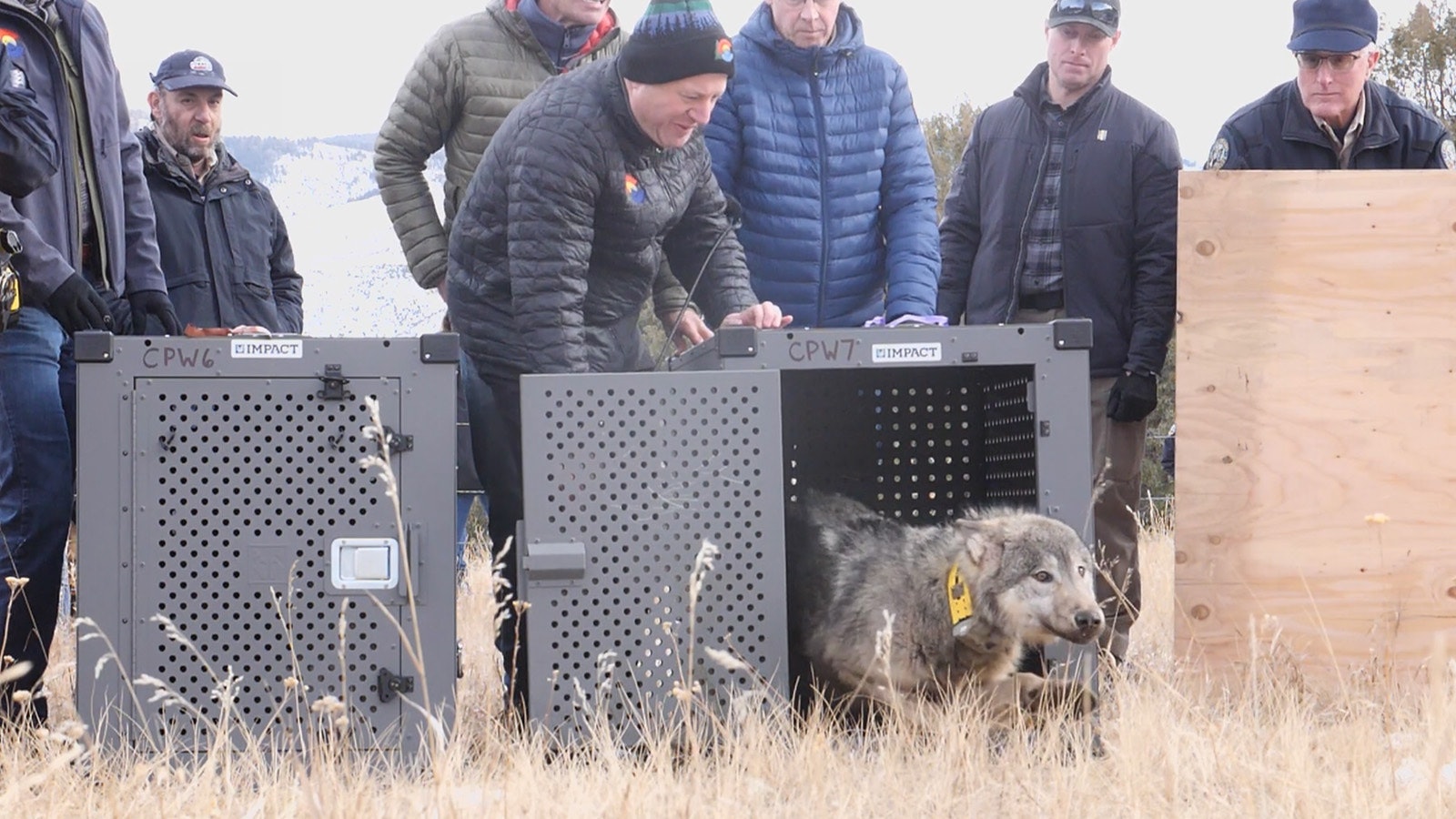
Less than four months after reintroducing wolves into Colorado, Wyoming’s southern neighbor has reported its first instance of cattle being killed by the predators after a calf was found dead.
A rancher in Grand County, Colorado, reported the dead calf early Tuesday, and Colorado Parks and Wildlife (CPW) investigators determined that it had probably been killed by wolves, agency spokesman Travis Duncan said in a statement.
Ten wolves were released in Colorado in December, and there were thought to be two survivors of the defunct North Park pack also still in the state.
The North Park wolf pack was formed by wolves that migrated into Colorado from Wyoming sometime around 2020. That pack was blamed for killing dogs and cattle in Jackson County, Colorado.
The reintroduced wolves came from Oregon and were members of packs that had killed cattle in that state.
Comes As No Surprise
Jim Magagna, executive vice president of the Wyoming Stock Growers Association, told Cowboy State Daily that he’d expected to hear about wolves killing cattle in Colorado.
“I’m certainly not surprised to hear it. It’s indicative of what we went through in Wyoming,” he said. “But here in Wyoming we have a wolf management in place.”
In Wyoming, wolves remain fully protected inside Grand Teton and Yellowstone national parks. In some areas adjacent to the parks, seasonal wolf hunting is allowed. Beyond that, in roughly 85% of Wyoming, wolves may be hunted at any time with no license required.
Wolves in Colorado remain under full federal endangered species protection and may not be hunted by the public. Colorado officials have stated that in cases of “chronic depredation” of cattle, game agents might kill some wolves. But what would amount to chronic depredation hasn’t been precisely defined.
Expects ‘Wolf Presence’ In Southern Wyoming
Colorado’s wolves have wandered fairly close to the Wyoming state line, although there haven’t been any verified reports of them crossing over.
Some wolves have also occasionally wandered from their stronghold in northwest Wyoming into the southern part of the state, Magagna noted.
So, he expects that either from the north, from the south or both, there will likely be more wolves in southern Wyoming.
“There will be some wolf presence,” he said. “And fortunately, unless something changes and the wolves are re-listed as an endangered species in Wyoming for some reason, it will be a manageable presence.”
‘We’re Going To Have Conflicts’
On the Colorado side, the loss of a calf to wolves wasn’t unexpected and likely isn’t cause for alarm, Colorado resident Matt Barnes told Cowboy State Daily.
“If we’re going to have carnivore restoration, we’re going to have livestock conflicts,” said Barnes, a range scientist who has worked on wolf and grizzly bear conflict mitigation on ranches in Wyoming and Montana.
He said the incident this week was handled well by CPW investigators. And that’s important, because wolf conservation advocates and ranchers must trust investigators’ conclusions for Colorado’s wolf program to succeed.
“We need impartial investigations” of suspected incidents of wolves killing livestock, he said.
Livestock losses are best handed on a “case-by-case basis,” and efforts to discourage wolves from attacking cattle by nonlethal means should be tried first, he said.
“I don’t think CPW is going to resort to lethal control of wolves until they’ve seen good-faith efforts to prevent conflicts by nonlethal means,” Barnes said.
Mark Heinz can be reached at mark@cowboystatedaily.com.