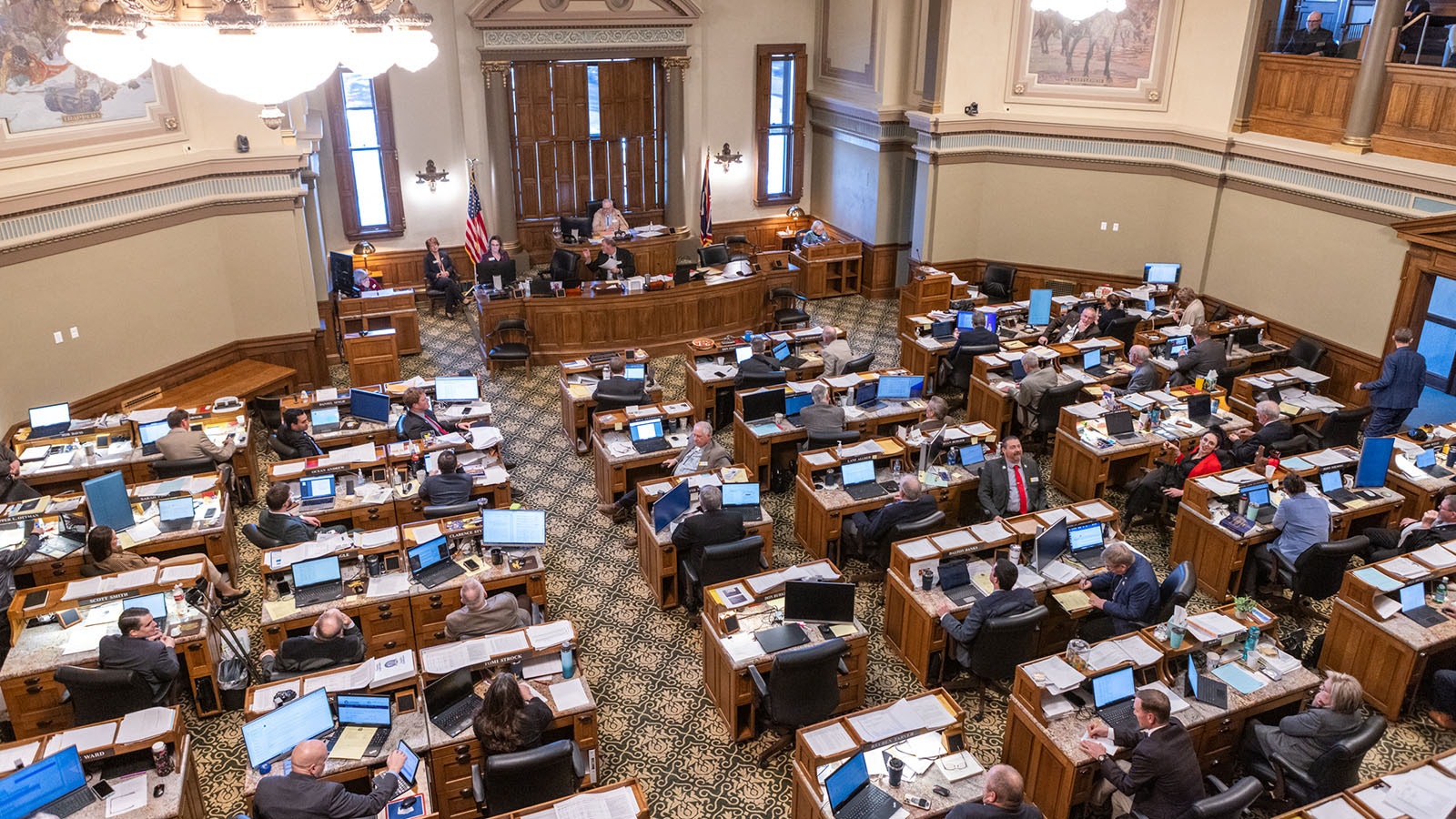
Support may be slowly growing among state legislators for calling a special legislative session to overturn Gov. Mark Gordon’s vetoes of some high-profile bills, but little has been said about what this session would look like if called.
On Monday night, Senate President Ogden Driskill, R-Devils Tower, and House Speaker Albert Sommers, R-Pinedale, put out a memo saying they are now considering a special session after less than 12 hours earlier saying they wouldn’t.
The proposition has come in response to a slew of vetoes Gordon made on bills passed during the recently completed legislative session, most notably Senate File 54, a property tax relief plan that would exempt 25% of fair market value up to $2 million of a home’s assessed value in Wyoming.
Sommers told Cowboy State Daily on Tuesday he believes Gordon’s veto of SF 54 was the proverbial straw that broke the camel’s back. He had heard no demands for a special session prior to that point.
Sommers believes people are now calling for a special session partially out of a desire to grandstand for the upcoming election, and partially from a legitimate frustration about Gordon’s veto.
“Some of it’s posturing and some it’s people honestly believe those bills are worth fighting for,” Sommers said.
‘Flip-Flopped’
State Rep. John Bear, R-Gillette, said Sommers and Driskill have “flip-flopped” on having a special session, but “thankfully they did so fast because it’s an election year.”
“Leadership talks out of both sides of their mouth,” Bear said. “They made Gordon a dictator, now they want to hold him accountable.”
Driskill and Sommers put their memo out Monday night after receiving new information from the Department of Revenue that SF 54 could be implemented for this current tax year.
Sommers said he was disappointed by Gordon’s veto, and particularly the tone the governor used in his veto message.
“I felt that wasn’t conducive to good governance,” Sommers said.
Although the legislative leaders have shifted toward actively considering a special session, Sommers said he is still leaning against it.
Bear, chairman of the Wyoming Freedom Caucus, said he saw this shift as evidence that “pressure works.”
“The people of Wyoming demanded that the Legislature do their job, and the Wyoming Freedom Caucus amplified the demands of the people,” he said.
What Would It Look Like?
What it won’t be is a quick vote to overturn any of Gordon’s vetoes. That ship sailed when the 2024 legislative session was officially adjourned.
When a special session is called in the Wyoming Legislature, it automatically falls under general session rules, aside from a 20-day limit on how many days it can convene.
This means that any bill could theoretically be introduced during the session, creating a pandora’s box that has Sommers concerned. And anything proposed has to go through the regular legislative process of being assigned to a committee, discussed there and voted on before dying or being sent back to either the House or Senate.
Sommers said if there is one, he would want the special session to solely focus on SF 54. During the most recent special session in 2021, 41 bills were brought, but only one passed into law.
A two-thirds vote would be required for the suspension of any rules to allow for specific parameters that the session would be held under, which Sommers said he is not confident could be achieved.
“It would be very hard to pass rules limiting ourselves,” Sommers said.
Those who have loudly advocated for the special session like Sen. Cheri Steinmetz, R-Lingle, and Bear have brought up not only addressing SF 54, but also Gordon’s vetoes on a bill banning gun free zones, legislation regulating Wyoming’s abortion clinics and funding cuts for the University of Wyoming’s Diversity, Equity and Inclusion Office and related programming within the budget.
In total, Bear said he would support addressing six bills, which he believes could be completed in a single day as long as a two-thirds vote could be earned to change the rules. A suspension of the rules could allow for a fast-track to quickly move bills through the legislative process without the assembling of committees and multiple readings.
Nothing could likely be done to prevent amendments, but Bear said a gentleman’s agreement could be arranged to keep bills in their original form.
Bear said that in 1981, the Legislature convened for two days, and during that time considered 30 bills, including a budget.
“We consider hundreds of bills in several weeks, I think we can do six,” he said.
If a special session is called, Bear said the rules may not be hashed out until the actual session convenes.
Another interesting aspect to special sessions is that they can be adjourned with a simple majority vote.

Money And Time
A special session would roughly cost around $35,000 a day, a figure based on the per-day costs of the 2021 special session.
Any bill passed out of the special session would still need to go to the governor. The governor would have up to three days to act on any bill, giving little for the Legislature to do in that meantime. That’s one of the reasons why Rep. Mike Yin, D-Jackson, said he opposes a special session.
“The state was founded on limited government, which limited our session days to limit how much work we could do as a Legislature,” he said. “If we say we must go back into session any time the governor vetoes something, we are growing our government. We are telling future legislatures that they should expect to have an encore session every year.”
Any bills the governor vetoes again would require a two-thirds vote to override. Even though a bill may pass convincingly at first, Sommers said this is never a guarantee it will again when it comes back from the governor.
This is what happened on Driskill’s Senate File 61, which authorizes charter schools as local education agencies to receive and apply for federal and state grants. Although SF 61 passed by nearly unanimous majorities, it failed to receive a two-thirds override in the House after Gordon vetoed it.
“If the governor can articulate that veto in a manner that changes your opinion, that raises an issue you hadn’t thought about on your original vote on the bill, you may not vote to override,” Sommers said. “New information is new information.”
Support, But With Limits
Sen. Brian Boner, R-Douglas, told Cowboy State Daily he supports calling for a special session. Boner said he would support bringing up any bill that passed with a super majority vote by the Legislature that Gordon vetoed.
“I think what the governor did was a gross example of government overreach,” Boner said. “I understand the governor doesn’t plan to run for reelection again, but people like myself and others in the Legislature are still beholden to the people.”
Sen. Dan Dockstader, R-Star Valley, also said he would support a special session, but only if it was limited to SF 54.
“This is something we need desperately on the west side of the state,” he said.
Dockstader said Management Council, which has a meeting on Monday, is studying how a special session could be limited to a single bill.
He was Senate president in 2021 when the last special session was called, but said this situation feels completely different. That session was called in response to COVID-19 regulations rather than governor vetoes.
“I’m going to need a little more information if we’re going to completely crack that back open,” Dockstader said.
Precedent
One of Sommers’ chief concerns is that calling a special session would establish a precedent for doing so whenever there’s discontent about a governor’s vetoes.
“I don’t think it’s good policy that every time we’re mad, we’re going to run to a special session,” Sommers said. “We need to show discipline.”
He worries this would create a more full-time political atmosphere out of what is considered a citizen’s legislature — made up by lawmakers who aren’t career politicians and can’t convene for more than 60 legislative days under state law.
“If you want to grow government, then grow the number of days the Legislature is going to meet,” Sommers said.
Rep. Clark Stith, R-Rock Springs, agrees and said this is why he opposes calling for a special session, even though he was disappointed by Gordon’s veto of SF 54 and the bill banning gun free zones.
“Nonetheless, I don’t want our Legislature to become a professional legislature as opposed to a citizen’s legislature,” Stith said.
According to information provided by the Legislative Service Office, there have been 23 special sessions held in Wyoming history, with the first in 1920 and the most recent in 2021. To date, none have ever been called to specifically override a governor’s veto.
What’s Next?
A vote to decide whether to have a special session can be triggered by legislative leadership or with a signature of support from 35% of the members from each chamber. Bear said he is confident this number has already been reached in the House. The Senate will have until 5 p.m. Friday to collect these signatures.
Sommers said he and Driskill are still actively studying the situation and wouldn’t engage in any poll on Tuesday.
“We’re still trying to assess the totality of the decision,” Sommers said.
He also said he’s unsure how the House would vote on the matter, but Bear said he sees people moving from “hard no votes starting to soften up,” and believes it has a greater than 50% chance of it being called for in his chamber, and a “high likelihood” a vote will be called for a special session in the near future.
If a special session is called, Sommers also said he has no idea when it will take place. Bear said he suspects it would happen in May.
Leo Wolfson can be reached at leo@cowboystatedaily.com.