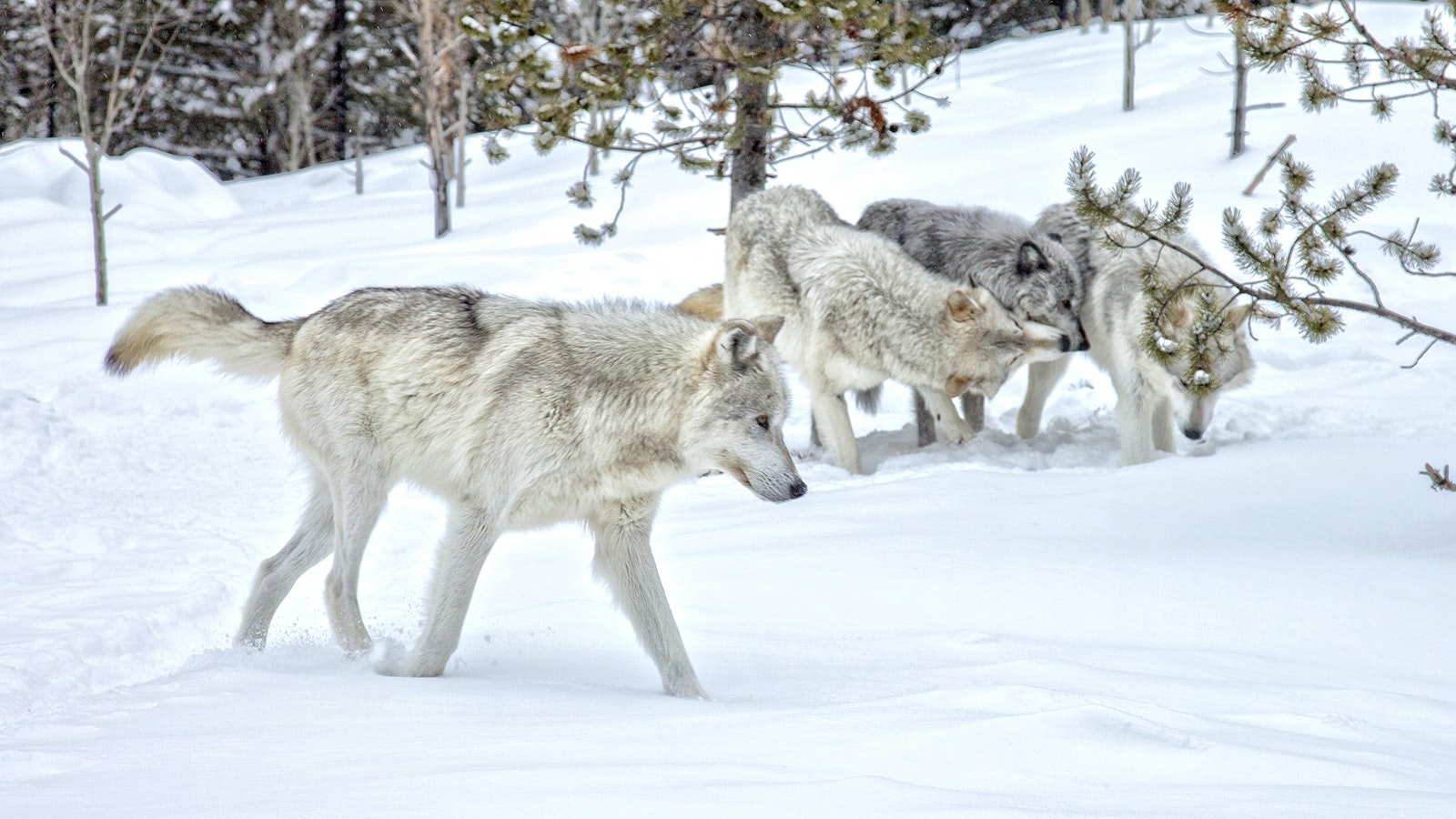
Wyoming, Montana and Idaho have been killing too many wolves, so the predators need to go back on the endangered species list, according to coalition of environmental groups threatening to sue the federal government over it.
“The (U.S. Fish and Wildlife) Service’s finding seems to give the green light for states hostile to wolves to follow suit with Idaho, Montana and Wyoming’s aggressive killing regimes if they are eventually delisted and transferred to state management West-wide,” Kelly Nokes, an attorney with the Western Environmental Law Center representing the groups, said in a statement.
“We can’t kill our way out of living with wildlife,” KC York of Trap Free Montana, another of the groups involved, told Cowboy State Daily on Monday.
However, Wyoming hunter and conservationist Josh Coursey said the coalition is better described as “litigation groups.”
The Wyoming Game and Fish Department has more than proven itself capable of managing a sustainable population of wolves, Coursey told Cowboy State Daily.
“I despise how these litigating groups have weaponized the court system at the expense of sound wildlife management,” he said.
The coalition last month filed a notice of intent to sue the U.S. Fish and Wildlife Service to have wolves relisted as an endangered species if the agency doesn’t respond by April 9.
It’s the latest episode in a decades-long battle over whether wolves should be protected or hunted in the northern Rockies.
Are States Doing It Wrong?
Among the coalition’s claims are that the states of Wyoming, Montana and Idaho have overestimated the number of wolves there, and thus allowed for overly-aggressive wolf hunting and trapping.
They also argue that the last delisting of wolves in about 2012 had more to do with politics than biology.
The states have ratcheted up wolf killing in recent years, York said.
“It’s the war declared on wolves on steroids in Idaho,” she said. Wyoming never lets their wolf population get over a few hundred, they never have. In 85% of the state they can kill wolves year-round.”
Wyoming has a three-tiered wolf management system. Inside Yellowstone and Grand Teton national parks, wolves remain fully protected. In a “trophy hunting zone” adjacent to the parks – or about 15% of Wyoming outside the parks – wolves may be hunting with licenses during set hunting seasons.
In the rest of the state, wolves may be trapped or shot on sight at any time, with no bag limits and no license required.
Inbred Wolves?
If the states’ current wolf management policies are allowed to continue, the long-term viability of the species in the Northern Rockies could be threatened, said Mike Garrity of Helena, Montana, spokesman for Alliance for the Wild Rockies.
“Wyoming has had poor protections for wolves. Idaho and Montana have joined Wyoming, so the numbers are really going down. We think it’s clear that they aren’t adequate regulatory mechanisms to ensure long-term viability for wolves,” he told Cowboy State Daily.
“If the wolf numbers get too small, they risk inbreeding,” Garrity said.
Tie-In With Colorado?
Garrity said the coalition’s possible legal action isn’t connected to the recent reintroduction of wolves to Colorado.
That’s a separate, unrelated matter that doesn’t have to do with the decision to put the USFWS on notice for a possible lawsuit, he said.
Former Wyoming Game and Fish Commission member Mike Schmid of La Barge said he thinks there could be a connection.
“I find it a bit curious shortly after Colorado begins their reintroduction program that this notice of intent to sue the USFWS has been filed,” Schmid said. “I think these groups understand the difficulty in getting Colorado’s wolf populations to grow when they be killed as a predator once they step across the Wyoming line.”
Wyomingites Defend Game And Fish
Coursey and Schmid both defended Game and Fish’s wolf management, which they think shouldn’t be interrupted by another lawsuit.
“The Wyoming Game and Fish Department has scientifically proven for years that they manage the wolf population objectives for sustainable existence and biological recovery,” Coursey said.
“WGFD has, and continues to adhere to, costly monitoring efforts and management actions to ensure wolves not only meet such requirements, but exceed,” he said. “These labors are met with buffer in order to prevent such agenda-driven efforts like these that look to manipulate the science to further their own narrative.”
Coursey said that sound wildlife management requires balance, and complete protection for only certain species undermines that.
“A balanced ecosystem requires management. Left unchecked, balance is negated at something else's expense,” he said.
Schmid also said Game and Fish has exceeded expectations.
“Game and Fish, in my opinion, has done a fine job of managing Wyoming wolves that meet or exceeds the guidelines set by the USFWS when they were delisted a few years ago,” Schmid said. “I am hopeful they can carry on with their management style. (Game and Fish wolf biologist) Ken Mills does a fantastic job with Wyoming’s wolves.”
Debate Over Trapping, Snaring
The groups’ pending litigation against the feds was partially prompted by a ramping up of no-holds-barred wolf culling, York said.
Montana and Idaho have started allowing more trapping and snaring of wolves, as well as hunting them with night-vision scopes and the like, she said.
That level of killing will never allow them to fully establish a permanently viable population or continue to expand their range, York said.
Schmid said that wolves are difficult to hunt, so trapping and snaring should be allowed.
“I support all forms of managing wolf numbers. Hunting, trapping, snaring should all remain as a legal form of take,” he said. “Wolves become so much smarter and harder to take by hunting alone. They learn quickly what hunters are all about.
“The Wolf advocates don’t like the trapping and snaring because it is such a successful way of managing Wolf numbers. They would love to see trapping and snaring stopped. The number of wolves taken would be drastically reduced each year in my opinion.”
Reintroductions Spark Controversy
Garrity said it’s a misconception that his group and the other members of the coalition want wolves to remain under endangered species protection forever.
“Our goal is to get every species that’s listed under the ESA recovered and delisted,” he said. “Our big criticism is, the federal government isn’t really recovering species.”
He added that the past 30 years or so of ideological and legal battles over wolves might have been avoided if they had just been allowed to repopulate Montana, Wyoming and Idaho on their own.
“People are much more accepting of animals moving in on their own, rather than the government doing it,” he said. “The wolves had already moved back into Montana from Canada, and then the government stepped in (in the mid-1990s) and moved a bunch of wolves down from Canada into Yellowstone and central Idaho, and it became controversial.”
Mark Heinz can be reached at mark@cowboystatedaily.com.