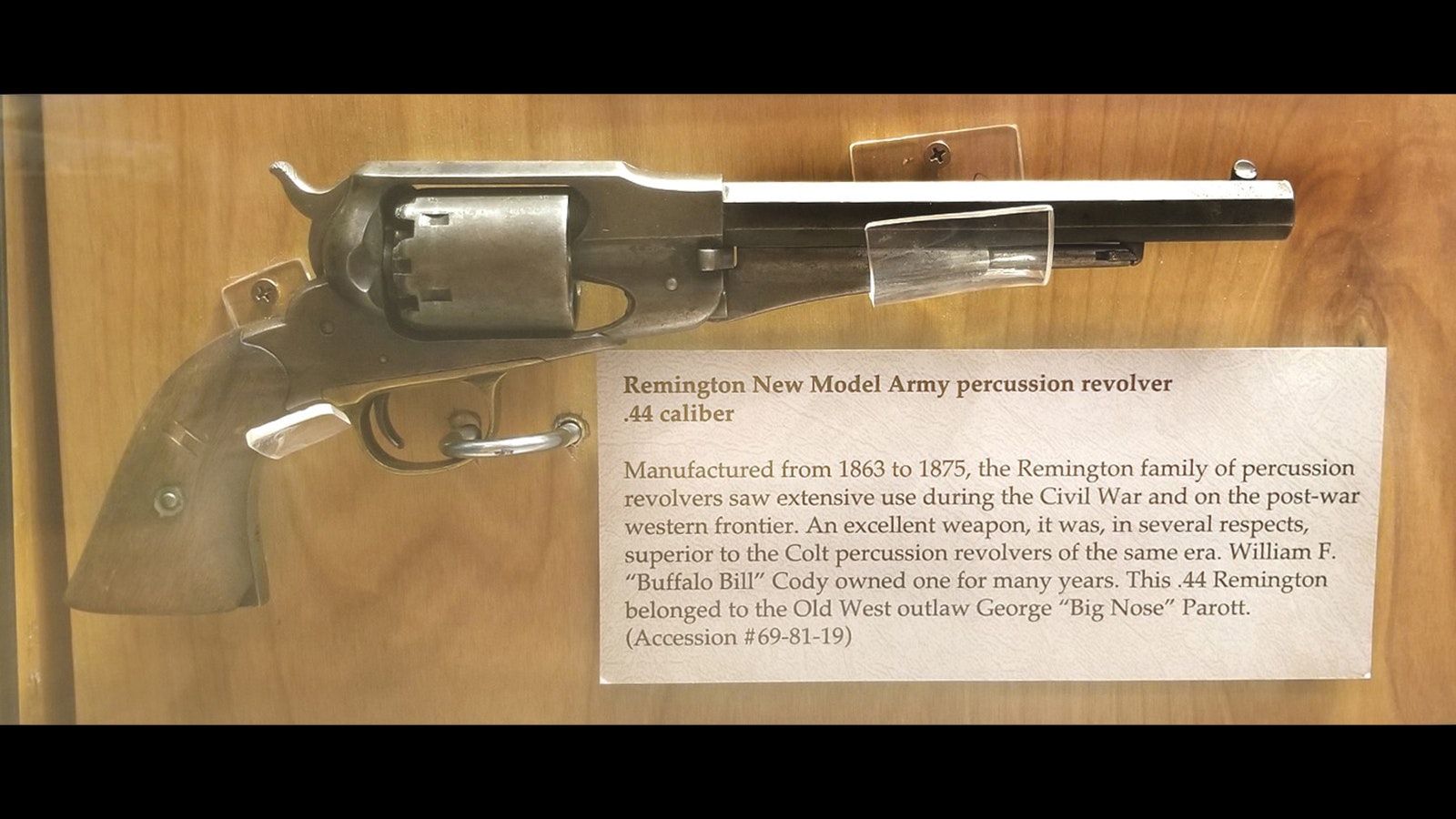
A gun associated with one of the Cowboy State's most notorious outlaws, “Big Nose” George Parrott, is now on display at the Sweetwater County Historical Museum in Green River.
But just how the gun that might have been used to commit some of the most infamous crimes in Wyoming history was lost for decades, then recently rediscovered, involves another outlaw who met a similar fate at the end of an angry mob’s rope.
The Civil War-era .44-caliber Remington New Model Army revolver, manufactured in 1864, spent decades squirreled away in the museum’s collections. That’s where Dick Blust, one of the museum’s staff members, discovered it.
“The gun wasn't on display,” he told Cowboy State Daily. “I checked it out, and the reference to George Parrott came up, and it was just kind of rock and roll from there.”
In the collections, the revolver was labeled as “Big Nose’s Gun." That tiny piece of information led Blust on a quest to research the revolver and see if it could be traced back to two murders and an infamous Wyoming outlaw.
Big Nose George
The story of “Big Nose” George Parrott is stuff of Wyoming legend. After a botched attempt to rob a train, Parrot and his gang killed two peace officers pursuing them on Aug. 19, 1878.
Parrott eluded justice until 1880, when he was found, arrested and sentenced to death. Ten days before he was supposed to be executed, Parrott attempted and failed to escape the Rawlins jail, which prompted a mob of locals to lynch him.
Like many Western outlaws, Parrott’s story continued long after his death. But it is primarily a Rawlins story. Most of his “personal effects,” including the infamous pair of shoes made from his skin, are on display at the Carbon County Museum in Rawlins.
That’s why Blust found it unusual that an artifact associated with Parrott would end up as far away as Green River, let alone one as significant as his gun. That’s where Blust’s 30 years of law enforcement experience helped him piece together the mystery.
Dutch Charley In Green River
Blust’s first clue was the man who donated the revolver to the Sweetwater County Historical Museum. Paperwork associated with the artifact said it was donated by John Dankowski, but not much else.
“Like many records from back in the day, it’s pretty scant,” he said. “But it was donated with the annotation that it had been Big Nose George’s gun. That was my first question: How could that happen?”
He got a lead from the book “Big Nose George: His Troublesome Trail” by Wyoming author and historian Mark Miller. While Parrott eluded capture for over a year, one of his partners in crime was captured near Laramie a few months later.
“He rolled over on his buddies right away and implicated a particular man named Dutch Charley, who was in Green River (at the time),” Blust said.
“Dutch” Charley Burris was also involved in the fatal events of Aug. 1878. With that information, former Albany County Sheriff N.K. Boswell took a train to Green River to apprehend and return him to Rawlins for trial.
With the assistance of the Sweetwater County Sheriff, authorities apprehended Charley in Green River on New Year’s Eve 1878. He was first taken from Green River to Laramie, then placed on a train bringing him to justice in Rawlins.
On Sunday, Jan. 5, 1879, the train stopped at Carbon City between Laramie and Rawlins. That’s when a posse of locals, including relatives of one of the peace officers killed by the gang, overwhelmed the men guarding Charley, dragged him off the train and lynched him using a rope, a telegraph pole and a whiskey barrel as a do-it-yourself gallows.
“There's some conflicting accounts that they may have beaten a confession out of him,” Blust said. “This guy had already fessed up.”
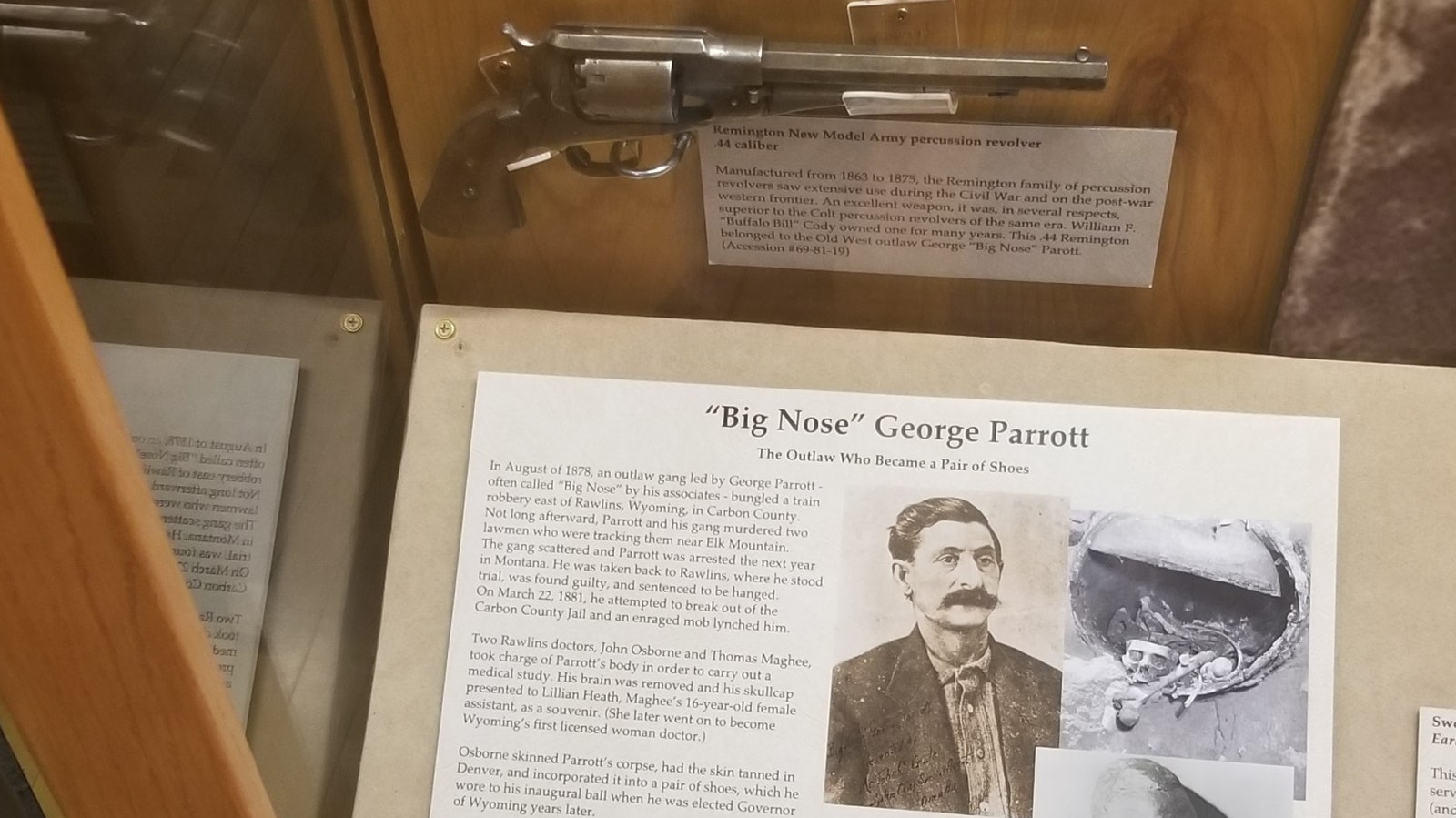
The gun "Big Nose" George Parrott may have used to kill two Wyoming law enforcement officers. (Courtesy Sweetwater County Historical Museum) 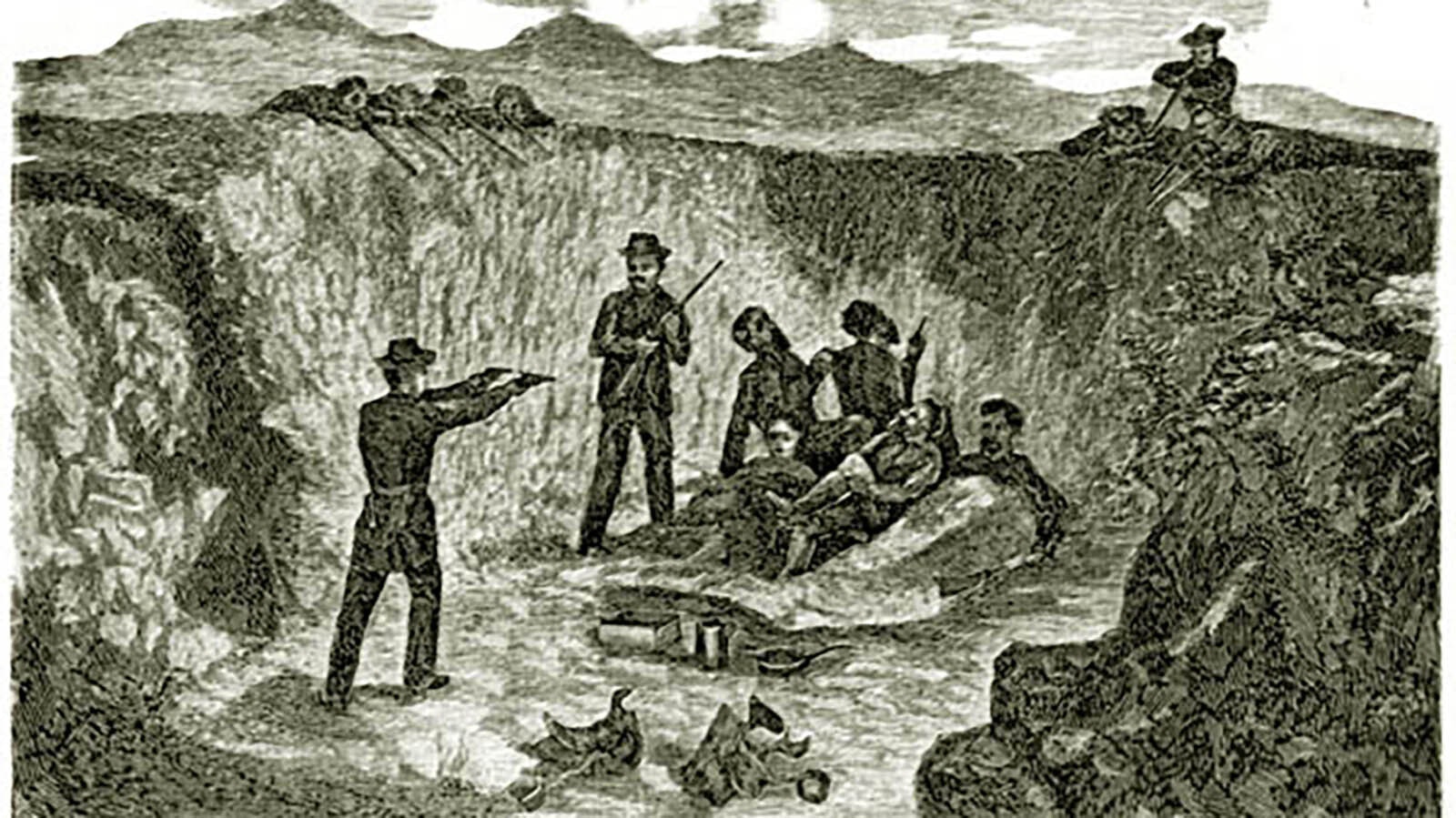
Capture of Dutch Charley's Gang near Rattlesnake Canyon, Elk Mountain, Wyoming Territory. (Courtesy Wyoming Tales and Trails) 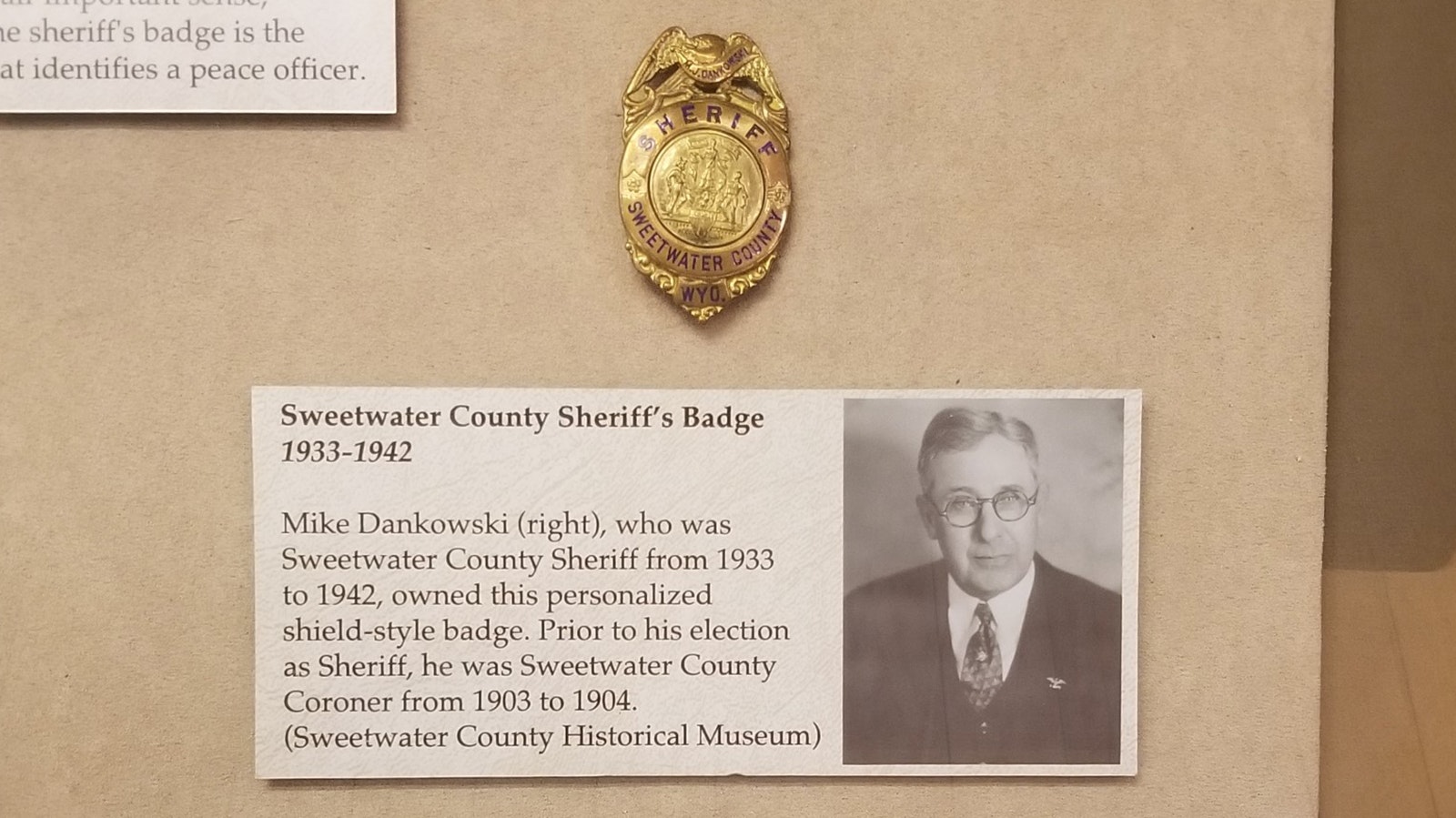
Former Sweetwater County Sheriff Mike Dankowski. (Courtesy Sweetwater County Historical Museum)
Gaining The Gun
The capture and lynching of Dutch Charley are well documented, but it doesn’t include any details on how Parrott’s gun ended up in the Sweetwater County Historical Museum.
“Law enforcement agencies of the day weren't big on keeping records,” he said. “There’s no paper trail to follow.
But for Blust, there was enough of a trail to follow. He’s the first to admit the narrative he’s compiled is speculative but compelling, nonetheless.
Based on his research, Blust believes the revolver was recovered in Green River during the arrest of Dutch Charley. The Sweetwater County Sheriff’s Office retained it as evidence for a future case against Charley, if necessary.
With Charley’s impromptu lynching, the evidence against him became immaterial. That would explain how it ended up in the Sweetwater County Sheriff’s Office, but not how it eventually found its way into the museum’s collection.
The crucial clue, according to Blust, is the man who donated the revolver, Dankowski. His father was Michael Dankowski, a former Sweetwater County Sheriff in the 1930s and 1940s.
“It wound up in the hands of Mike Dankowski,” Blust said, “and found its way from him to his son, along with the postscript that this was Big Nose George Parrott’s gun. And John donated it to the museum in the mid-1960s.”
No Nonsense Notches
Even if Blust has accurately assembled the revolver’s history, he can’t definitively prove that it belonged to Big Nose George Parrott.
“I’d love to, but I can’t,” he said. “There's just no way.”
However, one intriguing feature on the gun itself lends some promise to the possibility.
Western history says Parrott and his gang killed two peace officers in August 1878. Western legends say ne'er-do-wells notched the grip of their guns to represent the number of lives they took.
Two notches are etched into the revolver’s grip. It’s not absolute proof that this is Parrott’s revolver, but it’s enough to suggest a connection between the gun and its possible previous owner.
For Blust, that would explain why the Sweetwater County Sheriff recovered the revolver during Charley’s arrest.
“I believe the Sheriff of Sweetwater County hung on to the gun because it was going to be used as evidence later, possibly because of the two notches cutting the grip,” he said. “So, he hung onto it.”
On Display
“Big Nose” George’s gun is now displayed at the Sweetwater County Historical Museum. It’s the latest vintage firearm story the museum has rediscovered, but not the only one.
Blust continues working on the Vintage Firearms Research Program, tracking the history of firearms in the museum’s collections. He even does the same, free of charge, for people who want to know more about vintage firearms they own.
It’s his version of a fulfilling retirement.
“I've always been a firearms enthusiast,” he said. “I retired after 30 years in law enforcement and came to work here right away.”
Following the story of Parrott’s gun has been an engrossing project, but one that “raises more speculation.” One big unanswered question is if it really is Parrott’s gun, why was it recovered during the arrest of Dutch Charley?
“You have to start asking yourself, ‘Why this gun?’” he said. “He either stole it from Parrott, or Parrott gave it, sold it or traded it to him.”
There will always be uncertainty, but Blust is just happy to have a tangible explanation behind another fascinating firearm.
“It's all speculation,” he said, “but it's informed speculation about how the gun got here.”
Andrew Rossi can be reached at arossi@cowboystatedaily.com.