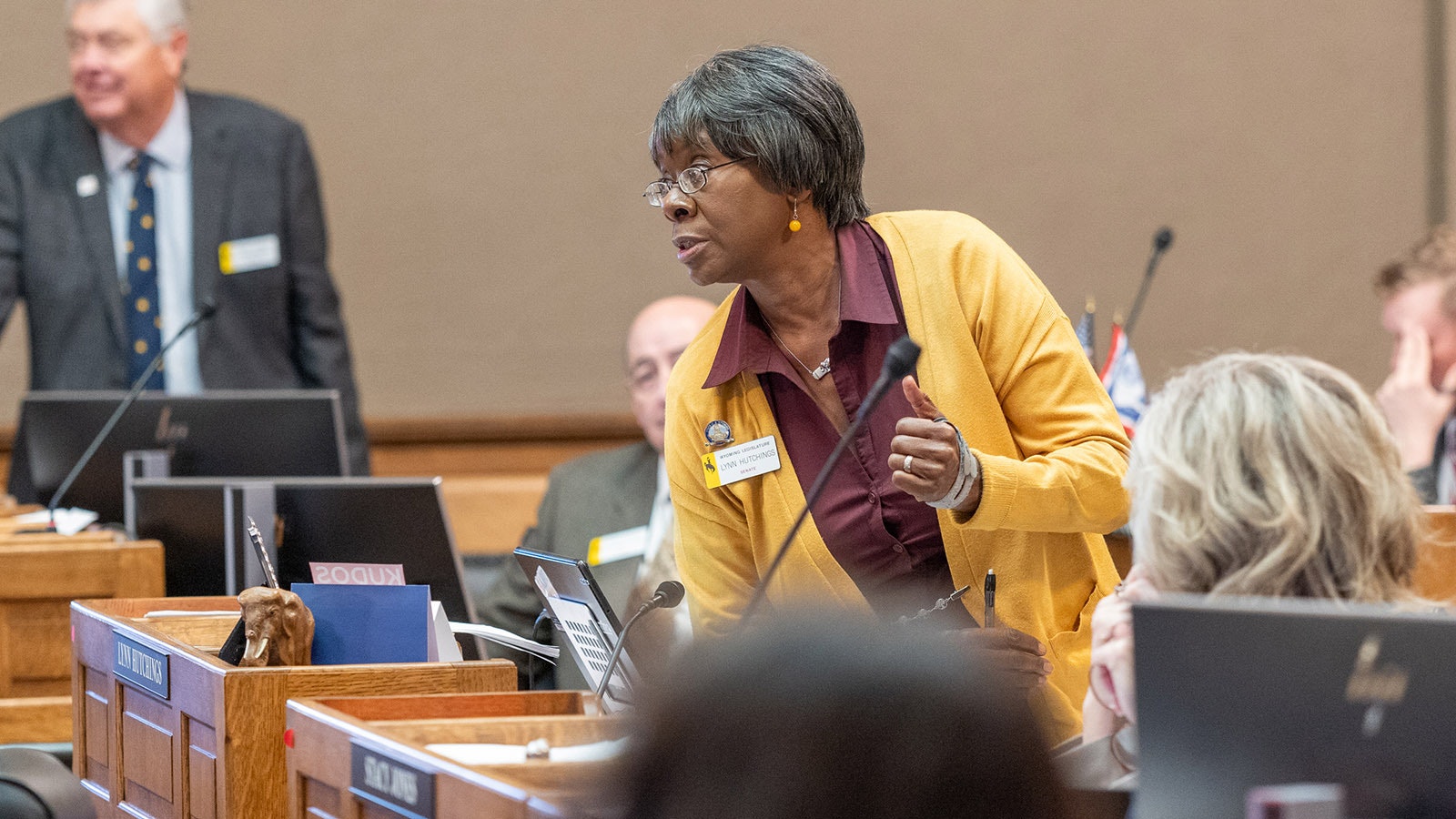
State Sen. Lynn Hutchings, R-Cheyenne, believes the social push over gender pronouns is getting out of hand and wants to do something about it in Wyoming.
She said that’s why she sponsored Senate File 94, Act Regarding Compelled Speech and State Employers, which would prohibit the state and its political subdivisions from requiring the use of terms like gender pronouns as a condition of employment, contracting, licensing or getting grants. It also extends to all county governments and public schools in Wyoming.
Hutchings said her bill protects free speech because, “The state should not compel someone to do this.”
On Tuesday, the Senate passed SF 94 on third reading by a 21-10 vote, sending it to the House for consideration.
Inspiration
Hutchings said she’s not aware of any specific instances where the state has required employees against their will to call another employee by a preferred pronoun such as “he/him,” the feminine “she/her” or the gender-neutral singular “they/them.” There are also “neopronouns” used to express nonbinary gender identity, such as “xe/xem.”
“You can’t force someone to call someone by their preferred pronouns,” Hutchings said. “It’s an infringement of freedom of speech.”
How far freedom of speech should be allowed to extend has been a growing debate around the nation and in Wyoming, with some social media companies making controversial moves to curtail speech they believe to be offensive or inaccurate.
Hutchings said one of her constituents who interacts with county and state governments pushed her to craft the bill. The bill would also apply to those who contract services with the state or a county.
What It Does
The bill would apply to state and county governments, along with employees of school districts and community colleges, as these entities are also considered political subdivisions in Wyoming.
The bill does not address what obligation teachers have to use preferred pronouns with their students. According to Education Week, teachers, staff and classmates aren’t required to use students’ pronouns or names if they don’t align with the student’s sex assigned at birth because of legislation passed in at least 10 states.
SF 94 would not apply to private businesses in Wyoming.
In addition to the prohibition, SF 94 also would provide a civil remedy for people to sue the state over violations of the rule in civil court. This could include injunctive or declaratory relief, compensatory damages, and any reasonable attorney fees and court costs.
National Issue
As the use of alternative gender pronouns has increased in use, there’s been a strong conservative backlash against it that some critics have alleged is a larger disapproval of transgender people.
“This has nothing to do with transgender rights, it’s about compelling speech,” Hutchings said.
The federal government has yet to regulate pronoun use in the workplace.
The U.S. Equal Employment Opportunity Commission has stated in guidance documents that "intentionally and repeatedly using the wrong name and pronouns to refer to a transgender employee could contribute to an unlawful hostile work environment" and is a violation of the Civil Rights Act of 1964.
In 2022, the U.S. Supreme Court ruled that although LGBTQ employees are protected from discrimination under the act, it didn’t address whether misgendering or declining to use someone's preferred name in the workplace violates federal civil rights law.
Back In Wyoming …
Hutchings said when she inquired with the state of Wyoming about its policy on pronouns, she didn’t get a clear response, but was referred to a few Title IX statutes, which she doesn’t believe to be relevant to pronoun use.
“This bill is not trying to discriminate,” she said. “It’s just something we don’t want the state to say to people.”
During the bill’s first reading last Friday, Sen. Chris Rothfuss, D-Laramie, addressed this point and questioned whether SF 94 would provide people immunity from federal and state law prohibiting workplace harassment.
He also questioned whether the bill would require someone to call someone who identifies with his or her biological sex as such.
“This reads as a way of circumventing that,” he said. “Can this be used by anyone at any time to choose whatever pronouns they want to call someone by, or do we have an expected double standard here where we will use what we feel to be the traditional pronouns, whether someone likes it or not?”
In situations like these, Hutchings said she believes it’s the duty of the disputing employees to resolve on their own.
Leo Wolfson can be reached at leo@cowboystatedaily.com.