FORT WASHAKIE - A petite, dark-haired girl walked into her school library at least 14 times between 2014 and 2016 to check out the same book.
She was a happy girl generally, but seemed to grow sadder as she grew older, her school librarian remembers now, nearly a decade later.
The book was from the “Alice” series by Phyllis Reynolds Naylor, the librarian said. The series is a collection of books tracking a girl named Alice with frank wit, from young teen through womanhood.
“It’s easy to recall something like that,” said the librarian, John Washakie, who now serves as a Business Council member for the Eastern Shoshone Tribe.
In the winter of 2016, the then 17-year-old girl joined “some individuals” who were partying. Then she froze to death in a snowbank on a mountainside on the Wind River Indian Reservation.
Her death from hypothermia was ruled accidental, but Washakie said he believes the people she was “partying” with helped lead her to her tragic end.
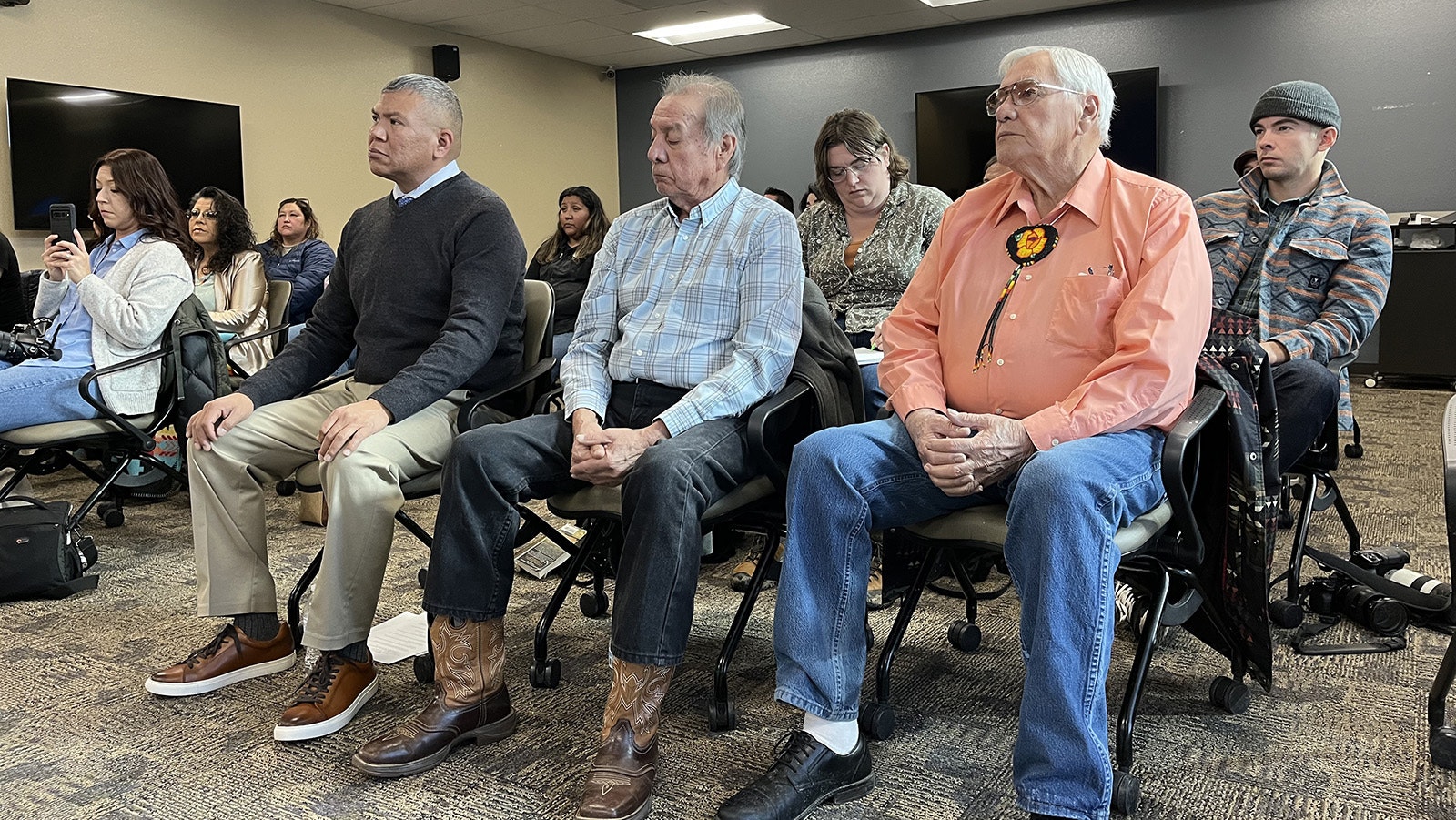
“I can tell you from personal experience the devastation and the loss that it causes families when something like this happens,” said Washakie at a Thursday joint press conference between the Shoshone and Northern Arapaho Tribal governments and the FBI, held in the town of Fort Washakie on the Wind River Indian Reservation.
John Washakie also related the story of his niece, Abigail Washakie, a young mother who was murdered in Riverton in 1989.
That case was solved, and Abigail’s killer is serving time in prison, John Washakie said. Washakie also attributes Abigail’s death to an unfortunate gravitation toward people who were not good company for her.
While other cases of missing and murdered natives may remain unsolved, people will have to talk to help solve them, other speakers at the event added.

Unveiling
The FBI hosted the press conference, which the two tribal business councils of the Wind River Indian Reservation also attended, to announce a 90-day tip line and email address for anyone with information about unsolved murders or missing cases of American Indians in Wyoming to contact the FBI.
People also may bring tips forward to the tribal governments or the local Bureau of Indian Affairs (BIA) office, FBI officials said.
The tip line is accessible by email or by a direct line to a voicemail, 307-433-3221. Callers who leave their name and number will get a call back, says an FBI statement about the new tip line.
Because, Holes In The Data
The tip line comes after several months of state authorities clamoring for data.
Gov. Mark Gordon started the Missing and Murdered Indigenous Women’s Taskforce in 2019, which has since expanded to address missing and murdered Indigenous males as well.
But throughout the state task force’s efforts to combat the higher rates of murder against tribal members, its representatives have consistently pointed to a lack of data.
Around the time the task force was formed, then-BIA Chief Tony Larvie told state legislators that the more prevalent issue on the reservation isn’t a mass vanishing: it’s repeat cases of children and teens running away from home.
Time To Talk
While state officials have pointed to holes in the data, the FBI has pointed to some tribal members’ hesitancy to talk to police about unsolved cases.
“In the past, tribal members have not always been comfortable working with law enforcement in general and the FBI specifically,” says the FBI’s Thursday statement.
Even in the post-treaty era, tribes have had a rocky relationship with the federal government for more than a century, amid Congress’ various and sweeping policy changes pertaining to tribal lands, child custody and other issues.
“The FBI recognizes these historical barriers and wants to do everything possible to improve the flow of information,” says the FBI’s statement.
After a 90-day collection period, the FBI will compile the tips it receives on the unsolved cases and pursue them, then at some yet-undetermined future date (depending on the volume of tips the agency receives), the FBI will share its new data – first with the tribal governments, then with the public.

‘There’s Always Substance Abuse’
Northern Arapaho Business Council Chairman Lloyd Goggles had to pull himself together before giving his speech at the press conference. He fought back tears through most of it.
He cited higher murder rates among native people.
“It cannot be allowed to continue,” said Goggles. “But there’s factors involved, like … there’s always substance abuse. And these things that affect not just here, but throughout the country and in Indian country.”
Goggles, formerly a tribal police officer, said he knows how hesitant tribal members can be to talk about crimes. He indicated that witnesses, victims and perpetrators often are interrelated or consider themselves family in the tightknit communities of the reservation and its surrounding towns.
“When they have a chance to divulge something, there’s a need to protect their own,” he said. “And I often encourage accountability among the people. Not in a hard fashion, but in a subtle fashion. Everybody knows somebody here.”
Goggles said he’s pleased to see the FBI reexamining cold cases and turning its attention toward other cases that may not have been reported.
“This is an opportunity to shine a light on the MMIP crisis,” said Goggles.
He urged tribal members to encourage their peers and family toward transparency and justice.
Later during a question-and-answer portion, NABC Council member Kim Harjo said more federal funding and programming is needed to address substance abuse and fallout on the reservation.
Feds Are More Hush
Data on open cases discussed in the tip line will be terse, because the FBI’s umbrella agency, the U.S. Department of Justice, keeps most open-case information away from the public, Vikki Migoya, public affairs officer for the FBI Denver Field Office, told the group of reporters at the press conference.
Migoya recognized that it’s harder for news reporters to get information from federal agencies than from local agencies.
“We won’t be able to talk specifically about a lot of open cases. That is the way it is. That’s not a great answer, it’s not what you want to hear,” said Migoya. “We’re going to do our best to communicate as clearly as we can to the tribes and to the public.”
Migoya added that the FBI can, however, share more information about case developments with victims’ families.
These Murder Rates
Homicide is the fifth-leading cause of death for American Indian and Alaska Native males, and the seventh-leading cause of death for females of those racial designations, according to the Centers for Disease Control and Prevetion.
The rate of violent crime against American Indians and Alaska Natives is about 1 in 10 – 101 violent crimes per 1,000 people. That’s more than twice the rate of the general U.S. population, at 41 per 1,000.
Clarification: An earlier version of this story said the FBI co-hosted the press conference with the tribal councils. While the tribal councils assisted with some planning details, they did not co-host the conference.
Clair McFarland can be reached at clair@cowboystatedaily.com.