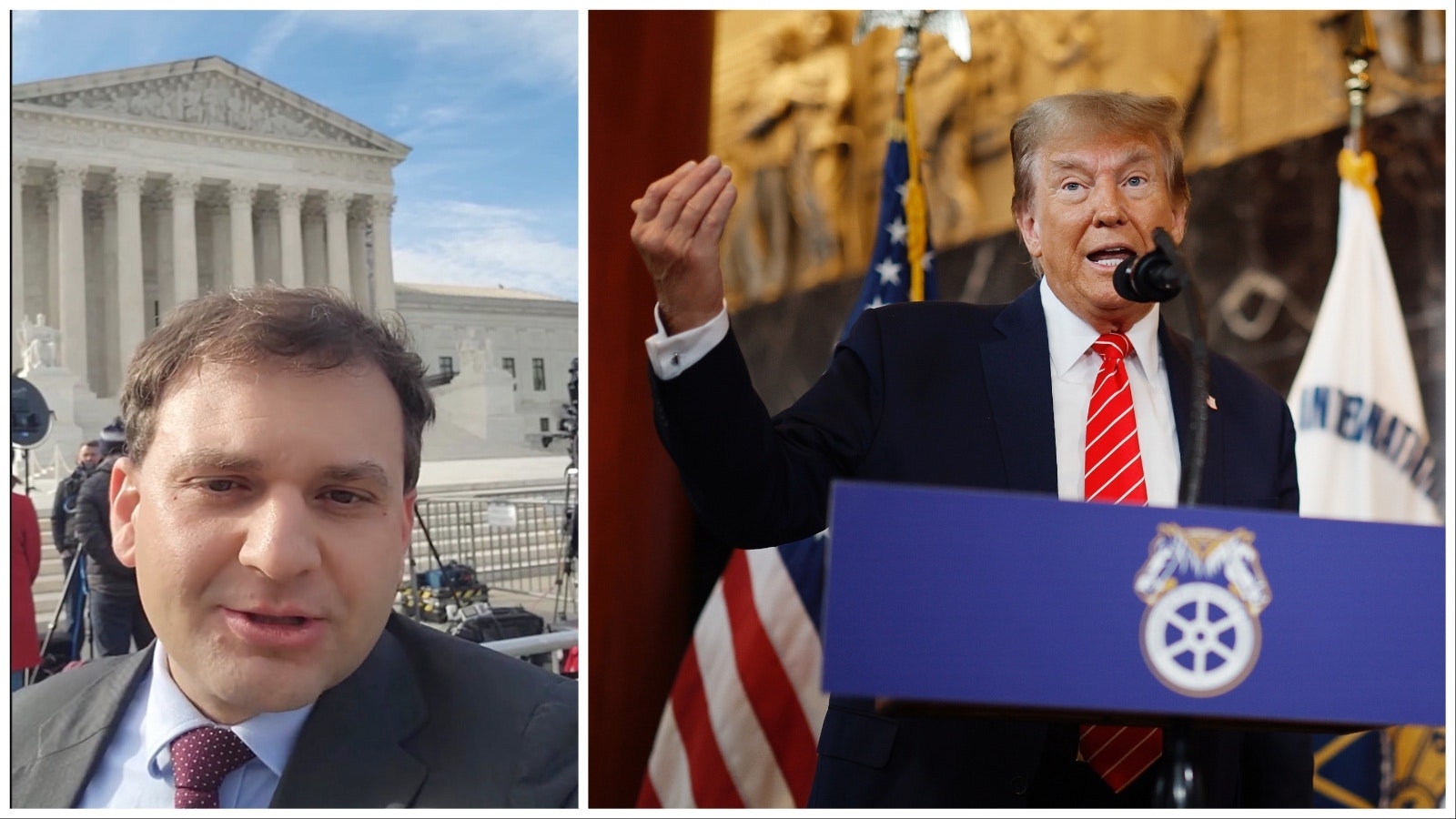
Just before two lawyers clashed over whether Colorado can disqualify former President Donald Trump from appearing on that state’s ballots, Wyoming’s top election official shot a selfie video from outside the U.S. Supreme Court building Thursday.
Wyoming Secretary of State Chuck Gray was the only secretary of state to file an amicus brief wholly backing Trump in the former president’s petition for the high court to overturn the Colorado Supreme Court’s ruling disqualifying him from the state ballot.
And he showed up in front of the high court moments before Thursday’s oral argument, where Colorado’s and Trump’s attorneys clashed over the deciding language: The 14th Amendment to the Constitution.
“Wanted to talk a little bit about our work in the Wyoming Secretary of State’s Office, in keeping President Trump on the ballot, pushing back on (what) this media and the radical left is doing,” said Gray.
Gray discussed the amicus brief he filed with other secretaries of state in the Colorado court in November 2023; the amicus brief he filed, along with legal counsel, before the high court last month; and the Wyoming lawsuit in which a retired Laramie attorney sued Gray to purge Trump from the state’s ballots.
That Laramie case is now in the Wyoming Supreme Court.
There Anyway
In a text response to a Cowboy State Daily inquiry about which sources of funding paid for his trip, Gray clarified that he happened to be in Washington, D.C., coincidentally during Thursday’s oral argument.
He’s attending the National Association of Secretaries of State Winter Conference, a gathering of state election officials from across the nation that former Secretary of State Ed Buchanan had also attended, Gray said.
“In between working sessions of the conference, I visited the Supreme Court during the historic oral argument,” he said, again pointing to his briefs and efforts to argue on Trump’s behalf in the Colorado case.
Gray said the Supreme Court justices’ questions during the argument make him confident “that Colorado’s outrageously wrong, unprecedented and unconstitutional decision will be reversed, and the people of America will be able to decide who represents them for themselves.”
‘Sounds Awfully National’
The attorney arguing from Trump’s perspective argued against giving states more power over federal elections, while the attorney for a handful of anti-Trump Republicans from Colorado argued in favor of broader state powers.
“I don’t take it there’s a great debate about whether or not states are allowed to exclude underaged or foreign-born candidates,” argued Jason C. Murray before the high court. “I don’t see why Section 3 (of the 14th Amendment) should be treated any differently.”
Murray’s argument was that states should have the power to disqualify presidential candidates from appearing on their ballots under the disqualifiers the U.S. Constitution lists.
Justice Elena Kagan challenged Murray, saying letting one state implement the 14th Amendment’s disqualifiers — of having participated in an insurrection or given comfort to the nation’s enemies — could also let one state sway the election for the whole nation.
“The question that you have to confront is why a single state should decide who gets to be president of the United States,” said Kagan. “This question … sounds awfully national to me.”
Murray said it doesn’t matter anyway: Litigation would force the Supreme Court to decide the issue in the aftermath of such a decision.
First, Senators
Jonathan Mitchell, Trump’s attorney, argued that a presidential candidate is not in the list of people disqualified under the 14th Amendment. The text starts with a high office and lists the rest in descending order by power.
Other parts of the Constitution exclude the president from a latter, broader category of “officer of the United States,” which fueled Mitchell’s argument that Trump isn’t lumped into that category either.
Mitchell’s chief qualm was with states removing someone from the campaign field. He said that amounts to a state adding its own language disqualifying people from running for office, beyond the 14th Amendment’s ban on insurrectionists being able to “hold” office.
But if Congress enacted legislation allowing states to exclude insurrectionists from the ballot, that would be allowed under the amendment, Mitchell added.
Justice Jackson Gives Trump’s Lawyer A History Lesson
Justice Kentanji Brown-Jackson asked Mitchell why he wasn’t relying more on the historical debates that ushered the 14th Amendment into existence.
She gave the attorney a brief history lesson.
The framers of the post-Civil War 14th Amendment were worried about Confederate operatives creeping into the then-reunited federal government by getting elected to state offices, appointed to federal bureaus or running for Congress, Jackson said.
The concern about Confederates creeping in and taking over the government by sheer volume is “very different than the worry that an insurrectionist will seize control of the entire national government through the presidency.”
Mitchell said Jackson was correct — mostly.
Some framers were concerned that a Confederate could be elected president. That’s why an earlier draft of the 14th Amendment included the office of presidency.
The final draft did not, which Mitchell indicated falls in support of his argument that both the text and history exclude Trump from that list of people who can be disqualified to hold office.
But, Mitchell added, the reason he focused his arguments on the text rather than the history is because so many different viewpoints were presented during the amendment’s drafting, relying on them could turn the present argument into a protracted back-and-forth.
Clair McFarland can be reached at clair@cowboystatedaily.com.